Indonesia palm oil export warehouse logistics has a temper, and I learned that on a night a few years back, driving a delivery to the port and ending up queuing outside the terminal past midnight. That run showed me the hard part up close: a line of tank trucks, twenty or thirty of them, drivers standing around smoking and talking about the same thing. A ship was stuck in the port, unable to discharge its palm oil because the oil had solidified in the tanks. They had been heating it for three days and the whole schedule was in pieces. That night I thought to myself, oil looks like a liquid, but it has a worse temper than a solid. Ignore its temperature and it will show you.
Indonesia is the world's largest palm oil producer. In the 2025/26 season it grew 47.0 million tonnes, 57.2% of world production, and exported around 25.0 million tonnes. Most of it moves in bulk, from mill to port tank to ship. Liquid the whole way, and demanding the whole way. In this trade, the money comes down to two things: temperature and cleanliness.
Indonesia Palm Oil Export Warehouse Logistics Starts at the Temperature Gauge
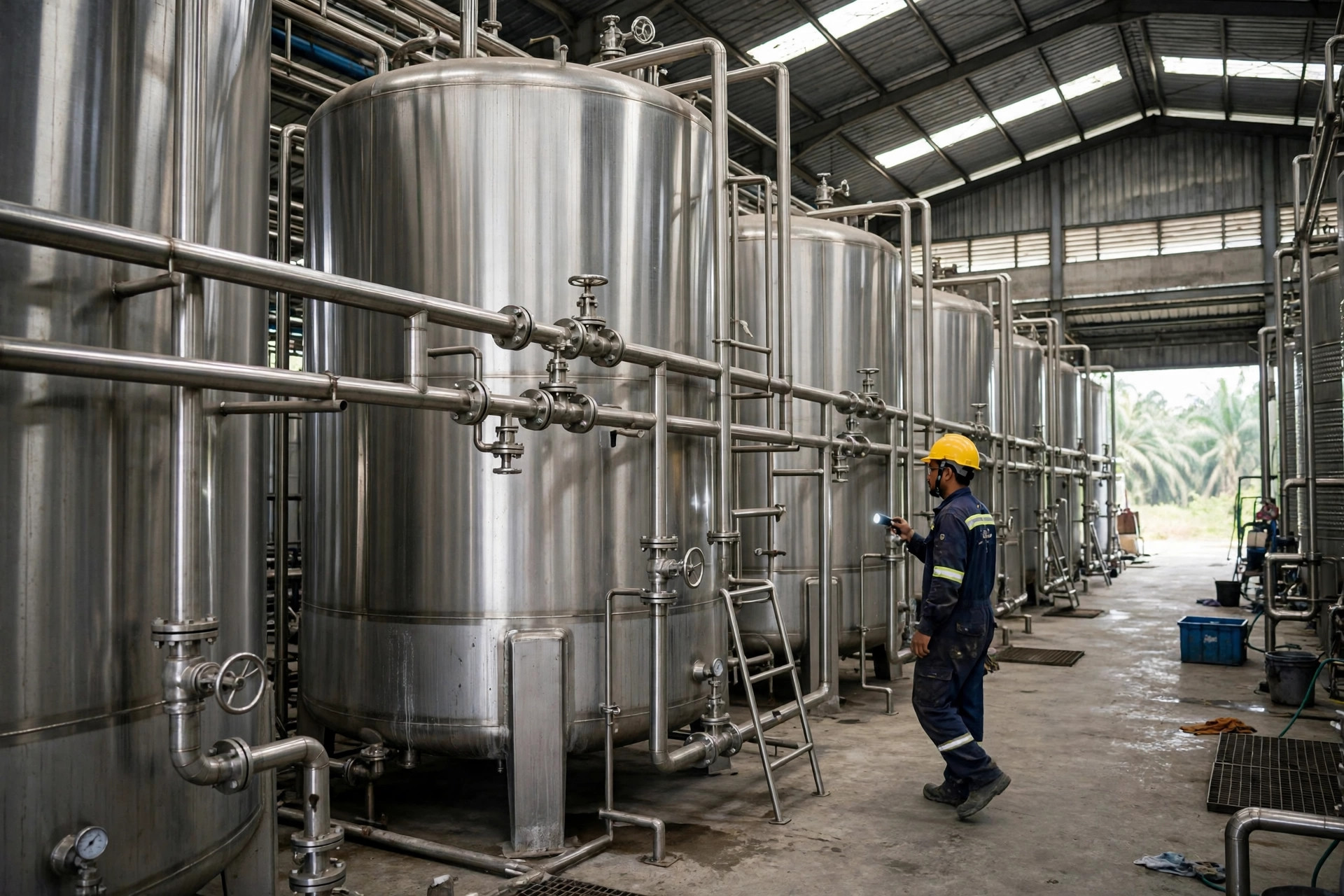
Palm oil has a strange habit: let it cool and it sets. Crude palm oil melts between 35 and 40 degrees Celsius, and once the temperature drops below that, the oil starts to crystallize until the whole tank turns into a thick paste that no pump can move. The Codex code of practice for bulk edible oils says it plainly: hold palm oil at 32 to 40 degrees for short-term storage, and heat it to 50 to 55 degrees for loading and discharge.
I know an old hand who has worked a port tank farm for more than a decade, and he told me the thing a tank farm fears most is not cold weather, it is a break in temperature control. One time a steam heating coil clogged up and the duty man did not catch it in time. A tank of oil sat for four days while the temperature slid from 38 degrees down to 31. When loading day came, the surface had formed a hard crust, thin underneath and solid on top, and nothing would pump. In the end they heated and stirred it for two days, the shipping line charged demurrage like clockwork, and the cargo owner was jumping up and down. The old hand said the temperature gauge on a tank gets checked four times a day, morning, noon, evening and night, and skipping even one check can cost you.
Let me run the temperature math for you. Take a hypothetical example: a 500-tonne tank of crude palm oil, worth a serious amount of money at any market price. Heating and holding that tank costs a few dollars a tonne per month in steam and power. Now flip it: oil that has set solid needs two days of reheating and stirring, demurrage and labor run into thousands of dollars, and that is before quality. Reheating pushes free fatty acids upward, and crude palm oil is generally sold with a free fatty acid limit of 5%. Go over it and the buyer docks the price. Heating to save the cargo can end up damaging the very cargo you are trying to save.
After all these years on the road, I have one rule: tank temperature is not judged by feel, it is judged by the record. Every tank keeps a daily temperature curve, and the owner sees it before loading. A flat, steady curve is the best calling card a tank farm has.
Here is something else you only see from the road: the mill takes a sample when the oil leaves, and the port takes another sample when it arrives, and the two results often do not match. The oil sloshes in the truck all the way, the temperature drops, the impurities settle, and a load that passed at the mill fails the moisture and impurity check at the port. Then the owner and the trucking team argue about whose fault it is. I saw one owner whose free fatty acids came back higher at the port than at the mill, the truckers blamed the oil, the mill blamed the road, and they argued for a week while the sailing date crept closer. Turned out the truck's insulation was torn and the oil had cooled too much halfway there. My rule is simple: check the insulation and the heating pipes before the truck loads, a truck with torn insulation does not go on the road, and the arrival sample gets taken by the driver and the warehouse man together, sealed and signed, so nobody can shift the blame later.
The Two Things Indonesia Palm Oil Export Warehouse Logistics Fears Most: Setting Solid and Cross-Contamination
Oil setting solid is the first fear, and contamination is the second. For bulk oil, what a ship's tank or a storage tank carried last decides what it can carry next. The international rule is that the previous three cargoes in a food-grade tank must be on the acceptable list, and nothing on the banned list can appear. Buyers call it the FOSFA last-three-cargoes check, and it is the first record they ask for at inspection.
I heard a true story about a ship that had carried an industrial oil, and the owner cut corners on tank cleaning before loading palm oil. At the destination port the buyer checked the last-three-cargoes record and rejected the whole shipment outright. The oil had to be sold off at a discount to a biodiesel buyer, and the difference wiped out a fortune. The owner said afterward that what he saved on tank cleaning did not even cover a fraction of what he lost. In bulk oil, whether a tank is really clean is not a matter of conscience, it is a matter of money.
The truck drivers know the same story from the road. Palm oil rides from the mill to the port tank farm in tank trucks, and the driver knows best what his truck carried last. Some small fleets take a palm oil job with a tank that was never properly washed after the last load, and the oil picks up the smell before it even reaches the port. The owner tests it at the terminal, moisture and impurities are over the limit, free fatty acids are high, and the whole truckload gets sold at a discount. My advice to owners is one sentence: before a truck enters the plant, look at its last load paperwork and its tank-washing record. A truck with no record is not a bargain, whatever the price.
Here is the counterintuitive part: plenty of people think long-term palm oil storage should stay heated, the hotter the safer. Wrong. The Codex guidance says it clearly: long-term storage of soft oils should be at ambient temperature with the heating switched off completely. Constant high heat makes the oil oxidize faster and the quality drops quicker. Heating is for short-term handling, not for long-term sitting. Long storage wants steady, not hot.
One more number owners should keep in mind: more than half of Indonesia's palm oil stays at home, and the biodiesel blending mandate keeps taking more of it for the domestic market, so export volume looks big but domestic buyers are competing hard for the same oil. Berth space and tank capacity have to be booked early. Looking for tank space in peak season means the price climbs fast, and you might not find any at all. I saw an owner whose ship arrived with no tank booked; the oil waited four extra days while demurrage ticked away. In this business, book the tank and the ship together. Ship booked and tank not booked is like leaving home with one shoe on.
Two Honest Words for Owners and Warehouses
In the palm oil business, the plantation grows the raw material, but what decides the price is the road from the mill to the ship's tank. Owners watch the market price like hawks, but the market sets the price and warehousing is the part you can control yourself. Check the temperature gauge every day, check the tank-washing record every time, and retest free fatty acids and moisture before loading. Do those three things and eight out of ten problems never come knocking.
And to the warehouses, an honest word too: a tank farm competes on records, not on how many tanks it has. Temperature curves, tank-washing records, last-three-cargoes paperwork, get those three in order and owners will trust you with their oil. Without them, cheap rent still makes people nervous.
After all these years on the road, I believe one old saying: a truck fears the night road, and oil fears being left alone. Treat the oil right, and the oil treats your money right.
By Shifu Zhao, Trucking Veteran (15 yrs)