Let me tell you something, after fifteen years on the road, grain is not afraid of distance. It is afraid of policy changing overnight. That is the whole story of India rice export warehouse logistics. While the curbs were on, the rice sat stuck in the warehouse. Once the curbs eased, it sat stuck on the road to the port. On July 20, 2023, India banned exports of non-basmati white rice, and the line of rice trucks outside the port stretched as far as the eye could see, drivers sleeping in their cabs, waiting for news nobody had.
India has been the world's largest rice exporter since 2011-12, and it has not given up that spot since. In the 2024-25 fiscal year, India exported 20.1 million tonnes of rice worth 12.95 billion dollars, including 6.06 million tonnes of basmati. Those numbers look clean on paper, but behind them sit thousands of warehouses and truck fleets, and when a ban lands, every one of them has to change how it works.
India Rice Export Warehouse Logistics: The Curbs Jammed the Warehouse First
The curbs did not appear in one day. In September 2022, India banned broken rice exports and put a 20 percent export duty on most non-basmati rice. On July 20, 2023, non-basmati white rice exports were banned outright. In August 2023, parboiled rice got a 20 percent duty too. Let me tell you what those two years looked like inside a warehouse.
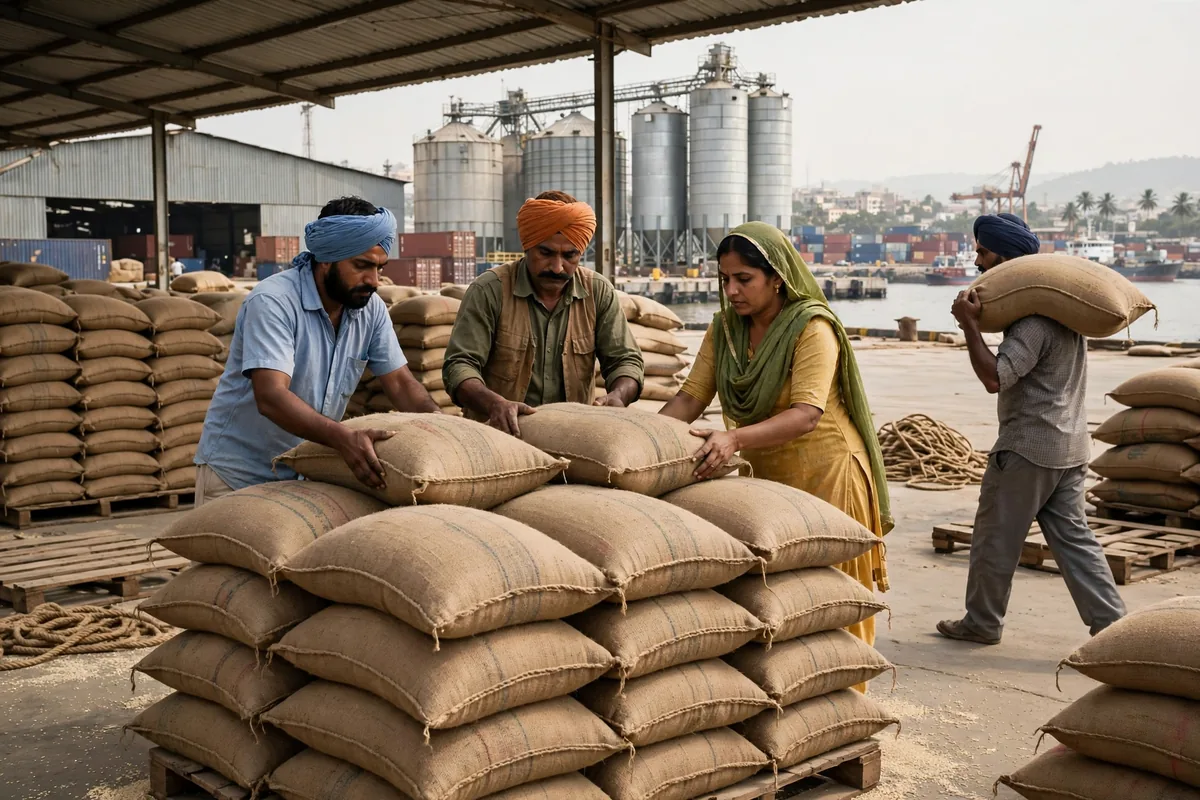
In the autumn of 2023, at a procurement yard in Punjab, 50-kilo sacks of rice were stacked to the roof, the moisture-proof mats underneath squashed flat. The owner had been waiting for a ship. The ban came, the sailing went away, and the warehouse rent kept running. One owner told me his lot of non-basmati white rice sat in storage for four months, and the rent plus the money tied up in stock ate most of the margin he had hoped to make. Stockpiling through a ban and waiting for prices to rise sounds clever until the warehouse bill arrives, and the rise does not even cover the rent.
The trade data tells the same story. In fiscal year 2023-24, India's non-basmati rice exports fell from 17.86 million tonnes the year before to 11.11 million tonnes, down nearly 40 percent. Over the same period, basmati exports went the other way, rising from 4.56 million tonnes to a record 5.24 million tonnes. A ban can stop white rice, but it cannot stop buyers from switching to basmati, so the warehouse ended up with two kinds of stock: one side piling up with nowhere to go, the other side rushing to load.
India Rice Export Warehouse Logistics: From Punjab Granaries to Port
The route from Punjab and Haryana is fixed: procurement yards take in paddy, mills turn it into white rice, it goes into 50-kilo bags, into a transit warehouse to build a truckload, then a long haul to a port in Gujarat for loading. On this run, the warehouse and the truck are tied together. If one link breaks, the whole shipment waits.
During the ban, the truckers had the hardest time. Drivers who had run the port route for years suddenly had nothing to haul. Some switched to other cargo, some just stayed home. Then, on September 28, 2024, the ban was lifted and replaced with a minimum export price of 490 dollars a tonne, so white rice could move again. In October 2024, the minimum export price was scrapped too. On March 7, 2025, the broken rice ban was lifted as well. The moment policy eased, the ports came alive and the trucks started rolling, but this time the jam was not policy. It was the road and the berth.
In 2025, India's rice exports jumped to 21.55 million tonnes, up nearly 20 percent from 18.05 million tonnes in 2024, just short of the 2022 record of 22.3 million tonnes. Non-basmati shipments rose 25 percent to 15.15 million tonnes, and basmati set a record at 6.4 million tonnes. With that much cargo, the port warehouse became the bottleneck: ships waited for berths, trucks waited to unload, and drivers sat outside the port for a day or two. After the curbs eased, the fastest ship out did not always make the most money, because demurrage for sitting outside the port ate a chunk of the margin first.
After the Curbs Eased, the Warehouse Math Had to Change
Once the curbs loosened, the whole warehouse game changed. Before, the cargo owner called the shots: ship when there is a vessel. Now the sailing schedule, the warehouse slot and the truck fleet have to line up together, and if they do not, the cargo should not move. Here is the part that goes against common sense: the more cargo there is, the less sense it makes to push it all to the port at once. Shipping in batches, timed to the sailing schedule, saves more money.
Run a hypothetical example on a 1,000-tonne lot of non-basmati white rice. Under the curbs, four months in storage means four months of rent plus the cost of money tied up in stock. After the easing, rushing to the port saves the rent, but two days queuing at the port brings demurrage and overtime charges of its own. Put the two bills side by side and it is genuinely unclear which one is bigger. The figures are a scenario illustration, and real charges follow local quotations, but the point stands: warehouse math cannot count rent alone or freight alone. It has to count the time spent waiting for ships, trucks and unloading too.
| 1,000-tonne lot, hypothetical example | Stuck in storage four months under the curbs | Rushing to port after the easing |
|---|---|---|
| Warehouse rent | Four months, paid in full | Saved |
| Time cost | Money tied up, margin eaten away | Port queue, demurrage charges appear |
| Result | Price rise never came, rent lost first | Fast out, but possibly a wasted trip |
The numbers in this table are a hypothetical example, a scenario illustration, not real quotations. Before dispatching, line up the sailing schedule, the warehouse slot and the truck fleet first. It beats queuing at the port.
One more warning: broken rice policy has swung back and forth these past two years, and in November 2026 there is fresh talk of tightening it again. Whether it happens or not, go by the latest official policy. That is what India rice export warehouse logistics comes down to in the end: policy sets the rhythm, and the warehouse and the truck have to dance to it. For anyone in India rice export warehouse work, put one line in the contract: if policy changes, how do the sailing and storage schedules adjust, written down in advance. After all these years on the road, I believe one saying: when policy changes, the person in the warehouse who prepared loses the least.
By Shifu Zhao, Trucking Veteran (15 yrs)