India pomegranate export warehouse storage, as a discipline, begins with a puzzle worth taking seriously: fruit that leaves the orchard in good condition still arrives, in some consignments, with a few pallets that fail on opening, and when the trail is followed back, the fault rarely lies in the ocean leg itself but rather in the first few days before departure. The puzzle matters because pomegranates are, by nature, among the hardiest exported fruits, tolerant of storage and transport in ways that berries are not, and yet arrival disputes keep pointing in the same direction, namely that handling at origin sets the ceiling for everything that follows. Once that logic is accepted, the whole chain reads differently, because quality in this trade is not settled at the destination port but accumulated, step by step, from picking, crating, pre-cooling, and stuffing, and any effort skipped early tends to return later at a higher price.
Industry reporting on the trade generally points to the same structure. The dominant export variety is Bhagwa, production is concentrated in Maharashtra, and the chain runs from orchard to packhouse to pre-cooling facility to Mumbai port, with each handover adding its own effect on arrival condition. The implication is straightforward but easy to miss in practice: the ledger for a consignment is written gradually, at every transfer, rather than settled in a single inspection at the end. A consignment that arrives cleanly is usually one whose early steps were done in the right order, while a consignment that generates disputes is often one whose early steps were merely done quickly.
India Pomegranate Export Warehouse Storage Starts Before the Cold Room
The first principle of the cold chain here is simple, and it concerns sequence more than temperature. A pomegranate comes off the tree carrying field heat, and until that heat is removed from the core of the fruit, every later preservation measure is, in effect, insulation around a fruit that is still warm. Equipment vendors commonly cite a range of 5–7°C with 90–95% relative humidity, but that is a vendor figure, and the binding specification is always the buyer's latest spec, which varies from buyer to buyer, so copying a generic number without checking is itself a risk. What matters more than the number on the thermometer is the order of operations: whether pre-cooling happens before or after grading and packing, and how long passes between cooling and stuffing the container.
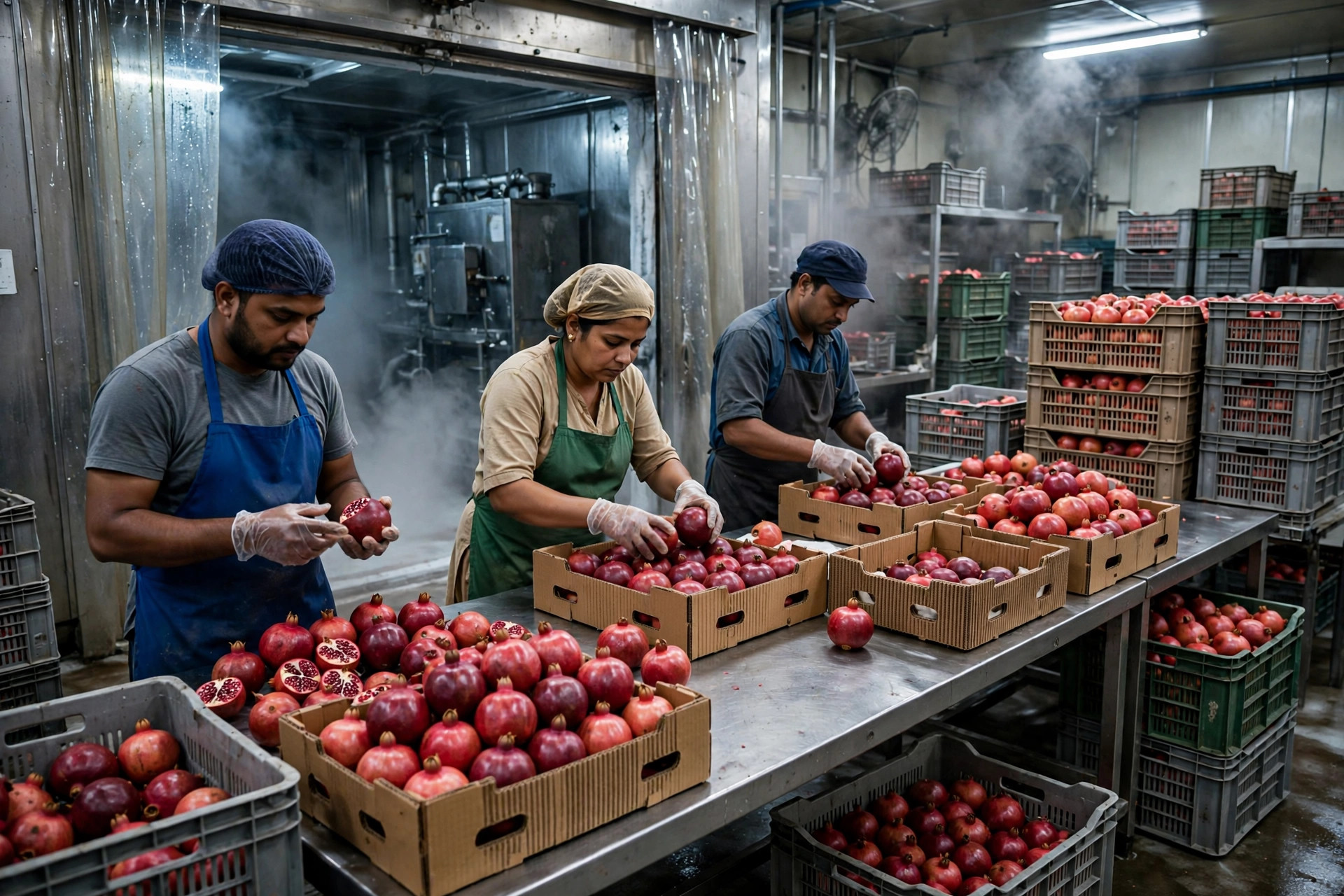
A packhouse in Maharashtra ran into exactly this problem during a busy harvest morning a few seasons ago. Several truckloads arrived in succession, the crew graded and packed first and pushed the cartons into the pre-cooling chamber afterwards, and a scheduling delay left the fruit sitting under an open shed for much of the day. Nothing looked wrong at the time, since the skins were firm and the colour was good, but when the buyer opened the cartons at destination, the outer pallets showed visible moisture loss and soft fruit, and a dispute followed. The post-mortem was not complicated: pre-cooling had been scheduled after grading, and the hours spent grading were precisely the window in which field heat should have been removed most urgently. After the change, the packhouse moved pre-cooling to the first step after intake and did all grading and packing inside the cold environment, which tightened the labour schedule for each pallet but visibly reduced arrival disputes.
That case supports a counterintuitive judgement: colder is not the same as safer. Driving temperature down while ignoring humidity can leave condensation on the fruit surface, which then amplifies mould risk during transit, so the real ledger is not about the lowest temperature achieved but about the most stable environment maintained. Temperature and humidity must both hold, and the chain must not break between pre-cooling and stuffing, because even half a day sitting in the sun at the port yard discounts all the refrigeration paid for earlier.
The Inspection Ledger in India Pomegranate Export Warehouse Storage
If the cold chain determines the condition of the fruit, the inspection ledger determines whether the consignment can actually be handed over. The document chain for Indian pomegranate exports is well established, involving APEDA-related procedures, a phytosanitary certificate, and a certificate of origin, with exact requirements subject to the latest official policy, and any change in wording can affect the release schedule. But complete documents are only an entry ticket, since what truly decides the shipper's return is the pass rate at the buyer's sampling inspection: how many pallets fail, where rework happens, and who bears the cost, and these are the most expensive lines in the whole ledger.
A consignment bound for Mumbai port illustrated the point at the final pre-stuffing inspection, when the buyer's representative opened cartons at random and found fruit outside the contracted grade in several pallets. The fruit was not spoiled, but its size and colour fell outside the agreed band, and the shipper faced two options on the spot: rework at the port, reopening cartons, regrading, and repacking at immediate labour cost, or accept a downgrade of the entire consignment, which would have cut the settlement grade for the whole lot. The shipper chose rework, paying an extra labour bill in order to protect the grade of the full shipment. The lesson is simple and general: inspection-stage costs are always higher than origin-grading costs, because by the time fruit reaches the port, time no longer belongs to the shipper.
Read together, the cold chain and the inspection ledger yield a compact decision framework:
| One extra step at origin | What it buys | Where the cost lands if skipped |
|---|---|---|
| Pre-cool on intake, grade inside the cold room | Field heat removed in time, less moisture loss on arrival | Disputes on opening, with rework priced higher |
| Grade strictly to the buyer's bands, never mixed | Sampling passed first time, grade protected | Port rework or a downgraded settlement for the lot |
| Verify documents against the latest official policy early | Release schedule stays controllable, no port dwell | Dwell and rescheduling, cold-chain time consumed for nothing |
The trade-off in this framework is unusually clear: every extra half day spent at origin buys a multiple of certainty at the port, while every step skipped at origin reappears at inspection priced higher. The warehousing ledger for pomegranate exports is, at bottom, a ledger about keeping costs in the cheaper stage of the chain.
Why Origin Capability Is Becoming the Bargaining Point
Stepping back, the trend judgement follows from the same evidence: as buyers specify arrival consistency in ever greater detail, competition in this trade is shifting from who has the largest orchard to who runs the most reliable origin operation. In the past, orchard scale and price were the main chips on the negotiating table, but grading precision, pre-cooling speed, and document compliance are now becoming the implicit filters buyers use when choosing suppliers. A supplier who can consistently grade inside the cold room, ship to grade, and clear documents on the first pass may not quote the lowest price, yet will more easily win repeat orders, because the hidden cost of disputes to the buyer far exceeds any visible price gap.
This shift deserves attention from smaller shippers in particular, because it suggests that investment does not have to start with a bigger cold store but can start with the certainty of the process itself: pre-cooling sequence, grading standards, and a document checklist. None of these items is individually expensive, yet together they determine the dispute rate of the whole consignment. Conversely, a strategy that competes only on price while leaving process gaps unfilled will find the going harder, because buyers are learning to price dispute costs into the total.
The future of India pomegranate export warehouse storage will therefore hinge on an open question rather than a settled answer: as more origin packhouses move pre-cooling and grading forward and turn inspection standards into daily routine, will the quality distribution of Indian pomegranate exports split into two tiers, one of low-dispute suppliers and one of suppliers still shipping on luck, and will buyers ultimately vote with their orders to raise the bar for the whole chain? That question is unresolved, but its answer will decide where every warehousing investment in this chain is best placed in the years ahead.
By Dr. Chen, Supply Chain Researcher