
We had a client, a home-goods e-commerce seller. November 2024, peak season inbound. A container rolled in from Ningbo to our Los Angeles warehouse. The bill of lading said 1,200 units. After unloading, our team counted 1,146. Fifty-four units short. The client's first instinct: bill the warehouse. We received the freight, so we're on the hook, right?
Not so fast. I walked them through the chain: how many units did the driver sign for on the delivery receipt? Did anyone photograph the full container before unloading? Were the missing 54 units all on the same pallet? Three questions, three blank stares. It turned out the factory's loading list was wrong — those 54 units never made it into the container. We didn't pay a dime. But the lesson was worth plenty: in a receiving discrepancy, who signed, who took photos, and who logged it in the system decides who pays.
Handling receiving discrepancies is really just a standard playbook. Follow every step and you can argue with anyone from a position of strength. Skip a step and even when you're right, you can't prove it. After years of getting "educated" by clients on the 3PL side, I'm going to lay out what we learned, in reverse.
Who Actually Owns a Receiving Discrepancy?
Here's a counterintuitive take: the scenarios where a 3PL truly owes you money for a receiving discrepancy are far fewer than most clients assume.
That's not us dodging. It's the reality of the chain: from the factory to your customer's door, freight passes through too many hands — the factory loader, the forwarder, the carrier, the port, the linehaul driver — and only then the warehouse. Any one of those hands can drop a few units or crush a few cartons. The warehouse is the last stop, but "last stop" is not the same as "responsible party."
Our first move on every discrepancy is always to locate the break point:
| Discrepancy type | Most likely responsible party | Key evidence | Claim against |
|---|---|---|---|
| Whole pallet/carton missing; receipt count vs. actual don't match | Carrier or shipper | Driver-signed delivery receipt, pre-unload container photos | Carrier claim, or recover from shipper |
| Crushed or torn outer cartons | Linehaul transit | Damage photos (with BOL number visible), driver acknowledgment on the spot | Carrier, cargo insurance |
| Outer carton intact, goods broken inside (concealed damage) | Packaging design or handling | Unboxing video, photos of inner and outer packaging | Depends on contract terms; hardest to win |
| Paperwork says 100, only 90 loaded (short-loaded at origin) | Shipper/factory | Loading list, seal number, weight records | Shipper — nothing to do with the 3PL |
See the pattern? Of the four common types, only one directly involves the warehouse — and even then, only if you can prove the goods arrived in our hands intact. So discrepancy handling isn't really about "making the warehouse pay." It's about building a complete evidence chain so the right party pays.
Another story. A lighting importer client, March 2025. A shipment of pendant lamps arrived. Outer cartons looked perfect. We opened them up: three lamps shattered inside, about $900 in goods. The client wanted us to cover it. Our contract has a concealed-damage clause: damage with intact outer packaging must be reported within 24 hours with all inner and outer packaging retained, or no claim is accepted. The client's receiving team, trying to save time, had already flattened and tossed the cartons. Evidence gone. The client ate the $900.
Clients, those clauses in your contract aren't there because we enjoy writing fine print — every single line is backed by a time we paid out of our own pocket.
The Standard Playbook for Receiving Discrepancies: Four Steps
Whatever the size of the discrepancy, our warehouse runs the same four steps. I'd suggest writing this into your own receiving SOP — or at minimum, walking through it with your 3PL to see if this is actually how they operate.
Step 1: Photograph everything, before a single carton moves.
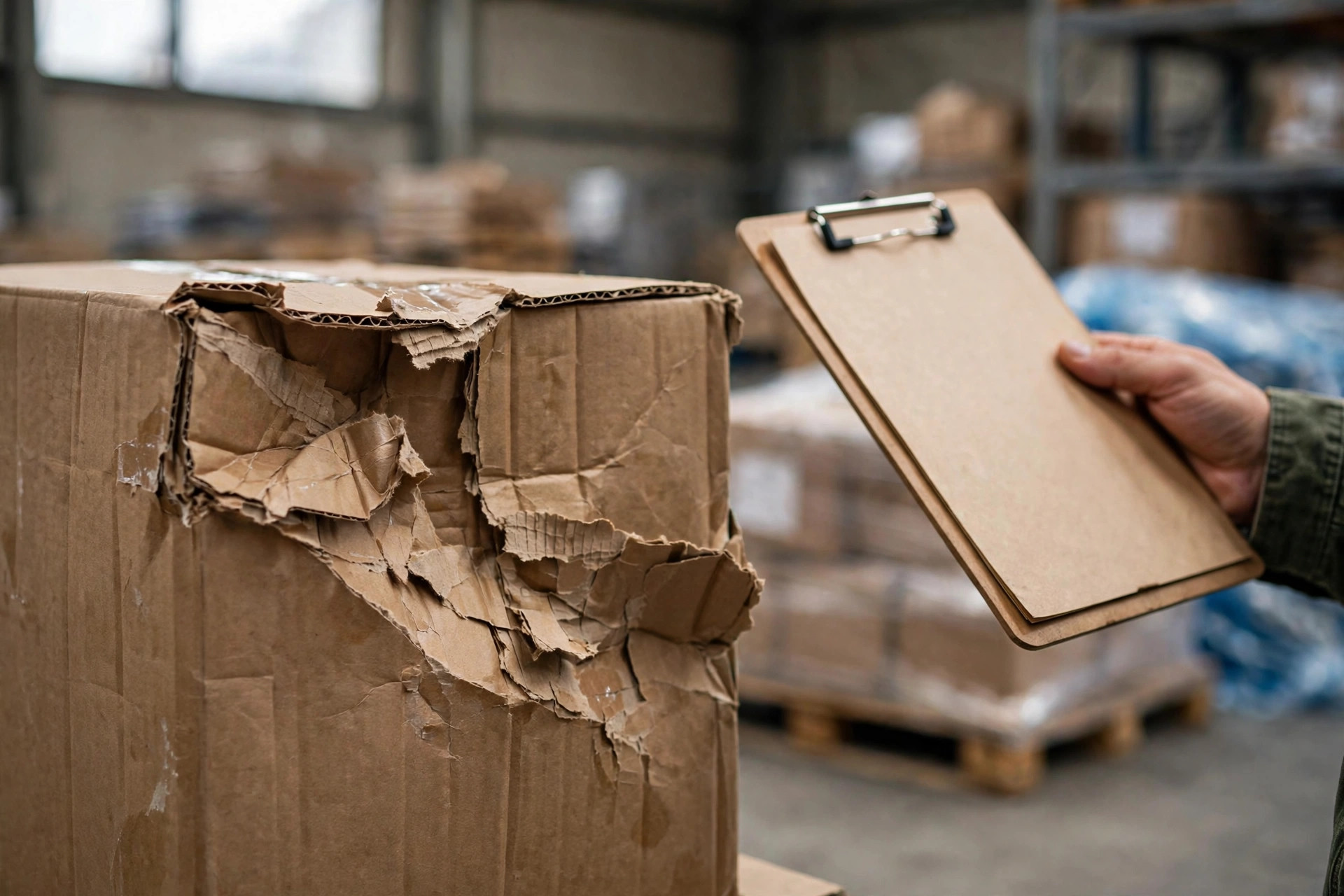
Driver at the door? Don't unload yet. Shoot the full container/trailer, the seal number, the signed delivery receipt. If you spot crushed, torn, or wet cartons during unloading — stop and photograph them close-up, with the BOL number or pallet label visible in the frame. This takes five minutes. It is also the starting point of the entire claim chain. Skip it and everything after is just arguing.
Step 2: Log it in the system exactly as found. Not one digit changed.
Record what you actually received, flag the variance. Your WMS needs a dedicated discrepancy record: type (shortage/damage/overage/mis-shipment), SKUs involved, quantities, photo attachments, who found it, when. Never "receive to the paperwork quantity and adjust later" to save time — the moment you adjust, the evidence chain breaks. Auditors and carriers only trust original records. An edited record is worthless in a carrier claim.
Step 3: Assign preliminary responsibility within 24 hours.
Our rule: within 24 hours of discovery, the warehouse issues a preliminary responsibility assessment with an evidence package to the client — signed receipt quantities, pre-unload photos, damage photos, system record screenshots. With that package, the client knows whether to go after the carrier, the factory, or us. Speed matters because carrier claim windows are limited. Wait too long and you get a polite "outside the filing window," and there's nothing you can do. Claim windows and procedures vary widely by carrier — always check each carrier's latest published policy, never rely on memory.
Step 4: Follow through on the claim. Whoever's at fault pays.
Here's an insider detail most clients miss: in many 3PL contracts, claims support is "assistance," not "full service." Translation: we'll organize the evidence and draft the claim letter, but the back-and-forth with the carrier — the calls, the chasing, the escalation — is on you. Unless you pay for a claims service where we handle it end to end. Read this clause before you sign. Otherwise you assume the warehouse will recover your money, the warehouse assumes you'll do it yourself, nobody does it, and the money evaporates.
Let's Do the Math: What Unresolved Discrepancies Really Cost
I've picked up a bit of Lao Zhou's costing habit, and this one is worth running. Say you inbound 40 containers a month at $80,000 of goods each. A 0.5% receiving discrepancy rate counts as well-managed in this industry — note that: 0.5% is the good number, not zero.
40 × $80,000 × 0.5% = $1,600/month, nearly $20,000 a year. And that's the "normal" scenario. If your goods are high-value small items — lighting, electronics — one concealed-damage case with no evidence can vaporize a few thousand dollars in a single shot. Then there's the time cost nobody reimburses: one three-way dispute, 20 emails back and forth, one person each from your team, the warehouse, and the forwarder, a week burned. Discrepancy handling isn't "the warehouse's problem." It's your wallet.
Negotiation Advice: Settle the Discrepancy Terms Before You Sign
By now you've probably figured it out: how well discrepancies get handled is 70% decided at contract signing. Every time a new client negotiates with me, the discrepancy terms are one of the three sections I tell them to read closely.
Next time you negotiate a contract, ask these three questions:
One: "What's the reporting window for discovering a discrepancy, and what happens if we miss it?" Some warehouses write 24 hours, some 48, some "at time of receipt." Shorter windows work against you — your team isn't staring at receiving all day. Push for 48 hours or more, with a peak-season exception.
Two: "Do you accept concealed damage, and what's the evidence standard?" This is the clause most likely to blow up. Some 3PLs write "no claims accepted when outer packaging is intact." Others accept it but demand a full unboxing video. Get the standard into a contract exhibit, not left as a verbal promise.
Three: "Are claims full-service or assistance-only, and what does it cost?" If full-service, what's the success fee (a percentage of recovered value is common in the industry)? If assistance-only, how fast do you deliver the evidence package? Decide who argues with the carrier at signing, not after the damage.
One last insider confession: as a salesperson, the clients I fear most aren't the picky ones — they're the ones who ask nothing and sign fastest. Because those clients are always the hardest to deal with when something goes wrong: they assumed the contract covered everything, when in fact they negotiated nothing. Three questions about receiving discrepancies at signing saves you thirty arguments over the next three years. That's a good trade.
By Susan, 3PL Sales Director