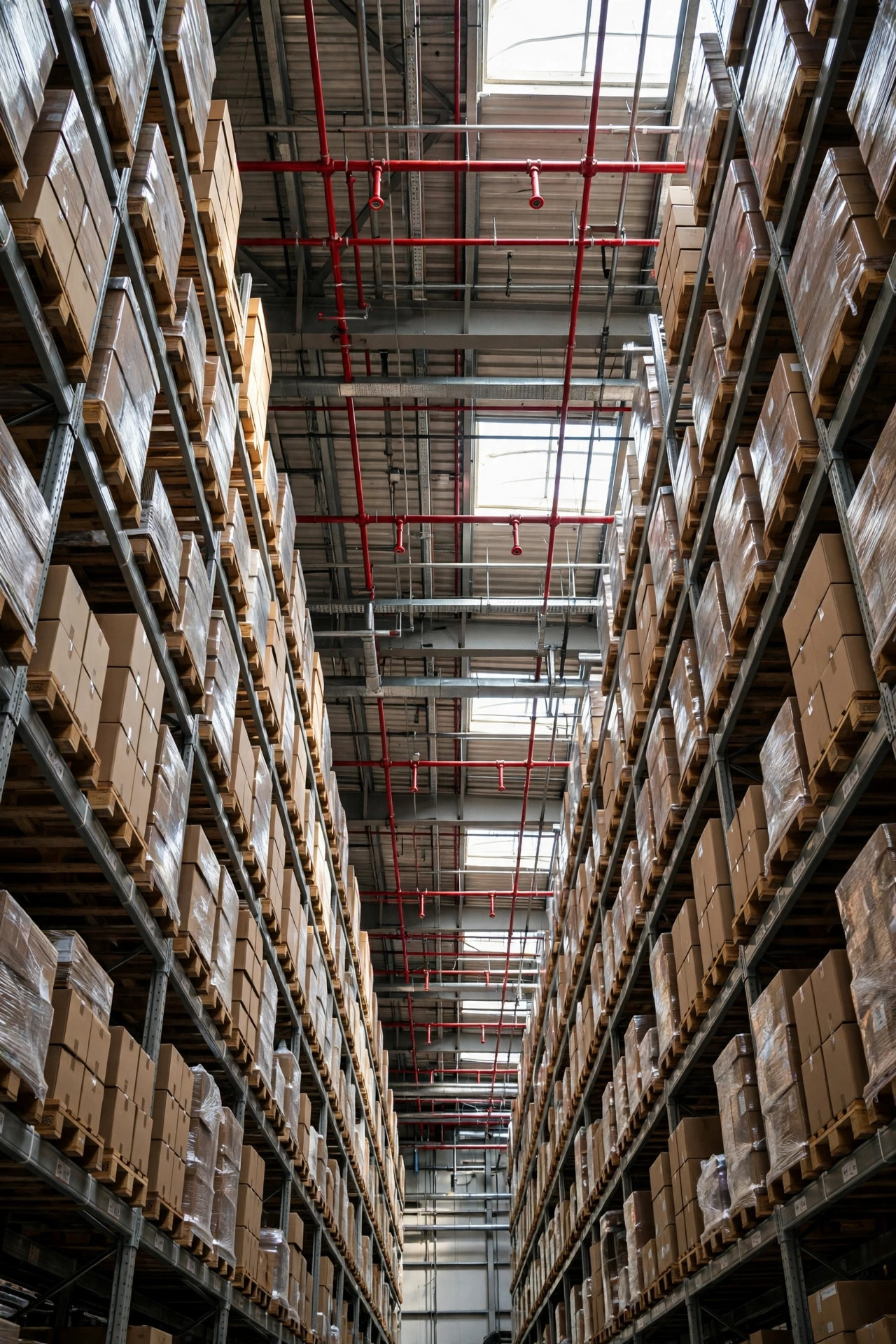
One of our clients learned the hard way when are in-rack sprinklers required in a warehouse: last year they leased a new 32-foot-clear building in Indiana with ESFR ceilings — the landlord said "rack it however you want" — and the fire marshal's answer came in one sentence: no in-rack heads, no occupancy permit. The retrofit ran into the low six figures, the opening slipped by more than two months, and peak-season orders nearly went unfulfilled.
I tell this story to every client now, because the question of when are in-rack sprinklers required in a warehouse has almost nothing to do with what's on the ceiling. It depends on what's inside the racks and what's stored on them. ESFR is powerful — but there are four scenarios it simply cannot cover.
Why landlords love ESFR (and why that should make you ask questions)
ESFR — Early Suppression Fast Response — throws a lot of water, fast, with the goal of suppressing a fire outright rather than merely controlling it. Under NFPA 13, the US benchmark standard for sprinkler installation, ESFR is the darling of developers and landlords for a very commercial reason: one ceiling system covers the building, and tenants can rearrange racking without major sprinkler rework. Easy to lease, easy to market.
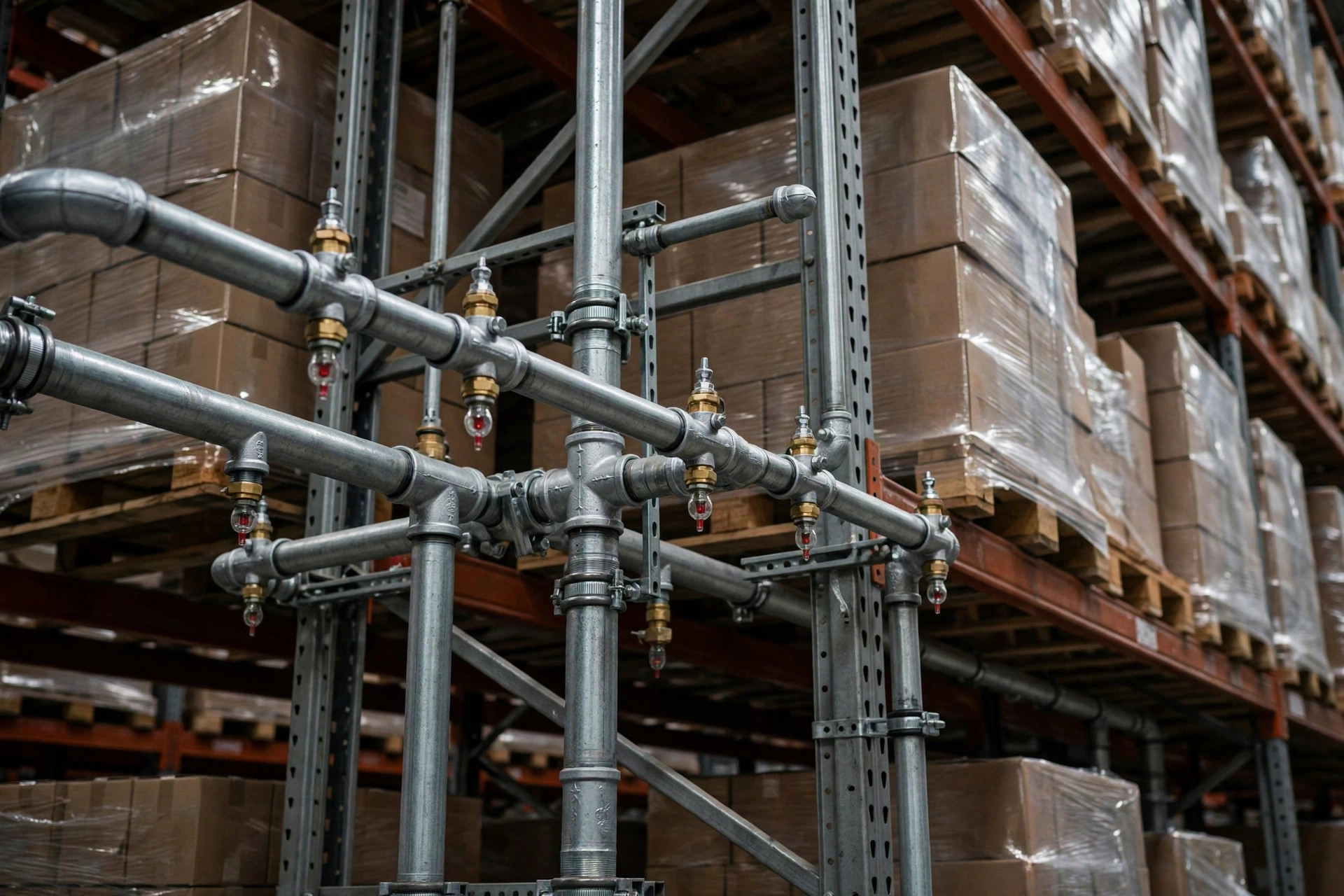
But every ESFR sprinkler carries a listing with boundaries: commodity class, storage height, ceiling height. A commonly cited FM Approval, for example, covers a K25.2 ESFR up to 40 feet of storage under a 45-foot ceiling — and that is a manufacturer listing, not a blanket promise. Go beyond the boundary, or put structure between the ceiling and the fire, and all that water never reaches the flames. In-rack sprinklers exist for exactly this reason: they put water where the fire actually starts — between the rack levels.
When ceiling ESFR is enough (the reassuring part first)
Not every warehouse needs in-rack heads. Ceiling-only ESFR generally passes inspection when:
- You run standard selective racking with open wire decks or no decking at all, so water travels straight down;
- Longitudinal and transverse flue spaces are maintained — the engineered gaps that let heat rise and water penetrate;
- Commodities are ordinary (cartoned general merchandise, apparel) and storage heights sit within the ESFR listing;
- Individual solid shelves are small — NFPA 13 draws the line at 20 square feet per shelf.
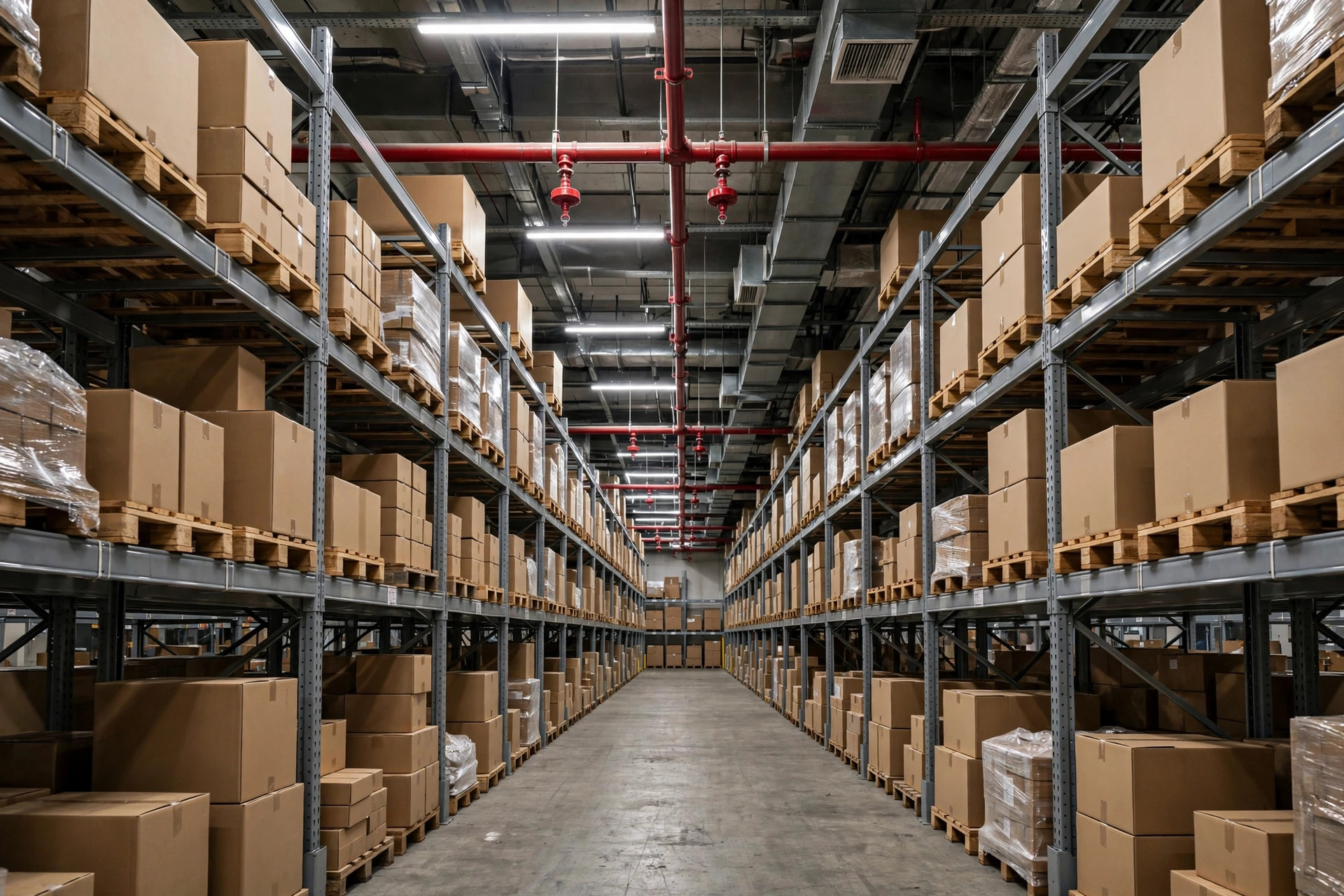
When are in-rack sprinklers required? Four scenarios ESFR can't cover
These are the four that blow up inspections most often. Check your racking plan against each one before you order steel.
1. Solid shelving that blocks the water
E-commerce and auto-parts operations love solid steel shelves — nothing falls through. But a solid shelf is a water shield: the ceiling dumps water on top while the fire burns happily underneath.
NFPA 13 tiers this precisely: shelves under 20 square feet each can skip in-rack sprinklers; 20 to 64 square feet need them at intermediate levels; over 64 square feet need them under every shelf level. And the International Fire Code, Chapter 32, Section 3207.2.1, says it plainly: shelf storage 15 feet or higher requires approved special fire protection, such as in-rack sprinklers.
We had an auto-parts client with solid shelves throughout — four levels, each shelf over 80 square feet. The fire protection engineer looked at the drawings and said: every level, no exceptions. That was a couple hundred sprinkler heads and a lot of pipe.
2. Deep-lane racking where flue spaces can't survive
Pallet-flow, pushback, and drive-in racks pack pallets nose-to-tail, and flue spaces get crushed or blocked. The 2022 edition of NFPA 13 tightened this specifically: racks deeper than 20 feet need either 6-inch flue spaces on all four sides of every pallet load, or in-rack sprinklers. Pick one.
In practice, keeping full flue spaces in a 20-foot-deep lane kills storage density, so most operators choose the sprinklers. This is also the line item most often missing from rack quotes: the rack vendor prices steel; the sprinkler retrofit is a separate invoice that only appears once fire drawings are done.
3. High-hazard commodities that outrun the ceiling system
A rack of cartons and a rack of plastic toys are two different animals to a fire marshal. Group A plastics, expanded foam, rubber tires, aerosols — these burn fast and hot, and the ceiling ESFR's listed protection height drops accordingly. Exceed the limit for your commodity class, and in-rack sprinklers become mandatory.
That Indiana client? They leased the building for "general merchandise" but moved in a large category of plastic-housed appliances. The commodity classification changed, and the original ESFR design no longer complied. Lesson: lock down your commodity mix before you sign the lease, and get it written into the fire protection design basis.
4. Storage height above 25 feet
The IFC's required-flue-space table (Table 3208.3) uses 25 feet of storage height as its dividing line: at or below 25 feet, ceiling sprinklers plus flue spaces usually work; above it, requirements jump sharply. Plenty of 32- and 36-foot "high-cube" buildings look impressive overhead, but racks topping out at 28 feet still trigger in-rack requirements.
Two clearance numbers inspectors love to check: standard spray sprinklers need at least 18 inches between the top of storage and the deflector; ESFR needs 36 inches. Add one more beam level or stack pallets a little higher, and you're redesigning the zone.
Quick decision framework: when in-rack sprinklers are required
| Racking scenario | In-rack sprinklers likely… | Deciding factor |
|---|---|---|
| Selective rack + open decks + ordinary commodities | Not required | Flue spaces kept, height within ESFR listing |
| Solid shelves, each under 20 sq ft | Not required | NFPA 13 lower tier |
| Solid shelves, 20–64 sq ft | Required at intermediate levels | Water partially blocked |
| Solid shelves, over 64 sq ft | Required under every level | Water fully blocked |
| Deep-lane rack (flow/pushback/drive-in), deeper than 20 ft | Required | NFPA 13 (2022) rule |
| Group A plastics, foam, tires, aerosols | Very likely required | Commodity class caps ESFR height |
| Storage height above 25 ft | Very likely required | IFC Table 3208.3 dividing line |
| Shelf storage 15 ft+ with solid shelving | Required | IFC 3207.2.1 |
(This is a working framework, not engineering advice — final say belongs to your fire protection engineer working to the current NFPA 13 and your local AHJ.)
The money math: who pays, and what it really costs
An in-rack retrofit for a mid-size warehouse — tens of thousands of square feet, a few thousand pallet positions — typically runs from the tens of thousands into the low six figures in USD, scaling with levels and head count. If the existing water supply can't keep up, a fire pump upgrade stacks on top. The expensive part is often time: design, AHJ review, installation, re-inspection — one to two months easily. Miss your opening before peak season and the lost orders dwarf the sprinkler bill.
Here's the counterintuitive part: the biggest hidden cost of in-rack sprinklers isn't installation — it's maintenance. Heads sit at forklift height inside the racks, and they get clipped. One client spends close to five figures a year just replacing heads smashed by forklifts — a line nobody mentioned in the original quote.
So here's my commercial advice:
- Fix your commodity mix and racking plan before the lease, and have a fire protection engineer — not the rack salesperson — review it in writing.
- If in-rack sprinklers are needed, put the cost in the lease: landlord-funded as part of delivery, or converted into free-rent months. Don't quietly absorb it.
- When comparing deep-lane racking quotes, add the sprinkler retrofit to total cost of ownership. The "cheap" steel option often ends up the expensive one.
Three questions to ask before you sign the lease
One: What commodity class and storage height was this ceiling system designed for? (Ask for the fire protection design basis — "top of the line" is not an answer.)
Two: Has a fire protection engineer reviewed my racking plan — shelf type, depth, height? (Reviewed, in writing, before you buy steel.)
Three: If the AHJ requires in-rack sprinklers, who pays and who eats the delay? (In the lease or the purchase contract — never a handshake.)
Answer those three, and the scenarios ceiling ESFR can't cover won't ambush you.
By Susan, 3PL Sales Director