Last spring I flew with a US 3PL client to Kunshan to tour a manufacturer of underride AGVs. The facility looked impressive — two-story office building, a showroom with half a dozen vehicles on display, and a sales manager with a slick slide deck. My client was ready to talk price on the spot.
I told him to hold on. Let's see the back of the factory first.
The "test area" was barely bigger than the showroom. There wasn't even room to paint a full loop on the floor — their vehicles had never run a long route inside their own building. The client shelved the contract talk right there. That plane ticket paid for itself.
When you buy automation equipment from China, the biggest risk is never that you overpaid. It's that the machine you receive isn't the machine you saw in the showroom. A factory visit is how you tear through that curtain. Over the years I've built a checklist — eight things, every visit, no exceptions.
Look at the test floor before the showroom
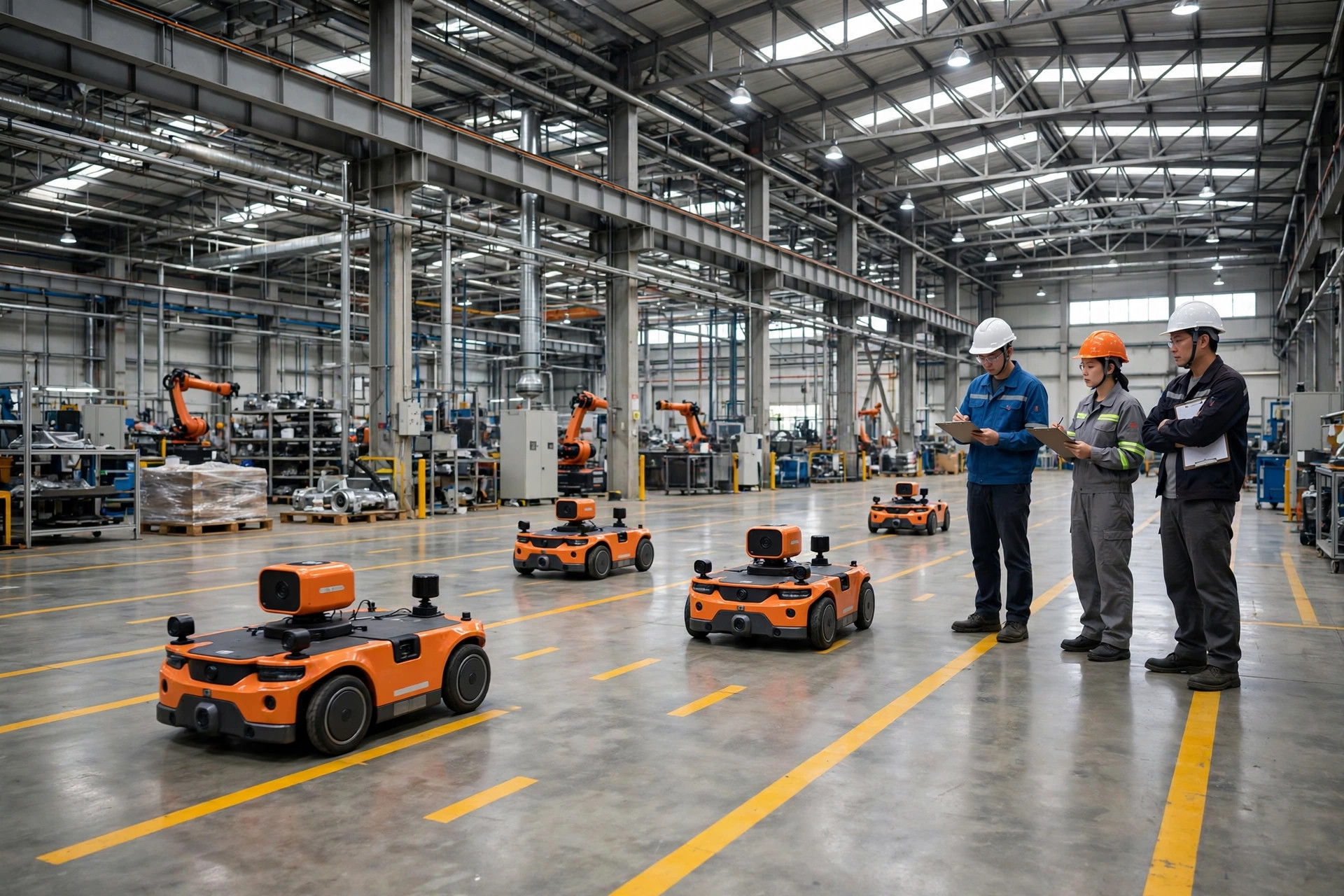
If a company building AGVs, AMRs, or four-way shuttles has nowhere to run them, that's a red flag. A serious manufacturer has a test area that simulates real working conditions: loops, narrow aisles, charging zones, obstacles.
I watch three things on the test floor. First, are the vehicles running loaded or empty? A smooth empty run means nothing — ask them to run at rated load. Second, how long do they run continuously? I ask for a full hour and watch for freezes, lost localization, or charging faults. Third, do they test edge cases — emergency stops, power-loss restarts, network dropouts? If the salesperson hesitates and says "we'd need to prepare for that," they probably never test it.
Here's a small trick: look at the tire marks on the floor. A test area that runs daily shows visible wear. If the floor is spotless, that "test area" was probably staged last week for your visit.
In the workshop, watch the process, not the machines
Don't just admire how new the equipment looks. Watch whether the production flow makes sense: incoming material, assembly line, burn-in testing, finished goods — four zones, clearly separated, materials delivered to each station.
I pay special attention to burn-in. AGVs should run continuously before shipping — dozens of hours at minimum, sometimes over a hundred. If the finished-goods area leads straight to the shipping dock with no burn-in stage in between, mentally adjust your expectations for out-of-box failure rates.
Also glance at the rework area. Every factory has one. What matters is how big it is and how many units are sitting in it. An empty rework area means either genuinely great quality or rework that's outsourced — the latter tells you field service won't be fast.
The spare parts room decides your life three years from now
Equipment runs three, five years. Parts wear out. I always ask to see the spare parts warehouse.
Three things: are common wear items (wheels, batteries, sensors, charging contacts) in stock? Are critical components (controllers, LiDAR) held as safety stock? And how active are the outbound records — busy outbound means their machines are actually running in the field and the service operation is alive.
I learned this one the hard way. In 2019 a client bought conveyor lines whose manufacturer later folded. One proprietary photoelectric sensor became unobtainable anywhere in the US, and the whole line was scrapped early. Since then, my standard question at every visit: do critical components have a second source? If every key part can only come from them, you'd better think hard about how long this company will survive.
Open the electrical cabinet: amateurs look at the outside, pros look at the wiring
Open one cabinet and check whether the wiring is tidy, whether wire markers are printed, and whether the terminal blocks have spare capacity. A factory with messy wiring will have messy commissioning — because they can't trace their own work.
Also check how cable harnesses are secured. AGVs vibrate constantly; a poorly secured harness chafes and shorts. The worst I've seen: harnesses zip-tied straight against raw sheet-metal edges, guaranteed to wear through in three months. You'll never see that in a slide deck.
Ask face to face: NRTL listing or field evaluation?
This is familiar ground from the certification series, but it has to be confirmed in person. Three questions for the salesperson: has your equipment been NRTL-listed in the US? Which agency issued the certificate? What's the certificate number?
If the answer is "we can do a field evaluation," understand what that means: field evaluations are done per project, per unit, and the cost and time fall on you. A single unit's evaluation easily runs into the thousands of dollars. That has to be negotiated at the purchasing table, not discovered later.
Ask to see the certificate on the spot. It lists models and standard numbers — if the model doesn't match what you're buying, the certificate is worthless. I've sat across from people pitching with someone else's certificate photocopy. Check the original or expect to get burned.
The software team: headcount doesn't matter, being in the building does
Automation equipment is half hardware, half software. During the visit, ask one question: is the software team in this building?
Plenty of small manufacturers outsource software or buy core algorithms. Outsourcing isn't the problem — the problem is who fixes a bug and how fast. My usual test scenario: "If our WMS times out calling your API, how long until you can root-cause it?" Watch the reaction — do they walk you through a triage process, or say "let me ask our software vendor"?
Also check whether their release discipline is real. Ask casually: when was the last release? Can I see the release notes? A team that can't produce release notes will never ship you a meaningful software upgrade.
Call their support line at 10 PM
This is my secret weapon. On the evening of the visit — 10 PM local time — call their after-sales support line. See if anyone picks up, how long it takes, and whether they can speak English.
Equipment never breaks during business hours. A support line that's dark at night and on weekends is the same as no support line. This trick has never failed me; it's filtered out at least three vendors who advertised "24/7 global support."
Do the real math: don't stop at the unit price
Back home, add it all up. Unit price, ocean freight, tariffs, field-evaluation certification, installation and commissioning, first spare-parts order, training. That's the true cost.
I've run this for clients: an AGV quoted at $80,000 lands near $110,000 once you add tariffs, certification, commissioning, and first-year spares. That's not a reason not to buy — it's a reason to know the real number at the negotiating table instead of being surprised by the invoice.
A factory visit is two days spent defusing mines for your next three years of operations. The flights and hotels cost a fraction of what one week of downtime will cost you.
Have you toured an equipment factory in China recently? What's the one thing you always check? Drop it in the comments.