A humanoid robot warehouse deployment is easy to announce and hard to run. Demo videos show a machine walking steadily and picking cleanly; a real warehouse hands it people, forklifts, changing parcel shapes, and a pace that never stops. According to public reporting, only one or two vendors have actually signed paying contracts and kept robots doing sustained work in a customer's warehouse. Everyone else is still at the pilot, demo, or press-release stage. Before asking how fast a humanoid can pick, it is worth pricing two things properly: the safety bar it has to clear, and what it really costs.
What Humanoid Robot Warehouse Pilots Have Actually Proved
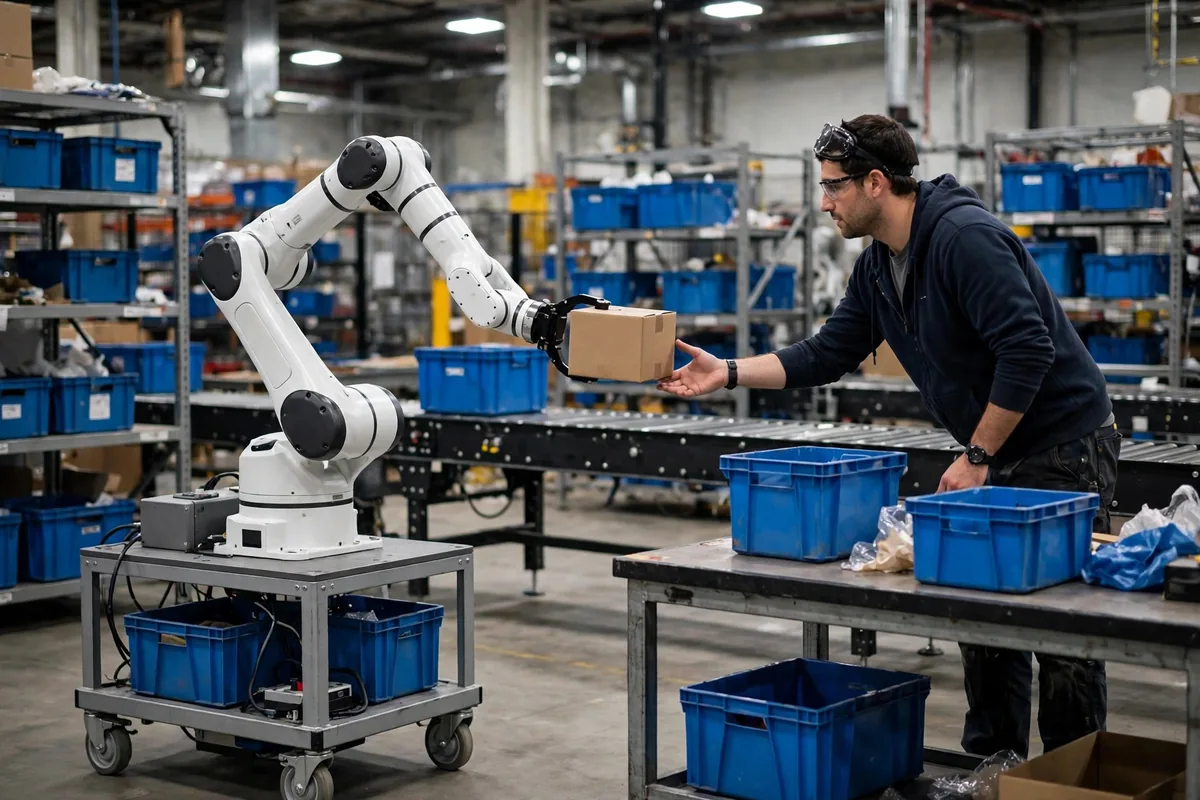
The most solid case on record belongs to Agility Robotics and its bipedal Digit. At a GXO-operated Spanx facility in Flowery Branch, Georgia, Digit has moved more than 100,000 totes, pulling them off autonomous mobile robots and stacking them onto conveyors through ordinary warehouse shifts, under a multi-year robots-as-a-service agreement signed in June 2024. The same machine completed a year-long pilot at Toyota's plant in Cambridge, Ontario, unloading auto-parts totes onto the RAV4 line, and that site is now expanding to seven or ten units. At Schaeffler facilities, Digit moved about 25,000 totes with roughly 98% operational accuracy.
The second case comes from Figure AI. Its Figure 02 robots ran an 11-month pilot at BMW's Spartanburg plant, moving more than 90,000 parts. On June 25, 2026, BMW confirmed that the newer Figure 03 had taken over a parts-sequencing job in the plant's logistics hall, picking components out of unsorted containers and sorting them into trolleys headed for the assembly line. The program then converted into the industry's first paid commercial-scale humanoid contract, an initial 40-robot order.
The third data point is Tesla. On the company's fourth-quarter 2025 earnings call, held January 28, 2026, Elon Musk said Optimus was not in use in Tesla's factories in a material way, and that units were primarily there to learn rather than to perform productive tasks. Reporting by The Information put actual 2025 output at a few hundred units, against a stated target of 5,000 for internal factory use. Musk has publicly targeted a $20,000–$30,000 unit price for a future consumer release, but as of mid-2026 there is no external customer with an Optimus on their floor at any price.
Put the three cases together and the picture is clear: humanoids have entered the warehouse, but the work is extremely narrow — moving totes, sequencing parts, one task in one controlled area, repeated. Nobody is doing high-speed picking, and nobody is improvising across mixed parcel types.
The Safety Bar for a Humanoid Robot Warehouse
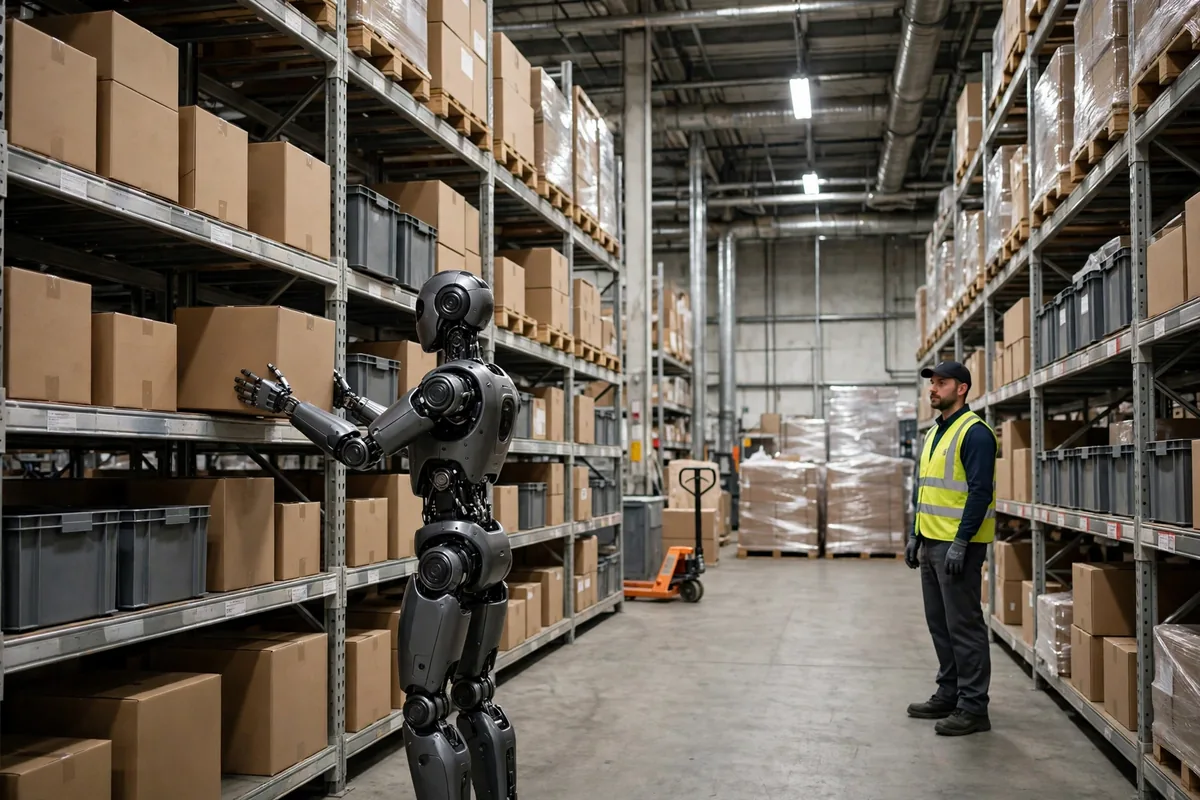
The defining difference from a traditional industrial robot is that a humanoid works without a fence, alongside people. A fixed arm sits inside guarding and stops when a person approaches; a humanoid walks the aisle with pickers and forklifts beside it, so the safety logic has to be built differently.
On standards, the current basis is ISO 10218-1:2025 and ISO 10218-2:2025, both revised in 2025. The collaborative contact force and pressure limits that used to live in ISO/TS 15066:2016 have been absorbed into ISO 10218-2:2025, and the US adoption, ANSI/RIA R15.06-2025, followed within months. The standards define four collaborative operation modes: safety-rated monitored stop, hand guiding, speed and separation monitoring, and power and force limiting. For a humanoid, the last two do the real work: slow down as people get closer, and stop within biomechanical force limits on contact. Compliance, the standards make clear, is a property of the application — the task, the tooling, the workspace — not of the robot alone. The same machine in a different task or a different cell needs a fresh risk assessment.
In November 2025, Digit became the first humanoid to pass an OSHA-recognized NRTL field safety audit at a live customer site. For a warehouse operator, that kind of audit matters more than any demo video: it is the paperwork that lets a robot work near people at volume, and without it, scaled deployment cannot start.
Three further gates sit at site level. The first is falling: a machine weighing tens of kilograms going down next to a person is itself a safety event, so fall prevention and post-fall self-protection belong in the risk assessment. The second is the emergency stop: it has to be reachable and pressable by anyone on the floor, and the restart procedure after a stop has to be explicit rather than a remote command. The third is load and grasping: a humanoid handles real boxes whose weight, center of gravity, and surface friction all vary, and a dropped box has to be accounted for in the assessment — whether it lands on a person or on goods.
The Cost Math of a Humanoid Robot Warehouse
The cost barrier has three layers. The first is unit price. Tesla's $20,000–$30,000 target is quoted constantly, but it describes a future mass-produced consumer version with no sales channel yet; the price a warehouse can actually sign today is a pilot lease. According to published reporting, Digit leases at roughly $30 per hour to enterprise warehouse operators, a rate that bundles hardware, software updates, remote supervision, and site integration. Operators that want to trial Digit in their own facility first can join Agility's Customer Acceleration Program, which carries a fee of about $500,000.
The second layer is everything around the robot. A humanoid does not simply arrive and start working: floors may need work, charging or battery swaps have to be scheduled, network and task-system integration has to be built, remote supervision has to be staffed, and spare parts and repair response times have to be agreed. An hourly lease absorbs part of that, but floor work, process changes, and the time spent adapting workflows still sit on the warehouse's own budget. The building has to change for the robot, not just the other way around.
The third layer is output. Judging value by the hourly rate alone is a mistake; the right comparison is full cost per unit of output. The table below compares the three routes on structure, not on precise quotes:
| Route | Best work | Cost structure | Deployment character | | Humanoid robot | Tote moving, machine tending, fixed-route inspection | Hourly lease dominant, site work extra | Long pilot cycles, safety assessment item by item | | AMR | Batch transport, cross-zone moves | Equipment purchase plus maintenance, lower unit cost | Mature, route planning already standardized | | Fixed robotic arm | High-speed picking at a fixed station | Equipment plus integration, high single-point efficiency | Fixed cell, expensive to reconfigure |
Market data frames the scale. According to IDC, robot makers shipped close to 25,000 humanoids worldwide in the first half of 2026, up 432% on a year earlier, against about 18,500 for all of 2025. About 70% of first-half shipments went to research labs, schools, exhibitions, and government data-collection centers, while around 30% went into real-world work, up from about 16% in 2025. Gartner predicts that through 2028, fewer than 100 companies worldwide will move humanoid trials past the experimental stage, and fewer than 20 will put them into production in supply chain or manufacturing. The heat is in the shipment figures; the actual work sits with a handful of operators.
Here is a usable calculation framework for a warehouse manager: count the effective moves one unit completes in a shift, multiply by the days it can reliably attend, and that is annual output. Add up the annual lease, amortized site work, and supervision and maintenance labor for annual total cost. Divide the second number by the first and you have the cost of one effective move. Compare that against the current labor-plus-AMR route, and the gap is visible. One rule before calculating: an effective move counts only when done right the first time — rework and human cover for failed moves get deducted.
Where Humanoids Land First
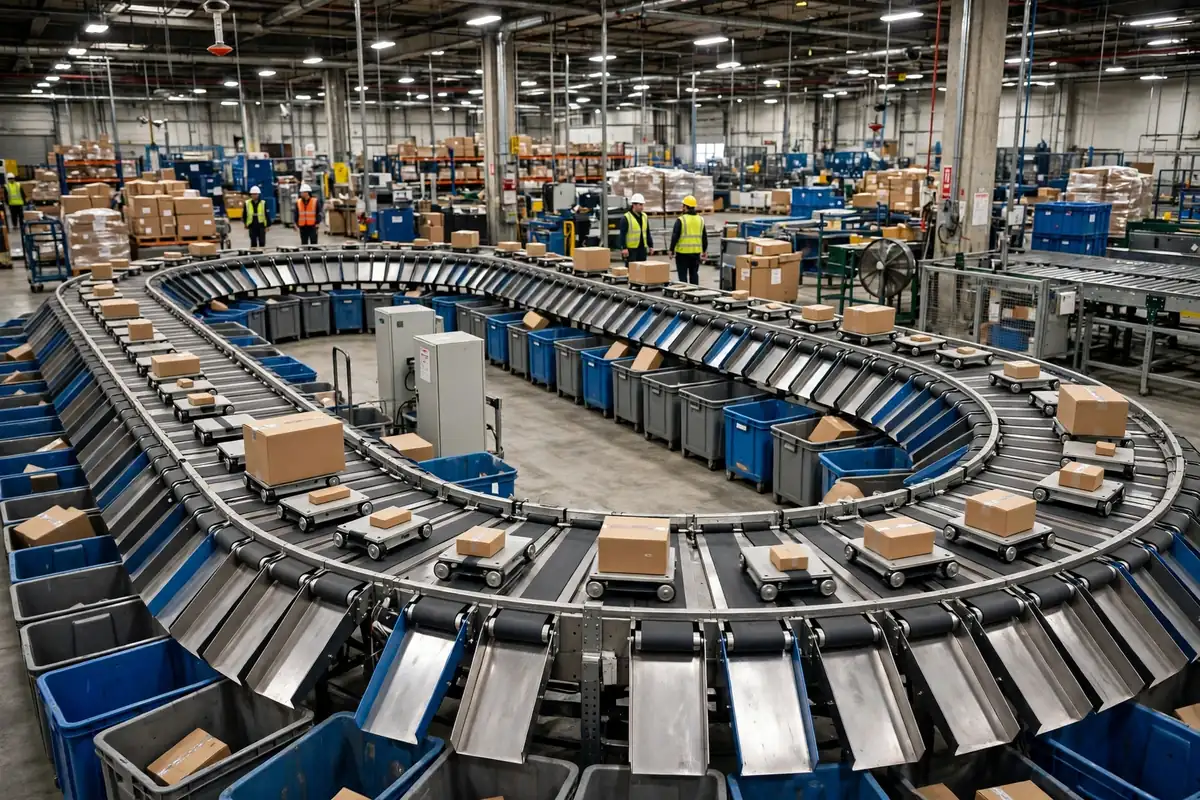
From the pilots that have actually run, humanoids establish themselves first in work that is single-task, fixed-area, and predictable in pace: moving totes between conveyors and AMRs, tending machines on a production line, inspection rounds on a fixed route. That work asks little flexibility, is friendly to safety assessment, and is the easiest to cost. High-speed picking, mixed parcel types, and work that needs judgment on the spot are not theirs yet — AMRs paired with fixed arms are faster, cheaper, and more stable there.
By warehouse type, large 3PLs and auto-parts operations move first, because they have steady tote flows, can afford pilot fees, and have safety teams to walk the assessment through. Smaller warehouses are better off waiting for lease prices to fall and for safety assessments to develop reusable templates. On Tesla's published timeline, external sales start only around the end of 2027, which means the purchasable choice before then is very narrow, and most warehouses will be negotiating for a pilot slot rather than a fleet.
The open question is not when humanoids replace people. It is whether a warehouse operator is willing to pay the two tuition fees — safety assessment and a pilot — for a technology that is still growing up. The data from pilots will answer that. Demo videos will not.
By Dr. Chen, Supply Chain Researcher