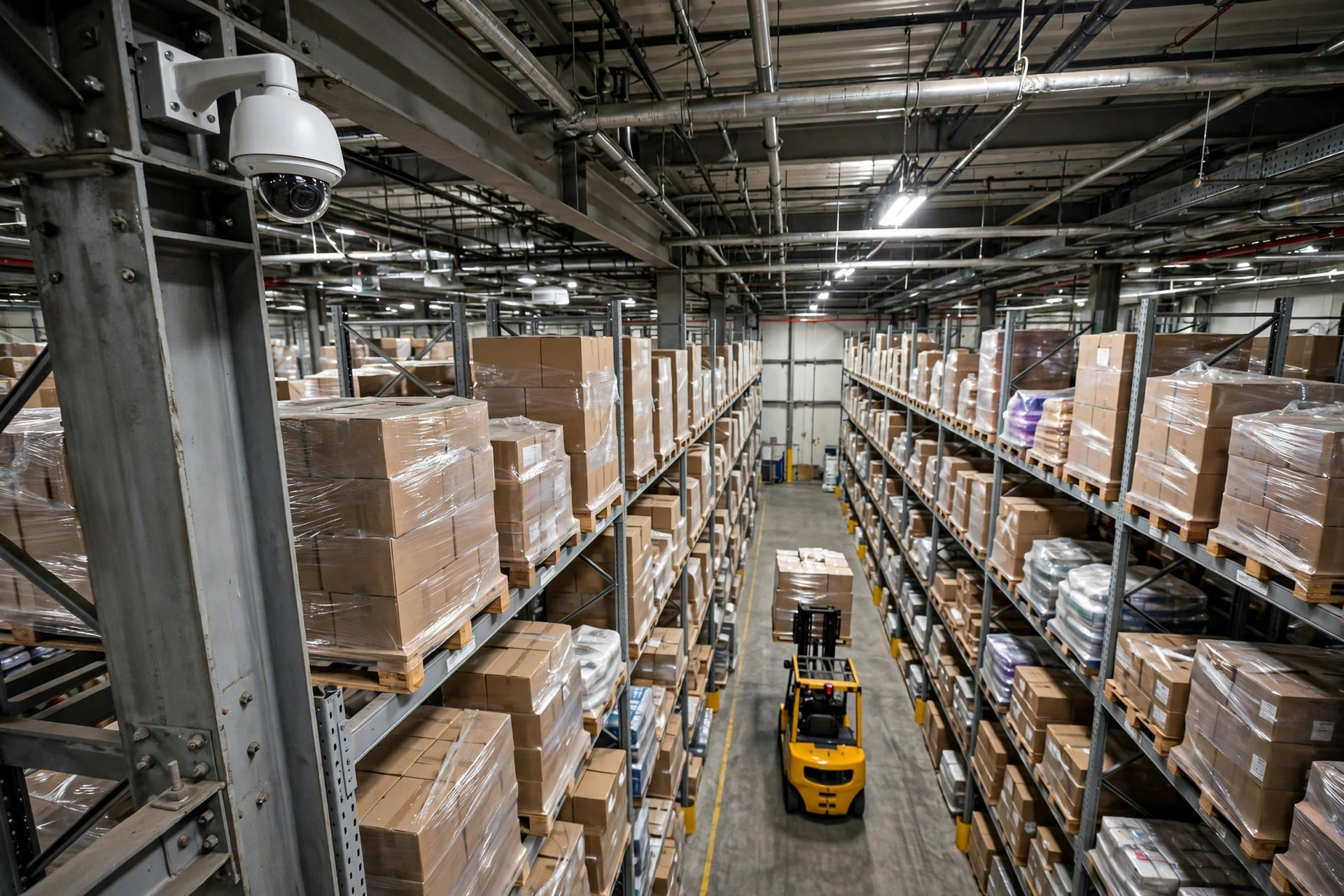
Search how many security cameras does a warehouse need and you'll get answers from 8 to 64 — all from companies selling cameras. Here's the thing: it's the wrong question. The right question is, when freight goes missing, when workers' comp files a claim, when a carrier shorts you 40 cartons — which camera angles do you need to pull to prove what happened? Work backward from the investigation, and the camera count answers itself.
My answer for a 50,000-square-foot warehouse with 10 dock doors: about 24 cameras — not 16 on a shoestring, not 40 carpeting the ceiling. I got to 24 by mapping the five kinds of incidents you'll actually need to investigate and assigning two to four angles to each. The list is below — add or subtract for your door count and aisle count.
This cuts both ways: too few cameras and you have no evidence when it matters; too many and you're burning money on storage nobody ever watches. I've seen warehouses lose on both ends.
How Many Security Cameras Does a Warehouse Need? Start With the Answer
In 2023 I walked a 60,000-square-foot e-commerce warehouse in Fontana: 32 cameras, $38,000 installed — mid-range at the going commercial rate of $700–$1,500 per camera installed, equipment plus labor. Money wasn't the problem. That peak season they lost a full pallet of Bluetooth earbuds worth $22,000. The cycle count caught the variance 47 days later. They went to pull footage. The system kept 30 days. Gone, overwritten.
Thirty-two cameras, nothing to show. The owner asked me if the $38,000 was wasted. Not wasted — misspent. All of it went into seeing, none into keeping. Most businesses keep footage somewhere between 7 and 45 days; 30 is the common default. But shrinkage and inventory variances surface on a 30-to-60-day cycle. Get retention wrong and cameras are decoration.
I've seen the mirror image too. A 3PL in Carson, back in 2022: camera over the receiving dock, beautiful wide shot — you could see the truck, the people, everything except the seal numbers and the carton count. The carrier shorted 40 cartons, both sides dug in, three months of arguing, and the warehouse ate $8,600 because the signed receiving paperwork said otherwise. That camera filmed the scene, not the evidence. One meter of placement and one zoom level was worth $8,600.
So the serious version of "how many security cameras does a warehouse need" is this: which five incident types do you need to investigate, and which angles does each one require? Mine are receiving variances, inventory variance and internal theft, workplace injuries, carrier claims, and after-hours intrusion. Two to four angles each, and the placement list writes itself. Here's the version for a 50,000-square-foot building with 10 dock doors:
| Zone | Placement | Count | What it captures (and why) |
|---|---|---|---|
| Entrances | Main / office entrance | 1 | Faces of everyone coming and going — must read features clearly |
| Entrances | Employee entrance | 1 | Buddy punching, tailgating at shift change |
| Entrances | Emergency exits | 2 | After-hours intrusion, theft out the side door |
| Dock | One angle per door pair | 5 | Seal numbers, carton counts, license plates |
| Dock | Staging area overview | 2 | Who touched staged inbound/outbound freight |
| Dock | Paperwork handoff counter | 1 | Signatures, document exchange |
| Racking | Both ends of high-value aisles | 8 | 4 aisles × 2 ends, hands at rack height |
| Racking | General aisle overviews | 3 | One per two aisles, good enough for context |
| Exterior | Yard gate | 1 | Plates and vehicle type, night vision required |
| Exterior | Fence corners | 4 | Perimeter, climbers |
| Exterior | Parking lot | 1 | Vehicle disputes, personal safety at night |
| Office | Server room / finance door | 1 | Access log for restricted areas |
| Total | 24 |
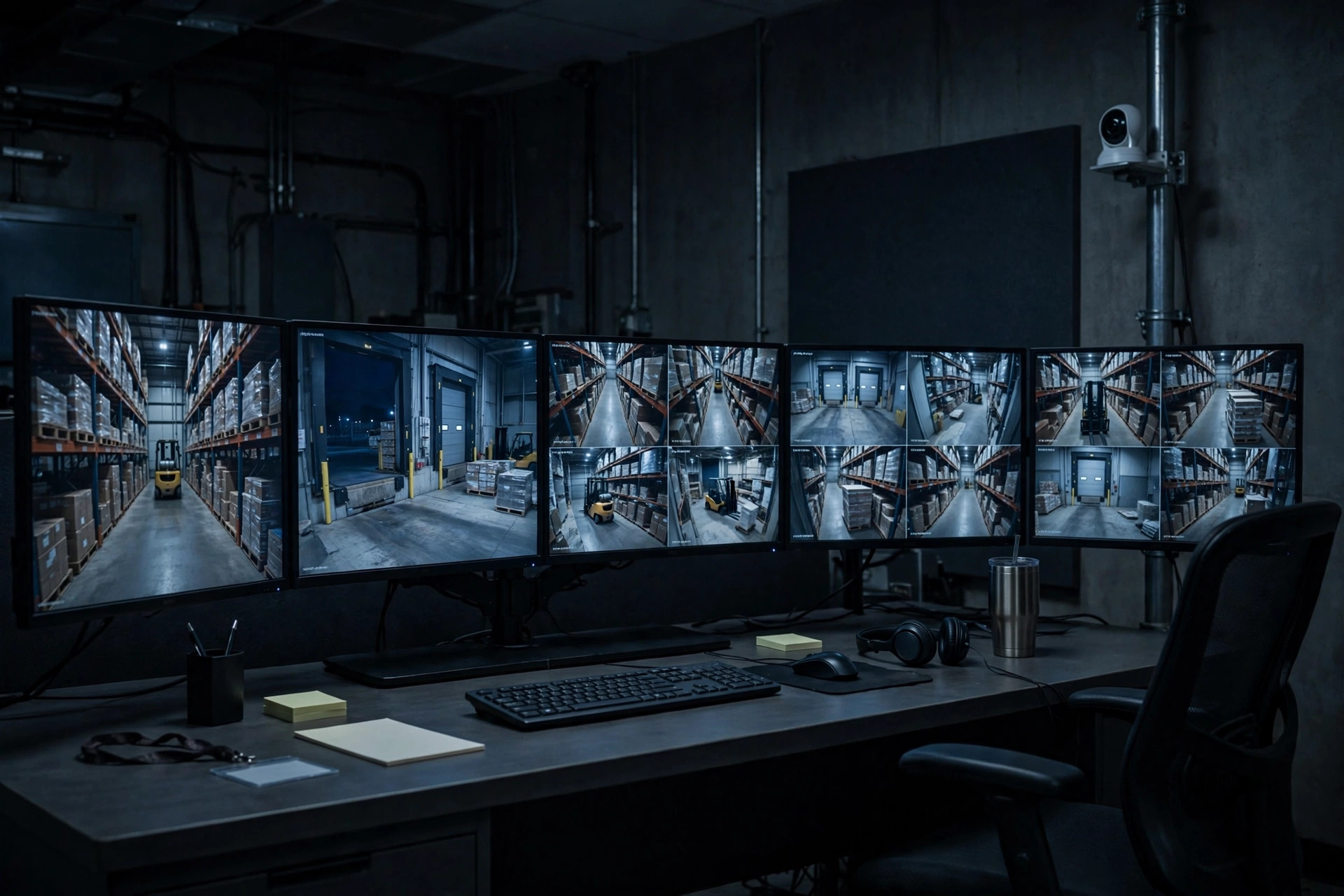
A few things that matter. First, dock cameras need one angle per door — don't cover four doors with one wide shot and call it done. Wide is fine for overview; seal numbers need a camera that can push in. Second, high-value aisles (phones, earbuds, supplements — small and expensive) get a camera at each end, lens at hand height along the rack. That's your anti-theft money shot. Third, mounting height: the trade standard is 8–10 feet, tilted 15–30 degrees down. Higher and you can't read faces; lower and someone reaches it. Fourth, every exterior and entrance camera needs night vision — half of warehouse incidents happen after dark.
The Placement List: Where Each of the 24 Security Cameras Goes, and What It Costs
Let's talk money on those 24 cameras. At the commercial installed rate of $700–$1,500 per camera, call it $1,000 mid-range: roughly $24,000 installed. Go 1080p bullets and it's less; 4K domes and it's more. Labor alone runs $80–$200 per camera — don't cheap out on the high work and the PoE networking to save a few hundred bucks and inherit blind spots.
The real trade-off is storage. Resolution and retention days are opposite ends of a seesaw: 4K sees everything but eats roughly twice the disk of 1080p for the same retention. Run the public storage formula for 24 cameras at 1080p, H.265, around the clock: about 15TB for 30 days, 45TB for 90. At roughly $30/TB for enterprise drives, that's $450 versus $1,350 — a $900 difference that buys you "footage still exists on day 47."
My split: 4K on evidence-grade angles (dock door close-ups, paperwork handoff, high-value aisles), 1080p everywhere else for overview, 90-day retention across the board. Three reasons for 90 days. First, shrinkage discovery routinely runs past 30 days. Second, 90 days is the standing industry recommendation for accident and crime footage. Third, plenty of 3PL contracts simply require 90 days; miss it and you can't bid. A $900 hard-drive delta hedging against an $8,600 write-off. You do the math.
One more rule, non-negotiable: when something happens, export and lock the footage that same day — an hour before and an hour after the incident. The overwrite cycle doesn't care about your good intentions. And never delete an unfavorable clip once a claim or lawsuit is on the table — that can be ruled spoliation of evidence, and a judge is allowed to assume the deleted footage hurt your case. Then it's not an $8,600 problem anymore.
Loss Prevention: Cameras Buy Verification, Not Surveillance
Here's the uncomfortable truth: 90% of internal theft happens in three places — high-value aisles, the receiving staging area, and the trash and returns zone. The placement logic is one sentence: make every movement of product traceable through timestamps. Receiving scan time, forklift pass time through the aisle, outbound verification time — line up the three timestamps, and the footage just confirms what was in someone's hands.
So loss prevention isn't about more cameras, it's about alignment: aisle-end cameras in the high-value zone, receiving and shipping timestamps, one random cycle count a month. Count a variance, check the timestamps to pin the shift and the ticket, pull those two camera angles — ten minutes to a name. I've seen too many warehouses do it backwards: four cameras in the break room, zero in the racking aisles. Theft unprevented, workforce furious.
Which brings us to the legal lines. California is strict; three rules to memorize.
First, restrooms, locker rooms, and changing rooms are absolute no-go zones. California Labor Code Section 435 says it plainly: no audio or video recording of employees there without a court order, and illegally recorded footage can't be used for any purpose. Film it anyway and you've built evidence against yourself.
Second, starting January 1, 2027, California AB 1331 takes effect, explicitly banning monitoring in bathrooms, locker rooms, changing areas, and lactation spaces. If your warehouse is in California, lay out to that standard now — don't redo the job in 2027.
Third, break rooms and cafeterias are the gray zone. No California statute names them, but it turns on whether employees have a reasonable expectation of privacy there — door closed, personal conversations, the character changes. My advice: skip the break room, or go video-only with clear signage and a signed handbook policy. And audio is its own high-voltage line: California is a two-party consent state — recording private employee conversations without consent is illegal. Disable audio on cameras wherever you can; in break areas and offices, it's mandatory.
One federal line regardless of state: don't film union activity. That's the National Labor Relations Act, and it doesn't care which state you're in.
A camera system buys you the right to speak after something goes wrong. Size it backward from the investigations you'll run, keep 90 days, and stay out of the forbidden zones. Quick question for you: of the footage in your building today, how much of it would still exist on day 47?
By Lao Mi, Supply Chain Veteran (20 yrs)