One week before peak season last year, I walked the floor at 6:50 in the morning and found the door to our valuables area — we call it "the black room" — sitting ajar. The night-shift guy said they'd been rushing picks and never locked it. My stomach dropped. Inside were 200-plus laptops worth over $300,000.
Let me be straight with you, brothers: high value goods warehouse security isn't really about keeping out thieves from outside. Anyone in this business knows — warehouse shrinkage is an inside job nine times out of ten. It's not that I don't trust the crew. It's that the system has to account for human nature first.
How our warehouse learned this the hard way
September 2023. We lost 48 Bluetooth earbuds, $12,000 in value. Here's how it surfaced: month-end count, system said one number, the shelf said another, short 48 units. Three days of camera footage later, we had our guy — a picker named Xiao Zhang, slipping earbuds into his jacket pockets, three trips. The method was laughably simple: valuables were slotted in the same pick zone as regular goods, he owned that zone, he touched hundreds of units a day, and nobody notices two extra units.
The part that stung: Xiao Zhang had been with us two years, solid worker, the old-timers praised his speed. After that I understood something: valuables control can't be built on "who we trust." Two clean years doesn't guarantee a third. Temptation sitting in front of someone every single day — anybody wavers eventually.
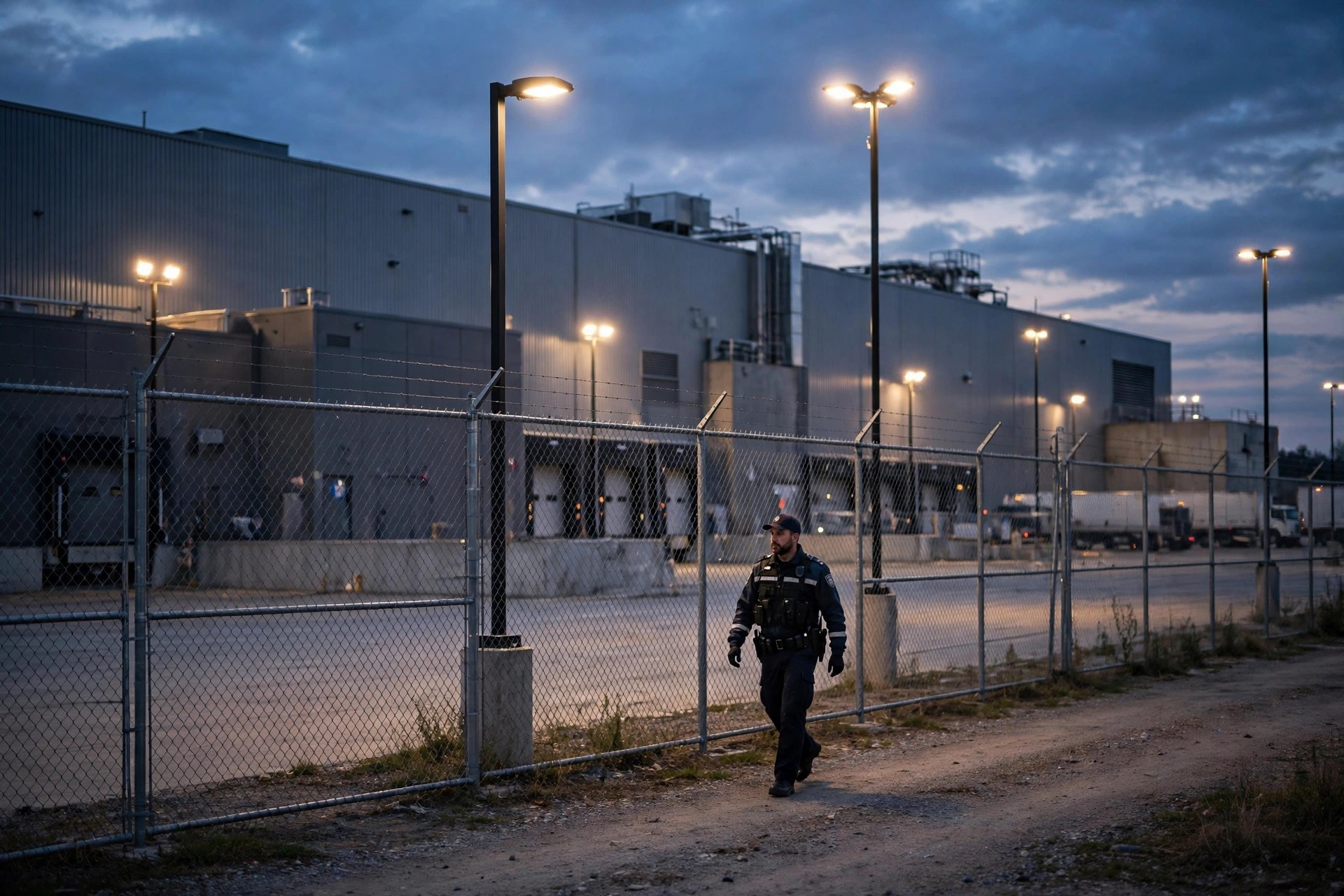
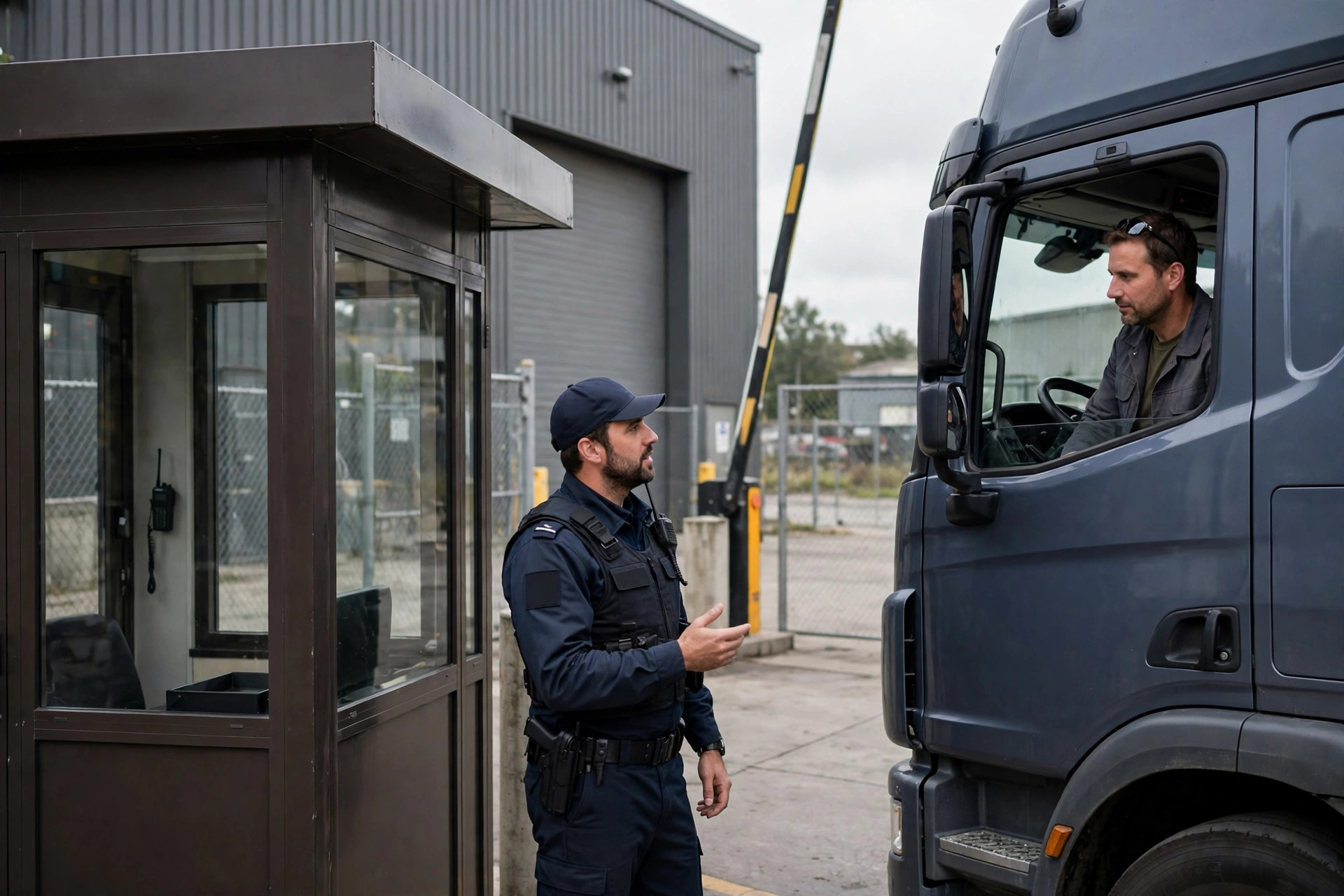
For the record, we also caught an "outside job" in 2024: a delivery driver waiting at the dock pocketed two boxes of CPUs off a pallet. How did we catch it? With the cage in place, every valuables movement is logged — those two boxes' outbound record didn't match receiving, and the timestamp lined up exactly with the half hour that truck sat at the dock. Camera footage confirmed it in minutes. In the old mixed-slotting days, those two boxes would have vanished without a trace.
Building the cage: our four-piece setup
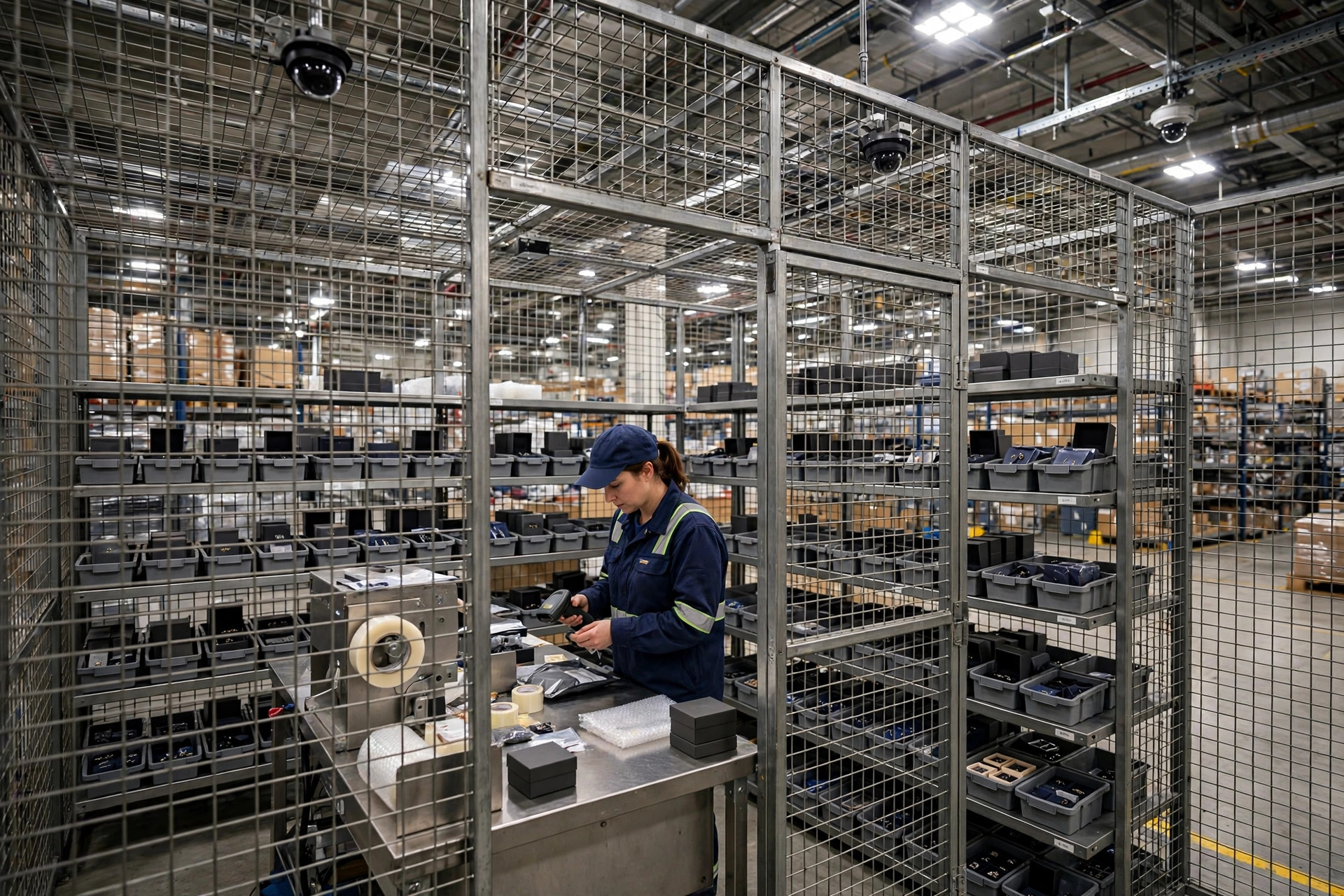
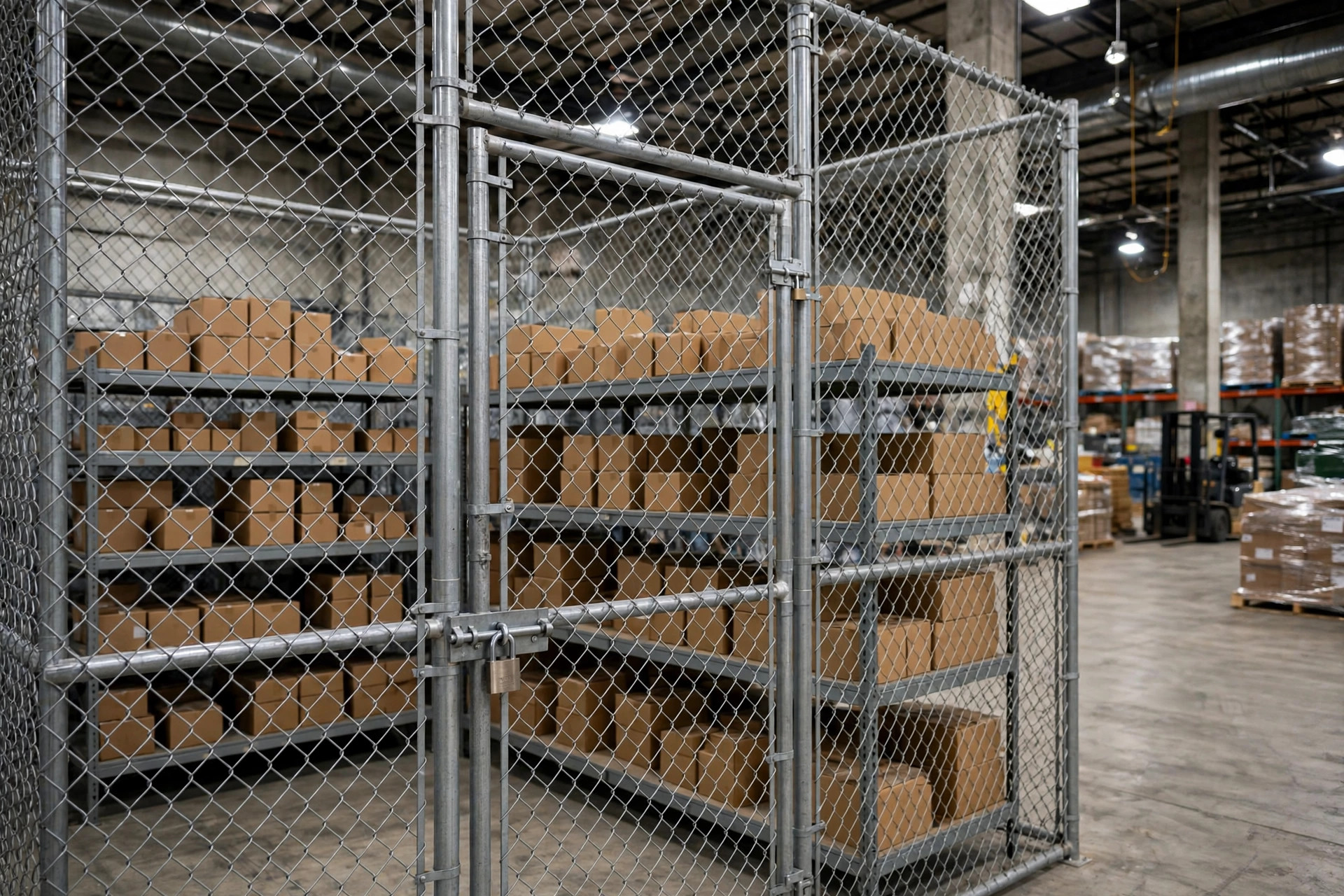
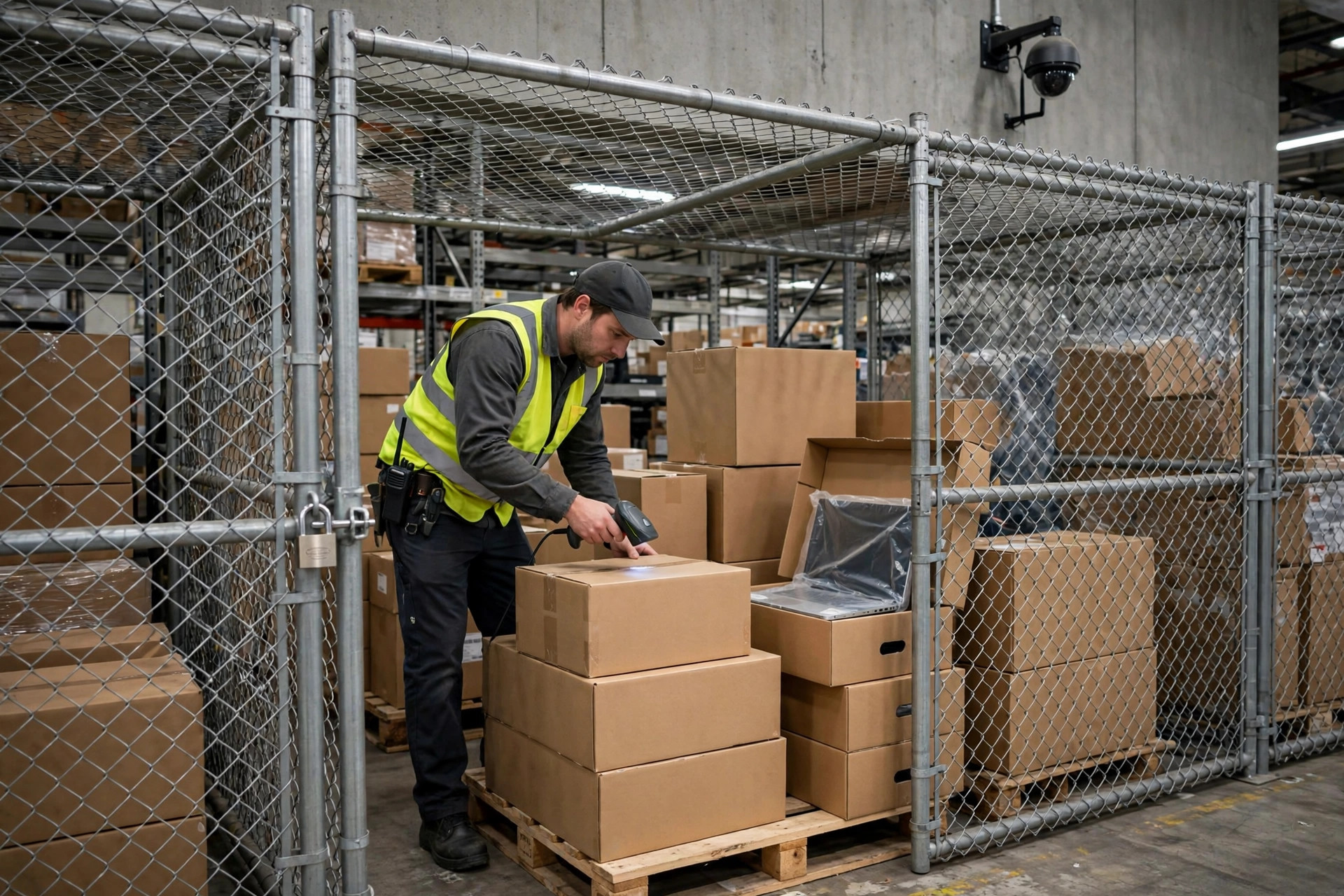
We built a cage inside the warehouse — a warehouse within the warehouse. The whole philosophy of high value goods warehouse security comes down to four characters in Chinese: physical separation. A "valuable" flag in the system isn't enough — system flags stop honest people, not dishonest ones. You need an actual chain-link fence.
One: physical separation. We fenced off about 300 square feet in a corner — 8-foot chain-link, roofed over the top. Electronic lock on the door, exactly three people with access: me, the valuables specialist, and the night-shift supervisor. Cost? Fencing, lock, cameras — about $8,000 all in. The price of one laptop, buying security for the entire valuables zone.
Two: a closed-loop process. Receiving, putaway, picking, and verification for valuables all happen inside the cage. Goods come off the receiving dock, pass through a walk-through metal detector first (yes, the airport kind, a cheap domestic unit, $3,000), then get put away in the cage. At outbound, a verifier does a second check at the cage door, scanning every serial number. Serial doesn't match the order — the door doesn't open.
Three: the people. The valuables specialist is a fixed post, no rotation. Why? The more turnover, the harder traceability gets. We pay 15% above standard hourly for the role, with conditions: background check at hire, no phones inside the cage. Some folks called it distrust. I told them straight: this protects you. When something goes missing, the first suspects are the people walking in and out every day. Strict rules are good news for honest people.
Four: the count. Full physical count of valuables every day before clock-out — not cycle count, full count. 200-plus SKUs, two people, 40 minutes. Any variance over one unit, nobody leaves until it's resolved. Two years under this rule: two variances in the first three months (both system scan misses, not theft), zero since.
The price tag: three calculations
Real talk — the cage costs you. Here's the math, judge for yourself.
Cost one: speed. Picking valuables runs about 30% slower than the regular zone — one extra security pass, one extra verification. In peak season this zone is the bottleneck. Our fix: two weeks before peak, move the fastest 20% of valuables SKUs to a "speed zone" right at the cage entrance, cutting entries and exits. Bottleneck impact drops from 30% to under 10%.
Cost two: labor. Specialist plus verifier, minimum two full-time heads — $80k–100k a year. Worth it? We ran the numbers: before the cage, valuables shrinkage ran 0.8% a year; after, 0.05%. On $20M in annual valuables throughput, that's $150k a year in prevented loss. Ten thousand in labor... sorry, $100k in labor, $50k net saved. Not a hard calculation.
Cost three: morale. Some people feel treated like suspects. My approach: the rules apply to everyone, me included. I go through the metal detector and sign the log every time I enter the cage. When the boss does it, nobody complains. And the specialist's 15% premium is visible to all — strict, yes, but the pay reflects it.
Three reminders for fellow operators
One: don't define "valuables" by unit price alone. Anything over $500 obviously qualifies. But the $50 items that are small and easy to fence — earbuds, memory sticks, cosmetics samples — those need it more. Thieves steal what's easy to sell, not what's expensive. Our current rule: unit price over $200, or smaller than a book with unit price over $30 — all of it goes in the cage.
Two: keep camera footage 90 days. Plenty of warehouses keep 30 days; by the time a loss surfaces, the footage is overwritten. Hard drives are cheap. Don't economize here. We run 90-day rolling, 180 days for the cage cameras.
Three: export the cage access log monthly and actually read it. What are you looking for? Entries outside working hours. The system is dead; the person reading the log has to be alive. I have the night supervisor send me the prior month's anomalies by the 5th.
Brothers, valuables management comes down to one line: don't test human nature. Isolate the temptation. Good for the goods, good for the people.
By Chen Feng, Warehouse Operations Manager