The worst hazmat drill I ever watched did not fail because the emergency plan was bad. It failed because the plan lived in a binder, and on drill day nobody could find the right page. The inspector left, the absorbent socks went back on the shelf, and the alarm batteries stayed dead. Here is my verdict after running drills at more than a dozen hazmat warehouses: the script is not for the inspector. It is for the three people on shift at 2 a.m., when adrenaline is up and nobody has time to read paragraphs.
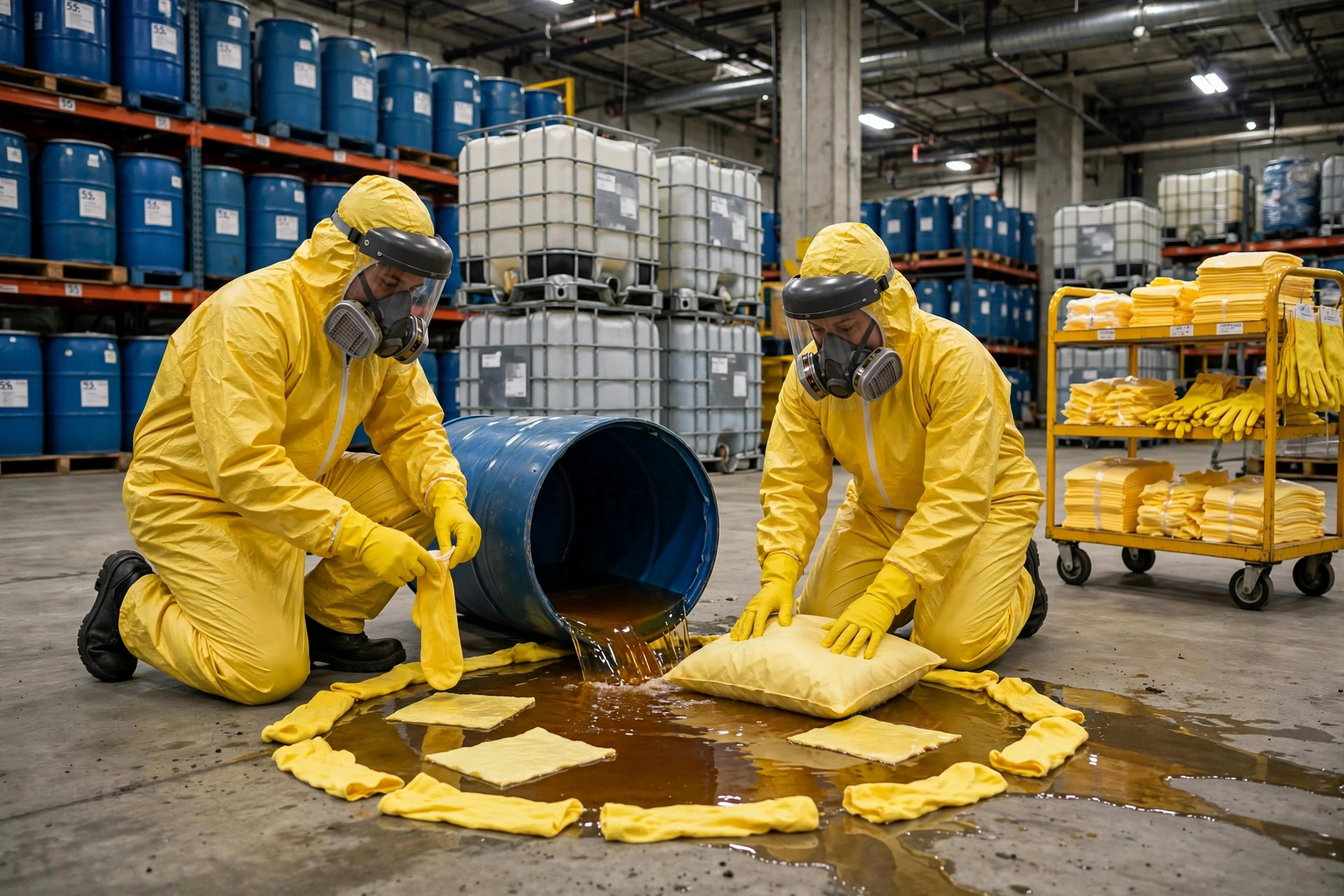
In 2023 I watched a drill at a 150,000-square-foot hazmat warehouse in Fontana. The scenario: a 55-gallon drum tipped over in the filling area, liquid running toward a floor drain. The first responder moved fast. He grabbed absorbent pads and threw them on the spill. I stopped the drill. He had grabbed oil-only pads. The spill was acidic. Oil-only pads will not touch acid. Since that day I have had one rule: every spill kit must be labeled for what it actually absorbs, and if you grab the wrong material in a drill, we stop and talk about it right there.
The spill script: contain first, absorb second, report last
Most warehouse spill plans get the order wrong. The muscle memory is four steps, and the order is non-negotiable.
Stop. Check whether you are safe. Suit up. Where the PPE lives and how many minutes it takes to go from spill spotted to geared up, that gets timed in the drill. My bar for warehouses I have run: two minutes. Slower than that, you drill again.
Then contain. Seal the low ground and the floor drains first. Ring the spill with absorbent socks before you think about cleanup. I have watched plenty of people do it backwards: throw loose absorbent on the liquid while it keeps spreading wider.
Absorb from the outside in, and do not step into the spill. Bag the waste separately, label it, and run it through the hazardous waste process. Not the dumpster.
Reporting comes last: pull the SDS, notify the supervisor and the safety lead, decide whether to escalate. One trade-off has to be settled in advance, in writing: how big a spill your own crew handles, and at what point you call an outside emergency contractor. My line: unknown substance, anyone injured, or the spill beyond what your absorbents can hold. Any one of those, escalate immediately. Write it into the script so nobody on the floor has to make that call under pressure.
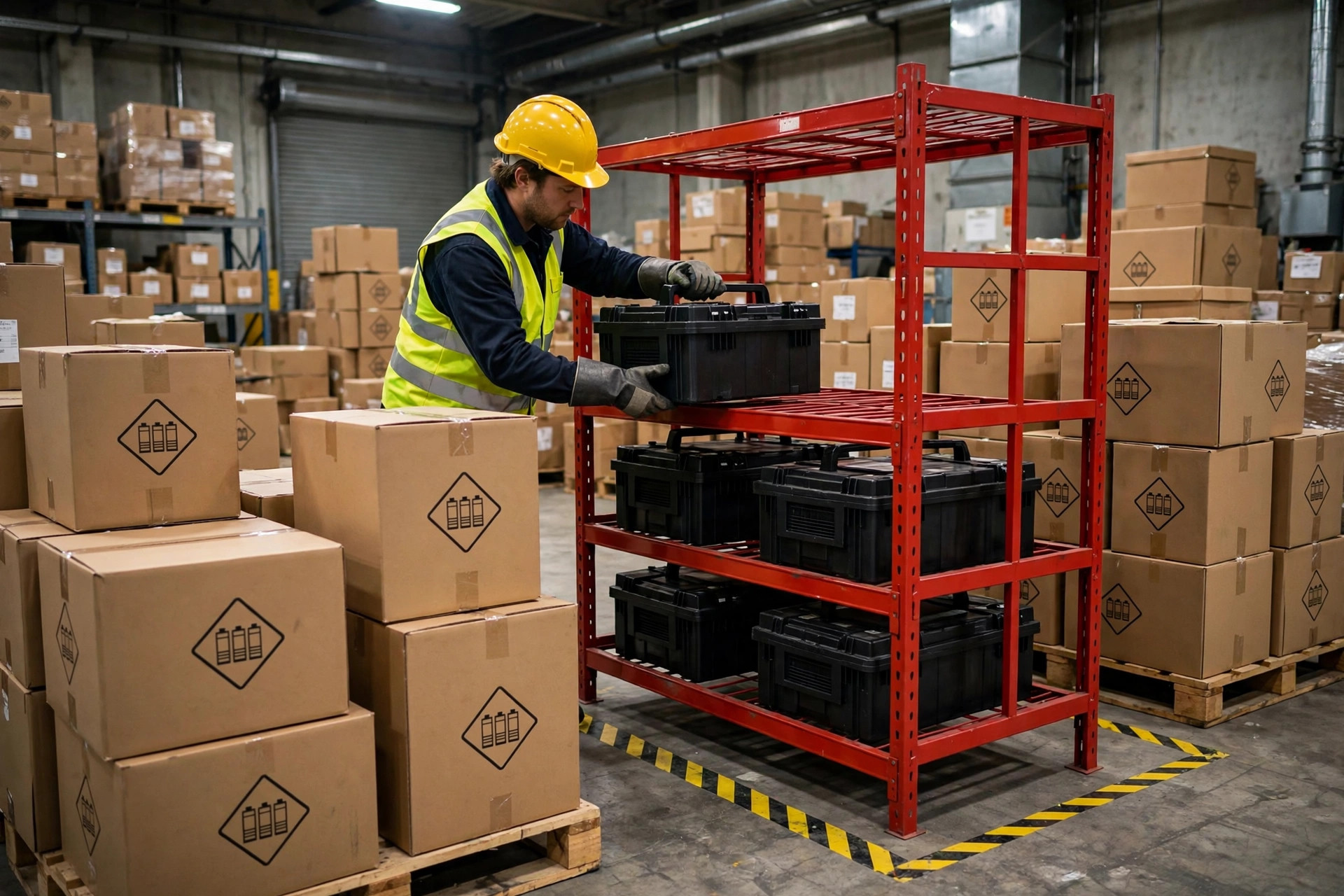
One more pitfall: spill kits in the wrong place. Eight out of ten warehouses I have visited keep absorbents in the office or the tool crib. My rule: kits live where spills happen. The dock, the filling area, the chemical staging zone. Within arm's reach. In drills, I pick a random person and ask them to point to the nearest kit with their eyes closed. Can not do it, you fail.
The fire script: hit the alarm before you touch an extinguisher
The first principle of a fire drill at a hazmat warehouse: firefighting is the fire department's job. Your crew's job is one thing. Everybody alive at the muster point. I have watched a drill where someone charged the fire with an extinguisher and the supervisor praised him for bravery. That is not bravery. That is a broken script.
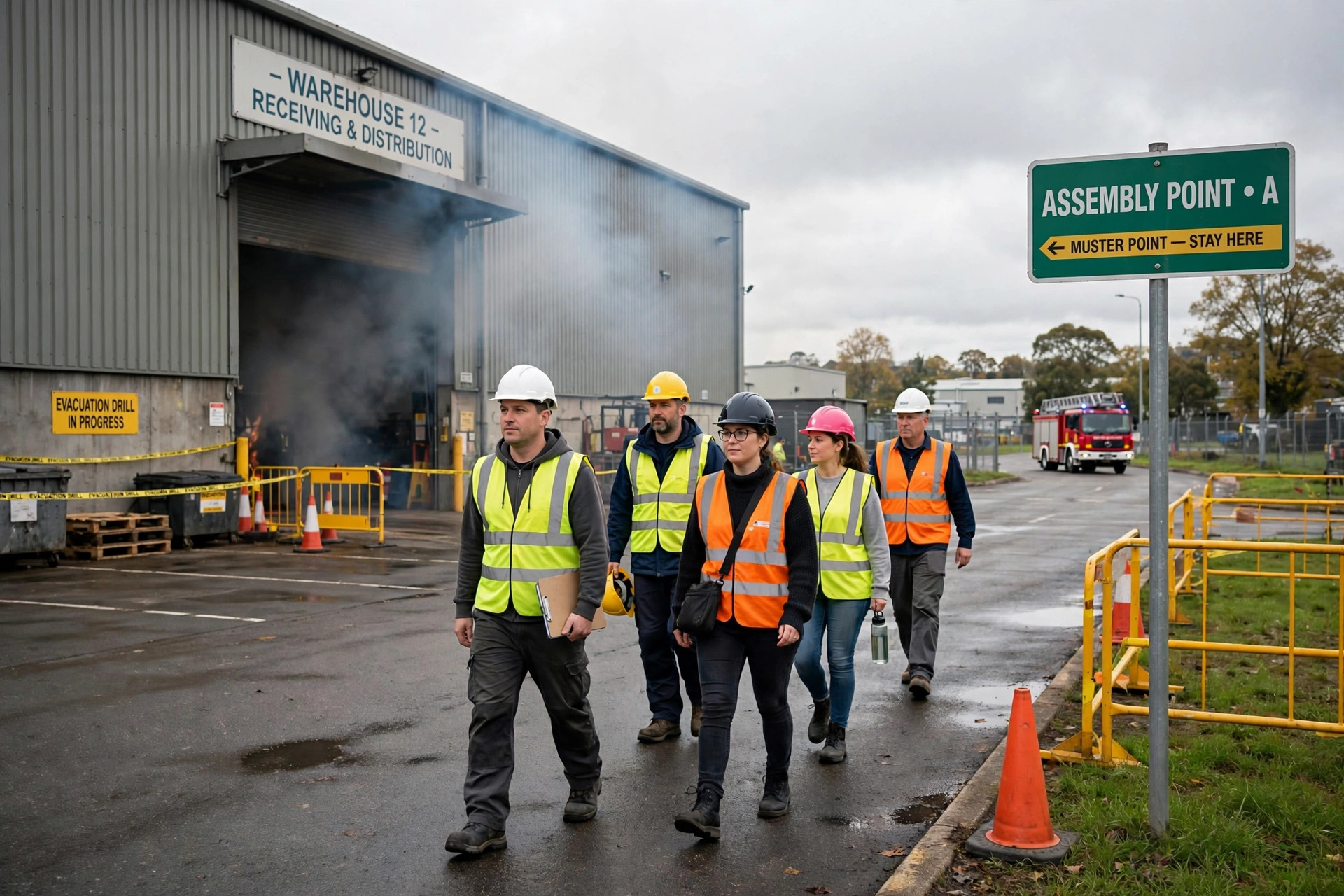
The order is: sound the alarm, evacuate by the marked route, muster and take headcount, set up isolation. Close fire doors, help the fire department get in. An extinguisher gets touched only by someone trained on it, and only on a fire small enough to die in five seconds. Past five seconds, you turn and walk. The five-second rule is my own practice. Written into the script so nobody has to hesitate.
Alarm systems get tested in every drill, not just at the annual inspection. I make the drill commander note whether the alarm was audible in the farthest corner of the warehouse, the racking area where the forklifts run. If half the floor did not hear it over the backup beepers, that is a finding, not a shrug.
Three details sink most evacuation drills. First, the muster point can not be a single fixed spot. Keep two, and check the wind. Smoke from burning chemicals can be toxic, and mustering downwind is walking into it. In drills I sometimes change the muster point on the fly, to see whether the floor lead catches it.
Second, headcount is not just counting heads. Every zone needs a designated last person out. Someone who sweeps their area, leaves last, and reports the zone clear to the drill commander at the muster point. That person has to actually walk it in the drill. No paper exercises.
Third, the doors. Fire doors propped open for ventilation. I have seen it at more than one facility. On drill day I check them on purpose. If a door can not close, your evacuation route is decoration.
Our target: everyone at the muster point, counted, within six minutes. That number is not a regulation. It is what we drilled down to. First attempts usually run past ten minutes. It takes three drills to get under six. That is also why drills can not be rare. Twice a year is already pushing it. The muscle memory fades.

How often, and what the logbook has to show
OSHA's 29 CFR 1910.120(q) requires an emergency response plan with rehearsals, and 29 CFR 1910.38 covers emergency action plans including alarms and evacuation. Neither sets a fixed number of drills per year. Check the current OSHA and EPA guidance on their official sites, because that part moves.
My practice: spill containment drills quarterly, fire evacuation drills twice a year. Spill drills can be small. One shift runs it. Fire drills are all-hands, night shift included. New hires join a drill in their first week. Not next time.
There is a trade-off between tabletop drills and live drills, and you need both. Tabletops are cheap: sit the office staff and shift leads down, walk through a scenario on paper, find the holes in the plan. Live drills are where the floor learns. The kit location, the door that sticks, the drain nobody remembered. I run tabletops when the script changes and live drills on schedule. A warehouse that only does tabletops has a plan nobody can execute. One that only does live drills keeps repeating the same mistakes without ever rewriting the script.
The logbook matters as much as the drill, because it is what the inspector reads. Every drill record needs: date and time, the scenario, the attendee list with signatures, elapsed time from discovery to muster-complete, the list of problems found, and for each problem a corrective action with an owner and a deadline. Whether last drill's corrective actions actually closed. That is the first item on the next drill's agenda.
How long to keep the records? OSHA does not set a single retention period for drill logs. My practice is at least three years. If a drill involves a reportable release, those records follow their own reporting requirements. When in doubt, go by the latest official OSHA and EPA guidance.
The drill you can run next week
Do not wait for the annual plan. Take forty minutes after a morning shift meeting, run a spill containment drill, and do not tell the floor which day in advance.
Time it: from the first shout of spill to a completed containment ring. Photograph it: where the kit was, what the ring looked like, how the absorbents went down. Write down the three slowest steps. The next drill trains only those three. Do not try to fix everything at once.
Within forty-eight hours, assign every finding: corrective action, owner, deadline, each one logged. Open the next drill by reviewing whether the last one's items actually closed.
One last real question: if a drum tipped over in your filling area tonight, how many minutes before your crew has it contained? Do not guess. Run one drill next week and you will know. That is what drills are for. Not performing for the inspector, but making sure the person on shift at 2 a.m. can find the kit blindfolded and knows the first move without thinking. And do you actually know your number, or are you guessing?