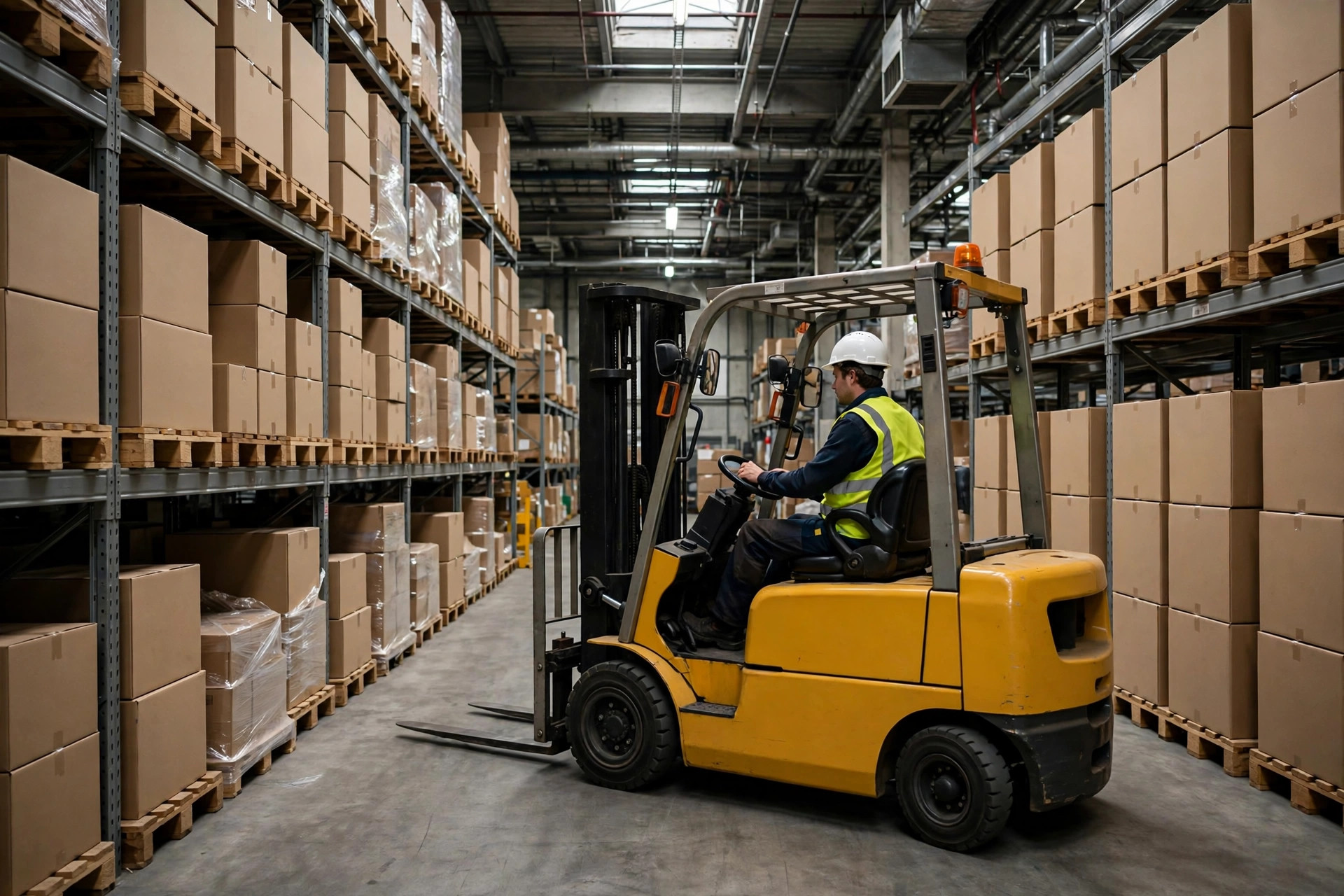
We had a client — a 3PL in Rancho Cucamonga, 90,000 square feet, fourteen propane forklifts — who taught me propane cylinder storage cage OSHA warehouse requirements the expensive way. Early 2024, they were shortlisted for a big food customer's RFP, and the final presentation went great until the customer's EHS manager asked one innocent question: "So how do you store your spare cylinders?"
Our guy froze for three seconds. Twenty-two spare cylinders, stacked — neatly, in his opinion — against the wall in the receiving area, right next to the cardboard staging zone. That question turned a routine walkthrough into the most expensive compliance lesson of that quarter — the kind you learn from a customer instead of a checklist.
You know how it ended. The food customer wrote "propane cylinder storage in compliance with OSHA 1910.110" into the contract appendix, with a 30-day cure period and a monthly 2% service fee held back as a compliance guarantee until the fix was done. The甲方爸爸, as we like to say — all smiles, and every smile has a clause behind it.
I'm in sales, not EHS. But here's a pattern I've learned over the years: in any warehouse running a propane forklift fleet, cylinder storage is the easiest citation to get — and the cheapest one to fix. A while back we ran the numbers on what a cylinder costs per hour of runtime (the fuel math). This piece is about the other ledger: what it costs when the bottles are in the wrong place.
Do the Math First: How Many Cylinders Can Stay Indoors?
OSHA's rule, 29 CFR 1910.110(f)(4), is blunt: inside a building not open to the public, you may not store more than 300 pounds of LP-Gas. Two devils hide in the details.
First, empty cylinders count as full. Paragraph (f)(2)(v) says empties that have been in LP-Gas service are treated as full containers when you tally the total. So no pointing at the empties and saying "those don't count." OSHA says they do.
Second, a standard forklift cylinder holds 33.5 pounds of propane — that's the 8-gallon industry-standard size, good for roughly one eight-hour shift. Do the division: 300 ÷ 33.5 ≈ 9. Nine cylinders, empties included, is your indoor ceiling. Bottle number ten tips you over.
The typical scene I walk into: fourteen trucks, two spares per truck, twenty-eight cylinders against the receiving wall — 938 pounds, more than triple the limit — and the manager telling me it looks tidy.
So where do the extras go? Outside. And outdoors has its own table — Table H-33 under 1910.110(f)(6) — setting the distance from the nearest important building by total quantity stored:
| Quantity stored | Distance |
|---|---|
| 500 lbs or less | 0 feet |
| 501–2,500 lbs | 0 feet (but at least 10 feet from any building on adjoining property or sidewalk) |
| 2,501–6,000 lbs | 10 feet |
| 6,001–10,000 lbs | 20 feet |
| Over 10,000 lbs | 25 feet |
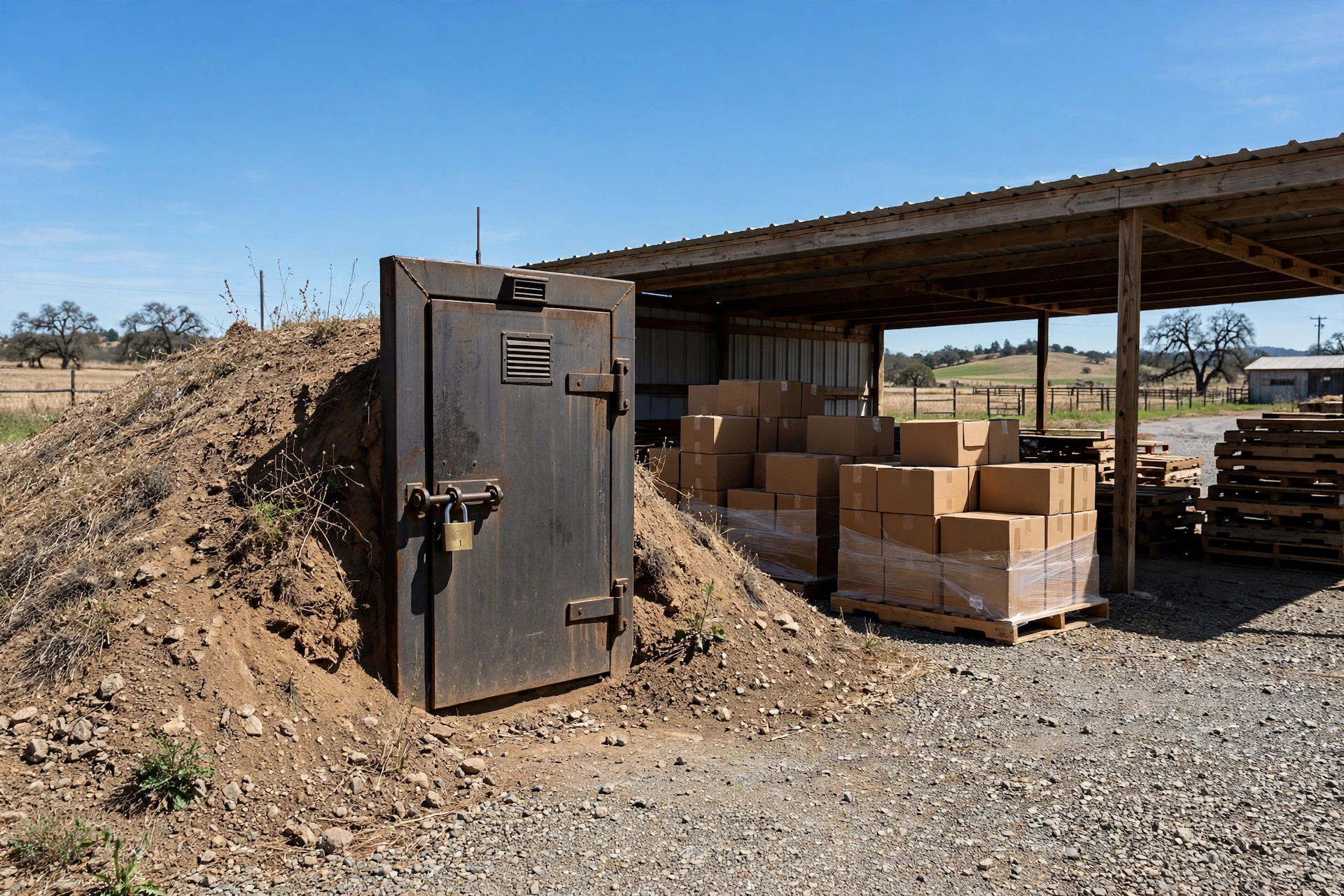
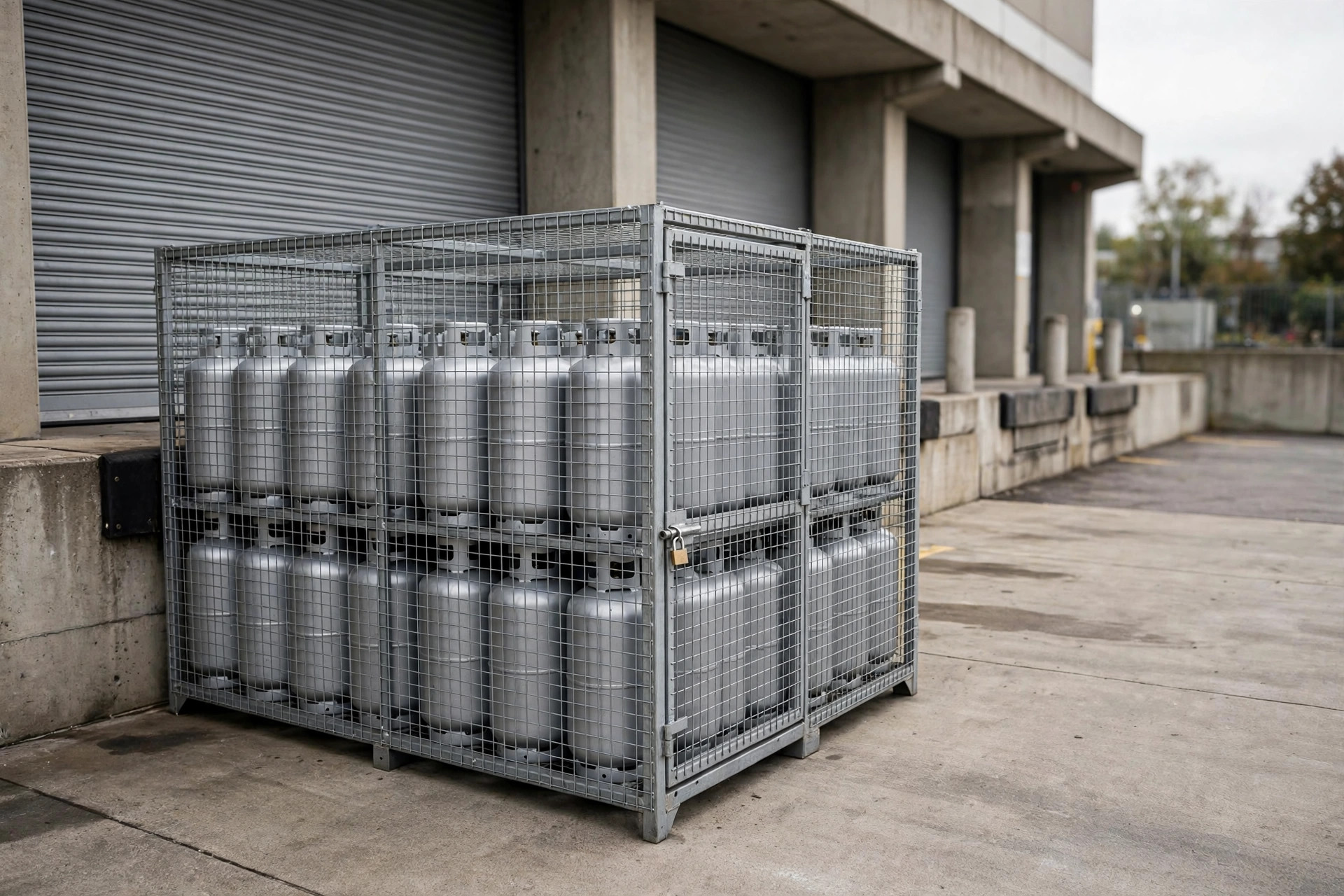
Run the numbers for that fourteen-truck site: 28 cylinders × 33.5 lbs = 938 pounds. That lands in the 501–2,500 band, where the table says zero feet — you can place storage right against your own building. But the same paragraph demands the containers sit in "a suitable enclosure or otherwise protected against tampering" (1910.110(f)(6)(ii)). That's where the cage comes from. OSHA doesn't literally order you to buy a cage — it orders you to keep unauthorized hands off, and a lockable cage is the laziest compliant answer.
Bigger fleet? Thirty trucks, sixty cylinders, 2,010 pounds — same band. Once you're up around two hundred trucks, roughly 13,400 pounds, you're in the 25-foot band.
One more rule most people miss: grouping. OSHA writes the same logic in 1910.110(c)(5) — in one unpartitioned area, a manifolded group of cylinders is capped at 735 pounds water capacity (about 300 pounds of propane), and groups must sit at least 20 feet apart. When an inspector walks your floor, that's the algorithm running in their head: over 300 pounds without splitting into groups, groups without 20 feet between them — every one of those is a finding.
Propane Cylinder Storage Cage OSHA Requirements for Outdoor Placement
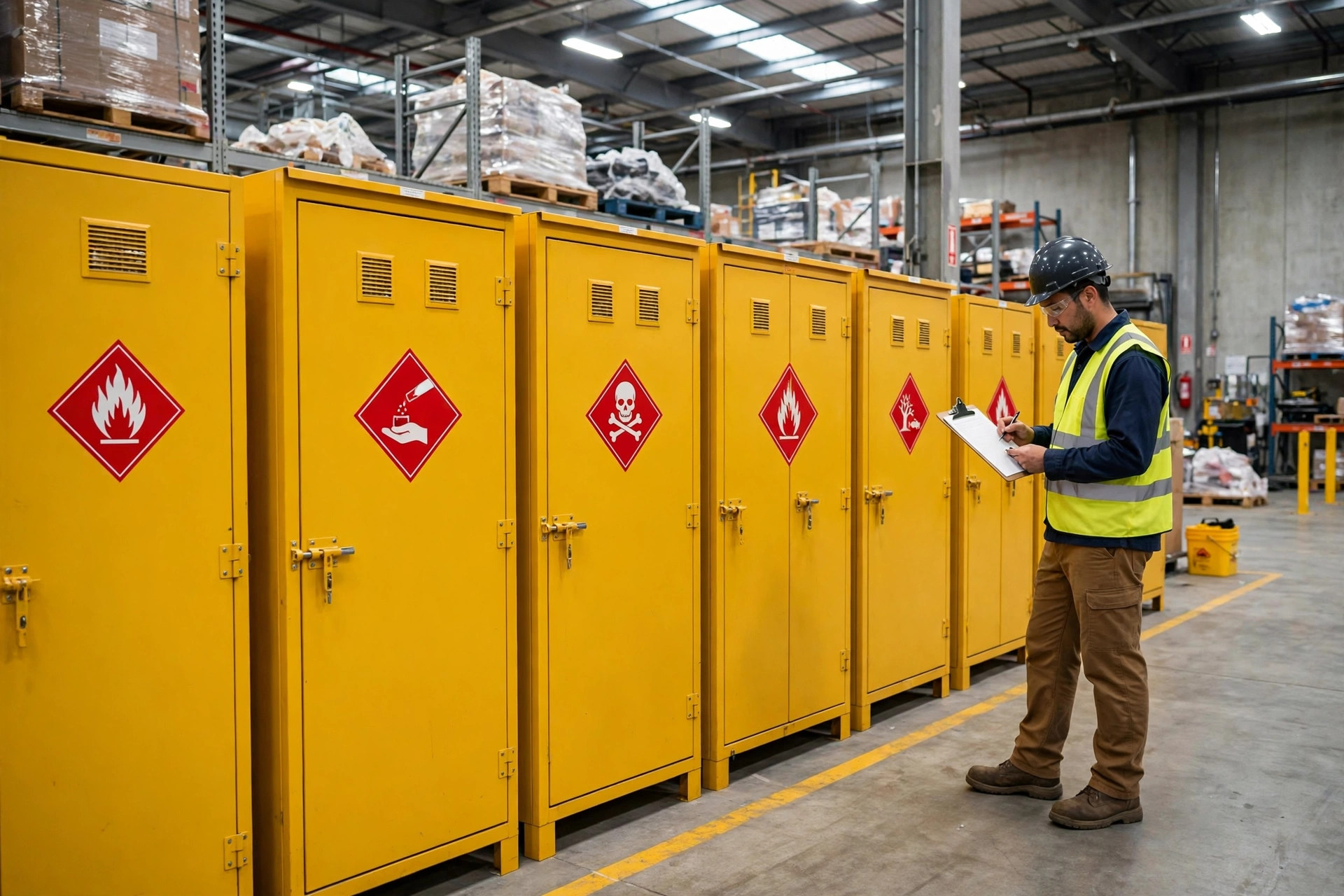
Cages come in two flavors. The basic wire-mesh locker runs a few hundred dollars — ventilated, lockable, keeps honest people honest. A purpose-built compliant cabinet starts around a thousand and climbs: I spot-checked the market, and an 8-cylinder cabinet lists anywhere from about $1,100 to $2,600, a 12-cylinder horizontal locker around $4,000, a 16-cylinder unit near $4,900. Price is the easy part; the propane cylinder storage cage OSHA warehouse requirements behind the purchase decision are what most operators never read.
My advice is pure sales-director pragmatism: buy for the customer you serve. A general industrial warehouse? Wire mesh cage, padlock, bolted to the pad — fine. A warehouse serving food, pharma, or big-box retail clients? Get the compliant cabinet. Their EHS and insurance audits come every year, and a failed audit costs you a contract worth a hundred times the cage. Your甲方 does that math faster than you.
Placement has two more hard rules. First, don't block egress. 1910.110(f)(2)(ii): cylinders stored inside may not sit near exits, stairways, or areas used for safe exit. The receiving-area wall feels convenient — it's also where forklifts and foot traffic are densest, and the first thing a fire blocks is the escape route.
Second, the extinguisher. 1910.110(f)(7): the storage location gets at least one approved portable extinguisher with a minimum rating of 8-B,C. Note the B:C — propane is a Class B fire. A water extinguisher with only an A rating doesn't count. And check the tag: auditors look at the inspection date before anything else.
The Daily Check Your Propane Cylinder Storage Cage Needs
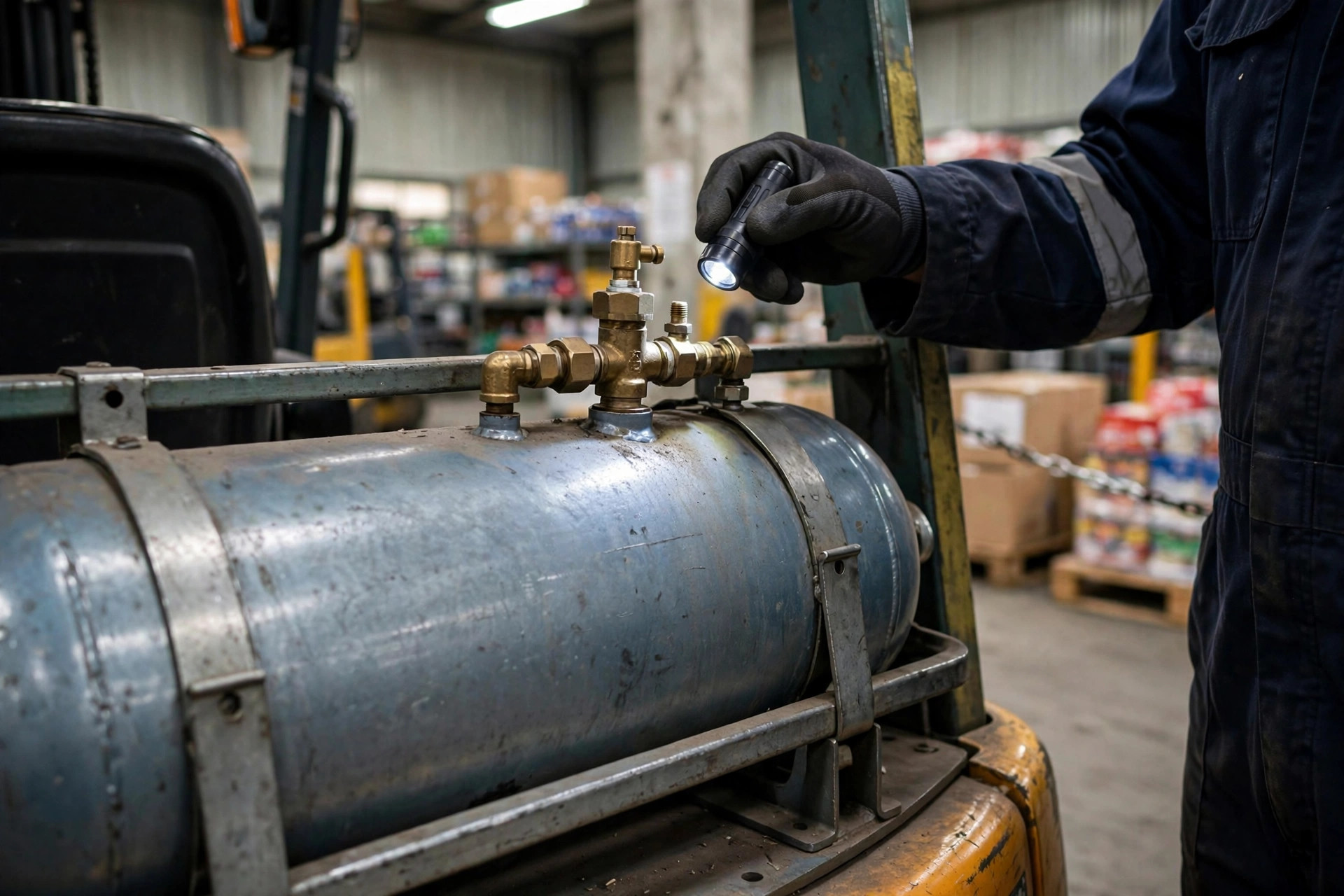
Buying the cage isn't the finish line. When the crew swaps cylinders, five checks take thirty seconds:
First, valves. In storage, service valves stay closed (1910.110(f)(2)(iv)), and valve fittings need their protective caps or collars so a knock doesn't transmit straight to the valve.
Second, relief-valve orientation — the most counterintuitive item in this whole article. On a horizontally mounted cylinder, the pressure relief valve must point at 12 o'clock, always in contact with the vapor space. That's straight from the Propane Education & Research Council's safety handbook. The physics: valve pointing down means an emergency vent discharges liquid propane, which flashes to roughly 270 times its volume as vapor — a fireball orders of magnitude bigger. Valve up vents vapor, a fraction of the fuel. Plenty of veteran techs spin the cylinder on however it lands. That habit has to go.
Third, the cylinder body. Rust, dents, gouges, frost at a fitting (possible leak), or that rotten-egg smell from the odorant — tag it and report it.
Fourth, keep empties and fulls apart. Mixed storage means someone grabs an empty, mounts it, and dies mid-shift — a small delay that turns into a rushed, sloppy swap.
Fifth, the cage itself. Is it locked? Are the vents clear? (Propane is heavier than air — a leak pools low, so bottom ventilation matters more than top.) Anything combustible within ten feet?
Three Questions for Your Next Contract Talk
Back to our Rancho Cucamonga client. The fix cost a little over six thousand dollars — two compliant cabinets, extinguishers, floor markings — done in a week. They won the RFP and have renewed twice since. Looking back, one walk-through of the cylinder area before the presentation would have saved the whole guarantee episode.
So now, before I sign any new client running a propane fleet, I ask three questions. They never fail:
One: who owns cylinder storage at this warehouse — and is it in the contract? Too many 3PL agreements leave EHS responsibility fuzzy, and fuzzy means it's yours when something goes wrong.
Two: who inspects the cylinders, how often, and who sees the records? An inspection without a record is an inspection that never happened. Auditors only certify evidence.
Three: if a citation lands or there's an incident tied to storage, who pays and who's liable? Get the uncomfortable sentence into the contract first — it's worth more than the most expensive cage on the market.
Cylinder storage is small money for a big risk. A few thousand dollars for cages, versus a citation — or a lost contract. The propane cylinder storage cage OSHA warehouse requirements aren't paperwork theater; they're the difference between winning the RFP and explaining a guarantee deduction. You don't need a spreadsheet for that one.
By Susan, 3PL Sales Director