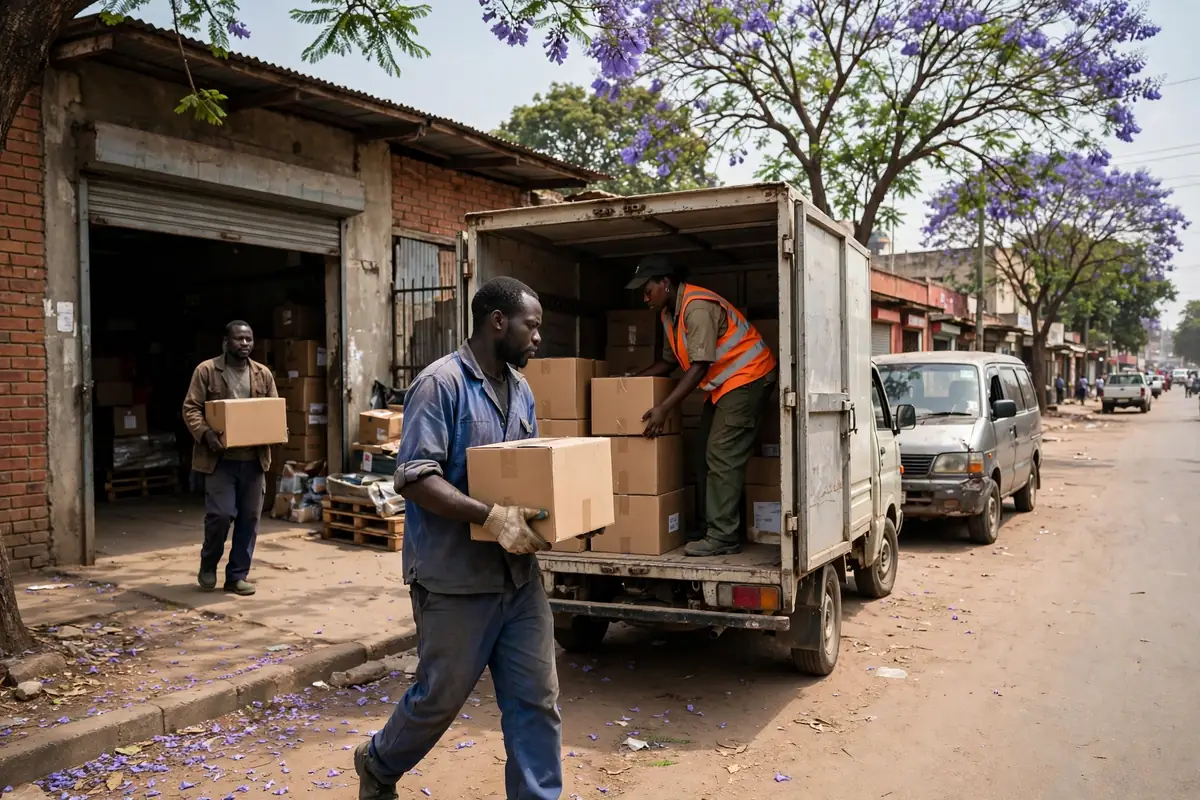
The first lesson of Harare urban warehouse distribution is not how to drive fast. It is how not to drive yourself broke. My warehouse is a 3,000-square-metre shed, four people, two vehicles. When we first started taking orders in Zimbabwe's capital, a delivery to Chitungwiza nearly wiped out the profit on the whole day. On the map it looked close, a little over twenty kilometres from the city centre. In real life, the small truck left in the morning, sat in traffic, queued for fuel, and still had not finished unloading by midday.
Harare is Zimbabwe's capital and largest city, home to roughly 1.6 million people in the metro area. Shops crowd the centre, dense suburbs stretch south and west, and towns like Epworth and Ruwa sit on the outskirts, scattering orders like beans thrown across a table. Money adds another wrinkle: the local currency, the Zimbabwe Gold or ZiG, was only introduced in April 2024, and US dollars still change hands every day. Power is just as unpredictable; the big outages of 2025 hit Harare hard. We just price all of it into every order.
In Harare, the Road Is the Real Rent
Big companies choose a warehouse from a map. We choose one from the fuel gauge and the driver's mood. A warehouse in the city centre costs far more, and a large truck can barely get in or out. The cheaper shed near a main road on the edge of town was the better decision: the rent was lower, the truck could drive straight to the door, and loading never needed a queue.
The extra monthly rent for a central warehouse would have paid for well over a hundred kilometres of extra driving, before counting the time burned in traffic. So we picked a spot that is easy to leave and not too far to return to. The first run of the day goes far, clearing the outlying orders on the way out. The afternoon run comes back to the centre, after the worst of the morning congestion has eased. We learned this by doing it backwards: one traffic jam ate a whole morning, and the outlying orders slipped to the afternoon.
One customer still sticks in my mind, a small supermarket owner in Epworth. His stock was promised for ten in the morning. We arrived at three. The order was not large, but he was a weekly customer, and he told us plainly he would not call us again. That was the day the route plan went up on the warehouse wall.
Our checklist for a site sounds like a joke until you have worked in Harare: can a truck turn around at the door, can two vehicles load at once, and is there a fuel station nearby? Those three questions matter more than an extra metre of ceiling height. Our shed is nothing fancy. Vehicles can enter, load, and leave without a drama, and two people can fill a truck in about half an hour.
Last-Mile Delivery in Harare Is Won by Avoiding Empty Trucks
The most expensive thing in Harare last-mile delivery is not fuel. It is an empty truck. Four people and two vehicles cannot outrun a big fleet. We can only out-think it, by making sure every trip carries as much as possible in the same direction. Every afternoon at four, we hold a fifteen-minute huddle. Tomorrow's orders go on a whiteboard, grouped by direction.
One day last year gave us the clearest example. Five orders were waiting in the Chitungwiza direction, all small shops, none big enough to justify a trip on its own. Run separately, that was five trips. Run together, it was one, out at seven and finished by half past eleven. Separately, the fuel and hours would have more than doubled. Customers were fine with it, because we told them in advance that delivery would come between nine and eleven, rather than promising nine sharp and arriving at noon.
Payment is part of the last mile too, and it is where small operators get hurt. Cash is still common in Harare, and a customer may pay in dollars or ZiG. Currency rules can change quickly, so treat the latest local policy as the final word and confirm the method and amount before the truck leaves. Our rule is low-tech: confirm payment before loading, carry only the small change needed for the day, and reconcile the cash when the driver returns. Once, a driver skipped the confirmation. At the door, the buyer had only local currency while we had only dollar change, and we lost half an hour borrowing change next door. That half hour would have covered another delivery.
When the Power Goes Out, We Work Ahead of It
You cannot write about Harare distribution without talking about power cuts. During the major outages of 2025, whole parts of the city went dark without warning, and with the lights went the computers and the barcode scanners. A large company buys a generator. We cannot burn that kind of money: a generator big enough for the whole warehouse, plus fuel and maintenance, would cost us several months of wages. So we stopped fighting the blackout and started working around it.
The routine is unglamorous and it works. The moment power returns in the morning, we print every order for the day, stick the labels on, and finish picking. When the power drops again, the goods are already sorted, and we can load by paper list, one person reading and one person loading. Phones are charged in advance, we keep two power banks in the office, and drivers save screenshots of their routes before leaving.
One afternoon in the second half of 2025, we were about to send the second run of the day when the power cut out and the electric roller door jammed half open. The truck could not get out. Since then, we move the afternoon loads to a staging area by the door before midday. It does not look professional. No truck has been trapped behind a door since. In a power cut, a small warehouse competes on preparation, not equipment.
Here is the rough comparison we actually use:
| Method | Best for | Main cost | Our verdict |
|---|---|---|---|
| Small truck, outlying run | Grouped orders toward Chitungwiza, Epworth, or Ruwa | Fuel and driver hours | Wait for at least three orders in one direction; an empty run is a loss |
| Van, city-centre run | Small top-up orders for central shops | Time lost in traffic | Deliver off-peak in the afternoon, never fight the morning rush |
| Customer pickup by appointment | Small, unhurried orders and regulars | Staff time at the door | Agree the time in advance and save a whole trip |
There is a counterintuitive conclusion buried in that table: in Harare, going slower can make more money. Consolidating orders takes waiting, and picking ahead takes time. Yet the months when we ran fastest were the months we lost the most money, because empty runs, rework, and lost customers piled up. When we changed the promise from same-day delivery to delivery today or tomorrow morning, we lost almost no customers, and our empty-running rate fell. For a big company, speed is the brand. For a warehouse our size, survival is the brand.
What I Would Tell Another Small Warehouse Starting in Harare
First, do not rent a big warehouse or buy a new truck on day one. Run one vehicle on a few fixed routes for three months. Learn which areas jam and which customers pay late. A truck is a liability. A route you understand is an asset.
Second, group customers by direction, not by size. A big customer is worth ten small ones on paper, but if their address runs against your route, that order still loses money.
Third, sort out payment and power before they sort you out. Confirm how each customer will pay before the truck leaves, and pick the day's orders while the power is on.
Fourth, do not worship software. We track orders on phone spreadsheets and talk to customers on messaging apps. When order volume doubles, then think about a system. Buy it too early and it will eat you first.
Harare is not an easy city for a small warehouse, but it has not closed the road either. The traffic is real, the blackouts are real, and getting paid takes care. The orders are scattered, regular customers remember a reliable driver, and a well-packed truck saves real money. We are still four people, two vehicles, and an unremarkable shed. At the end of the month, the books balance, the customers are still there, and the trucks still run. That is enough. A small warehouse has its own way of surviving: not by matching the big players move for move, but by making sure no single order loses money.
By Xiao Ma, Small Warehouse Owner