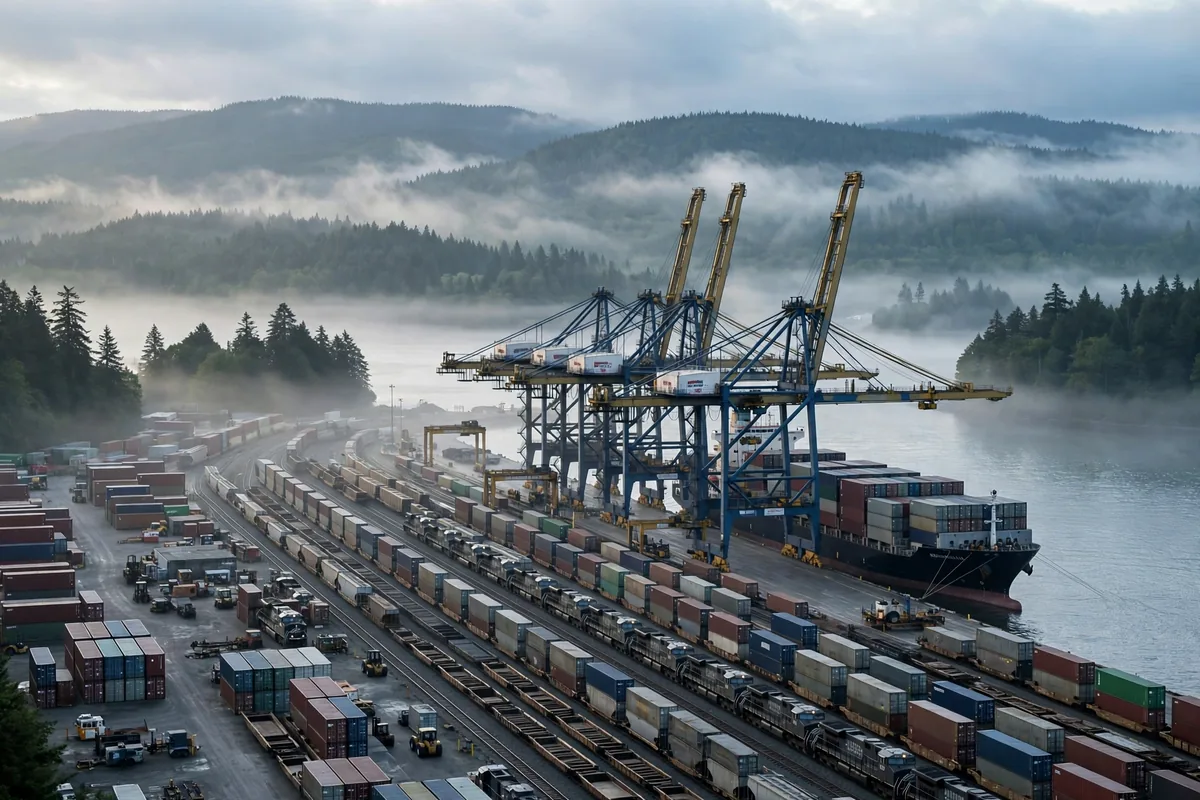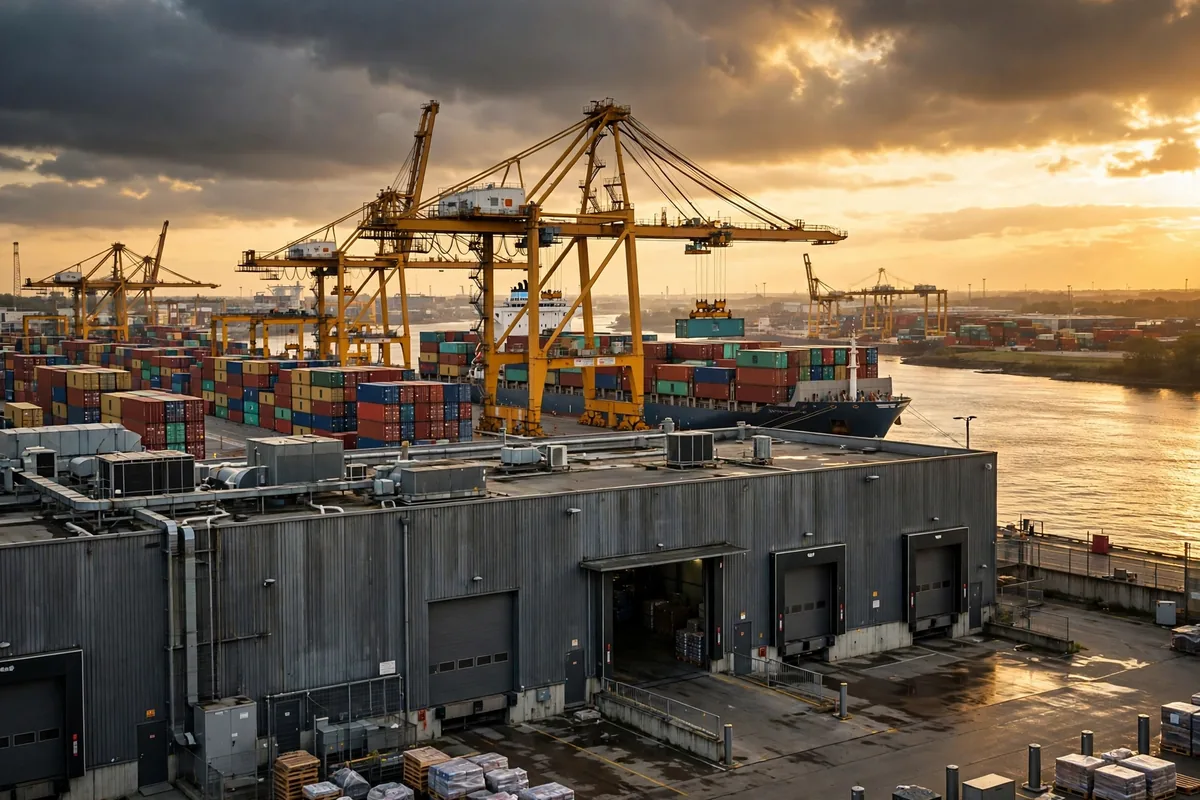
Hamburg port warehouse distribution begins, in a practical sense, not at the warehouse door but on the River Elbe, where Germany's largest port connects ocean shipping with inland waterways, rail, and road networks. That combination is why Hamburg functions as a distribution gateway for Central and Northern Europe rather than merely as a place where containers are unloaded. A shipment that arrives efficiently can still become expensive if the warehouse is chosen for storage alone while the distribution work — labelling, pallet exchange, picking, and linehaul departure — is left to improvise after arrival.
Hamburg Port Warehouse Distribution Is One Decision, Not Three
Consider a pattern that recurs every spring. In 2025, a home-goods seller shipping from China sent two standard containers into Hamburg, roughly 800 cartons in total, with orders split unevenly across markets: about half for Germany and the remainder divided between France and the Netherlands. The plan had been straightforward, to store everything near the port and release it gradually as orders arrived, yet within the first week the plan began to strain. French orders needed to leave in small batches, Dutch orders required pallets to be exchanged and local labels applied, and the warehouse had no reserved area for that work, so additional labour had to be arranged at short notice to get the first outbound loads away.
A second pattern, observed on the distributor side in the winter of 2024, shows the same logic from the opposite direction. A German distributor built up roughly 300 pallets ahead of the peak season, a modest volume spread across more than twenty product lines, which meant that most orders required picking four or five lines rather than shipping whole pallets. A warehouse priced mainly for full-pallet movements becomes expensive under that profile, because most of the time is spent breaking pallets, picking, and checking rather than moving goods. The adjustment was not a change of location but a change of rhythm: fast-moving lines were placed near the picking area, slow-moving lines were pushed back, and the order cut-off was aligned with the linehaul departure. Taken together, the two cases point to the same conclusion: much of the cost accumulates in dwell time, in the number of times goods are touched, and in waiting between picking and departure, rather than in headline storage or transport rates.
The structure can be set out as a simple table. No precise market rate is needed to read the direction of each line, and specific charges should be checked against the latest published information from the port and the operators concerned.
| Cost segment | Main components | Where it is usually underestimated |
|---|---|---|
| Port handling | Discharge, stacking, customs handover | Dwell beyond the free storage period, which compounds quickly |
| Warehousing | Storage, space occupation, in-warehouse handling | Long dwell and mixed product lines, which cost more than whole pallets |
| Outbound linehaul | Domestic German and cross-border trunk transport | Small, fragmented orders, where the cost per shipment rises sharply |
| Order processing | Picking, labelling, pallet exchange, checking | Every additional touch, which raises the probability of error and rework |
| Exceptions and rework | Order changes, returns, replenishment | A single unplanned change, which can cancel several small savings |
A short calculation makes the leverage of dwell time visible. Take a shipment of 1,000 cartons released in three waves, the first within seven days of arrival, the second on day twenty, and the third on day thirty-five. The third wave does not merely occupy space for twenty-eight days longer than the first; it also passes through more stock checks, more internal moves, and more verification, while the capital tied up in it remains locked for nearly an extra month. If that third wave had instead been delayed by two weeks, to land closer to the real pace of sales, storage days would fall and the linehaul could move in larger batches. The improvement comes from timing, not from negotiating a single unit price.
The Counterintuitive Part of Hamburg Port Warehouse Distribution
The counterintuitive judgement in this market is that the warehouse closest to the quay is not necessarily the cheapest choice. Proximity brings its clearest benefit when goods turn over quickly, arriving, being broken down, and leaving within days, because the saving is in fewer short-haul movements and faster handover. For goods that will sit for a month or more, or for mixed product lines that need substantial in-warehouse work, that advantage is gradually consumed by storage duration and handling intensity, and a warehouse slightly further from the port, with more space and more room for operations, can produce a lower total cost. The decision therefore needs to start with dwell time and handling intensity and only then consider distance from the quay; reversing that order is one of the more common ways the calculation goes wrong.
The same trade-off appears in the geography of distribution. Hamburg serves the German domestic market through a mature network, while cross-border distribution into France, the Netherlands, and Northern Europe adds another layer of coordination: trunk schedules, customs documentation, and the delivery rhythm of the destination country all affect the service promise that can be made to the customer. A seller who sets up a warehouse for Germany alone and later tries to extend it across borders often discovers that the distribution work was never reserved, and routes added at short notice are expensive and unstable. A seller who designs the process for several countries from the start generally finds goods move more smoothly after arrival. The difference lies less in the unit price of any one segment than in whether the whole chain was arranged in advance around the real map of sales.
On the longer trend, public discussion of European distribution suggests that a single gateway warehouse covering an entire continent is becoming harder to sustain, not because Hamburg has lost its position but because orders are becoming more fragmented while delivery expectations rise. Sellers need stock close to the market and also need to control total inventory, and one node struggles to satisfy both pressures at once. The structure that looks more likely over the next two to three years is a combination of a gateway warehouse and regional warehouses, with Hamburg handling arrival, central storage, and cross-border distribution, and warehouses closer to the main sales regions handling fast replenishment and local delivery, connected by regular trunk services.
Three Questions Before Choosing a Warehouse
The analysis can be reduced to a decision framework of three questions, and the answers will largely determine which warehouse model fits. The first question is where the goods are going: Germany alone, or Germany together with France, the Netherlands, and Northern Europe, because the more dispersed the destinations, the more the warehouse plan needs to include distribution zones and cross-border routes from the start. The second question is how long the goods will stay: a rapid turnaround within a week of arrival, or storage of a month or more, with short dwell favouring a location near the quay and long dwell requiring a calculation of total storage and handling cost. The third question is how mixed the goods are: whole pallets in and out, or multi-line orders that need picking, because the more mixed the profile, the more the choice depends on picking capacity and on space for labelling and pallet exchange, rather than on floor area alone.
Those answers map, broadly, onto three models. Fast-turnover goods fit a warehouse near the port, emphasising quick receipt and release with minimal dwell. Medium-term stock fits a warehouse in the Hamburg suburbs, emphasising generous space, room for operations, and stable linehaul connections. Multi-country distribution fits a two-level model, with Hamburg as the first node and a second warehouse near the main sales region, linked by regular trunk services. Each model carries its own cost: the port warehouse saves short-haul movements but may be expensive for storage, the suburban warehouse saves storage but adds a leg of transport, and the combined model is flexible but requires managing inventory at two levels.
Whether Hamburg is worth using, then, depends less on the port itself than on whether the seller's own goods can be matched to this chain. If the pace of sales is clear, the destinations are known, and dwell time is under control, the gateway value of Hamburg becomes visible; if the pace of sales is unclear and the destination is decided only after arrival, even the best port location cannot rescue the calculation. The open question for the next two to three years is whether the combined gateway-and-regional structure will become the prevailing pattern, and whether coordination between the two levels can genuinely reduce total cost rather than simply moving it from one segment to another.
By Dr. Chen, Supply Chain Researcher