Over the past year, sales directors at several Midwestern 3PLs have described the same new detail to me: halal and kosher certifications are increasingly appearing together in food clients' RFPs, with warehouses expected to satisfy two parallel sets of segregation requirements. According to Pew Research Center's 2017 estimate, the U.S. Muslim population had already reached roughly 3.45 million, and the consumer base for kosher food extends well beyond the Jewish community itself. When the compliance demands of two religious dietary systems land on the warehousing link, a warehouse stops being merely a place to store goods and becomes a link that itself must be certified.
The phenomenon: why both certifications end up in the same RFP
The driver is not theology; it is distribution channels. Kosher certification is close to a standard ticket into mainstream U.S. grocers, while halal products are gaining ground in Muslim-community distribution, retailer diversity lines, and Middle East-bound export chains. An imported-snack distributor often needs both marks at once, and the pressure travels upstream: brand owners ask their 3PLs for warehouses that can hold both categories, and RFPs start carrying the sentence many warehouse managers dread — the facility shall be halal/kosher certified, or demonstrate equivalent segregation capability.
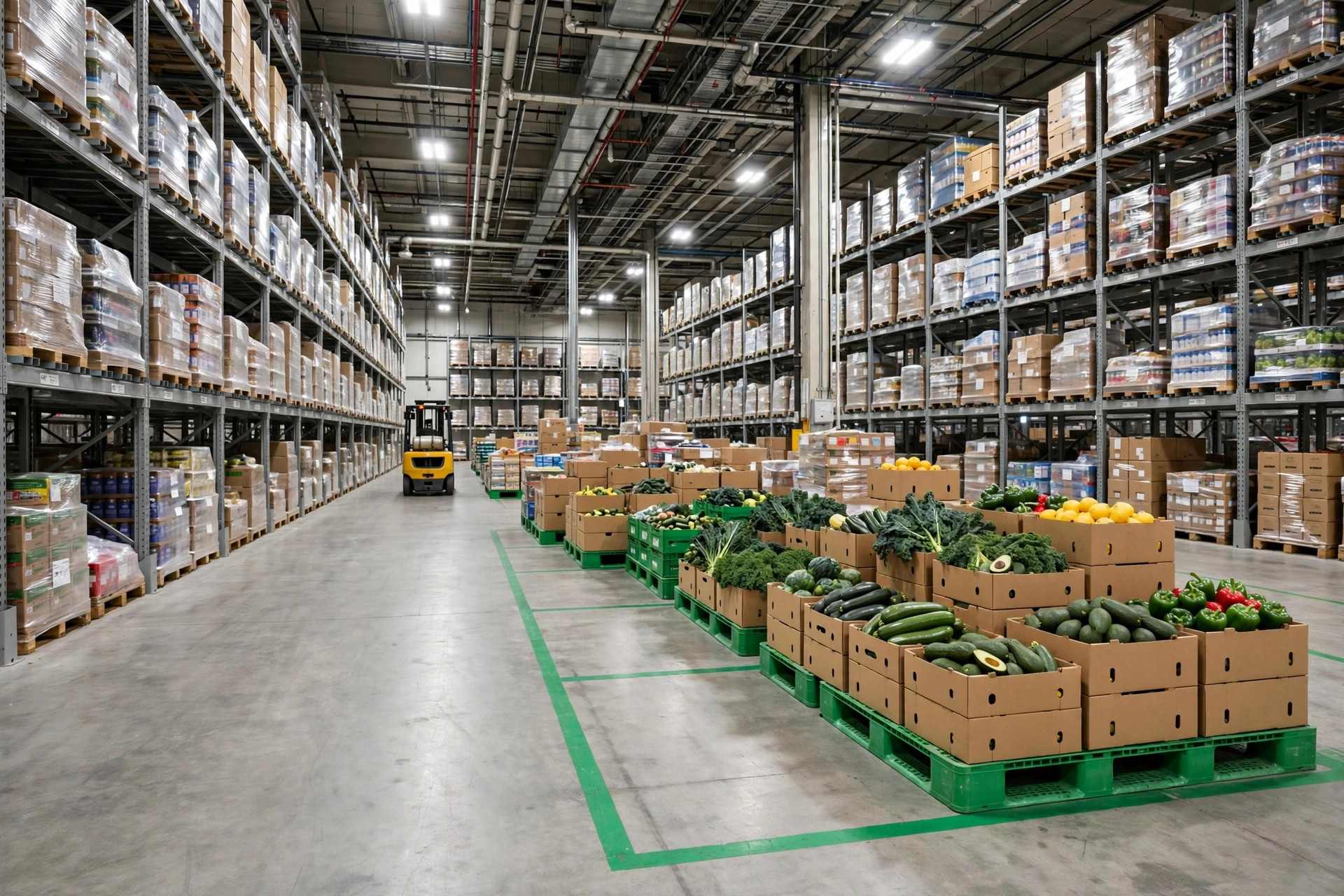
In 2023, a 3PL near Chicago won a distribution contract from a Middle Eastern snack brand requiring facility-wide halal certification for its roughly 80,000-square-foot building. Starting from a mixed freight base, it spent two months on retrofits: a 12,000-square-foot dedicated zone, green floor markings, dedicated dock windows, and forklifts and pallets that never crossed zones. The auditor visited twice. The first visit's findings centered on untraceable cleaning records and undocumented training; the second passed. The real time sink was not paint or pallets, but converting "this is how we've always done it" into "every step is documented."
A second scene, in New Jersey: a cold-chain 3PL serving a kosher meat distributor deep-cleans every March or April, a month before Passover — racking, floors, and forklift tires under the certifier's prescribed protocol, cleaning agents verified free of animal-derived ingredients, the process photographed and filed. This is a compliance event with a fixed annual timeline, because Passover standards are materially stricter than year-round kosher rules. Many first-time kosher warehouses get caught exactly here — unable to answer the auditor about a seasonal operation they never wrote into their annual plan.
What halal and kosher segregation actually segregates
The two systems look similar — both say keep things apart — but their logics diverge completely. Halal warehousing runs on a contamination logic: pork, pork-derived ingredients, alcohol, and alcohol-containing products are haram, and contact compromises halal status. Segregation centers on physical separation, cleaning protocols, and traffic patterns. Kosher warehousing runs on a classification logic: dietary law divides food into meat, dairy, and parve (neutral); meat and dairy may never touch or share equipment. The warehouse's job is categorical storage under clear labeling, and well-managed sealed parve products face lighter requirements.
The comparison below draws on guidance published by bodies such as the Orthodox Union (OU) and the Islamic Food and Nutrition Council of America (IFANCA), plus certified 3PLs' experience. Certifiers revise requirements periodically — treat this as orientation, not a substitute for any body's formal standard, and verify against the latest published requirements before bidding or auditing.
| Dimension | Halal warehousing | Kosher warehousing |
|---|---|---|
| Prohibited items | Pork and pork derivatives; alcohol and alcohol-containing products | Pork, shellfish, other non-kosher animal sources; meat-dairy mixing |
| Segregation logic | Anti-contamination: haram must never contact halal products | Categorical storage: meat, dairy, parve zones, clearly labeled |
| Physical setup | Dedicated zone or clear physical separation; dedicated pallets safer | Zoned storage suffices; sealed parve products face lighter rules |
| Cleaning | Agents free of animal-derived ingredients; records traceable | Same, plus stricter deep clean before Passover |
| Audit focus | Traffic patterns, cleaning records, training documentation | Labeling integrity, meat-dairy separation, seasonal cleaning plan |
| Known certifiers | IFANCA and others (see current directories) | OU, Star-K and others (see current directories) |
The variable that unlocks this table is sealed packaging. Managers often ask: my freight is all sealed cartons — do I still need segregation? Yes, but intensity depends on the certifier's judgment. Sealed packaging lowers contamination probability; it does not remove the burden of proving controllability. The auditor wants the mechanism guaranteeing that a pallet of alcohol-containing product and a pallet of halal food in one building will never be co-mingled, co-picked, or co-shipped by mistake. Color-coded floor zones, system-enforced location attributes locking categories to zones, pick-task category validation — that is what segregation means inside a warehouse management system.

The halal/kosher warehouse certification path, step by step
No two certifiers run identical programs, but the path converges. Five stages, each with its most common sticking point.
One, self-assessment: walk the site against the certifier's published checklist, item by item. The most underestimated stage — warehouses that skip to inviting the auditor collect a dozen findings on the first visit. Run two internal self-audits first; get the paper trail (traffic patterns, signage, cleaning records, training files) in order before anyone external arrives.
Two, select the body and apply: certifiers differ in industry coverage, audit rigor, and market recognition — the choice depends on which mark your customers recognize. Fees and timelines vary widely and change periodically; no figures here. Refer to each body's latest published requirements.
Three, the on-site audit: the facility (zones, signage, equipment), the records (cleaning, training, temperature logs), and the people (random interviews on whether frontline staff can explain the procedures). Across multiple 3PLs, the people are the most common failure point: a polished SOP means nothing if a forklift operator cannot explain the halal zone's traffic pattern.
Four, corrective action and re-verification: findings carry closure deadlines, and missing them delays certification. Run remediation as a project with named owners and deadlines.
Five, annual re-audit and maintenance: bodies typically re-audit yearly, and unannounced spot checks happen. The real test is turnover — frontline turnover is high, and without halal/kosher modules in new-hire onboarding, the site drifts within three months.
The counterintuitive part: the real cost is not the retrofit
The judgment I most want on the table, and it cuts against intuition: for halal/kosher certification, the largest line item is rarely the segregation retrofit. It is opportunity cost.
The retrofit — floor markings, signage, dedicated pallets, upgraded cleaning — is a one-time investment of manageable scale for a mid-size 3PL. But afterward, slotting flexibility is permanently lower: the halal zone cannot casually absorb an ordinary SKU for two days, kosher meat-dairy zoning hardens slotting logic, and the peak-season habit of putting freight wherever there is space is dead. Certification trades slotting elasticity for a channel ticket.
Whether the trade is worth it depends on customer mix. If kosher and halal SKUs are a small share of volume, facility-wide certification is likely a losing proposition — certify a dedicated zone on its own instead of dragging the whole building through. But if you are positioned as a food 3PL, or a key account requires it, the certificate is the ticket into specific channels: without it, you cannot even qualify to bid.
A finer point: for a dry warehouse that only stores, kosher audits are often more granular than halal ones. Halal's warehousing demand is comparatively singular — keep pork and alcohol away — while kosher's meat, dairy, and parve trichotomy plus Passover's seasonal escalation gives auditors more to examine. The statement reverses the moment meat processing enters the picture, where halal slaughter compliance becomes sharply more demanding. Which certificate is harder has no universal answer; it depends on where you sit in the supply chain.
The structural read: halal/kosher certification is shifting from a nice-to-have to a ticket-to-play for certain categories. Roughly: 2023 to 2024 saw leading customers writing it into RFPs, 2025 onward brought mid-size brands along, while certifiers' audit capacity is finite — so early movers enjoy a window of local scarcity long enough to amortize costs into several years of channel premium.
One open question to close: if U.S. food-3PL compliance thresholds keep rising — FDA traceability rules, state-level environmental requirements, layered religious and ethical certifications — will mid-size 3PLs be forced to choose between specializing in one compliance lane and exiting food altogether? Whether warehousing compliance capability becomes the next fault line dividing 3PLs has no standard answer yet. But every food-warehouse operator should start thinking about it now.
By Dr. Chen, Supply Chain Researcher