When people talk about warehouse dust control methods, the first instinct is to clean more often. Yet across many operating warehouses, dust problems rarely persist because the floor is swept too seldom. They persist because the floor, the high racking, and the ventilation are managed as three separate chores rather than as one system, and dust, left to its own logic, moves quite happily between all three.
Dust in a warehouse does not spread evenly, and that unevenness is the key to it. A first stream comes in from outside, through dock doors, on shoes, on pallets, and on inbound goods. A second is generated inside, by cardboard opening and closing, by fibre packaging wearing down, and by forklift tyres on concrete. A third is dust already settled and lifted again, when air movement or vibration disturbs the layer on high beams and light fittings. Once those streams are distinguished, a familiar frustration becomes easier to explain: a sincere cleaning routine can still fail, because it only intercepts one stream while the other two keep replenishing the problem.
In the spring of 2024, a third-party warehouse in California's Inland Empire, roughly twenty thousand square metres and mostly holding boxed consumer goods, ran into exactly this pattern. Its dock doors opened more than a hundred times a day, and the entrance floor showed dust again by afternoon even after a morning clean. Management raised floor cleaning from once to three times a day, but after two weeks, checks found almost no change on cartons at mid-rack height, and pickers at height still moved through visible puffs of dust. A closer look shifted the diagnosis: the weak point was not the floor, but dock-door sealing and air movement during inbound peaks. Outdoor air travelled straight into the racking area, so floor cleaning only dealt with dust after it had landed, not with where it came from.
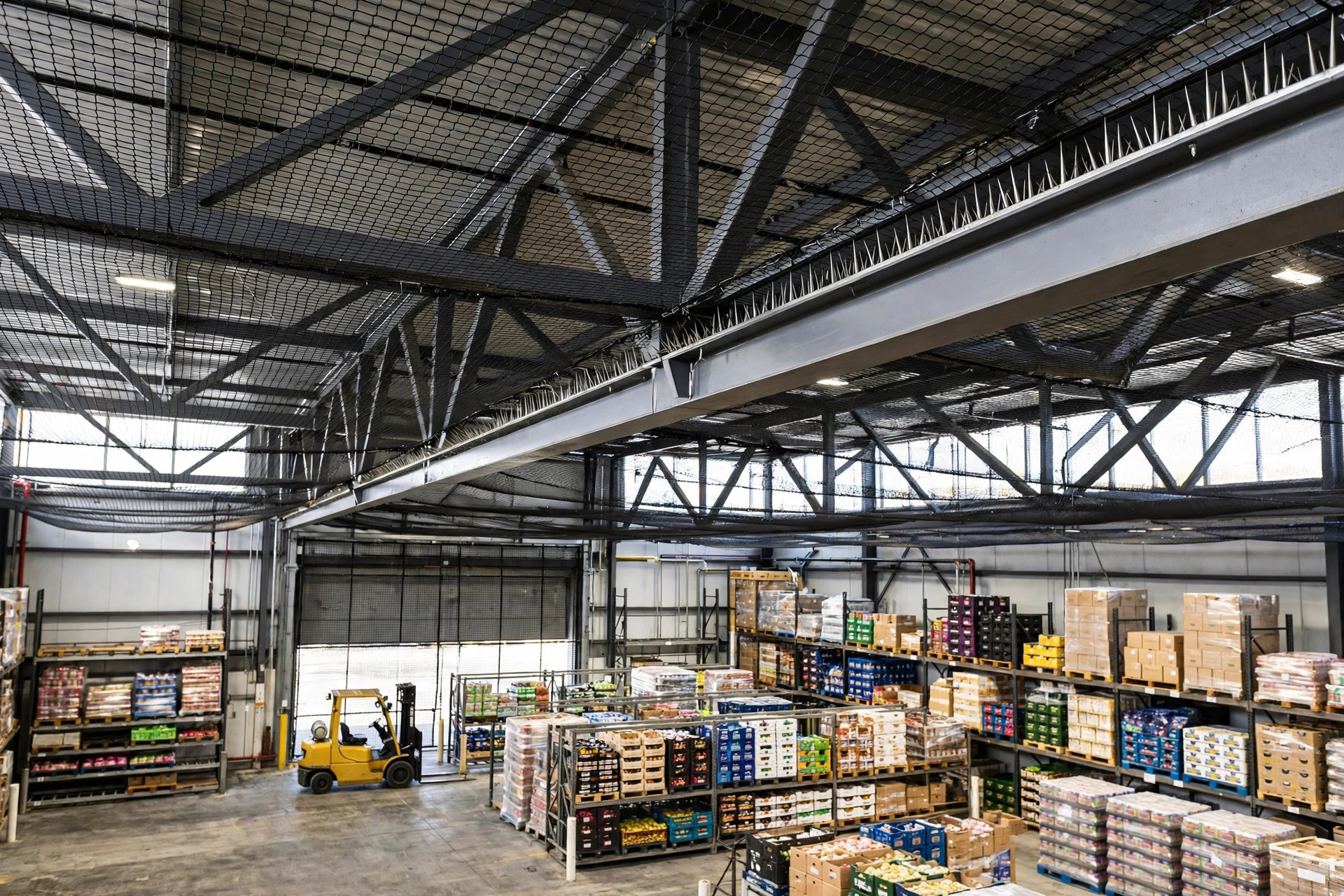
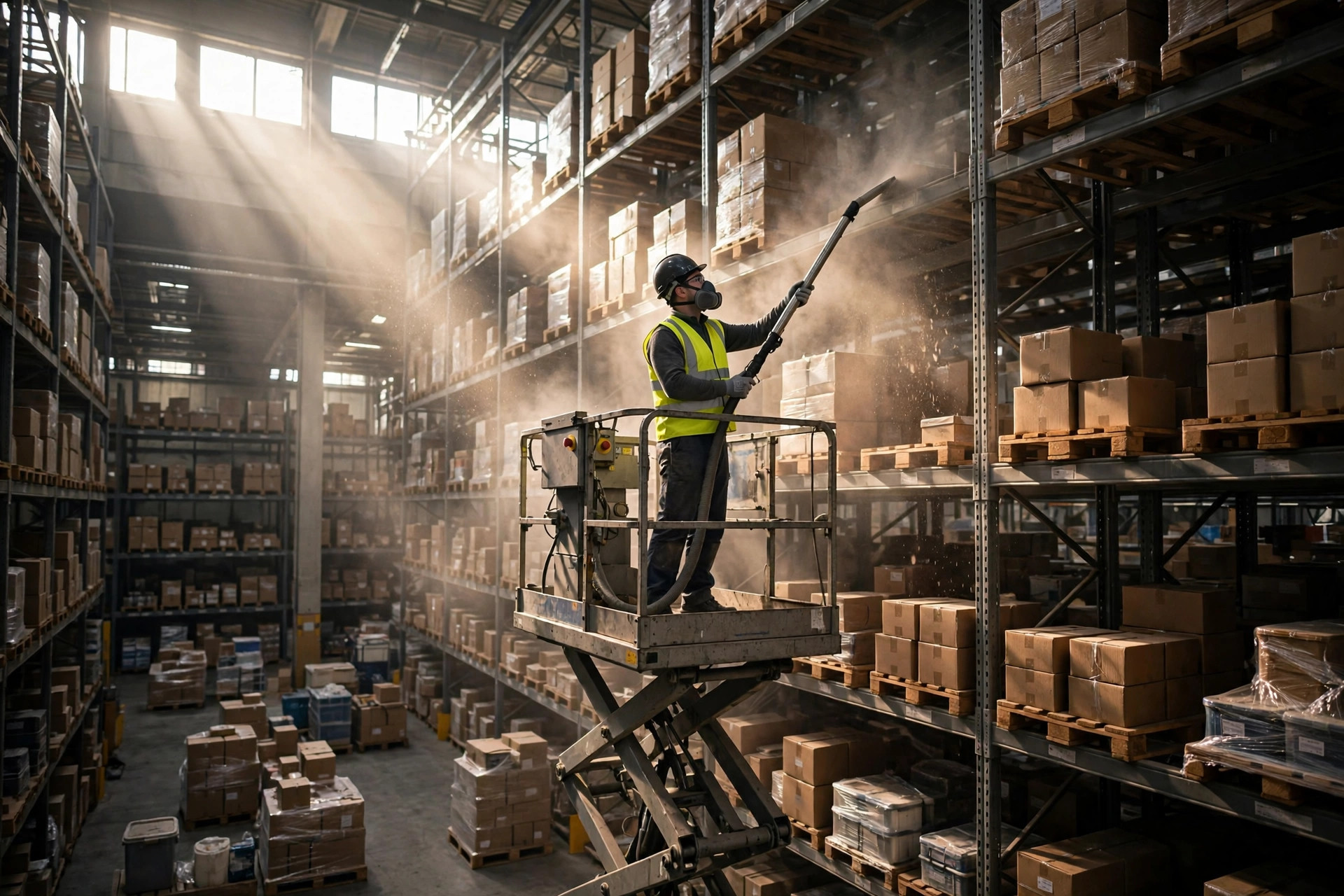
A different shape of the same problem appeared in early 2025 in an e-commerce warehouse in eastern China. It stocked mainly small items, its racking rose above ten metres, and the top beams had gone uncleaned for years, outside anyone's daily line of sight. During a seasonal stock count, staff found fine dust on goods inside open cartons, and returns quality checks began taking roughly a fifth longer than usual. When the warehouse finally booked lift platforms for a concentrated clean of the high beams, the cleaning day itself produced a short spike of airborne dust, and goods in neighbouring aisles had to be wiped down again. The episode is instructive: high dust is not absent dust, merely invisible dust, and handled without covering and sequencing, cleaning becomes a fresh contamination event of its own.
Why Warehouse Dust Control Methods Fail in Three Places at Once
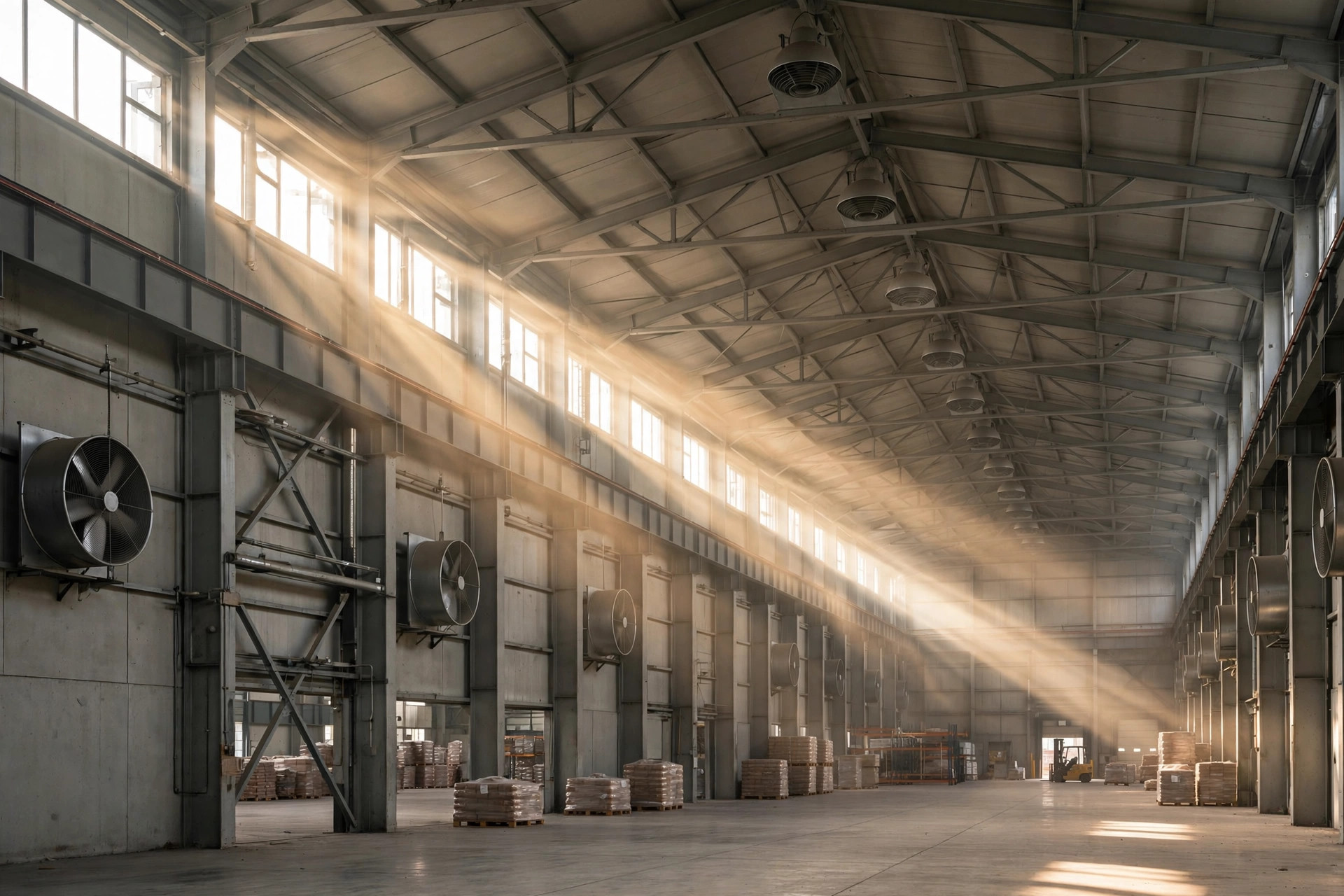
According to the pattern shared by both cases, the three routes tend to fail for different reasons, which is why a single remedy so rarely works. Floor control fails through a mismatch of rhythms: dust is generated fastest around doors and aisles during peaks, while cleaning is often scheduled for quiet periods, so the team perpetually chases dust rather than intercepting it. High-racking control fails through invisibility: dust above eye level falls outside daily responsibility, so no fixed cycle exists until a stock count or complaint forces attention. Ventilation fails more quietly still: a system meant to carry dusty air out can, with a badly placed intake, an airflow path cutting across the racking, or filters changed late, become the very mechanism circulating dust from one zone to another.
This leads to a counterintuitive judgment: the moment a warehouse looks dustiest is not necessarily when it is dirtiest, but often when its dust circulation is most active. A building with a spotless floor and thick dust on its high beams can pass a casual inspection, then fail suddenly when high work or a strong draught disturbs that layer. A building with a faint film on the floor but its sources under control may, over months, prove the more stable of the two. The fair test, then, is not how the floor looks an hour after cleaning, but whether sources have been cut off, settled dust can be removed safely, and airborne particles are carried out rather than around. If any answer is no, dust will simply find another route back.
Floor, High Racking, and Airflow: Three Separate Budgets
Keeping three separate budgets matters, because spending on the most visible route otherwise quietly excuses neglect of the other two. Floor work is about interception and fast removal: door mats, dock-door seals, and zoned cleaning of entrance and aisle areas. Spending is comparatively low, but frequency must be high and responsibility named. High work is about safe removal on a cycle: lift-platform cleaning of beams and light fittings, temporary covering of goods below, and a top-down sequence. Each visit costs more, but visits can be less frequent, provided the gap never stretches into years. Ventilation work is about airflow design and filter discipline: intake placement, exhaust direction, and replacement intervals. Upfront spending may be the largest of the three, but it determines whether the other two routes' results survive the week.
| Route | Main focus | Spending pattern | Typical sign of failure |
|---|---|---|---|
| Floor | Doors, aisles, dock areas | Lower cost, higher frequency | Clean in the morning, dusty film by afternoon |
| High racking | Beams, fittings, rack tops | Higher cost per visit, longer cycle | Sudden dust cloud during high work |
| Ventilation | Intakes, airflow paths, filters | Larger upfront cost, maintenance decides the outcome | Goods dusty again soon after cleaning |
The same table works in reverse as a diagnostic tool. If dust keeps returning near the entrance, check sealing and airflow before adding cleaning shifts. If high work throws up dust, restore a high-cleaning cycle with covering before blaming the cleaning crew. If dust returns everywhere and cleaning gains last less than a day, examine ventilation intake and filtration first. Spending should follow the signal of failure, not whichever route is easiest to fund. Much dust spending is wasted for precisely this reason: money goes to the most visible surface rather than to the route that failed first.
A few details are easy to overlook. High cleaning belongs in quiet periods, covered below and worked top-down. Mops and dust pads that are rarely washed stop being cleaning tools and start being sources. Filter replacement should follow pressure readings or the manufacturer's guidance, with shorter intervals in dusty seasons and peaks. Worker exposure limits and local dust rules differ by jurisdiction, so check the latest official guidance rather than borrowing a figure from another region.
How to Sequence Warehouse Dust Control Methods
A workable sequence runs in this order: cut off the source, clear the stock, and only then stabilise the circulation. First, the doors and dock areas, the main channel by which dust enters, where sealing, zoning, and door discipline during inbound peaks often achieve more than extra cleaning across the whole floor. Second, put high dust on a fixed cycle, removed with covering and sequencing so the stock is cleared safely rather than in a panicked one-off. Third, tune ventilation so air moves from cleaner zones toward dustier ones, with filter maintenance written into the equipment plan instead of remembered only when performance drops. Each step's result is protected by the next, rather than undone by it. That is why a sensible warehouse dust control methods programme reads less like a cleaning schedule and more like a system design.
Looking ahead, the direction of travel seems clear enough. Dust control is shifting from reactive cleaning toward managed systems, and the reasons are structural. Racking keeps getting taller, product ranges keep widening, and the share of small items in open packaging keeps rising, so dust now touches product appearance, quality-check time, and the working environment more directly than it used to, while simply adding cleaning labour no longer reaches the high and airborne dimensions. Sensors and maintenance records are also making dust patterns visible as never before: which zone re-dusts fastest, which task slips most often, and where a small fix would change the curve.
None of this implies that every warehouse needs the same high-specification answer. A small closed store, a busy cross-dock, a building holding sealed goods, and a building holding open cartons face genuinely different dust pressures. The more productive question may not be whether a warehouse is clean enough in some absolute sense, but whether, under its own workload and product mix, its dust sources have been identified, its settled stock has a safe removal rhythm, and its air circulation is helping rather than hindering. Where all three answers are yes, the system will probably hold. Where any one is still vague, the next investment is most likely hiding inside that vagueness.
By Dr. Chen, Supply Chain Researcher