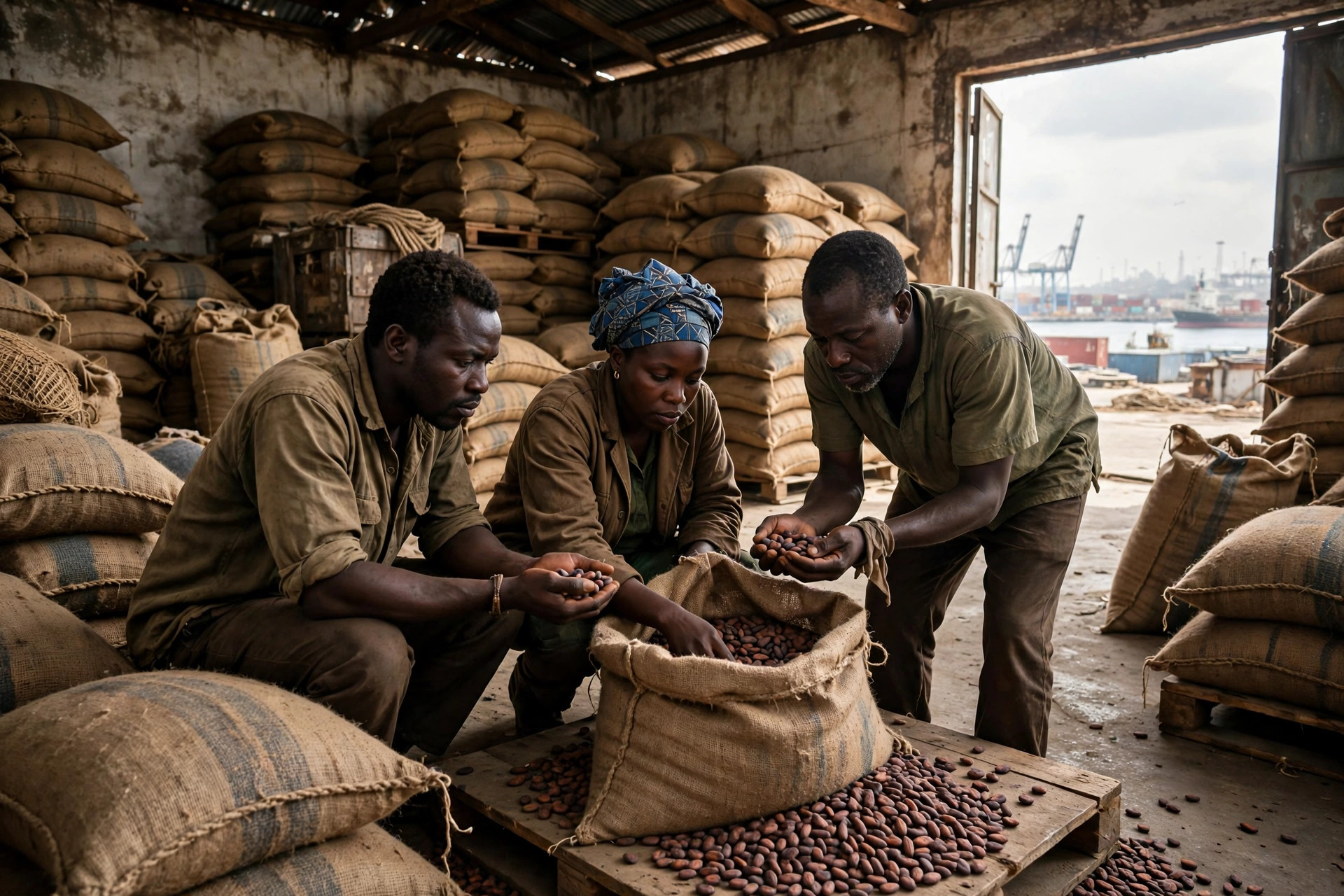
We have a client in Ghana cocoa export warehouse storage, a European specialty chocolate buyer, who learned his first lesson in the place he least expected: the warehouse itself.
In the middle of the 2024 season, he bought two lots through a Licensed Buying Company around Kumasi, more than six hundred bags in total, and parked them in a cheap private warehouse near Tema port while waiting for a vessel. His logic was perfectly reasonable, the way a client's logic usually is: cheap rent is money saved, and beans sitting in a stack are not going anywhere. Two weeks later, at inspection, everything surfaced at once. The bags against the wall had absorbed moisture and caked. A few bags from the previous season's broken beans had been mixed in. The sample labels did not match the actual goods. He missed the vessel, and re-grading and turning the bags cost him another week, plus labor and double handling. The rent he saved did not cover a fraction of it.
When we went over it afterward, I told him one thing: in Ghana, cocoa is not something you buy, store, and ship just because you own it.
Ghana Cocoa Export Warehouse Storage, Lesson One: Who Is Actually in Charge
Ghana's cocoa export system is tightly regulated, and that is the first reality to accept. The Cocoa Board system, the Cocoa Marketing Company, and the Licensed Buying Companies are the key players on this chain. Export authority for raw beans sits with the Cocoa Marketing Company or licensed exporters. A private warehouse cannot simply export raw beans on its own, no matter how good its location is. At the port, beans wait in port storage under Cocoa Marketing Company control until they are shipped. Renting a warehouse near the port does not put you in charge of that step.
So before you negotiate any storage contract, answer one question: in whose name is the cargo held, and through whose export channel does it move? The warehouse is only one link in the chain, and every link has to line up. Too many first-time buyers in Ghana fill their contracts with rent and handling rates but leave out title, handover documents, and release conditions. When something goes wrong, the warehouse shrugs and says the cargo belongs to your client and they only stacked it, and you have nowhere to go.
Policies, licensing conditions, and fee schedules can change from season to season, so check the latest official guidance before you sign anything. Do not treat last year's experience as a contract term.
Ghana Cocoa Export Warehouse Storage and the Moisture Bill: Drier Is Good Until It Costs You
Our second client was a small American chocolate brand that came to us at the end of 2023 wanting to rent space near Tema as a transit point. Their brief sounded entirely sensible: the warehouse should be dry, ventilated, and close to the port. We ran the numbers for them, and the answer surprised them.
Cocoa is sold by weight. Over-dry it and the weight drops, which means you are paying to make your own cargo lighter. Under-dry it and mold and caking risk climbs immediately, and one failed port inspection can send the whole lot back for reconditioning. The real target is not "as dry as possible." It is holding steady inside the deliverable range.
We set three rules for them. First, test moisture and draw retained samples at intake, bag by bag, with labels matched one-to-one against the lot sheet. Second, stack off the wall and off the floor, keep ventilation aisles open, and inspect weekly during the rainy season, with the inspection written into the handover sheet. Third, re-test before loading out, and if the number has moved, ask why before a single bag goes into a container.
Here is how that moisture bill actually breaks down:
| Option | What you pay | What you gamble | When it makes sense |
|---|---|---|---|
| Cheap near-port space, no inspections | Lowest rent | Moisture damage, mixed lots, missed vessels, and rework bills that dwarf the rent | Only for a few days, with someone watching daily |
| Standard warehouse plus regular inspections and samples | Rent plus inspection labor | Risk contained, problems traceable to a batch | Most export shipments; this is the one I recommend |
| Straight into port storage to await the vessel | Higher storage cost, queue depends on vessel schedule | Closest fit to the export channel, but least flexible | Vessel fixed and cargo already passed inspection |
The cheapest option is almost never the lowest-cost option. My client eventually saw it clearly: the rent he saved would not have paid for one round of rework labor and double handling. The real price of a cheap warehouse usually hides in the lines that are not in the contract.
Grading and Samples: Your Paper Trail from Buying Station to Port
Here is a counterintuitive judgment most newcomers get wrong: they assume grading is a port problem, something that happens at the end. In practice, the grading bill starts at the buying station. Beans from different farmers and different lots in the same region vary in size and trash content, and if you heap them together, the port grades the whole lot down to its worst bag. Your good beans get dragged down for free.
Retained samples work the same way. They are not decoration for an inspection visit. They are your only evidence: one sample at intake, one at load-out, so that when a grading dispute comes up at the port, you argue with samples, not with your voice. One of our clients kept a full sample record and used it to hold the pricing on an entire lot during a grade dispute, instead of taking a downgrade. After that, the first question he asked in every negotiation was how samples would be managed.
My advice is simple: separate stacks, separate labels, and separate records from the buying station onward. Every transfer gets its documents updated. Every port entry gets re-checked. The longer the chain, the less you can afford a gap in the paperwork. One gap, and everything after it is an argument.
A small story from Tema port makes the point. In 2024, a routine re-check pulled a few dozen bags for inspection and found two bags running noticeably high on moisture. The whole lot was held back from loading. The client was furious that two bags could hold up a container. Look at it the other way: that hold stopped a claim that could have covered the entire container. The two bags were pulled out, re-dried, and re-checked, and the rest shipped on schedule, only two days late. Without sample records and lot sheets, those two bags could never have been isolated, and the whole container would have waited.
One more rainy-season note. Around Tema, humidity climbs in the wet months, and a warehouse routine of open doors by day and closed doors at night has to be written into the operating requirements, not left to whoever happens to be on shift. An inspection sheet that just says "normal" is no inspection at all. It should say which row, which bags, and what they felt like. Clients love to call these forms make-work from the 3PL side. On the day a claim lands, those forms are your only witness.
Before You Sign: Three Questions Worth Asking
So when it comes to the contract, it really comes down to three questions. First, in whose name is the cargo, through whose export channel does it move, and what are the port storage release conditions? Second, who signs off on intake and load-out inspection and sampling, how many samples are kept, and for how long? Third, when moisture damage, mixed lots, or a delayed vessel force rework, re-inspection, or demurrage, who pays?
Ask those three questions out loud and the other side knows you understand the business. Fail to ask them, and even the thickest contract is just a thick stack of paper. The money in Ghana cocoa is made on patience and attention to detail, not on boldness. Next time you negotiate a contract, remember to ask these three questions.
By Susan, 3PL Sales Director