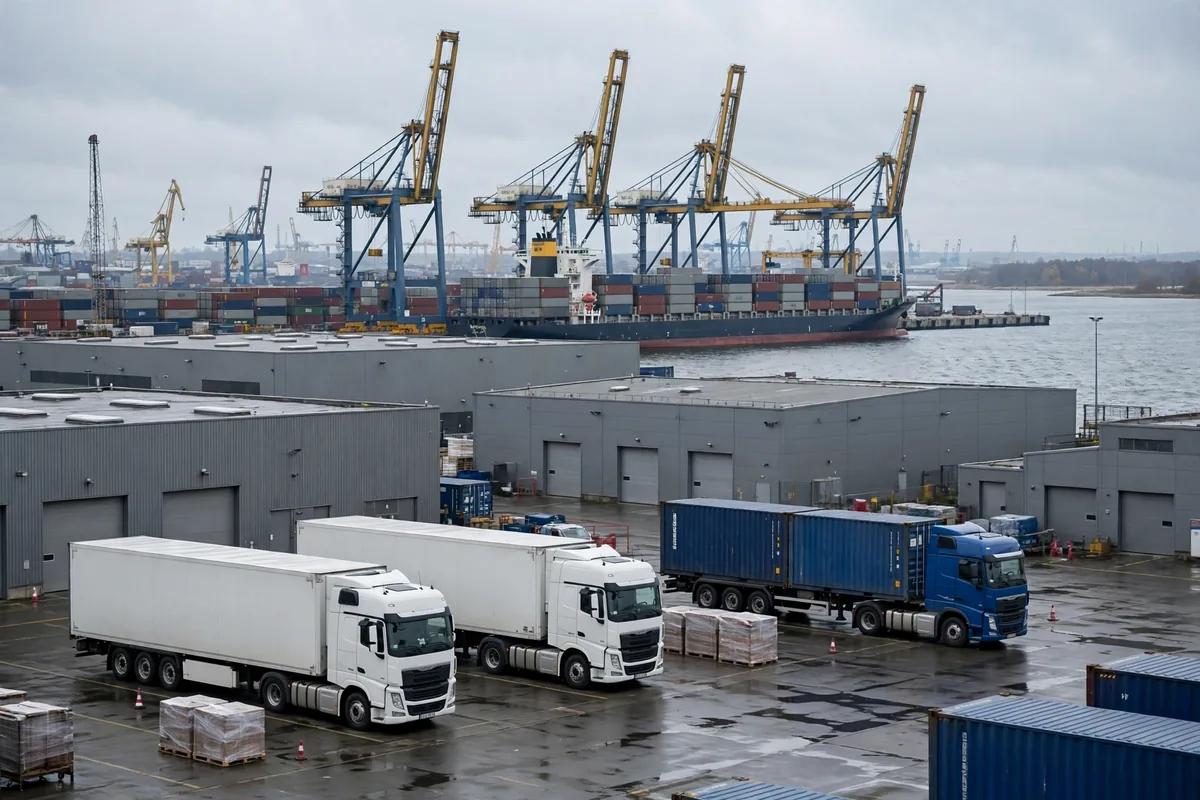
A noticeable phenomenon has emerged in Polish site selection. Candidate lists that once contained only central nodes — Lodz, the Warsaw area, Poznan — now routinely include Gdansk, even for cargo with no obvious maritime character. Gdansk Poland warehouse logistics has shifted from a port-services topic into a standalone location question, and that shift deserves examination in its own right. Is it a temporary migration driven by short-term rate movements, or a longer adjustment in the geography of Polish logistics?
As a researcher, I prefer to separate phenomenon from conclusion. Gdansk attracting attention does not automatically make it right for every flow, just as the accumulated scale of central Poland will not disappear because one port has grown. This article follows a deliberate sequence — phenomenon, evidence, attribution, and trend — and ends with an open question rather than a location verdict for any individual company.
Phenomenon and Evidence: Why Gdansk Poland Warehouse Logistics Entered the Shortlist
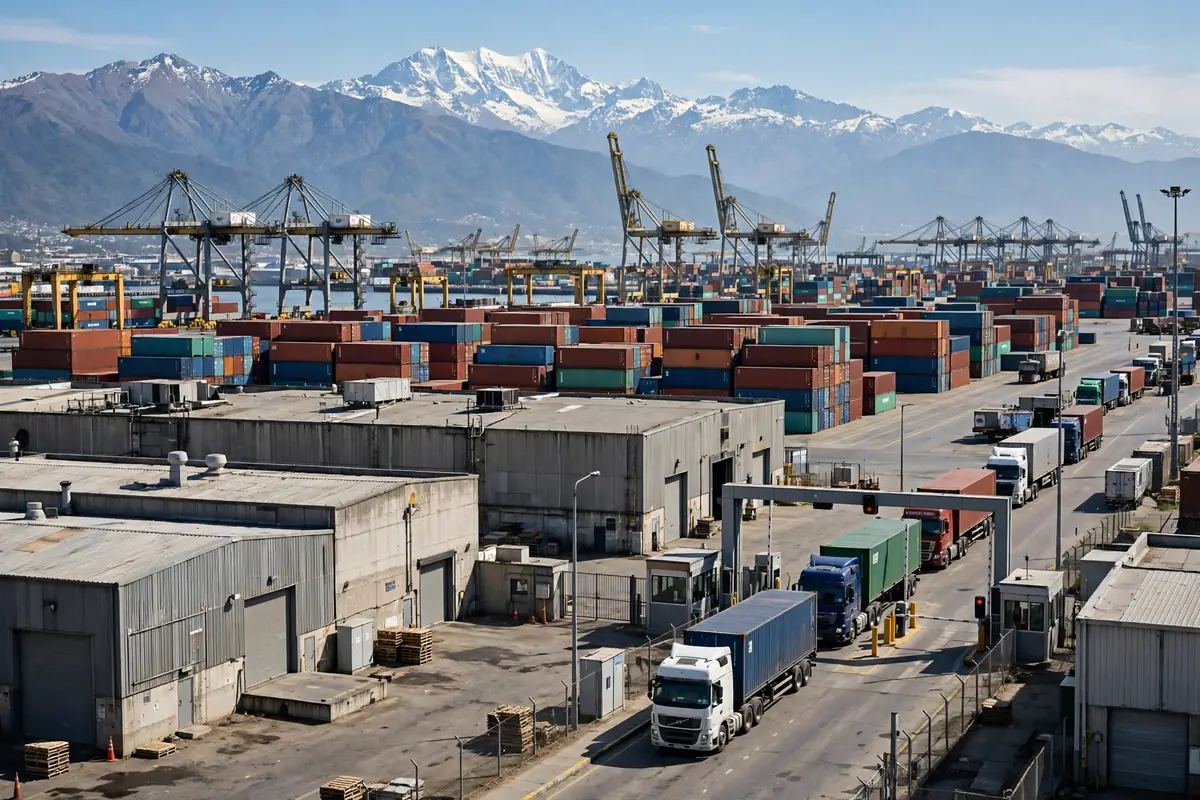
Start with the phenomenon. According to information published consistently over the years by the port operator and Polish trade media, Gdansk is one of the Baltic's significant deep-water container ports, and its container business has expanded over the past decade and more, with the Gdansk–Gdynia port complex serving as a major maritime gateway for Central and Eastern Europe. I deliberately avoid resting the argument on a single year's throughput figure. Annual numbers are heavily affected by service changes and macroeconomic cycles; readers who need precise values should consult the port operator's latest annual statistics. What matters for a location decision is not a ranking in one year, but whether the structural fact — deep-water direct services combined with continued expansion — holds.
In parallel, the warehouse supply of the Tricity area — Gdansk, Gdynia, Sopot and their surroundings — has changed in structure. Early Tricity warehousing mainly served port-related work: short transfers, devanning, and temporary storage, in relatively small units with narrow functions. More recent supply shows two different features. First, standard buildings capable of regional distribution have appeared in greater numbers. Second, the warehouse belt has begun to extend inland along the main corridors, creating a genuine distance gradient from the port. For the first time, a company evaluating Tricity can compare, in one exercise, a port-adjacent turnaround unit, a mid-distance distribution site, and a larger inland site whose cost structure approaches that of central Poland.
A qualification is necessary. In total stock, the Tricity market remains smaller than Poland's central core — a judgement on which most market reporting broadly agrees. Central Poland, after years of development, offers greater depth in available buildings, specifications, and tenant mix. The correct reason to shortlist Gdansk is therefore not that it has become larger than the centre. It is that, for a specific class of cargo flows, its overall conditions have become competitive for the first time.
Attribution: Three Structural Reasons Behind Gdansk Poland Warehouse Logistics
The first attribution concerns the direction of flows. For import cargo distributed onward into Poland and neighbouring markets, the conventional path devans at the port, moves the full load to a large central warehouse, and then distributes back outward by order. If a substantial share of final demand sits in northern Poland and along the Baltic coast, the southbound-then-northbound movement is pure repetition. Placing the distribution point near Gdansk removes exactly that leg. The logic holds only under its premise: demand genuinely weighted to the north, or a devanning-and-split operation that dominates the cost structure. If final demand is concentrated in the south, the conclusion reverses.
The second attribution is the improvement of port-to-hinterland connections. A port warehouse is worth using only if its road and rail links inland are reliable, not merely present. Connections from Tricity toward Warsaw, the centre, and the south have been progressively strengthened over many years, which has turned "Gdansk warehouse plus line-haul distribution" into a scheme that can be costed seriously rather than sketched hopefully. In research terms, I describe this as a narrowing of the accessibility discount: as the practical time gap between two nodes shrinks, the maritime advantage of the port node begins to offset its geographic disadvantage.
The third attribution involves labour and seasonality, and it cuts both ways. Central warehouse clusters, after years of concentration, face intense peak-season labour competition — a recurring theme in industry discussion. Tricity's labour pool does not fully overlap with the central one, and the seasonal employment rhythm of a coastal urban area does not perfectly coincide with warehousing peaks in e-commerce and retail, which creates a possibility of staggered staffing. The other side must be stated with equal clarity: the Tricity labour pool has a lower ceiling, and projects needing very large short-term recruitment may find less elasticity there than in the centre. Seasonality can stagger peaks, or it can collide with the local tourism season. Which effect dominates depends on a company's own peak months, and it has to be checked case by case rather than assumed.
To make the judgement operational, I usually recommend a first-pass screening framework rather than an immediate rent comparison:
| Decision dimension | Leans toward Gdansk | Leans toward central Poland |
|---|---|---|
| Dominant cargo source | Seaborne imports needing split on arrival | Road-based consolidation from many origins |
| Dominant market | Northern Poland, Baltic coast | Even national spread, or south-weighted |
| Inventory strategy | Import buffer plus regional distribution | Single national site, full-range stocking |
| Labour profile | Moderate scale, peaks offset locally | Very large short-notice hiring, elasticity first |
| Expansion plan | Regional node first, second node later | One national centre from day one |
The table's value is not the answer. It turns "is Gdansk good?" into five questions that can each be evidenced.
A Labelled Hypothetical: Why the Rent Gap Is Rarely the Deciding Item
Public claims about Tricity versus central rents are plentiful, but figures vary widely with building grade, lease length, and negotiation, and I will not present any unverified rent figure here as fact. Instead, consider a clearly labelled hypothetical that demonstrates a frequently missed calculation. Suppose an import distribution operation handles the equivalent of one thousand pallets a month, and suppose roughly sixty percent of that volume is distributed directly into northern markets after arrival. Suppose further that a central location forces that sixty percent to make an additional line-haul round movement, at whatever unit rate the company's own carrier quotations provide. The structure of the comparison is then simple: the central option costs central rent plus line-haul on all volume; the Gdansk option costs Tricity rent plus line-haul on the remaining forty percent. Whenever the avoided backtracking on the sixty percent exceeds the rent difference between the two locations — whatever that difference happens to be — the Gdansk option wins on paper.
The lesson is that port-node comparisons are never rent against rent. They are the rent gap against the transport gap. Companies that screen on rent tables alone, without entering their flow structure, systematically undervalue port nodes. I have also seen the reverse case work out correctly: a national e-commerce fulfilment operator with highly dispersed demand and a very wide SKU range, dependent on single-site inventory pooling, modelled the same framework and still chose central Poland. That conclusion was equally sound, and fully consistent with its flow structure. A framework does not favour a place. It favours complete arithmetic.
A second, often ignored variable is inventory shape. With a buffer warehouse near the port, a company can operate three tiers — on the water, buffered at the port, and forward-stocked centrally — relieving space pressure at the central site. Gdansk and central Poland then become a division of labour rather than substitutes: the port node absorbs volatility, the central node performs stable fulfilment.
Trend Judgement, and an Open Ending
My trend judgement is deliberately restrained. Gdansk's role will likely keep evolving from a port-serving node toward a northern regional distribution node, and the Tricity warehouse belt will probably continue extending inland. Central Poland, on scale, labour depth, and national coverage, will remain the default for most national projects. The boundary depends not on fashion but on each company's flow direction, inventory strategy, and peak profile — once those are measured, the conclusion usually surfaces on its own.
Several questions still lack sufficient evidence. Can Tricity supply keep pace if demand keeps migrating north? How will northern labour cost and stability evolve at larger scale? For decision-makers, a more useful question precedes these. It is not whether Gdansk will become the next central Poland. It is this: given your cargo structure over the next three years, should your warehouse sit closer to the port or closer to the customer — and if those answers differ, how many inventory tiers will you use to reconcile them? Once that is answered honestly, the city's name is almost the last blank to fill in.
By Dr. Chen, Supply Chain Researcher