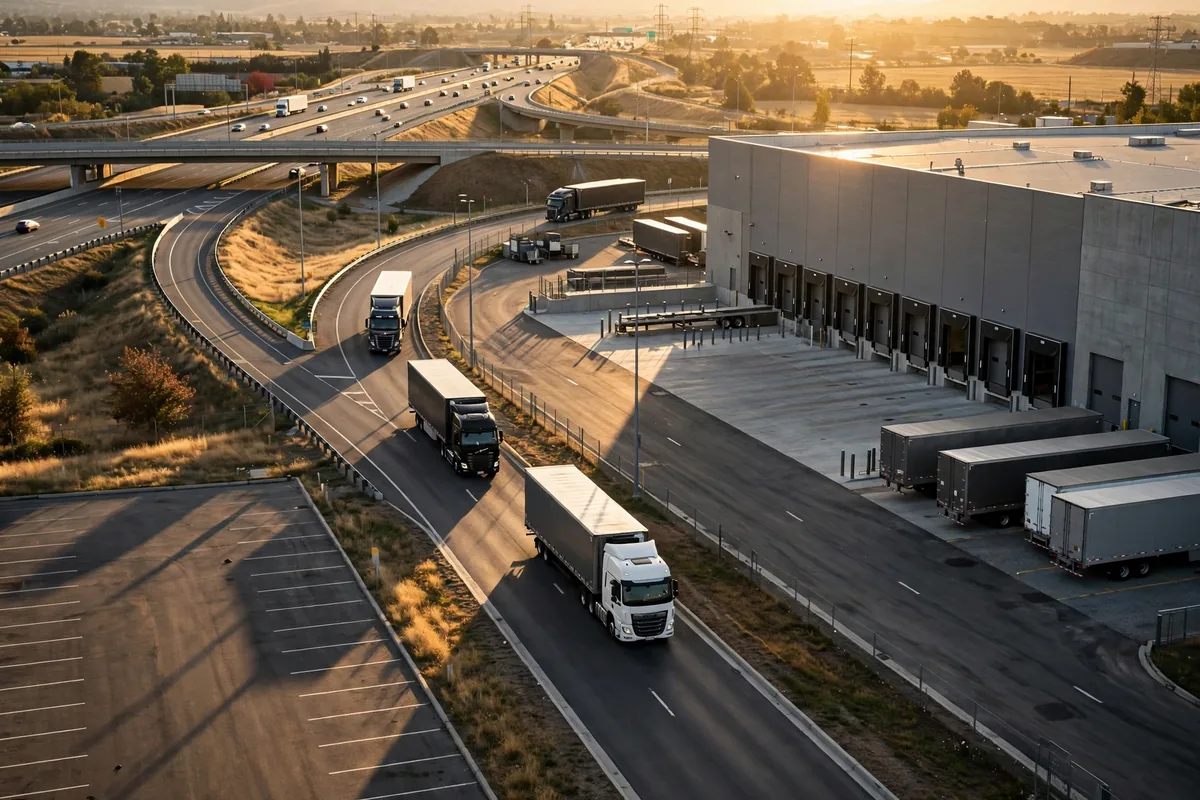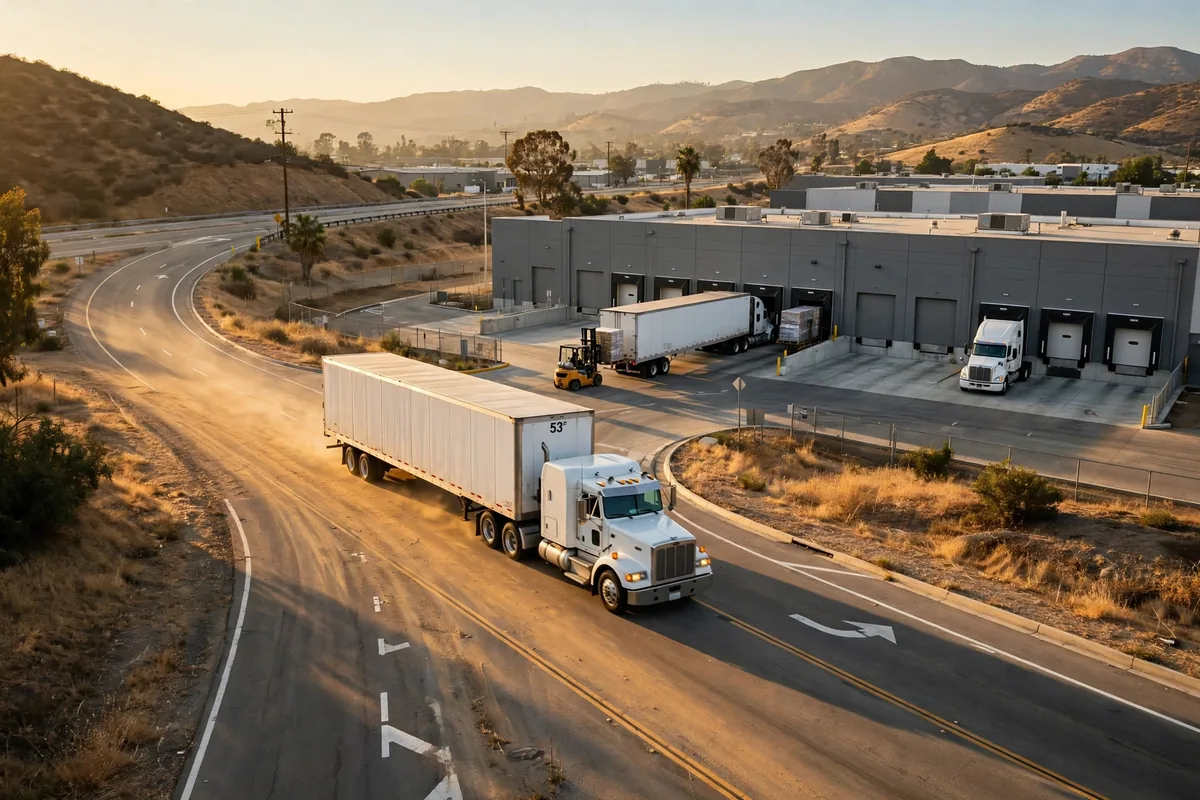
Here is my answer up front: if your warehouse location near a highway exit saves five minutes per trip, the fuel savings alone rarely justify higher rent — until your truck count crosses a threshold, and then the math flips hard. For a small operation running a few trucks a day, five minutes is noise. For a busy warehouse running twenty or thirty truck trips a day, those five minutes add up to tens of thousands of extra miles a year, and the fuel is only the beginning. The real bill shows up in driver hours, scheduling headaches, and trucks you cannot get in peak season.
Every site decision has two sides, and this one is a classic. Closer to the exit means less fuel, less time, happier drivers. It also usually means higher rent, and sometimes a worse entrance. I have watched too many operators pick the cheaper lease, celebrate the rent they saved, and then spend the next two years paying for that decision one truck trip at a time.
The Ontario warehouse that taught me this lesson
In 2019, a client of mine in Ontario, California — an e-commerce fulfillment operator — asked me to look at a warehouse he was about to lease. The space was right, the rent was well below comparable buildings nearby, and there was one catch: it sat twelve minutes from the Interstate 10 exit, through four traffic lights and two turns. He figured twelve minutes was nothing. Drivers could drive a little longer. The rent savings felt real.
Three months after move-in, the problems were everywhere. The building ran about 28 truck trips a day, rising to 36 in peak season. Every trip carried an extra twelve minutes each way — twenty-four minutes round trip. Across a day, that was more than ten hours of driver time burned on one short stretch of city road. Drivers started complaining. Long-haul drivers did not want the short shuttle runs. Dispatch spent an extra half hour every day just reworking the schedule around that stretch.
Fuel made it worse. That twelve-minute leg was not highway driving. It was stop-and-go city streets, and a loaded truck burns far more fuel per mile in stop-and-go traffic than it does cruising on the highway. My client ran his own numbers: at 28 trips a day over roughly 260 working days, the extra mileage ran into the tens of thousands of miles a year. He priced the fuel at local pump prices — check current local prices rather than taking any single figure as gospel — and the total stopped looking like a rounding error.
When the lease came up, he moved. The new building was three minutes from the exit, and the rent was higher — noticeably higher, every single month. But the whole equation changed. On-time performance improved. Shuttle drivers stayed. Dispatch stopped firefighting that one stretch of road every day. After the first quarter, he told me the move cost more in rent and less in everything else. That line stuck with me: rent is the visible bill, but the road is the hidden one, and the hidden one is often bigger.
Warehouse location near a highway exit: where the money really goes
Most people do this math wrong because they only count fuel. I count three things.
Fuel is the first, and the most obvious. A loaded truck crawling through traffic lights burns more per mile than the same truck cruising at highway speed. You do not need a precise figure to see the direction — more stop-and-go miles, more fuel. Multiply by trips and days, and a small per-trip difference becomes a large annual number.
Time is the second, and it is usually bigger than fuel. Five minutes sounds small. Twenty trips a day at five minutes each is a hundred minutes a day. Over a month, that is dozens of hours. Those hours turn into driver overtime, dispatcher waiting time, and late departures for the next order. In warehousing, time always turns into labor cost eventually.
The third is the one nobody puts in a spreadsheet: driver patience and truck availability. Drivers who run highways hate the last stretch after the exit — the lights, the narrow streets, the awkward U-turn. A warehouse that is hard to reach gets fewer willing drivers, and in peak season that means you cannot get trucks at all. You cannot price that line item in advance, but you will feel it in November.
So here is the counterintuitive part: being close to the exit often saves you more in time and truck availability than it saves in fuel. Fuel is just the easiest number to calculate, so people calculate only fuel, get a small number, and conclude the move is not worth it. They are measuring the smallest part of the savings and missing the rest.
Do the math with your own truck count
Do not take my word for it. Run your own numbers with this framework. The figures below are a working model, not a quote: plug in your real trip count and your real mileage, and price fuel at local rates.
| Drive from exit | Extra miles per one-way trip (approx.) | Extra miles per year at 20 trips/day | Extra fuel per year (order of magnitude) |
|---|---|---|---|
| 3 minutes | About 2 miles | About 10,000 miles | A few thousand gallons |
| 8 minutes | About 5 miles | About 26,000 miles | Over ten thousand gallons |
| 15 minutes | About 9 miles | About 47,000 miles | Tens of thousands of gallons |
The formula is simple: extra miles per trip, doubled for the round trip, times trips per day, times working days per year (use 260 as a starting point). Swap in your own numbers and the answer appears fast. A small warehouse running three to five trips a day gets a small number out of this table — do not pay extra rent for five minutes. A warehouse running twenty trips a day or more gets a number that makes you look at the rent difference in a completely different light.
There is also a simpler rule of thumb I use with clients when judging a warehouse location near a highway exit. Under ten trips a day, prioritize rent and space; five extra minutes from the exit is not your problem. Ten to twenty trips a day, put the rent gap and the fuel-plus-time gap side by side and compare them honestly. Over twenty trips a day, put highway access ahead of rent, because time cost has already overtaken the rent difference. And always run the math on peak-season trip counts, not the quiet-season average — the warehouse that struggles in peak season is the one that pays for this mistake.
Too close to the highway exit can hurt you too
In 2023, a client south of Dallas, Texas made the opposite mistake. He picked a building practically touching the highway exit — one minute off the ramp, he thought, and the problem was solved. What he had not checked was the exit itself. In the morning rush, the off-ramp backed up, and trucks waited through two or three light cycles just to turn toward the warehouse. In the afternoon, the two-lane road at the entrance clogged with trucks going in and out. Being near the exit did not mean getting in and out fast. The exit, the entrance road, and the left turn ate back every minute he thought he had saved.
So do not judge a site by the line on the map. Drive it three times before you sign: once in the morning rush, once in the afternoon shipping peak, once at night. Watch whether the ramp backs up. Check whether two trucks can pass each other at the entrance. See whether a truck can turn around without a long loop. Three drives will tell you more about the real drive time than any map will.
Ask one more question: is that exit a full interchange, or only half of one? Some exits let you off but not on, or only serve one direction, so the truck has to drive to the next exit and double back. The way in can look short while the round trip is anything but. Run both directions before you sign, not just the way in.
There is no universal right answer here. There is only the right calculation: your real trip count, your real route, your real rent gap. Five minutes on a map is worth nothing. Five minutes multiplied by dozens of truck trips a day, every working day of the year, is worth a serious look. So — how many trucks a day are paying for your five minutes?
By Lao Mi, Supply Chain Veteran (20 yrs)