In 2023 I walked a client through a routine OSHA inspection, and the inspector barely glanced at the fire extinguishers. He made a beeline for the gas cylinder area. On his clipboard, the first page was compressed gases.
He stood in the doorway for maybe thirty seconds and asked three questions: are the oxygen and acetylene cylinders stored separately? Are they all upright? Are the chains on?
Three questions, thirty seconds. That's the inspector's view of cylinder storage. Nobody cares how polished your safety manual is in that moment. He's looking at one thing: will it fall, will it leak, will it blow. I asked him later what the most common cylinder violation is. He didn't look up: "Cylinders not secured."
After twenty years in American warehouses, I've seen too many facilities treat the cylinder corner as a "just stick it over there" problem. So here are the three iron rules — stand them up, tie them down, keep them apart. Each one comes with a line of regulation and at least one real-world lesson.
Rule one: cylinders stand. They never lie down.
A standard industrial oxygen cylinder is about five feet tall and weighs a couple hundred pounds. Laying it on the ground looks convenient until you think about what happens when it rolls. OSHA's language is plain: cylinders must be stored where they "will not be knocked over or damaged by passing or falling objects" (29 CFR 1910.253(b)(2)(ii)). A loose cylinder is a battering ram with a valve on top.
Acetylene is a different story, and a more dangerous one. An acetylene cylinder isn't filled with pure acetylene gas — it holds a porous mass soaked in acetone, and the acetylene stays dissolved in the acetone. Lay the cylinder on its side and acetone migrates toward the valve. Open it in that state and you're pulling solvent into your torch lines, which is a great way to wreck equipment or worse. That's why the industry rule is absolute: acetylene cylinders stay upright, always, including in transport.
OSHA's public enforcement records have a ready-made example. In November 2022, a truck maintenance shop was cited under 1910.253(b)(2)(ii): argon, oxygen, and acetylene cylinders sitting loose by the maintenance bay doors, where trucks rolled in and out all day, one bump away from going over. What they spent on abatement dwarfed what a few cylinder racks would have cost.
So rule one is non-negotiable: every cylinder stands upright, in a designated spot, away from elevators, stairs, and main traffic aisles. "Designated" matters. If the cylinders live somewhere different every week, the inspector's next question — "so where exactly do you store them?" — is one you don't want to answer.
Rule two: standing isn't the same as secured. Chain them.
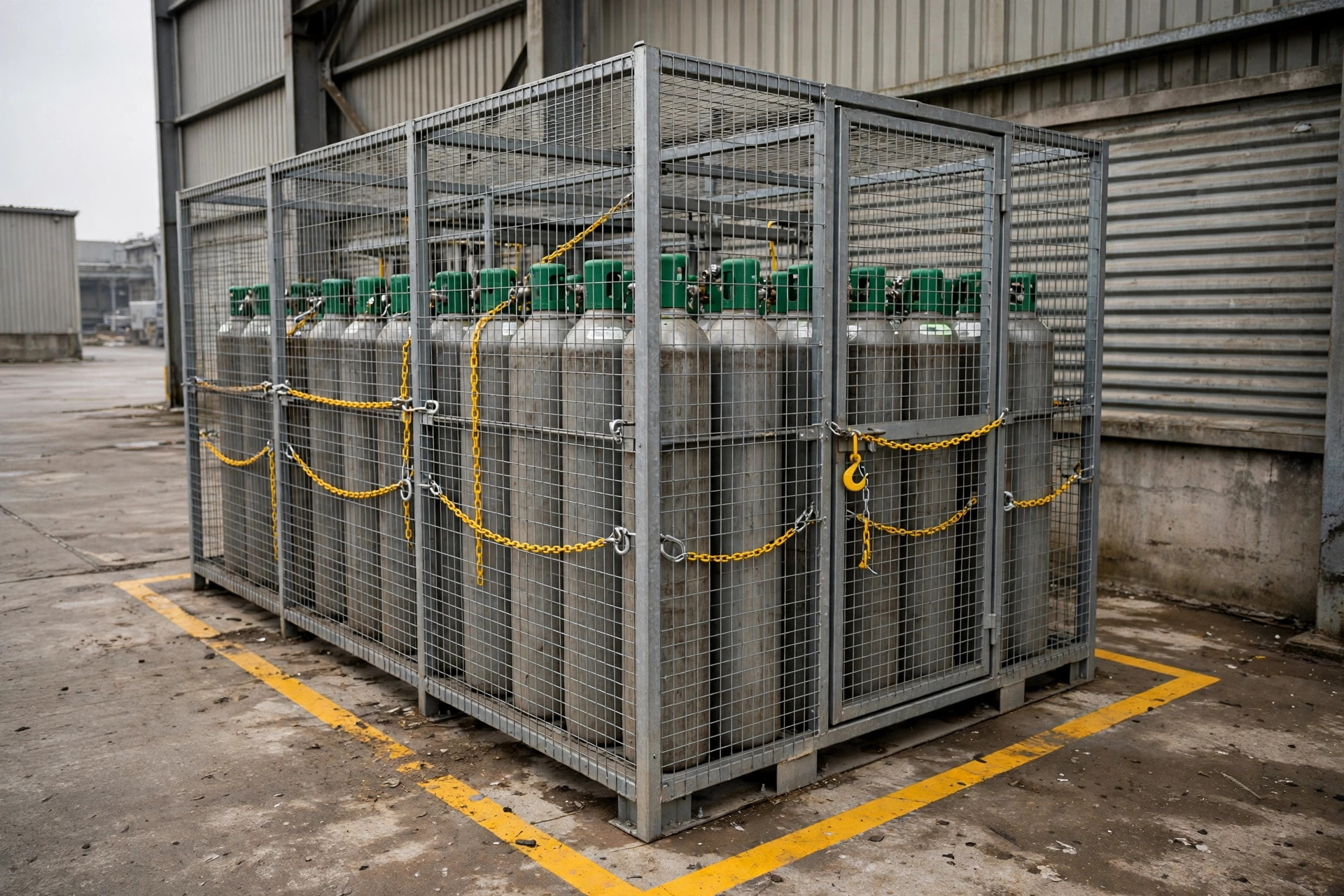
Standing upright is step one. A forklift clipping a corner, a pallet jack bumping the rack, a worker tripping into the cage — an unsecured cylinder goes over anyway. "Will not be knocked over" has to mean something physical: chains, straps, or a cylinder cage, with the restraint across the upper half of the cylinder body, one restraint per cylinder.
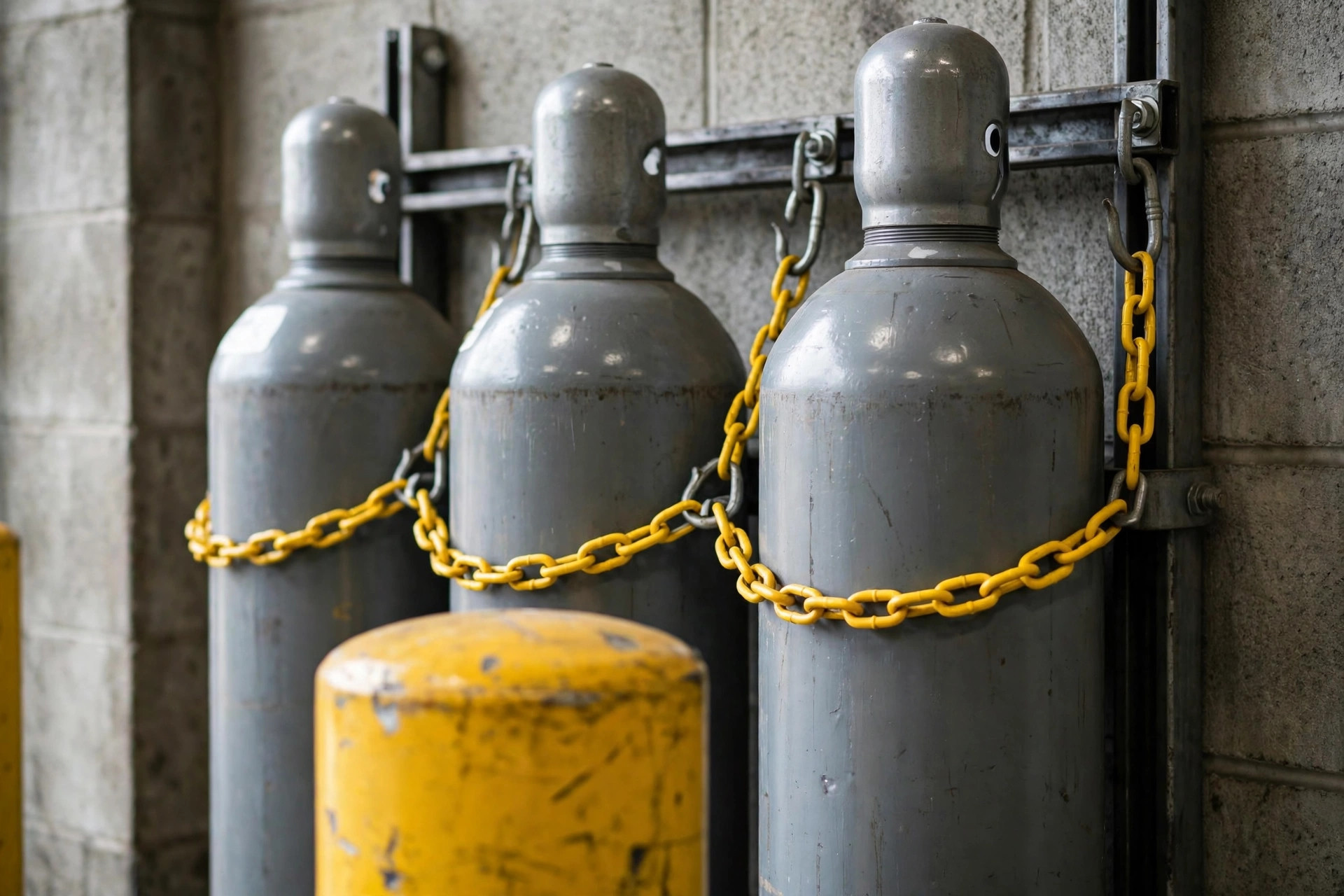
I've seen three approaches, each with a trade-off. Wall chains are the cheapest fix, but only if the wall is real — I've watched a cylinder pull its chain anchor straight out of drywall, which is security theater, not security. Floor anchors with railings suit outdoor cylinder yards and stand up to weather and impacts, but they mean drilling concrete and real installation work. Cylinder cages are the inspector's favorite: locked, ventilated, impact-resistant. They also eat floor space and budget — a proper eight-cylinder cage with installation isn't pocket change.
My practical take: small indoor quantities get wall chains (after you've confirmed the wall is concrete or structural steel). Outdoor or high-volume storage gets a cage. Don't economize here — one citation pays for rebuilding the entire cylinder area to the highest standard.
Two details people always miss. First, valve protection caps. The regulation says that where a cylinder is designed to accept a cap, the cap "shall always be in place, hand-tight, except when cylinders are in use or connected for use" (29 CFR 1910.253(b)(2)(iv)). I walk into warehouses where the cylinders are beautifully chained and the caps are God knows where. The valve is the weakest point on the cylinder — damage it and you're venting high-pressure oxygen, which turns any trace of oil or grease into a fireball. Second, before moving any cylinder, the cap goes on (29 CFR 1910.253(b)(5)(ii)(D)) and it rides on a purpose-built cylinder cart. Never roll a cylinder by hand. The cart exists for a reason.
Rule three: oxygen and fuel gas stay strangers.
This is the most black-and-white rule in the book, and inspectors check it every time. Here's the actual text of 29 CFR 1910.253(b)(4)(iii):
"Oxygen cylinders in storage shall be separated from fuel-gas cylinders or combustible materials (especially oil or grease), a minimum distance of 20 feet (6.1 m) or by a noncombustible barrier at least 5 feet (1.5 m) high having a fire-resistance rating of at least one-half hour."
Read it carefully. Twenty feet is the minimum, not a suggestion. And the barrier alternative has teeth: noncombustible, five feet tall, half-hour fire rating. A sheet of plywood or a plastic curtain doesn't count, and an inspector spots the difference in one glance.
Tight on space? That's exactly what the barrier option is for. But the barrier has to meet the full standard — no shortcuts.
The chemistry is simple: oxygen doesn't burn, but it makes everything else burn faster and hotter. A leaking oxygen valve next to a fuel-gas cylinder turns a small leak into a potential explosion. Oxygen and acetylene work together at the torch every day; in storage, they stay apart. The iron rule among iron rules.
Two companion rules. Separate full cylinders from empties, keep empty valves closed and marked — you don't want someone hooking up what they think is a full bottle. And keep cylinders away from heat: radiators, dryers, windows with direct sun. The Compressed Gas Association's P-1 standard says the same thing about caps in storage — if the cylinder takes a cap, the cap stays on. Same idea as OSHA, different letterhead.
One last thing, and it's the question every inspector asks: "How often do you inspect the cylinder area? Show me the records."
My system is boring on purpose. Once a week, ten minutes, whoever's on shift: are all cylinders upright? Chains fastened? Oxygen separated from fuel gas by twenty feet or an intact barrier? Caps on? Fulls and empties separated? Once a quarter, a deeper pass: check restraints for looseness and corrosion, verify signage, confirm the barrier is intact, reconcile the inventory log. The record is one sheet — checkboxes and a signature.
The day the inspector actually shows up, you want him to see exactly what you see every week. Compressed gas is the quietest thing in your warehouse right up until the day it isn't. Three iron rules, ten minutes a week, and the cylinder corner stops being the thing that keeps you up at night.