We have a client who has traded African timber for over a decade, and late last year he called me about gabon timber export warehouse work. His first sentence was: Susan, I spent three months negotiating this deal, the price is agreed, but nobody will give me a straight answer on warehousing. The timber sits in the forest, the processing zone has no space booked, and when the rains come the road breaks down and the boards sit in an open yard for two weeks, warping and splitting. By the time the buyer in China inspects them, the deduction wipes out the margin. He asked whether our 3PL could take the whole chain, from forest to port. I said yes, but only after we work out the numbers and put them in writing. A contract that talks about unit price and says nothing about responsibility is waiting to hurt someone.
Here is the background. Gabon supplies roughly 90% of the world's okoumé timber. Its forests cover 22.8 million hectares, about 88% of the country's land. But since 2010, Gabon has banned the export of raw logs; only processed timber may leave the country. That policy rewrote the warehousing logic: logs now go into a processing zone first, come out as sawn boards and plywood, and only then go out to sea. Processing, drying, protection, and loading are chained together, and if any link breaks, everything spent before it is wasted.
Gabon Timber Export Warehouse Work Starts in the Forest, Not at the Port
Our client's first loss happened in the forest. Logs come out of the cutting area and wait at a collection point until there is enough for a full truck. When the rains come, the dirt roads turn to mud and trucks can neither get in nor out. Then there is the weighbridge at Ndjolé, with a 32-tonne limit nobody bends by a single kilo. One load was stopped there, part of it unloaded before the truck could pass, and the logs left by the roadside spent four days in the open and started to discolor.
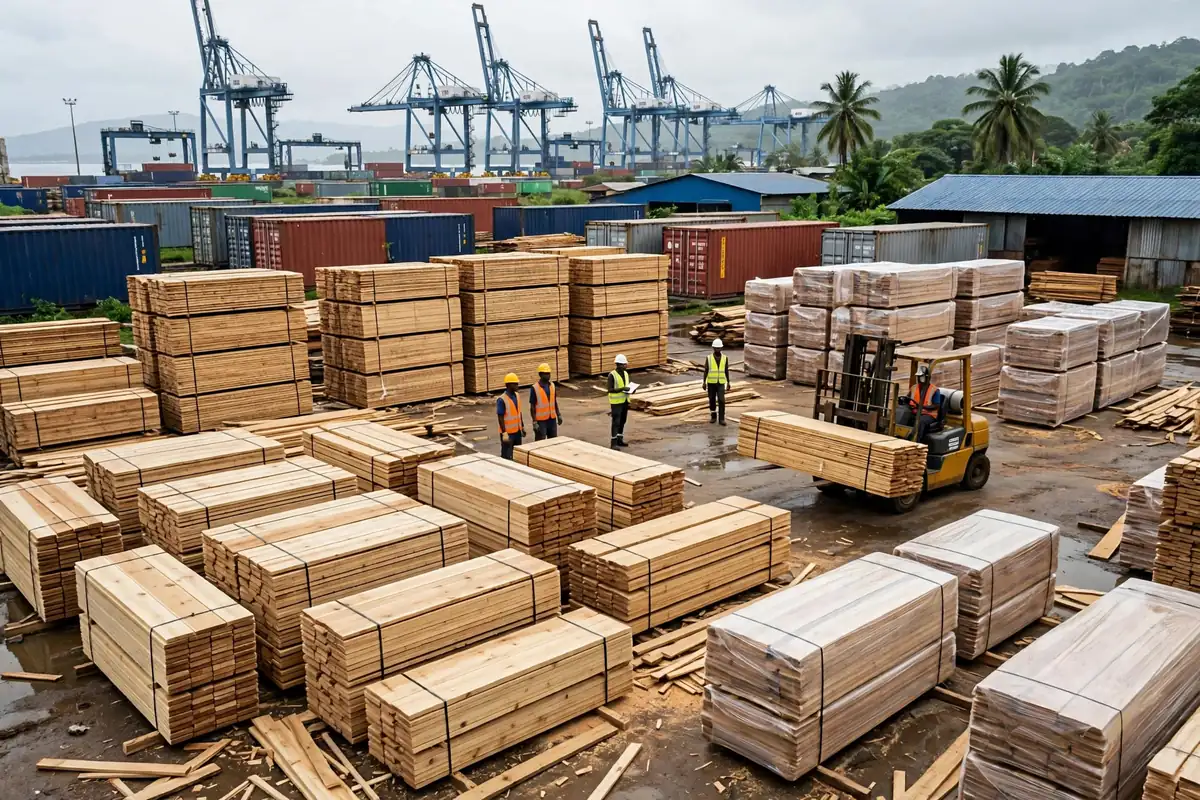
Our fix was unglamorous and it worked: keep collection points small, close to the cutting area, raised off the ground, and roofed. Spray logs with anti-split treatment the day they arrive, seal the ends with wax, and leave air gaps between stacks. Once a board's ends split, the buyer inspects it as a lower grade, and the price difference on a single cubic metre can eat the margin of the whole shipment. We wrote it into the contract: if logs sit beyond the agreed days, the cost of covering and moisture protection is ours, not the client's. The client asked us to make the clauses stricter after he saw a deduction case.
Here is the counterintuitive judgment: in the Gabon timber trade, the most expensive thing in warehousing is not rent. It is time. A day too long in the wrong place does not cost a day of rent; it costs a whole shipment's grade. Plenty of people calculate the price per square metre and never calculate the chance that a day of delay downgrades the boards. Pay a bit more for the warehouse and never let cargo spend an extra night in the open.
Gabon Timber Export Warehouse Space in the Nkok Zone Follows the Utilization Rate
Logs that reach the Nkok Special Economic Zone enter the real processing stage. The zone covers 1,126 hectares and sits 20 kilometres from Libreville, the heart of Gabon's timber processing. But even a heart skips beats: some factories in Nkok run at about 50% utilization, so half the capacity idles while the other half rushes. When the lines rush, space runs short and boards end up stacked outside the workshop. When the lines idle, the space sits empty and the rent is still charged.
One client of ours got hurt exactly here. He signed a fixed-volume contract, the plant ran at half capacity for two months, output was half of what he expected, half the space stood empty, and the money was paid anyway. I told him it was not a warehousing problem. It was a contract problem. A warehousing contract has to say clearly whether the fee follows reserved space or actual inbound volume, what discount applies to reserved space in the low season, and whether the warehousing fee stops when the plant stops. If those three sentences are missing, the settlement day will end with both sides threatening to walk away.
The table below is the simplified version we use with clients. The figures are an illustrative example, not a quote:
| Charging method | 500 m³/month (illustrative) | 250 m³/month (illustrative) | Who carries the swing |
|---|---|---|---|
| Fixed monthly fee for reserved space | One fixed amount, whatever arrives | The same amount, no refund | The client carries it |
| Fee per actual inbound volume | Moves with volume; less in, less paid | Roughly half the fee | Shared by both sides |
| Monthly base plus a tiered overage rate | Fixed within the base volume, higher unit price above it | Only the base part is paid | Client carries the base, overage is separate |
This table is a negotiating tool, not a price list. Take it into a meeting and you will see how much water is in the other side's quote. My rule: when a zone's utilization is unstable, never sign a pure fixed monthly fee. A per-volume fee looks dearer per unit, but the money saved in the low season more than covers the extra paid in the peak season.
Moisture and Warping: The Line Everyone Skips in the Contract
Okoumé boards and plywood fear two things: damp and sun. Gabon is tropical rainforest country with high humidity year round. Boards stacked on a floor with no moisture barrier start to mold on the bottom layer within a fortnight. Plywood is fussier still: stack it unevenly, space the bearers wrong, and the boards slowly bend. The buyer measures flatness at inspection and the whole container gets downgraded.
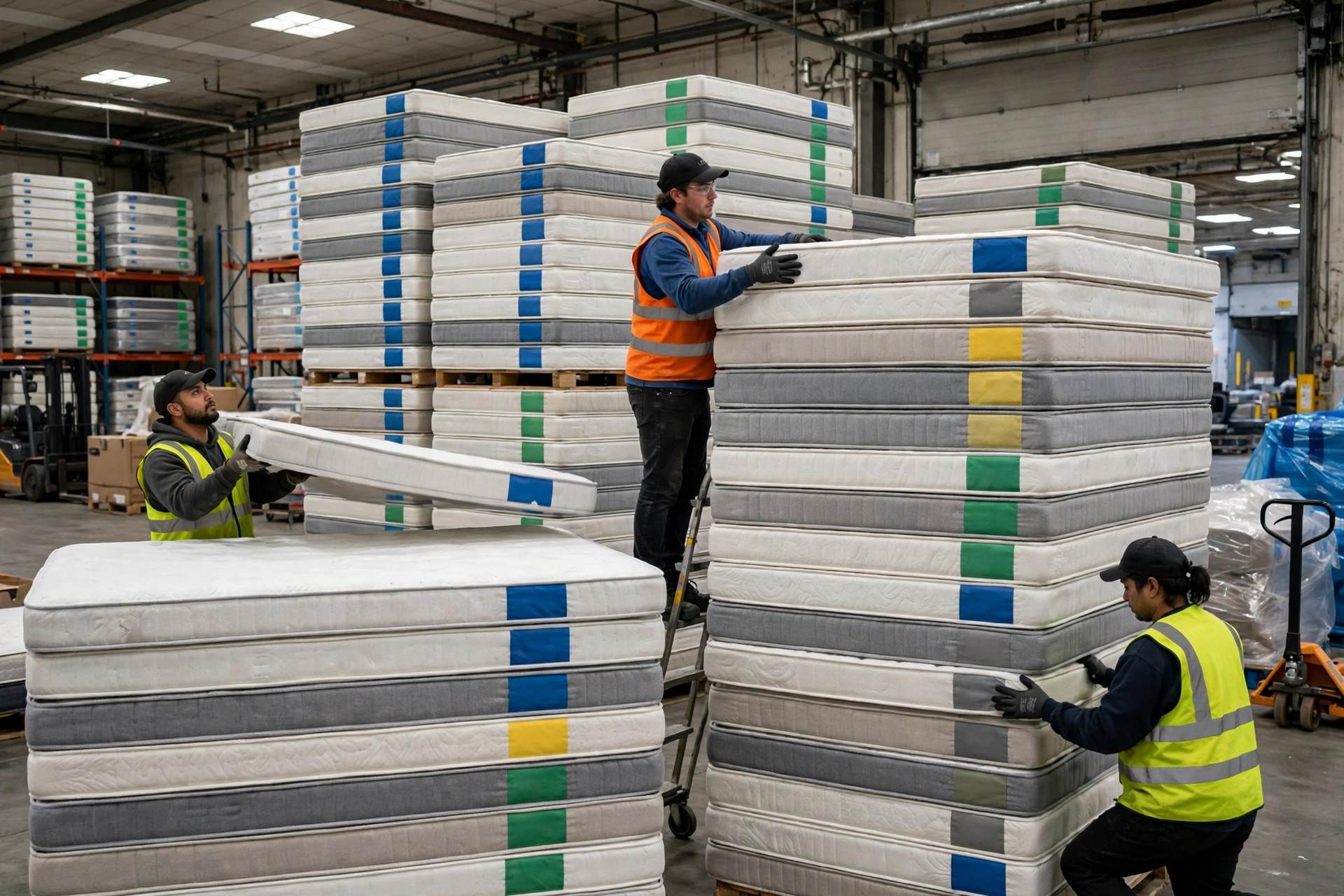
Our rules are three hard lines, written into the operating manual and attached to the contract. First, boards go into the warehouse raised off the floor, at least a hand's breadth up, on a moisture barrier; no board ever touches bare ground. Second, stack height is capped; once plywood reaches the agreed number of layers, that is the top. Third, every batch is moisture-tested on entry and again on exit, and both numbers go on the receiving note. Those readings are the evidence that settles a dispute. Without them, when boards arrive in China warped, nobody can say whether it was processing, warehousing, or the ocean voyage, and the 3PL carries the blame.
Keep one more number in mind: local okoumé trades at roughly 160,000 Central African CFA francs per cubic metre, the figure cargo value, insurance, and compensation are built on. The compensation cap and the deductible in the contract have to be tied to cargo value, not plucked from thin air. Push the compensation clause below half the cargo value at negotiation time, and the contract is barely worth signing.
The Last Mile to Owendo Port
Boards leave the processing zone for Owendo port, the sea outlet. The road is not long, but the rains make scheduling unpredictable, so truck runs need slack built in. Our practice is to load containers inside the zone's warehouse, not at the port: boards are packed, sealed, photographed, and only then trucked to Owendo, so the port only receives sealed containers and the boundary of responsibility for cargo damage stays clean.
One more date to watch: the Central African Economic and Monetary Community plans a region-wide ban on log exports starting in 2028. Gabon moved first in 2010, and once its neighbours follow, the whole Central African timber trade becomes a processed-timber trade. The warehouse space, moisture standards, and loading routines being set now will only get stricter. Getting the process right early is far cheaper than scrambling later.
The policy's weight shows in one comparison: in 2024, Chinese customs recorded zero imports of tropical logs from Gabon, against 14,063 tonnes in 2019. The log route is dead. Processed timber is the only road left.
Next time you negotiate a contract, ask these three questions. First, is the fee based on reserved space or actual inbound volume, and is there a low-season discount? Second, are board moisture readings taken on entry and exit, and do the numbers go on the paperwork? Third, who pays when boards warp or take damp, and is the compensation cap tied to cargo value? Get those three answers straight, and the gabon timber export warehouse numbers will finally add up.
By Susan, 3PL Sales Director