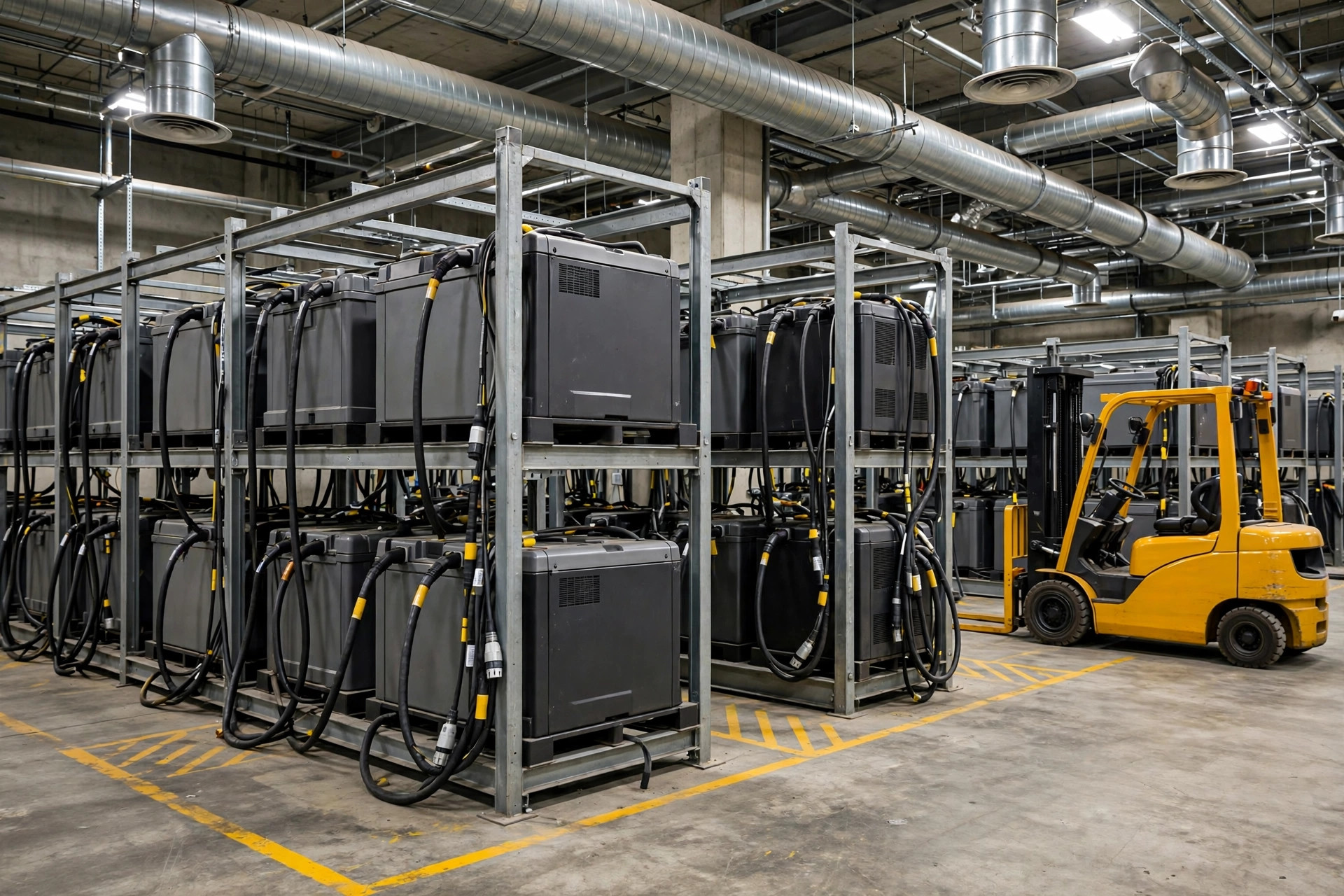
Picture a 200,000-square-foot distribution center running forty electric forklifts, with the battery room tucked into the farthest corner of the building. Every day, drivers shuttle back and forth for battery swaps and charging — 150 meters each way, dozens of trips. Add it all up over a year and that floor-plan decision is costing you several full-time salaries in pure walking. Of all the underpriced decisions on a warehouse layout, battery room location might be the most underpriced.
In most layout projects, the battery room is an afterthought: whatever space is left over gets the batteries. Then the building goes live, and that "wherever fits" location starts collecting a daily walking tax.
Do the Math First: What the Location Is Really Worth
The calculation fits on a napkin: total daily swaps and charges × one-way distance × 2 (round trip) × time per trip, converted to labor hours, multiplied by your labor cost. That's the annual "flow cost" of the battery room's location.
Take an example — the numbers are assumptions, plug in your own. Forty trucks, sixty swaps and top-ups a day. Option A puts the battery room in the corner: 150 meters one way. Option B sits it near the main work zone: 40 meters. An unloaded forklift travels about 10 km/h, so 150 meters takes 54 seconds and 40 meters takes 14. Over a day, Option A burns 80 more minutes of pure travel than Option B — and that excludes the swap operation itself.
Eighty minutes a day, three hundred working days a year: four hundred hours. At U.S. warehouse labor rates, that's a part-time position on the payroll. And it's spent entirely because somebody drew a rectangle in the wrong corner of the plan.
That's only the visible cost. The hidden one is bigger: swap queues. When the battery room is far away, drivers start batching — "I'll swap twice while I'm here" — and a line forms at the charging racks. Trucks wait on people, people wait on trucks. I've seen three or four forklifts parked outside a battery room just waiting their turn — every one of them a crewed, hourly-costed asset, sitting idle.
Once you've run the numbers, the principle is obvious: the battery room belongs as close to the high-frequency work zone as you can get it — subject to safety and fire constraints, which we'll get to.
Battery Swapping and Opportunity Charging Are Two Different Location Problems
First, figure out which charging model you run. The location logic is completely different.
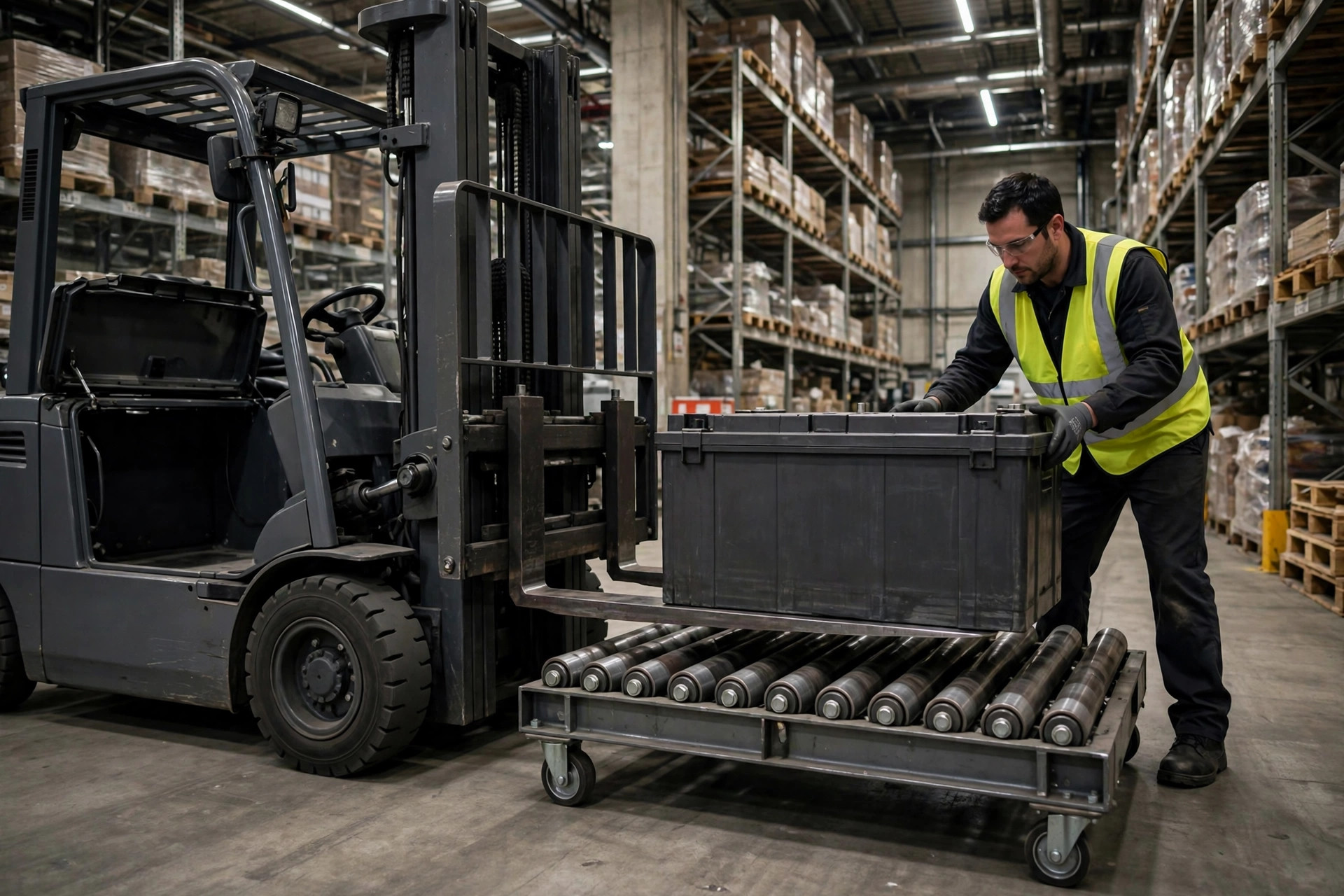
Battery swapping (mostly lead-acid fleets): the battery room is a high-traffic workstation. Dozens of swaps a day, packs lifted off trucks with an extractor or hoist and rolled onto charging racks. Anyone who's run lead-acid counterbalances — say a Toyota 8-series class truck — knows the feeling: the swap itself takes the better part of fifteen minutes, and a long drive to the battery room eats half an hour out of the morning. In this model the room needs to sit near the main work zone, with staging room for battery rotation and maneuvering space that doesn't fight the main travel aisles. Undersize it or push it far away, and the whole swap process chokes.
Opportunity charging (mostly lithium): the logic flips. Trucks top up during 15- to 30-minute breaks, so there's no centralized swapping. Charging points can scatter — a few chargers by the break area, a few by staging. The "battery room" can be small or barely exist, and it can sit farther off because visits are infrequent and short.
A few years ago at a 3PL's new building in Perris, I saw the most wasteful version of this: a lithium fleet on opportunity charging, but the building was designed with a big corner battery room sized for lead-acid swapping — far away, oversized, underused. Get the charging model wrong and the location follows it off the cliff.
Then there's the mixed fleet, which is more common than anyone admits: the old lead-acid trucks haven't retired and the new lithium trucks have arrived. My rule is to design for the stricter constraint — honor lead-acid's ventilation requirements, while reserving scattered charging points for the lithium trucks. The transition usually lasts two to three years; don't build permanent structures for a transitional setup. Use movable chargers so the layout can shift again when the fleet goes all-lithium.
Lead-Acid and Lithium Have Nothing in Common on Constraints
Lead-acid batteries release hydrogen gas while charging, so ventilation is a hard constraint. The battery room has to be standalone, against an exterior wall, well ventilated, with space for watering and acid protection. Want to tuck it inside near the work zone? Ventilation and fire code usually say no. That's the real reason lead-acid battery rooms end up far away — not because nobody wanted them closer, but because they can't be closer.
Lithium changes the equation: no hydrogen, no watering, far more freedom to site near the work zone. But don't celebrate yet — lithium brings its own constraint, and it's electrical capacity. Dozens of trucks fast-charging at once means the cable runs and transformer capacity from the electrical room have to be sized up front; adding capacity later is expensive and disruptive. And check with your local fire marshal before you build: some jurisdictions want lithium charging areas in a separate fire-rated enclosure. Ask before the inspection, not during it.
One line to remember: lead-acid is about ventilation, lithium is about electrical capacity. The binding constraint is different, so don't apply lead-acid instincts to a lithium fleet.
The Location Decision Checklist
Before you lock the location on the plan, run through these six:
One — count total daily swaps and charges, and when they happen. Volume sets how much the location matters; timing tells you whether you need staggered bays.
Two — measure the one-way distance from each candidate location to the high-frequency work zone, for at least two options. Run the cost formula above and let the annual flow-cost delta make the decision.
Three — confirm the binding constraint for your battery chemistry: ventilation and watering space for lead-acid; electrical capacity and fire-separation requirements for lithium.
Four — leave 20 percent expansion room. Fleets only grow, and expanding a battery room is far cheaper than relocating one.
Five — never put the battery room on the must-pass route between receiving and shipping docks. At swap rush hour, battery carts fighting inbound and outbound pallet traffic jam everything up.
Six — co-locate charging with the maintenance area. Batteries, tires, and daily inspections in one spot means the tech handles it all in one trip — that's flow savings too.
Retrofitting an old building where the battery room can't move? Add scattered charging points. Two or three chargers tucked into corners of the work zone let a lithium fleet top up during 15-minute breaks, cutting trips to the far-away battery room in half. Small money, big knot untied.
Next time you revise a layout, don't start by drawing the battery room. Start by locking in fleet size for the next three years, the battery chemistry, and the charging model. Get the location wrong and you're paying the whole building a walking subsidy — for the next ten years.