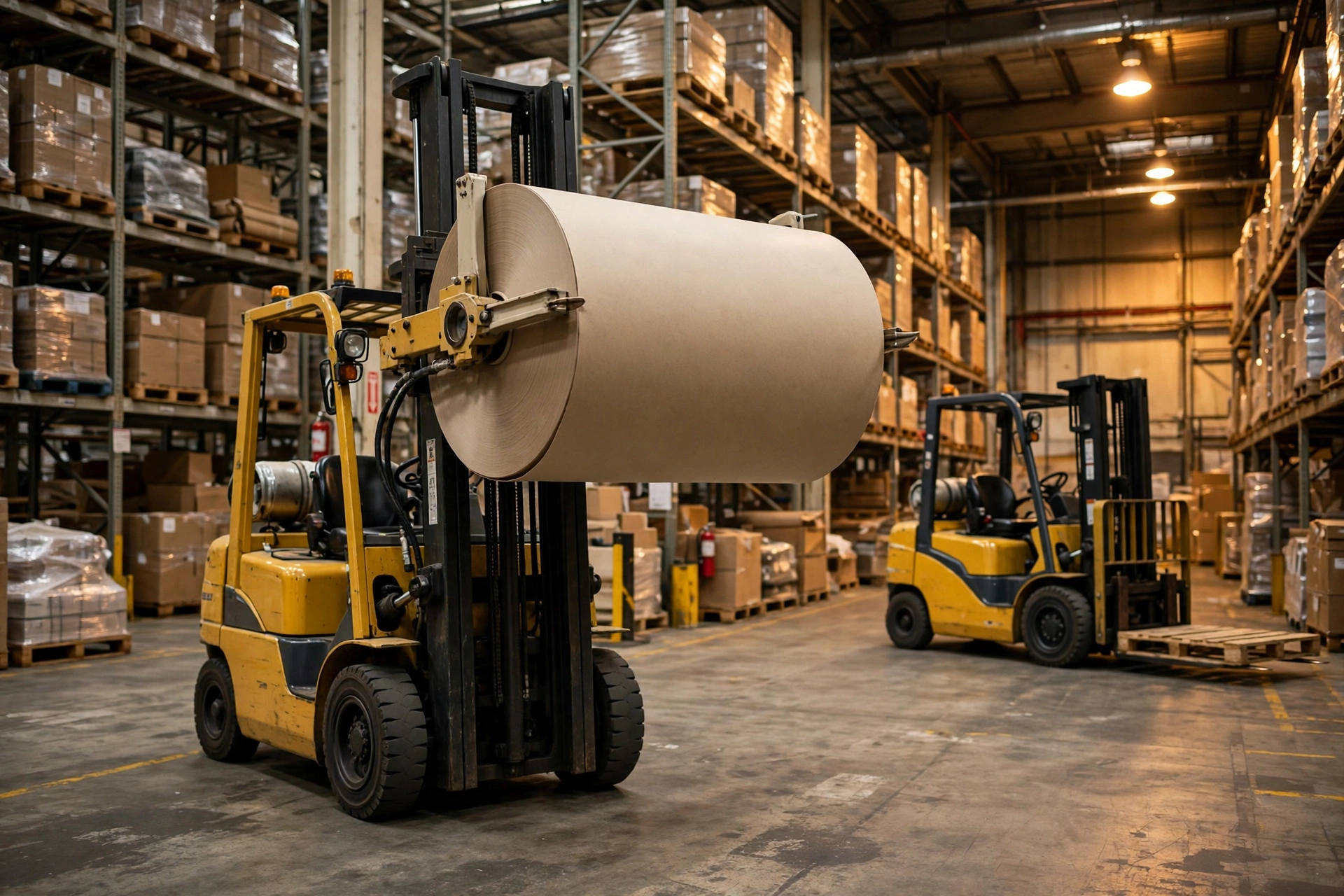
Let me tell you about forklift attachments the way I first met them, on a delivery to a paper mill warehouse a few years back. I was waiting in line to unload, and ahead of me a forklift fitted with a paper roll clamp was easing a roll taller than a man toward the racks. The driver told me the attachment had cost a small fortune, but once it was bolted on, the truck got a lot weaker — a forklift that used to lift two and a half tonnes now had to think twice about one point eight. After all these years on the road, I have seen too many warehouses get burned on them. The attachment itself is never the problem — the problem is the wrong truck, for the wrong load.
An attachment is basically a different pair of hands for the truck. Plain forks only handle pallets, and warehouse freight comes in all shapes: paper rolls have no pallet, cartons crush under pressure, long stock cannot be forked at all. That is what attachments are for. But every attachment costs weight and forward reach, and once it is fitted, the rated capacity always drops. Before you pick anything, pull the load chart off the truck's data plate, hold it next to the maker's spec sheet, and work out what capacity is left. Check load figures against the manufacturer's data — I will not invent specific numbers here, because every truck and every attachment is different, and a made-up number would only get someone hurt.
Paper Roll Clamps and Carton Clamps: Forklift Attachments That Live or Die by Their Grip
A paper roll clamp is standard kit in paper, printing and packaging warehouses. Without one, a paper roll has to be moved with slings or rolled by hand, which is slow and damages the roll edges. The clamp arms rotate, so a standing roll can be laid flat for stacking. But the clamp has its own traps: squeeze too hard and the core of the roll deforms, and the print shop ends up with waste; squeeze too softly and the roll slides out halfway across the yard, and you do not want to see that happen. When you size a paper roll clamp, start with the diameter range and weight range of your rolls, make sure the arms open wide enough, and treat adjustable clamping force as a must-have.
A carton clamp is a cousin of the roll clamp, but with a different temper. It is built for pallet-less cartons, common in appliance and fast-moving consumer goods warehouses. The wide clamp pads grip the sides of the carton by friction. A carton clamp hates two kinds of freight: cartons that are too soft, so a light grip drops them and a firm grip dents them, and the goods inside suffer either way; and cartons with slick surfaces, where friction is not enough and the load slides forward every time the forklift brakes. Test it on the actual cartons you handle most before you buy.
(Hypothetical scenario) I know a warehouse owner in the appliance business who bought two carton clamps three years ago to save on pallet costs. In the first week, a batch of soft-walled microwave cartons came through, the pads squeezed the corners in, and the customer rejected the delivery on inspection. After that they changed the rule: carton clamps only for the few products with reinforced outer boxes, everything else back on pallets. The attachments were not a waste, but their use narrowed a lot, and the savings came in well below what he had hoped.
Sideshifters and Fork Positioners: Small Attachments, Big Difference
A sideshifter is the most common forklift attachment, and the easiest to underestimate. It lets the forks slide left and right, so the driver can line up with a pallet slot without shuffling the whole truck back and forth, and the stacking comes out straight. After all these years on the road, I will say this: any warehouse with dense racking and tight aisles should treat a sideshifter as standard. It is light, it barely dents the load capacity, and it gives you the best value for money.
A fork positioner is a different kind of animal. It adjusts the gap between the two forks electrically, so the driver never has to climb down and move the forks by hand to fit a different pallet width. It sounds like a small thing, but over a shift the driver climbs down dozens of times fewer, and that saves both time and his back. It suits a warehouse with mixed pallet sizes, like a 3PL handling several clients whose pallets are all different. Turn it around, though: if your pallets are all one size, a fork positioner is money spent on a gadget that just sits there.
Double-Pallet Forks: Money Saver, or the Start of Trouble
Double-pallet forks move two pallets in one trip, and on paper that looks like pure savings: same run, double the load, half the forklift trips. Plenty of owners see that maths and their eyes light up. But let me tell you, of all attachments, double-pallet forks are the most likely to look like savings and turn into trouble.
Start with capacity. The attachment itself is heavy, and two pallets push the load centre further forward, so the rated capacity takes the biggest hit of any attachment. A truck rated for three tonnes can end up overloaded with two one-tonne pallets once the forks are on. An overloaded forklift steers heavy and brakes long, and is at its most dangerous when the mast tilts forward.
Then there is space. Moving two pallets at once widens the turning circle, so the aisles have to be wide enough and the racking gaps generous. This is where older warehouses get caught: the attachment arrives, the aisles are too narrow for the truck to turn between racks, and it can only be used in the open yard, where the whole advantage evaporates.
(Hypothetical example) Run the numbers on a simple case. One forklift moves one pallet per trip and makes 100 trips a day. Fit double-pallet forks and in theory 50 trips do the same work. But if each alignment takes an extra half minute and the truck waits longer in the aisles, the real saving might be only a fifth of the trips. Add in the purchase price, the maintenance, and the cost of moving up to a bigger forklift once the capacity no longer fits, and the deal may not pay at all. Before you sign anything, measure your real trip counts and waiting times for a week.
Forklift Attachments Decision Table: Match First, Then Buy
| Attachment | Best for | Watch out for | Check first |
|---|---|---|---|
| Paper roll clamp | Cylindrical paper and film rolls | Excess clamping force crushing the core | Roll diameter range, adjustable force |
| Carton clamp | Pallet-less cartons, appliances, FMCG | Soft walls, slick surfaces | Real carton tests, pad area |
| Sideshifter | Dense racking, narrow aisles | Few real drawbacks | Sideshift travel, capacity impact |
| Fork positioner | Mixed pallet sizes, 3PL sites | Uniform pallet sizes | Pallet size range |
| Double-pallet forks | High pallet volume, wide aisles | Narrow aisles, tight capacity | Data-plate load chart, aisle width |
How to use this table: match it against the two or three load types that dominate your warehouse, then check the capacity against the truck's data plate and the maker's spec sheet, then go and measure the aisles with a tape. When all three line up, then talk price. If any one of them fails, rent the attachment for a month and try it before you buy. A month's rent is tuition, far cheaper than buying the wrong attachment.
Here is a counterintuitive one: many attachment problems start with the forklift, not the attachment. Trucks are rated with bare forks, and once an attachment goes on, the capacity drops, so an older truck carrying a new attachment often cannot keep up. Sometimes the smarter move is to skip the attachment and step up to a truck one size bigger. An attachment is the icing, not the cake — if the base is not strong enough, no icing will save it.
After all these years on the road, it comes down to one line: pick attachments by the freight first, the truck second, and the price last. If the load type does not match, even the cheapest attachment is decoration; if the capacity is not worked out, even the best attachment is a hazard. Before you buy, go and see how another warehouse uses the same attachment, and ask the drivers whether it works well day to day. That tells you more than ten pages of brochures ever will.
By Shifu Zhao, Trucking Veteran (15 yrs)