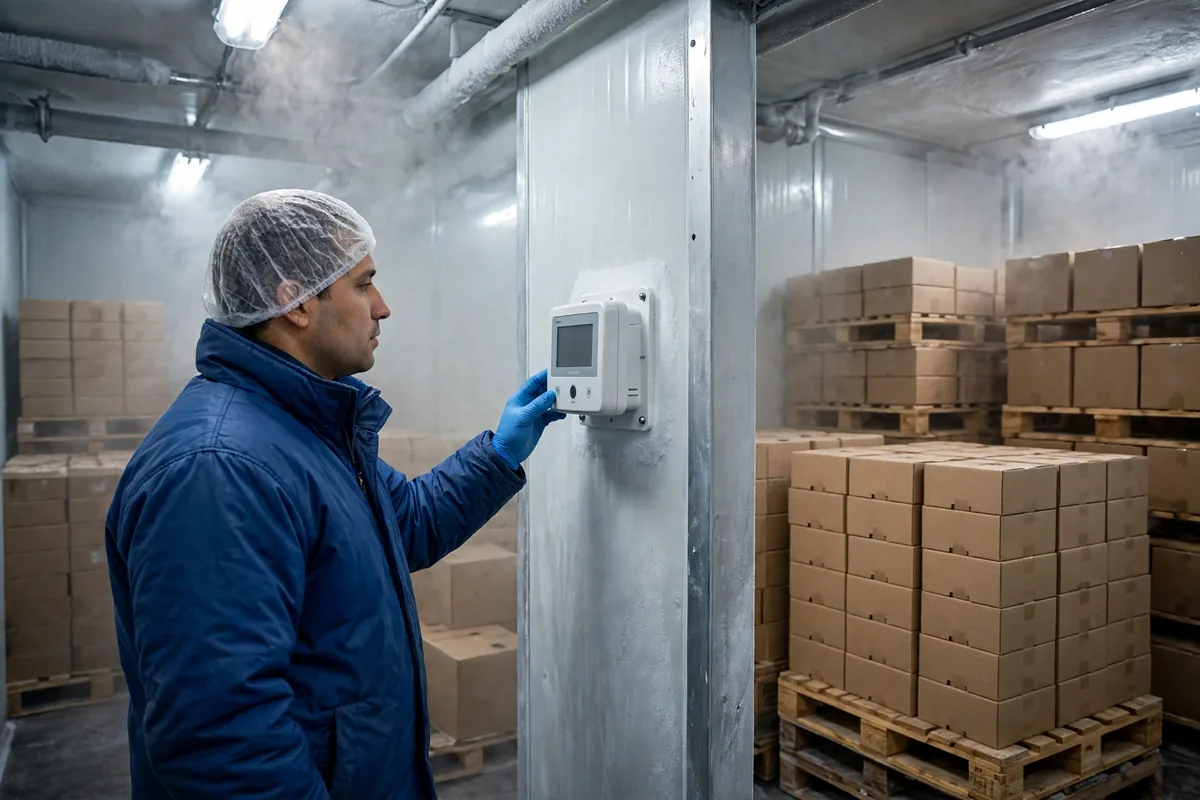
We had a client, a California importer of sauces and seasonings, warehousing out of a building near Los Angeles with thirty-odd SKUs, mostly shelf-stable, plus a few refrigerated lines. In our second year working together, they landed a big regional grocery account, and a week before the audit the buyer's quality manager asked us for three months of FDA food warehouse temperature humidity records. Our warehouse manager went digging and found the cold room's records full of holes: a batch of sensors had been swapped out, the old system's data wouldn't export, and the paper logs had blank weeks. They kept the account in the end, but only after the buyer parked a third-party inspector on site for two full days, and the freight rate got squeezed a point in the next round. That was the week I stopped thinking of FDA food warehouse temperature humidity records as paperwork and started thinking of them as a contract term.
Here is the part most people get wrong. Auditors do not walk in admiring your shiny new cold room. They check whether your records tell a consistent story: is the curve continuous, did anyone respond when an alarm went off, and is there a trace of what they did about it. If those three things don't line up, the fanciest equipment in the world won't save you. We rebuilt that client's record-keeping from scratch afterward, and rewrote the related contract clauses at the same time. The next two audits went through clean. Everything below comes from real projects, on the seller's side of the table, where we learned it the expensive way.
What FDA Food Warehouse Temperature Humidity Records Really Get Judged On
Let me start with a counterintuitive judgment: more data is not better data. Plenty of warehouses think that stacking sensors and sampling every minute makes them more compliant, and then they drown in exports, archiving, and reconciliation. When audit day comes, nobody can explain the mess. What an auditor actually looks at comes down to three things. First, are the records continuous, or are there unexplained blank stretches? Second, when a reading went out of range, did an alarm fire, did someone act, and was the action written down? Third, can every record be traced back to a person, a device, and a specific location and day?
We had another client, a nut exporter with a warehouse in central California, who learned the blank-gap lesson the hard way. During an audit, the inspector pointed at a three-hour blank one afternoon and asked what happened. The warehouse supervisor mumbled something about a system upgrade, and the inspector wrote it up as an observation on the spot. It later turned out the sensor had simply lost power, and the room temperature had never gone out of range at all. But because nobody had written a single line of explanation at the time, the gap looked like a cover-up. A gap with an explanation is a footnote; a gap with no explanation is a suspicion. Never backfill or alter records, but a same-day note saying "sensor lost power, battery replaced, manual spot check normal" with a signature changes everything. Honest records are allowed to have small blemishes. Fabricated records are not.
Alarms and Traceability: Temperature Humidity Records Are Only Half the Job
Plenty of warehouses stop at "we recorded it." The alarm goes off, nobody follows up, or somebody follows up and leaves no trace, and the whole exercise was pointless. The classic scenario is a weekend in the cold room: the chiller alarms at 2 a.m. on Saturday, the on-call person glances at it remotely, sees the temperature still inside the critical band, and doesn't go in. By Sunday morning the temperature has genuinely breached, and the product has been sitting in it for half a day. The alarm log exists, the response record doesn't, and when the customer asks what happened in those hours, nobody can say.
Our approach is to split alarms into two tiers. A minor deviation triggers an automated message to the duty supervisor, who confirms remotely and leaves a one-line note in the system. A serious deviation, or one that persists beyond an agreed window, requires someone on site, with photos, a written record of the action taken, and a signature. It's not complicated. The point is that every step leaves a trace. And here is an insider detail most operators miss: the problem is often humidity, not temperature. Dry goods and sauces can sit at perfect temperatures all year while humidity drifts in the rainy season, cartons go soft, labels wrinkle, and the customer complains before anyone has even looked at the humidity log. Temperature and humidity belong on the same review sheet. Don't audit one and ignore the other.
The money side matters too. Here is the comparison table we use when scoping a solution for clients. The figures are illustrative examples, not quotes; actual pricing depends on the vendor:
| Approach | Illustrative cost level | Best for | Biggest trap |
|---|---|---|---|
| Manual paper checklists | Lowest, mostly labor | Small warehouses, few SKUs, no cold storage | Missed entries, unprovable backfills, hardest to defend in an audit |
| Semi-automatic: sensors plus manual export | Mid-range equipment plus light system cost | Mid-size warehouses with a cold room | Exports and archiving depend on someone remembering, and gaps appear whenever it gets busy |
| Fully automated monitoring with alarms and audit trail | Highest equipment plus subscription cost | Warehouses serving grocery chains or export markets | Installed and then ignored: if nobody reviews the alarms, you paid for nothing |
There is a trade-off in that table worth sitting with. The fully automated option costs the most, but what it buys is not labor savings, it is negotiating leverage. Handing a customer a clean export on the spot is a very different conversation from saying "we'll pull that together and get back to you." The first one builds trust; the second one invites a discount. That sauce importer later worked out that the two days of on-site inspection, the delayed shipments, and the squeezed rate had already cost more than a monitoring system would have. Compliance spending should never be judged on equipment price alone. Judge it against the cost of a lost account and a renegotiated rate.
Negotiation Advice: Write the Records Standard Into the Contract
Most shippers negotiate price and payment terms and wave the records clause through in one line, then discover after an incident that the contract says nothing at all. From the provider's side, a clear records clause protects both parties. The more specific the shipper's requirement, the more defensible the warehouse's execution; and the warehouse, frankly, would rather have the standard written down than have a shipper wave "your records were incomplete" around as a discount lever later. This part of the contract deserves thirty minutes of honest discussion at signing time.
Next time you're at the table, ask these three questions. First, what is the retention period and delivery format for the records, who explains any gap, and within how many days? Second, are alarm tiers and response times written into the service standard, and who covers nights and weekends? Third, how far does warehouse cooperation extend during an audit, who pays for third-party inspection, and how many days are allowed for corrective action? Get those three answered and the fuzzy territory around records is mostly cleared.
One last note on the regulatory side: the specific compliance requirements for food warehousing depend on your product category and channel, so always check the latest policy on the FDA's official site. Broad frameworks like 21 CFR Part 117 are the starting point, not the whole answer, and the details that apply to your category and warehouse setup still need to be matched against the current rules and your customers' channel requirements. No vendor should ever promise you a guaranteed pass. Solid records, alarms with real owners, and a traceable trail: get those three right, and you walk into an audit with a clear conscience.
By Susan, 3PL Sales Director