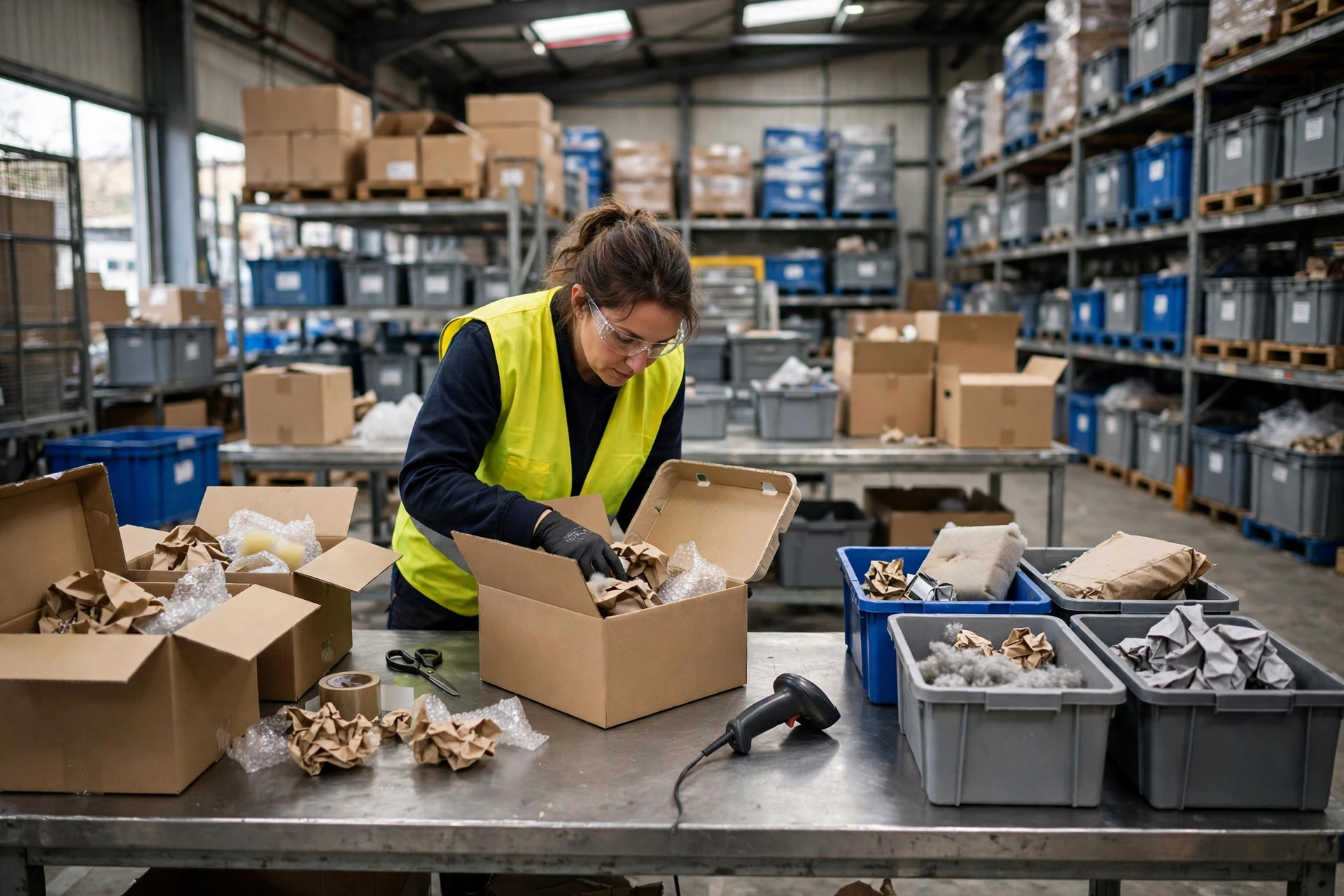
Warehouse returns processing time is a bill most warehouses calculate in the wrong direction. The moment a return comes back through the door, money starts leaking three ways: space is occupied, cash is trapped inside cartons, and labor is burned on hunting for goods and recounting them. The leak is slow, but it never stops, and by month-end it shows up as a hole in the numbers.
First, the bill for letting returns sit for 30 days. After the peak season of November 2023, a mobile-accessories warehouse in Dongguan asked me to look at its returns. The returns area had grown from 2 rows of racking to 7, and its 3 inspectors could barely keep up with each day's new arrivals, let alone the backlog. The oldest batch had waited 29 days between receipt and being put back on sale.
I laid out the costs. One earphone-case model had already dropped in market price by the time it was restocked, so it had to be sold cheaper. Another batch of charging cables had damaged packaging that nobody separated in time; the cables were shipped out again and came back a second time, so the freight was paid twice. And more than 40 cartons were buried so deep in the returns pile that the stock count missed them entirely — on paper, they had vanished for a month. The racking rent alone for those 7 rows, for one month, would have covered hiring an extra inspector for two months. That is money spent on nothing: not on the returns themselves, but on the delay.
Give warehouse returns processing time three tiers, not one queue
The worst way to handle returns is to treat them all the same. Inspecting everything in full is the safest and the most expensive option; waving everything through on experience is the fastest and the surest way to get second returns. My rule is to sort at receipt, into exactly three tiers. More than three, and the floor stops following the rule.
| Tier | Test | Service-level target | Handling |
|---|---|---|---|
| Tier A: directly resalable | Packaging intact, seal unbroken, model verified | Back on sale within 24 hours | Scan, verify, restock |
| Tier B: needs testing or light repair | Opened, lightly damaged, function untested | Testing decision within 72 hours | Tested goods restock; failures move to Tier C |
| Tier C: scrap or supplier return | Damaged, incomplete, off-season dead stock | Disposal decision within 7 days | Scrap, discount sale, or supplier return |
The point of the tiers is not a pretty table. It forces one question every day: which of today's returns can be sold tomorrow? Tier A never spends a night in the returns area — that is the floor of the whole system. Tier B gets 72 hours because, past three days, untested goods pile up on the inspectors' benches and the rework rate climbs with them. Tier C gets 7 days not to sit for 7 days, but to give purchasing a deadline for supplier negotiations. A negotiation without a deadline never ends.
In March 2025, an apparel warehouse in Hangzhou switched to this system. Before the change, inspectors worked through returns in arrival order, opening one carton after another. After the change, goods were sorted by scan at receipt: Tier A went straight to restocking, Tier B to the testing benches, Tier C to a separate holding zone. Two months later, the returns area had shrunk from 6 rows of racking to 2, and second returns had fallen — because Tier B decisions were no longer "probably fine" but tested and signed off. More importantly, the inspection lead could finally report a reliable number at the end of each day: whether Tier A had cleared, and how many cartons had entered the over-7-day bucket. Before, with mixed storage, that number could only be guessed.
The backlog cost ledger for warehouse returns processing time: three costs, counted separately
Most warehouses count only racking rent when they cost a backlog. That is the smallest part. Backlog cost has three parts, and they must be counted separately — mixed together, they hide the lever that actually saves money.
The first is space cost: how many locations the returns area occupies, and how many orders those locations could have shipped if they held normal rotating stock. Once returns overflow their zone, they start eating into picking aisles and walkways, and every extra step a picker walks is paid for.
The second is cash cost: the money tied up in returned goods. Goods that are not back on sale are cash sitting in cardboard. Seasonal goods are the sharpest case — a month late back on sale can mean another round of markdowns. This cost never appears on the rent report, but it appears in month-end margin.
The third is labor cost: searching, digging, recounting. The deeper the returns pile, the longer it takes to find one item, and goods dug through three times have their handling labor paid three times. The Dongguan warehouse later worked out that its inspectors spent nearly a third of each day on "finding yesterday's unfinished goods" rather than on inspection itself.
The lever sits between the first and third costs: give each tier its own physical zone. Tier A clears daily, Tier B queues by testing bench, Tier C sits in a locked zone awaiting disposal. Zoning costs nothing, but it removes the "searching" step entirely — where a carton sits is what state it is in, and nobody has to dig to find out.
A daily clearing rhythm beats a month-end push
The rhythm I recommend is simple: before closing each day, bucket the returns by days since receipt — 0 to 1 day, 2 to 3 days, 4 to 7 days, over 7 days. The morning meeting looks at only two numbers: did Tier A clear overnight, and did the over-7-day bucket grow? If Tier A spent the night, it gets priority the next day. If the over-7-day bucket grew, the blockage is in Tier C disposal, and the conversation belongs with purchasing, not with the inspectors.
This rhythm is also what makes peak-season load-shaving possible. Two weeks before a peak, clear the over-7-day bucket first and free up the returns area — what you gain is not a few locations but a buffer for the incoming wave. The Dongguan warehouse did exactly this before its second peak season: old returns were cleared in advance, and during the peak the returns area never spilled into picking aisles, so pickers never had to walk around returns piles.
During the peak itself, the rules do not bend. Tier A still clears overnight. Tier B testing may queue, but the queue needs a physical cap — say, 30 cartons per testing bench. When the benches are full, the answer is a temporary extra bench, or moving obvious Tier C goods out first — never letting goods queue outside the testing zone, where scans and physical goods stop matching and every later search becomes extra cost.
The worst peak-season failure is not volume. It is old backlog meeting new volume at the same time. A warehouse that clears its buckets daily is merely busy during a peak; a warehouse that never clears them faces an avalanche.
The counterintuitive part: faster is not always cheaper
Here is the uncomfortable part: pushing every return's processing time to the minimum does not always save money. Scrap Tier C goods in a hurry and the supplier's share of the loss lands on you instead. Skip testing on Tier B goods to save a day and the second-return freight and support cost comes back multiplied. The real saving is Tier A fast, Tier B solid, Tier C on a deadline. Speed belongs on goods that can be sold; patience belongs at the negotiating table — not in a warehouse corner.
So start with two numbers: how many days pass on average between receipt and restocking in your warehouse, and how many locations the over-7-day returns occupy. If you cannot produce those two numbers, start recording them tomorrow: arrivals today, Tier A cleared or not, cartons in the over-7-day bucket. Two weeks of that record will show which product types pile up and which step jams first. Once you can see those numbers, the saving for next quarter is no longer a guess — it is a line you can point to, achieved not by hiring more people but by stopping goods from losing value in a corner.
By Lao Zhou, Logistics Cost Analyst