Here is the conclusion up front: in eyewear warehouse storage, you account by the piece, not by the carton. One scratch on a lens, one frame in the wrong color, one prescription off by a single step, and you do not just lose the cost of that item. You lose the return shipment, the remake, the customer service time, and the review. Get three things right and most of the damage goes away: keep lenses separated, check the prescription twice, and inspect every return before it goes back to sellable stock. Miss any of the three, and the tidiest shelves in the building will not save you.
I have seen this exact failure three times. The first was a WMS go-live for an eyewear e-commerce warehouse. The location map looked beautiful, but lenses were piled by category in wide bins, and pickers grabbed three or four at a time. Lens rubbed against lens. In the first month after go-live, scratches accounted for 40 percent of all returns. The second case was worse in a quieter way: left-eye and right-eye lenses shared one bin, separated only by small print on the outer packaging. Under dim night-shift lighting, a left-eye lens went into a right-eye box. The third was a returns problem. A customer returned a lens, nobody inspected it, and it went straight back to sellable stock. The next buyer received a lens with fine scratches, and the complaint landed on the product page for everyone to read.
Eyewear Warehouse Storage and Scratch Protection: Smaller Bins, Fewer Scratches
Lenses fear two things: hard contact with each other, and dust particles trapped between them. The fix is not complicated. The hard part is enforcing it bin by bin.
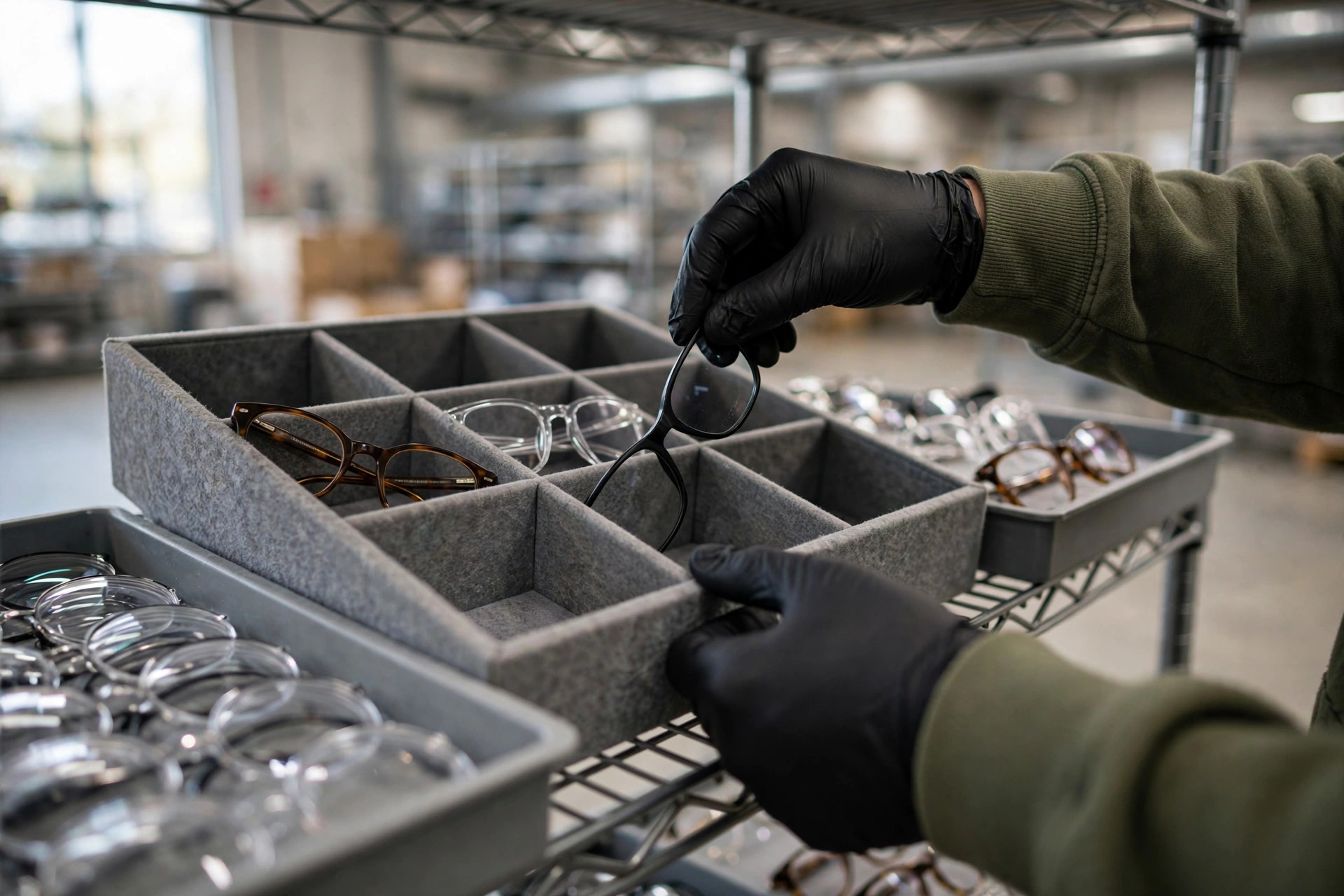
First, stop stacking lenses and start standing them. Each bin should hold only one prescription from one batch, with soft dividers between lenses. The dividers must rise above the edge of the lens. Flocked dividers and silicone pads both work, and neither needs to be expensive. What matters is replacing them on schedule. Once a divider collects dust, it turns into sandpaper. I have watched warehouses where dividers went three months without replacement, and the scratch rate quietly climbed back up.
Second, fix the picking motion: one lens at a time, close the bin lid, then pick the next. It sounds fussy, but it belongs on the go-live-night checklist. In November 2024, an eyewear e-commerce warehouse in Wenzhou, shipping more than 20,000 orders a month, made exactly this change. Lenses had sat in bins 40 centimeters wide, shared by two pickers. Scratch returns ran above 300 orders a month. After switching to bins holding 20 lenses each, adding soft dividers, and enforcing one lens at a time, scratch returns fell below 90 the following month. Smaller bins meant two extra rack bays. I will do the math on that trade below.
Third, bag finished glasses before they go on the shelf. A completed pair, frame plus lenses, should never sit bare in a bin. Slip it into a soft bag first, zipper facing out, and pick it up by the bag, not by the temple arm. Temple arms bend easily under pressure, and a bent pair sits unevenly on the face. The customer usually blames the prescription. In reality, the warehouse bent it.
Preventing Mix-ups in Eyewear Storage: One Diopter Off Ruins the Order
Mix-ups in eyewear are harder to catch than mix-ups in apparel. A wrong shirt color is obvious at a glance. A prescription off by 25 degrees of power may take three days of headaches before the customer realizes something is wrong, and by then the return reason reads "quality problem," which is almost impossible to dispute.
Start with the slotting strategy. Slot frames by style and color, and write three lines on every bin label: model number, color, and size. A label missing any one of the three does not go on the shelf. Slot lenses by prescription range, with left-eye and right-eye lenses in separate bins, never shared. Pupillary distance does not belong on a bin label. Bin labels solve "pick the right item." The prescription form and the order check solve "match it to the right person."
Here is the step-by-step list I hand to warehouses. Follow it in order:
- At receiving, split everything into three streams: frames, lenses, and finished pairs. Count them separately and slot them separately. Never share a pallet between streams.
- Before slotting a lens, verify three values: sphere, cylinder, and axis. If any one does not match, hold the lens. Never slot first and verify later.
- Pick in this order: frame first, then lens. Scan after the frame, scan again after the lens. Both scans must match the order.
- At the packing check station, keep a copy of the prescription form in view. Read each item aloud before sealing the box: left-eye power, right-eye power, pupillary distance, and frame color. All four must match before the label goes on.
- Hold returned lenses in a separate inspection area. Inspection has three steps: check for scratches under a lamp, remeasure the power, and check the coating for peeling. Fail any step, and the lens is scrapped or downgraded. It never goes straight back to sellable stock.
In March 2025, a Guangzhou warehouse supplying brick-and-mortar optical shops learned this the expensive way. A batch of lenses, left eye minus 3.00 and right eye minus 2.75, sat in bins labeled only by prescription range, with no left-right split. A picker pulled two left-eye lenses and shipped them. An optician caught it during a store check, and all 120 pairs in the batch were recalled and remade. Freight and remake costs alone came to more than 40,000 yuan. After that, the warehouse split left and right eyes into separate bins and started reading both powers aloud at the check station. The same error has not happened since.
Doing the Math: What Two Extra Rack Bays Really Cost
Most warehouses cost small-item storage by rent alone. That is the wrong denominator. Using the Wenzhou warehouse numbers: two extra rack bays added 1,600 yuan a month in rent. Soft dividers and bags added 900 yuan a month in consumables. The packing check added about 40 seconds per order, roughly half a full-time worker at 700 orders a day, or about 3,500 yuan a month. Total extra cost: 6,000 yuan a month.
On the other side, scratch and mispick returns fell by 210 orders a month. At 45 yuan per return in freight, remake labor, and packaging, that is 9,450 yuan saved, before counting lost traffic from bad reviews or customer service hours. The prevention costs less than 70 percent of what the returns used to cost. Give up a little density, and the profit goes up, not down.
Here is the counterintuitive part: denser bins are not always better. When a bin is so tight that a picker has to twist a wrist to reach inside, the picking motion breaks down, and scratches and mispicks bounce straight back. Leave enough width for a hand to go in and out flat. It is better to store two fewer lenses per bin than to force an awkward reach. In the end, small-item storage is not a contest over space utilization. It is a contest over how forgiving the picking motion is.
Mistakes I Keep Seeing
- Lenses stored bare or mixed, with only small print on the packaging to tell prescriptions apart.
- Left-eye and right-eye lenses sharing a bin, labeled by range instead of by eye.
- Returns going back to sellable stock without inspection.
- Finished glasses shelved bare, with temple arms bent under pressure.
- Bin labels showing only the model number, with no color or size.
- Packing checks that scan barcodes but never read the prescription form, so pupillary distance errors slip through.
Put all six on the go-live-night checklist and check them off one by one. Do not open the warehouse with one unchecked. Eyewear sits on a person's face. A small error is immediately obvious to the customer. When the small-item math is done honestly, in eyewear warehouse storage as anywhere else, reputation and repeat orders follow.
By Lin Xiao, WMS Implementation Consultant