Asking an embodied AI humanoid robot to pick in a warehouse today is like asking a toddler to run a shift: before you talk about embodied AI, ask how many cases it moves in an hour. On October 26, 2026, GXO and Agility announced that Digit would move into two more warehouses, in North Carolina and Tennessee. But on GXO's earnings call in August 2026, its own CEO said the company had run 45 humanoid pilots and had not earned a return on any of them. The excitement is real. The profit is not. Not yet.
What Embodied AI Humanoid Robots Can Actually Do in a Warehouse Today
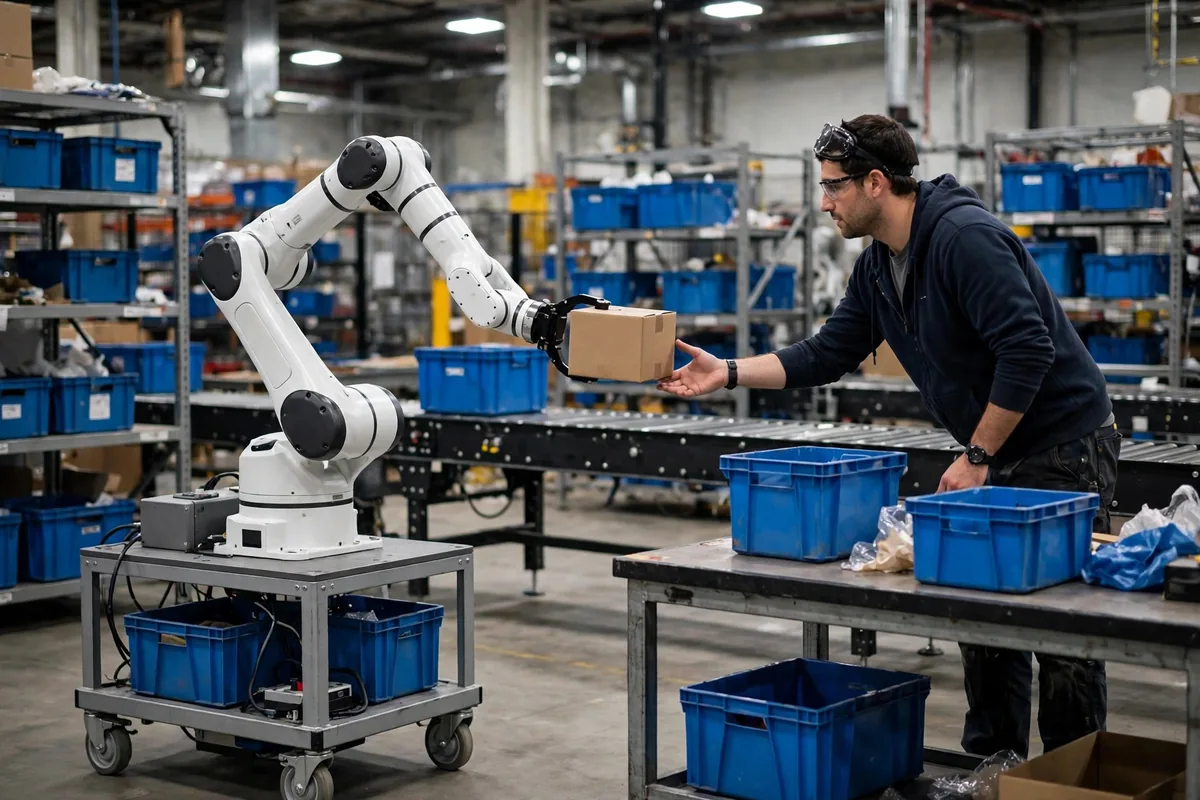
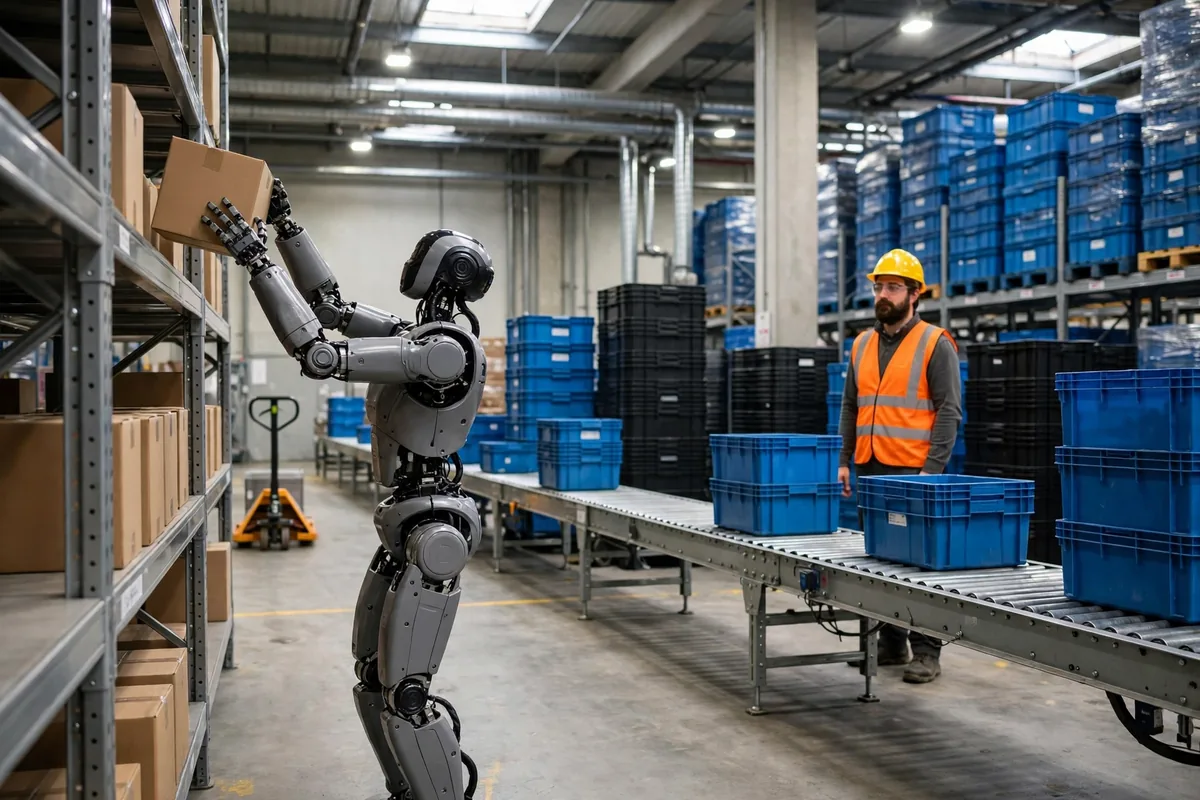
Job one is moving totes, and the robot doing it is Agility's Digit. In late 2023, Digit went live at GXO's Flowery Branch, Georgia facility with a very specific task: lift totes off autonomous mobile robots and place them onto conveyors. In June 2024 the two companies signed a multi-year Robots-as-a-Service agreement, described as the industry's first commercial humanoid contract. By October 2026, Digit had moved more than 100,000 totes at that one site, at roughly 98 percent on-task accuracy, with 65,000 cumulative operating hours. Treat those figures with care: they are company-reported, not independently audited.
Job two is sequencing, and the robot doing it is Figure. Figure 02 spent 11 months at BMW's Spartanburg plant, supporting production of more than 30,000 X3 vehicles by feeding sheet-metal parts into the welding process. In June 2026, its successor Figure 03 moved into logistics sequencing: picking parts from bins and sorting them into trolleys that feed assembly workers just in sequence. Notice what both jobs pick: parts with fixed shapes in fixed positions. Not the wild mix of SKUs in an e-commerce warehouse.
Job three is doing nothing at all, and that is Tesla's Optimus. On Tesla's January 2026 earnings call, Elon Musk said it plainly: the program is still in the R&D phase, and the existing units are doing no productive factory work. The long-term target price of around 20,000 dollars per unit is a goal Musk has stated, not a price list. You can think of it this way: the Optimus in the demo videos cracks eggs, folds laundry, and dances. The Optimus on a real warehouse shift does not exist yet.
Here is the counterintuitive part: the humanoid robot making money today does the dumbest job in the warehouse, moving totes. The smartest jobs in the launch videos, cooking and folding clothes, earn nothing. A job that pays does not need to look human. It needs to be cheap, stable, and always running. Two legs are not an advantage. They are a cost. Wheels are cheaper, steadier, and use less power, and AMRs proved that years ago. Humanoids win because they can use shelves and aisles built for people. They lose because everything about them costs more and runs slower.
The Embodied AI Humanoid Robot Cost Math
Set the rules before you run the numbers: do not compare sticker prices, compare one full year. The table below is a hypothetical worked example to show the method. Actual prices are subject to the latest figures published on each vendor's website.
| Comparison | Human picking station | Humanoid robot | Fixed automation |
|---|---|---|---|
| Totes per hour (assumed) | 120 | 40 | 300 |
| Effective hours per day (assumed) | 7 | 20 | 22 |
| Totes per year (assumed) | About 300,000 | About 290,000 | About 2.4 million |
| What it fears | Hiring gaps, night-shift turnover | Charging, breakdowns, exception cases | Slow changeovers, expensive reconfiguration |
The robot wins on hours and loses on pace. Digit 4 runs on roughly a 2-to-1 charge ratio, about 30 minutes of work followed by 15 minutes of charging, so a third of its day sits at the charger. Digit 5, unveiled on September 15, 2026, runs 90 minutes on a 9-minute charge and lifts 50 pounds, but general availability is not expected until late 2027. Low pace plus long hours is the only way the yearly tote count breaks even with one human. That is the arithmetic behind the GXO CEO's remark: 45 pilots, zero returns so far, and a payback still a couple of years out.
The selection line sits here: single repetitive task, uniform totes, modest pace requirements, an embodied AI humanoid robot pilot is worth discussing. Variable tasks, odd-shaped items, exceptions every day, put wheeled AMRs and fixed automation first and do not use a humanoid as the test subject. Before you buy, ask the vendor one question: is the contract priced on availability or on units purchased? Availability pricing makes downtime the vendor's problem. Buying units makes it yours.
What Is Still Missing Before the Money Works
The first gap is the hand. Dexterous handling, odd-shaped items, damaged boxes, goods left crooked, that is the daily reality of warehouse picking, and no vendor has published an independently audited success rate for it. Demos pick neatly placed standard parts. Warehouses pick up the mess the last shift left behind.
The second gap is uptime and endurance. Digit 4 works 30 minutes and charges for 15. Digit 5 improves the ratio to 10-to-1 but does not reach general availability until late 2027. Mean time between failures and uptime figures are not public, so before signing, ask the vendor for 30 days of continuous operating data.
The third gap is safety and liability. Safety standards for mixed human-robot work, guarding, insurance, and who carries the blame when something goes wrong all need to be written into the contract before anything goes live, not discovered afterward.
The fourth gap is price transparency. Neither Figure nor Agility publishes a price, and the 20,000-dollar Optimus figure is a target, not a quote. Without a price there is no return calculation, and without a return calculation the only sensible posture is to rent, not buy. Pay for availability.
If you want to pilot one, pass five questions before spending: is the task single and repetitive? Is there a cheaper wheeled option that can do it? Can you accept teleoperation as a fallback? Is the contract priced on availability or units? Is safety liability settled in writing? Answer all five and talk pilots. Miss one and keep the money on AMRs.
Whether an embodied AI humanoid robot is worth the money comes down to one number: a single robot moving totes steadily for 30 days straight, 20 hours a day, no stops, no human rescue. Hit that and we can talk about buying. Miss it and the launch video is all you get.
By Da Liu, Automation Engineer