Here is the conclusion up front: in the Egyptian cotton export warehouse business, the money is not in freight and it is not in rent. It is in moisture and grading. Put simply, once a bale of Giza cotton leaves the Nile Delta fields for a container at the port of Alexandria, any slip on moisture or any mix-up of grades knocks the whole shipment down a price tier. There are two sides to this. On one side, Giza is among the most expensive cottons in the world. On the other, it is also among the most delicate. Get sloppy in the warehouse and the premium evaporates.
I have seen too many people store Egyptian cotton like ordinary cotton. With ordinary cotton, a bit of color loss or a grade slip costs you a little. Giza is different. Its entire premium rests on fiber length and color grade, and what the warehouse loses, no spinning mill can put back.
Egyptian Cotton Export Warehouse Rule No. 1: Moisture Decides the Price
In October 2018, harvest season was in full swing in Sharqiya province, in the eastern Nile Delta. Farmers there were pulling 10 to 12 kantars per hectare, with each kantar fetching 2,500 to 2,700 Egyptian pounds. That same season, ALCOTEXA, the Alexandria Cotton Exporters' Association, expected long-staple exports of around 65 million kilograms, worth roughly 150 million US dollars. Those are solid numbers, but notice one detail: that 65 million kilograms only counts cotton that passed inspection at its stated grade. Shipments that fail inspection never make it into that figure.
Moisture is the first gate. Research from the USDA Agricultural Research Service puts it plainly: the best moisture for seed cotton cleaning and ginning is 6 to 7 percent on a wet basis. Bale storage above 8 percent moisture degrades fiber color during long-term storage, and the National Cotton Council recommends 7.5 percent as the maximum moisture level for cotton bales. Another storage study is even more direct: bales should not be stored above 7.3 percent moisture, regardless of the bale covering. Alexandria sits on the Mediterranean, the air is humid, and a bale left in a warehouse without moisture control gains moisture over a few weeks. It does not lose it.
So the first rule of Egyptian cotton export warehousing is this: test moisture at receiving, dry anything out of spec before it goes into storage, and never let a shipping deadline talk you into skipping the test. It sounds obvious, but I have seen too many warehouses skip it to catch a vessel, only for the CATGO inspection report to come back with moisture out of spec and the whole lot held up for renegotiation at destination. CATGO is the Cotton Arbitration and Testing General Organization of Egypt, and every export lot passes through its grading and testing, with certificates covering grade, HVI fiber testing, and moisture. Whatever the certificate says is what the buyer pays for. Whatever shortcuts the warehouse took are worth nothing against that piece of paper.
Grading: Giza 87 and Giza 86 Are Not the Same Price
Egyptian cotton comes in two tiers. Extra-long staple (ELS) runs over 35 millimeters, with Giza 87, Giza 96, Giza 92 and Giza 93 as the representative varieties. Long staple (LS) runs 30 to 34 millimeters, with Giza 86, Giza 94, Giza 95 and Giza 90. The price gap between those two tiers is exactly the money a warehouse is most likely to throw away.
The trap is mixed lots. Bales from the gin all look alike, and in a busy yard Giza 87 bales end up stacked next to Giza 86 bales. A forklift driver in a hurry grabs the wrong one, and a few low-grade bales slip into a high-grade lot. The buyer does not pay the Giza 87 price because 90 percent of the lot is Giza 87. He pays the lower grade, because that is what the mixed bales are. The trade-off is clear: separate stacking, separate labels, separate records cost extra labor and extra floor space. Mixing saves that effort, but the labor saved is nothing next to the premium lost to a downgrade.
There is also a contractual layer. Every export sales contract must be registered with ALCOTEXA and executed under the season's Export Selling Conditions. That makes the warehouse part of contract performance, not a place where things can be handled flexibly. Location, batch, grade and certificate: if those four do not line up, the contract cannot be executed cleanly.
Here is a worked example, labeled as a hypothetical illustration: take a lot of 100 bales of Giza 87, roughly 250 kilograms per bale, about 25 tonnes in total. If 10 of those bales are out of spec on moisture or mixed in from the wrong grade, the lot gets downgraded at destination, and what you lose is not the price difference on those 10 bales. It is the grade premium on all 100. Set against that, the cost of moisture testing, separate stacking and rechecking is almost nothing per bale. Once you run that math, you see the warehousing fee for Egyptian cotton is not a storage charge. It is an insurance premium.
Egyptian Cotton Export Warehouse: From the Gin to Alexandria
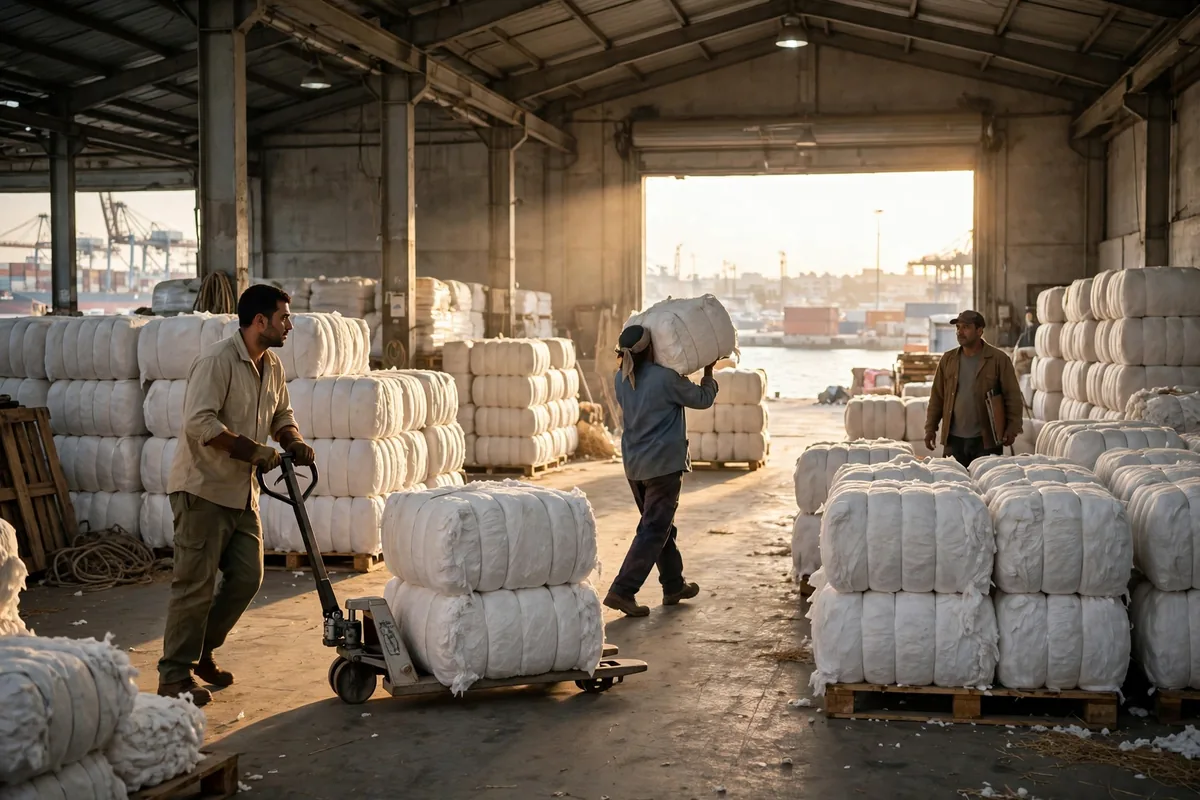
Harvest generally runs through September and October. Cotton comes off the fields, goes to the gin where seed is separated from fiber, gets pressed into bales, passes CATGO grading and testing, and then enters the export warehouse before consolidation at Alexandria. The documents travel with the goods: CATGO grade and HVI certificates, moisture certificates, certificate of origin, packing list and weight certificate. Miss one and the shipment can stall at destination.
Consolidation deserves the same discipline. Bales of different varieties, grades or batches packed into one container become indistinguishable once the doors close. When the container is opened at destination and the grades do not match the paperwork, the dispute costs far more than shipping separately would have. My rule is simple: one container holds one variety, one grade, one batch, and the container number, batch number and certificate number all go on the same packing list, with the warehouse, the forwarder and the buyer all holding the identical document. It costs no money, only patience, and it prevents the most expensive arguments later.
Here is the counterintuitive part: most people treat warehousing as a cost center to be squeezed. For Egyptian cotton, the warehouse is where the price is set. Moisture, grade and certificates are all decided in the warehouse. Freight and rent are the visible costs. Downgrading is the invisible one, and the invisible one is usually bigger. Anyone who has worked this trade knows it: the profit on a container of Giza cotton is protected by the warehouse, not negotiated by the forwarder.
So the next time someone tells you Egyptian cotton warehousing is just finding a shed to stack bales in, ask one question: did you test the moisture, and who issued the grading certificate? If they cannot answer, do not take the shipment.
By Lao Mi, Supply Chain Veteran (20 yrs)