Egypt exported about 126,000 tonnes of mangoes in 2025 through the Egypt mango export cold chain, according to the country's Ministry of Agriculture. Set against a national harvest of roughly two million tonnes grown on more than 100,000 hectares, the export figure looks modest. That modesty is the point. The Egypt mango export warehouse cold chain does not exist to move volume; it exists to decide which fruit is good enough to travel, and to keep it that way for the two weeks it takes to reach a European shelf.
Trade data tells the same story in a longer arc. In 2023, Egypt shipped 72,520 tonnes of fresh mango worth about USD 133.6 million, under HS code 080450. By 2025 the volume had reached 126,000 tonnes. The growth is real, and it is uneven: in the 2024/25 season, Turkey's mango imports from Egypt roughly quadrupled, putting Turkey among the top seven destinations. When new demand arrives that quickly, the cold chain's margin for error shrinks just as fast.
Small export volume, large Egypt mango export cold chain bill
Ismailia is Egypt's flagship mango governorate. The province alone carries around 120,000 acres of mango, roughly 36 percent of the national area, and accounts for about 40 percent of export volume. The old Delta orchards and the newer reclamation blocks of Nubaria add volume behind it, and the season is staggered from south to north: Aswan picks first, Ismailia runs its main harvest from mid-August into October, and Keitt carries the late season into November and even December. The first test of the Egypt mango export warehouse cold chain comes within hours of picking.
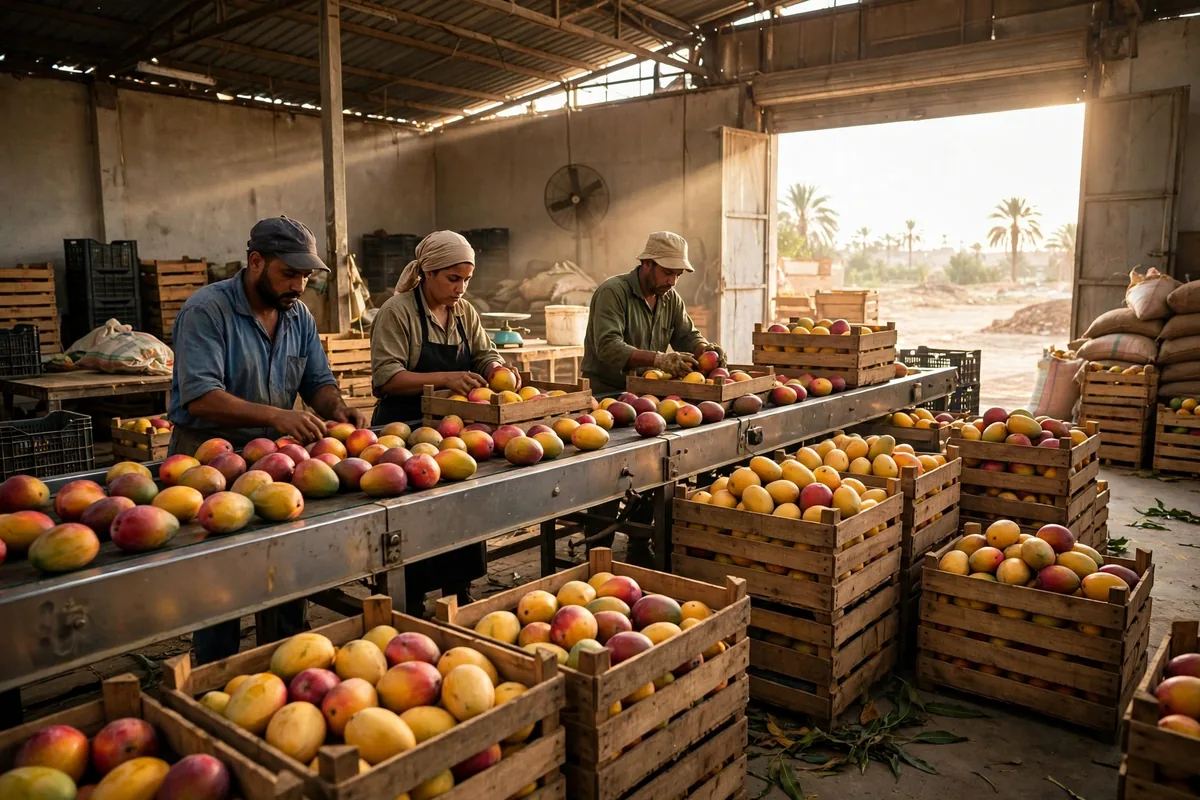
A night shift at an Ismailia packhouse in September 2025 shows what that test looks like in practice. Kent mangoes picked in the afternoon went through the grading line by evening, packed into 4 kg telescopic cartons, foam-netted piece by piece, 264 cartons to a pallet, and then into the pre-cooling room until the pulp temperature reached 10 to 12 degrees Celsius. Only then was the fruit allowed into the container. There is no shortcut here. A reefer container is built to hold a temperature, not to pull one down, and fruit loaded warm carries its over-ripening risk inside the box with it.
The arithmetic of one container looks roughly like this (illustrative example):
| Item | Value (illustrative example) |
|---|---|
| Container | 40 ft reefer |
| Load | 20 pallets, 264 cartons of 4 kg per pallet |
| Gross weight | About 19 tonnes (midpoint of the 18–20 tonne range) |
| Cargo value | About USD 19,000, at roughly USD 1,000 per tonne, the midpoint of the 2024 season FOB range |
| Cost of a break | A 5 percent downgrade on arrival, about USD 950 |
The point of the table is simple: this cold chain is not priced per container. It is priced per degree.
In the Egypt mango export cold chain, what mangoes fear is not heat. It is cold.
Here is the counterintuitive part. The biggest enemy of the Egypt mango export warehouse cold chain is not high temperature; it is low temperature. Keitt and Kent have a chilling injury threshold of 10 degrees Celsius. Below it, the fruit does not freeze. It is injured slowly, from the inside: grey lenticel scald on the skin, uneven ripening, flesh that turns patchy days later. Worse, the damage has a latency period. Exporters have documented loads carried at 6 degrees for twelve days that looked acceptable when the doors opened, then turned grey and blotchy 48 hours later in the ripening room, and the whole container was downgraded.
That is why sea freight set points for these varieties are normally 10 to 12 degrees Celsius, with relative humidity of 85 to 90 percent and fresh air exchange of 15 to 25 cubic metres per hour to vent ethylene and carbon dioxide. Keitt is a green-skinned variety, so maturity cannot be judged by colour; it has to be set by internal indicators at harvest, and if that call is wrong, no temperature control downstream can rescue the load. The international standard ISO 6660 points the same way, recommending around 13 degrees for Keitt in storage for two to three weeks. The logic is consistent: better to let the fruit ripen slowly on the water than to chill-injure it in the cold room.
The real cost sits in the calendar, not the freight rate
Sailings from Alexandria and Damietta to the main Mediterranean and northern European ports normally run 7 to 14 days. The harvest stretches from June into early November, commercial exports concentrate in August to November, and September to October is the peak. The window is only that long, so the variety schedule is the timetable: Kent from August to October, Keitt from September to December, the late varieties holding the tail of the season. When one variety runs late or one region runs early, the cold chain plan has to move with it.
One more figure deserves a place in the picture. Market research estimates post-harvest losses across Egypt's mango value chain at 20 to 30 percent of production, with inadequate cold chain as a leading cause. The estimate itself carries a wide range, but the attribution behind it is stable: losses do not happen evenly. They concentrate in post-harvest handling and pre-cooling, not at sea. In other words, the money is best spent on the few dozen kilometres between the orchard and the packhouse, not on a more expensive container.
The trend, for now, points upward: from about 72,500 tonnes in 2023 to 126,000 tonnes in 2025, with the increment coming mainly from the Gulf, Europe, and new demand such as Turkey. One question remains unanswered, and it will decide whether that trend holds: as export volumes keep climbing, can pre-cooling capacity in the Delta and Ismailia, and the night-shift throughput of the packhouses, keep pace with the same curve? The bottleneck in this cold chain was never at sea. It was always on shore, and the next season will have to answer for it.
If you are booking space for next season, the cheapest insurance is a short checklist agreed with the packhouse before the first truck leaves the orchard: confirm the pre-cooling start time in writing, agree who signs off the pulp temperature at loading, and reserve reefer plugs at the port a week earlier than you think you need them. None of these steps costs money. Each of them is the kind of detail that decides whether a container arrives as a premium shipment or as a claim file.
By Dr. Chen, Supply Chain Researcher