Let me be straight with you: in the Ecuador fine cocoa export warehouse business, the money is not made on selling beans. It is made on two things, grading and traceability. In 2024, Ecuador exported close to 398,000 tonnes of cocoa beans worth about 3.1 billion dollars, and fine cocoa is the name this country is known by around the world. But the louder the name, the finer the warehouse work has to be. One bag graded wrong, one lot mixed up, and the premium a fine-cocoa buyer was willing to pay is gone on the spot.
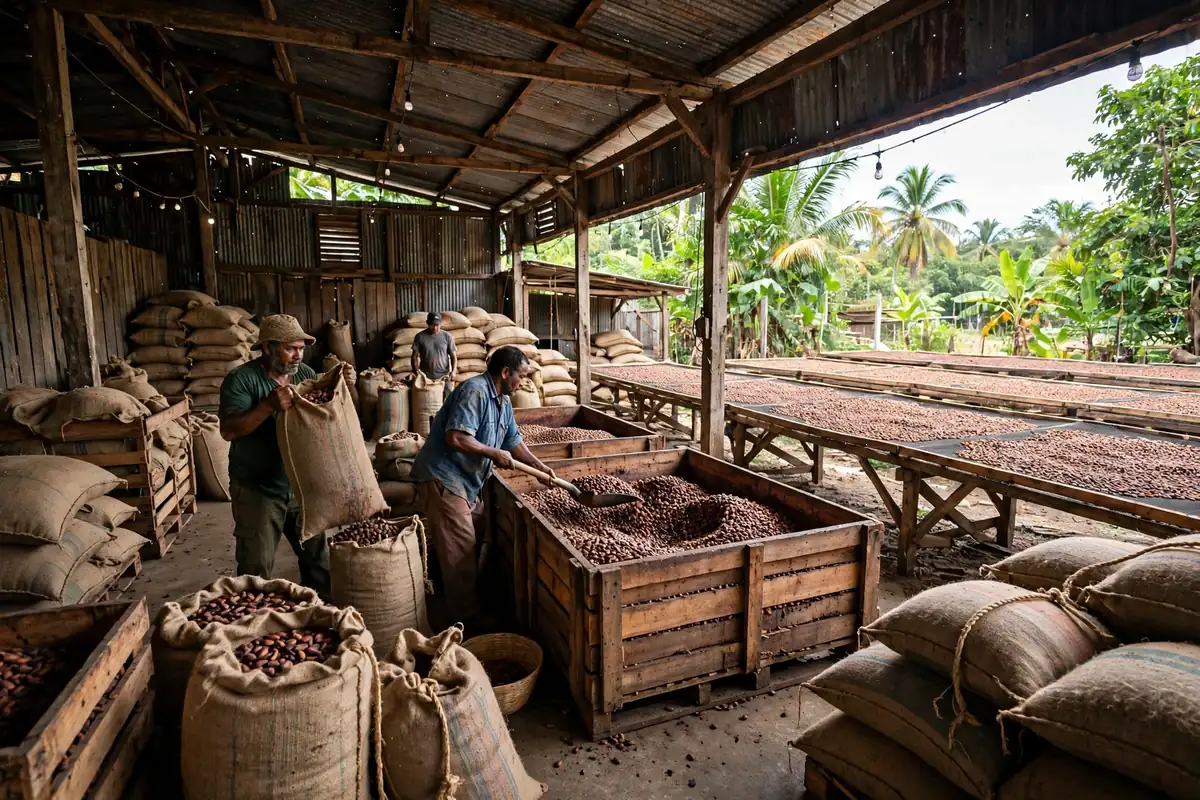
In March 2025, a delivery from a cooperative in Los Rios province arrived at our warehouse near Guayaquil Port. Jute sacks, 69 kilos each, stacked neat as bricks, paperwork saying fine cocoa. The buyer's inspector cut open a few beans and frowned: fermentation was short, and mouldy beans were mixed in. That lot dropped from fine grade to ordinary grade right there on the floor, and the cooperative felt that lost money for half a year. Brothers, the problem was not the port and not the sailing schedule. The problem started beside the fermentation boxes, in the one minute at receiving when nobody pushed back.
Ecuador Fine Cocoa Export Warehouse: Grading Comes First
Ecuador is the world's largest producer of fine-flavour cocoa, and Arriba is its calling card. UNIDO's material notes that Ecuador accounts for over 60 percent of fine-flavour cocoa of the Arriba variety. National cocoa production passed 375,000 tonnes in 2023, with Los Rios, Guayas and Manabi as the main growing provinces. The numbers look good on paper. The grading work in the warehouse is anything but glamorous.
Fine cocoa and ordinary cocoa are not separated by a variety name. They are separated by what the beans actually look like after fermentation, drying and the cut test. Beans from the same field come out at a different price if they spend one day too many in the fermentation box, or if one rainstorm hits the drying beds. The way we do it in our warehouse now is fixed: every incoming lot gets sampled and cut first, checking fermentation, mould and foreign matter, and anything over the moisture line goes to its own corner, never stacked with the good beans. If the grade is not set at the moment of receiving, nobody can save it later.
Here is the part that goes against common sense: grading finer does not mean earning more. Some warehouses split beans into five or six grades, beautiful on the shelf, and then cannot fill one container when it is time to consolidate. Small odd lots sit in the warehouse taking up space, getting moved back and forth, and the labour cost eats the premium before the container even leaves. To be honest, for fine cocoa, grade down to the level the buyer recognises and the container can be filled with, and leave the rest of the fine work to the buyer.
Ecuador Fine Cocoa: From Fermentation Boxes to Guayaquil Port, How Lot Traceability Works
Traceability sounds like a system feature. In practice it is three pieces of paper: the fermentation record, the drying record, and the receiving record. The fermentation box number is written down, with the day the beans went in, the days they were turned, and the day they came out. The drying bed record says which lot, how many days in the sun, and whether it rained in between. At receiving, the lot card travels with the sacks, and pallets are stacked by lot, not by arrival order. When those three records match, a buyer can ask about a lot and we can walk it from start to finish in ten minutes.
In December 2024, the international cocoa price hit 12,000 dollars a tonne, a record high. Plenty of people rushed the harvest and the drying that season, and some beans arrived at the warehouse before fermentation was finished. We took in one such lot: paperwork complete, beans looking fine, but the fermentation record was missing two turning times, so the inspector put the whole lot on hold. It sat on its pallet position for two full weeks while records were completed and samples re-tested. When prices are through the roof, the most expensive thing in a warehouse is not the beans. It is time you cannot afford to wait.
Guayaquil is Ecuador's main gateway port. Official figures put its 2023 throughput at 10.6 million tonnes of cargo and 1.2 million TEU. From the warehouse to the port, through customs and onto the ship, lot information has to travel with the goods at every step. The European Union keeps tightening its traceability requirements, and for policy detail, go by the latest official rules. What the warehouse can do never changes: a lot with unclear traceability does not leave the building, and a container where goods and paperwork do not match does not get loaded.
The Consolidation Math Fine Buyers Actually Care About
When fine buyers consolidate a container, they are not chasing the cheapest freight. They are chasing consistency. A small fine-cocoa order is often beans from several cooperatives packed into one container, and the warehouse job is to bring grade, lot and delivery date together. Get it wrong, and the buyer tests the delivery and the reputation of the whole container is gone. That is the daily work of an Ecuador fine cocoa export warehouse: grade it right, keep the lot together, and fill the container with beans the buyer will recognise.
Here is a hypothetical example to run the numbers on. Take a 25-tonne container. If the grade is called right, the premium covers the extra cost of inspection, separate stacking and lot management, with something left over. If the grade is called one level wrong, the whole container settles at the ordinary price, and all that extra warehouse work is wasted. The figures are a scenario illustration, and real price gaps follow the market at the time, but the logic does not change: before taking an order, work out how much of the grading premium your warehouse work will consume.
| 25-tonne container, hypothetical example | Grade called right | Grade called one level wrong |
|---|---|---|
| Settlement price | Paid at fine grade | Paid at ordinary grade |
| Extra warehouse labour | Inspection plus separate stacking, cost under control | Same work spent, premium gone |
| Result | Premium covers the cost, with margin left | A wasted effort |
The numbers in this table are a hypothetical example, a scenario illustration, not market quotations. Run this table against your own costs before taking an order. It beats arguing about it at the port.
One reminder for fellow warehouse people: next time you take a fine cocoa order, ask three questions first. Are the fermentation records complete? Did the lot card stay with the sacks? Is this lot enough to fill a container? If any of the three is unclear, take one extra day at receiving rather than rushing the goods to Guayaquil Port. One slow day in the warehouse can save three days at the port.
By Chen Feng, Warehouse Operations Manager