Here is the ugly truth about ecommerce dimensional weight shipping cost: your parcel can be light as a feather and still bill like a brick. I learned that the hard way. The first time I saw a DIM weight invoice, I thought the carrier had made a mistake. The product weighed under two pounds. The bill charged me for almost seven. Customer service was polite and completely unhelpful: for light, bulky parcels, carriers charge for volume, not for actual weight. That day I stopped thinking about shipping as a weight problem. It is a box problem.
In March 2025, I was selling a storage box on a US marketplace. The product itself weighed about two pounds. Once packed, the outer carton measured roughly 13 by 10 by 9 inches. The dimensional weight came out well above the actual weight, so the billable weight followed the dimensional weight. That month I shipped more than 1,800 orders of that one product, and the per-order shipping cost ran far above my original budget. My advertising cost of sales was sitting around 22 percent, which looked fine on its own, but once the shipping overrun hit, it ate roughly half the profit on the product. I did not lose on product selection. I lost because I never did the DIM weight math before I priced the listing.
How Ecommerce Dimensional Weight Shipping Cost Actually Works
The logic is simple once you say it out loud. A truck and an aircraft sell space, not just lifting capacity. A big, light box takes the slot another parcel could have used, so the carrier charges for the space it occupies. Billable weight is whichever is greater: actual weight or dimensional weight. That is the whole rule, and it punishes exactly the kind of product many new sellers love to sell: light, bulky, and easy to source.
One important caveat before any numbers. Every carrier sets its own DIM divisor and billing rules, and those rules change. Always check the carrier's official policy for the current terms. The figures below are worked examples only, meant to show the logic, not to state any carrier's current divisor as fact.
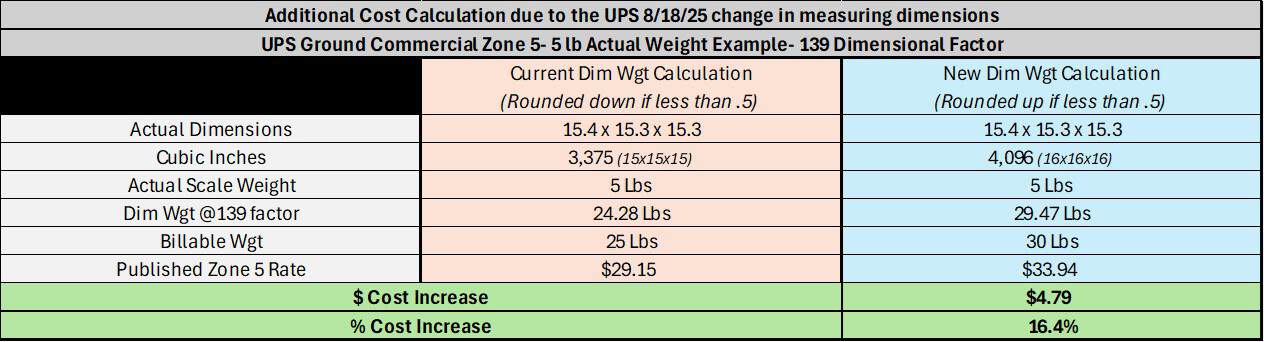
Here is a worked example. Take a carton measuring 12 by 10 by 8 inches. That is 960 cubic inches. Using an example divisor of 139, the dimensional weight comes to about 6.9 pounds. If the actual weight is only 2 pounds, the billable weight is 6.9 pounds. You shipped two pounds of product and paid for almost seven. Make the box one inch bigger on each side and the gap gets worse fast. Most sellers build their cost sheet from product weight and inbound freight, then forget this outbound step entirely. Their profit table is wrong from the first row.
I now have a boring rule that saves me real money. Before any new listing goes live, I measure the packed carton on all three sides, work out the dimensional weight, and only then set the price. I usually stock about 45 days of inventory, and I cost shipping on billable weight, never on actual weight. Ten annoying minutes up front beats a whole quarter of quietly losing money.
Three Moves That Cut My Ecommerce Dimensional Weight Shipping Cost
Move one: change the box. For that storage box, I went from a carton of about 13 by 10 by 9 inches to one of about 12 by 9 by 7 inches, with a tighter insert that actually held the product more securely. Volume fell by roughly 29 percent, billable weight fell with it, and in my worked example the per-order outbound cost dropped by about 18 percent. Across 1,800 orders a month, that saving paid for two extra weeks of advertising. Nothing about the product changed. Only the box changed.
Move two: stop assuming that combining parcels always saves money. In November 2025, during peak season, a friend selling plush toys and pillows learned this the expensive way. Each item was light but bulky. He combined two items into one big carton to save a shipment, and the combined dimensional weight cost more than shipping them separately. He switched to a simple test: price the single-box option and the split-shipment option on billable weight, then pick the cheaper one order by order. His average shipping cost per order fell by about 12 percent that peak month. Combining is not always cheaper. Splitting is not always wasteful. Run both numbers and let the math decide.
Move three: put the box check before dispatch, not after. My packing team now writes the three carton dimensions and the billable weight on the pick sheet, and any oversized carton gets flagged for review before it leaves the warehouse. It used to be that we discovered the wrong box after the parcel had shipped. Now we catch it before it ships. Returns did not rise when I moved to the smaller carton, because the insert and cushioning were redesigned at the same time. I did not just cram the product into a smaller box. I repacked it properly.
| Option | Outer carton | Billing logic | Worked result |
|---|---|---|---|
| Original packing | About 13 by 10 by 9 inches | Dimensional weight above actual weight | Billed on dimensional weight, higher per-order cost |
| Repacked carton | About 12 by 9 by 7 inches | Volume down roughly 29 percent | Worked example: per-order cost down about 18 percent |
| Blind combining | Two items in one large carton | Dimensional weights stack up | Sometimes costs more than shipping separately |
Three Traps That Eat the Savings Back
Trap one: smaller is always better. That is wrong. Squeeze the carton too tight and the product arrives scuffed, dented, or crushed. One return wipes out the shipping saving, adds return handling cost, and can easily add a bad review on top. The floor for packaging is not the smallest box that closes. It is the smallest box that still delivers the product in perfect condition.
Trap two: looking only at outbound shipping. Some sellers split an order into two parcels to cut dimensional weight, and the outbound quote does look cheaper. But they have added a second sort, a second delivery, and twice the chance of a lost parcel or a customer complaint. The real cost is shipping plus returns plus customer service time. Count all three or the saving is an illusion.
Trap three: pricing from last year's rules. DIM divisors, billing rules, and surcharges change. A template that worked last year can quietly stop working this year. I recheck the carrier's official policy every quarter and update my templates when the rules move. A seller who prices from an old template is pricing blind.
Here is the counterintuitive part most sellers miss: sometimes spending a little more on packaging makes you more money. A better insert costs a few cents extra per order. If it cuts the damage rate by even one percentage point, the returns and replacements it prevents are worth far more than those few cents. Your real enemy is not packaging cost. It is return cost and review cost. Once you cost packaging all the way through to returns, the decision changes completely.
So my playbook is short. Before launch, do the DIM weight math, and if dimensional weight beats actual weight, change the box. Before dispatch, check the carton, not just the product. Every quarter, recheck the carrier's official policy and stop pricing from an old template. And when you repack, redesign the protection at the same time, because a cheap box that breaks products is the most expensive box you will ever ship. This trick actually worked for me.
By Ah K, E-commerce Seller (5 yrs)