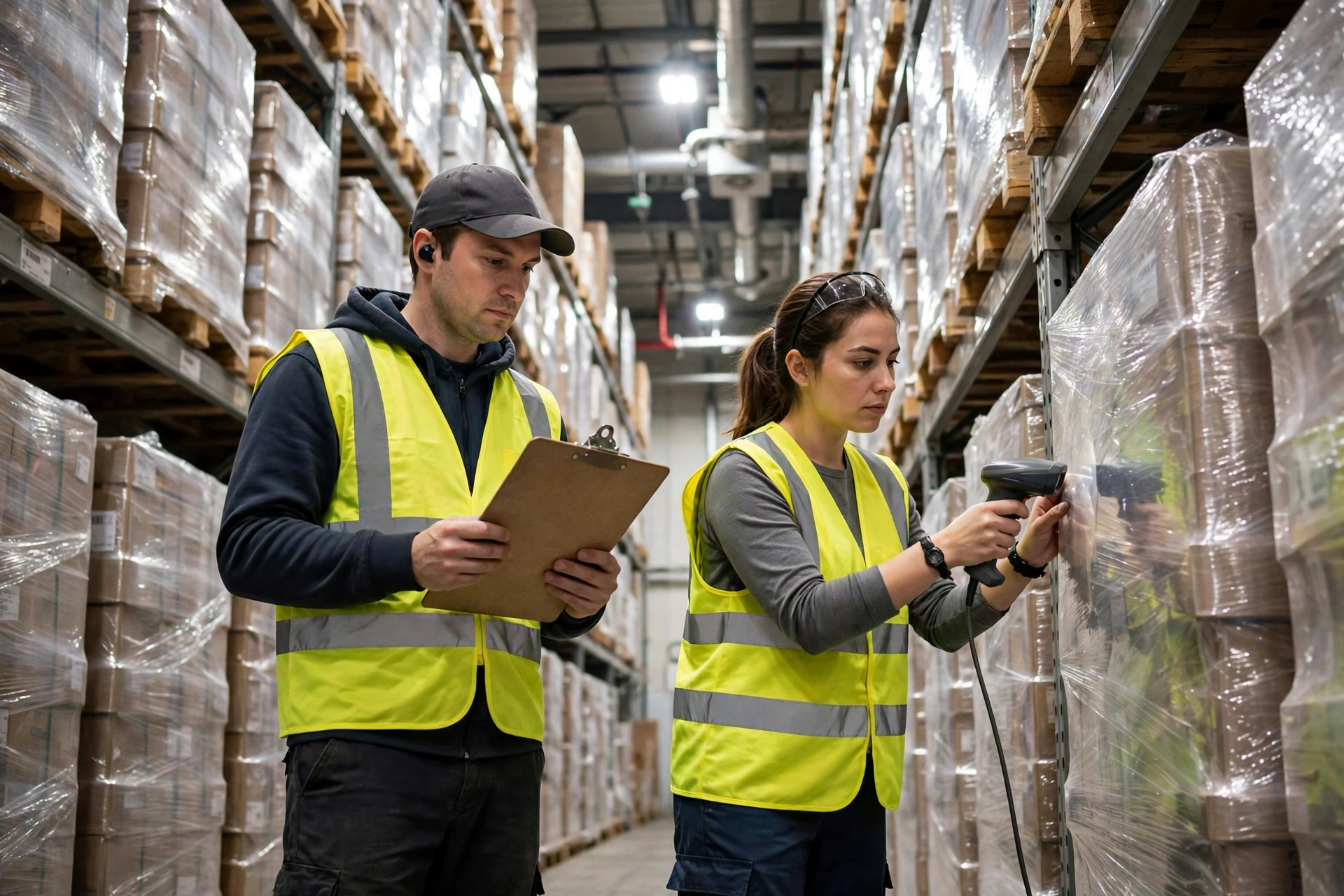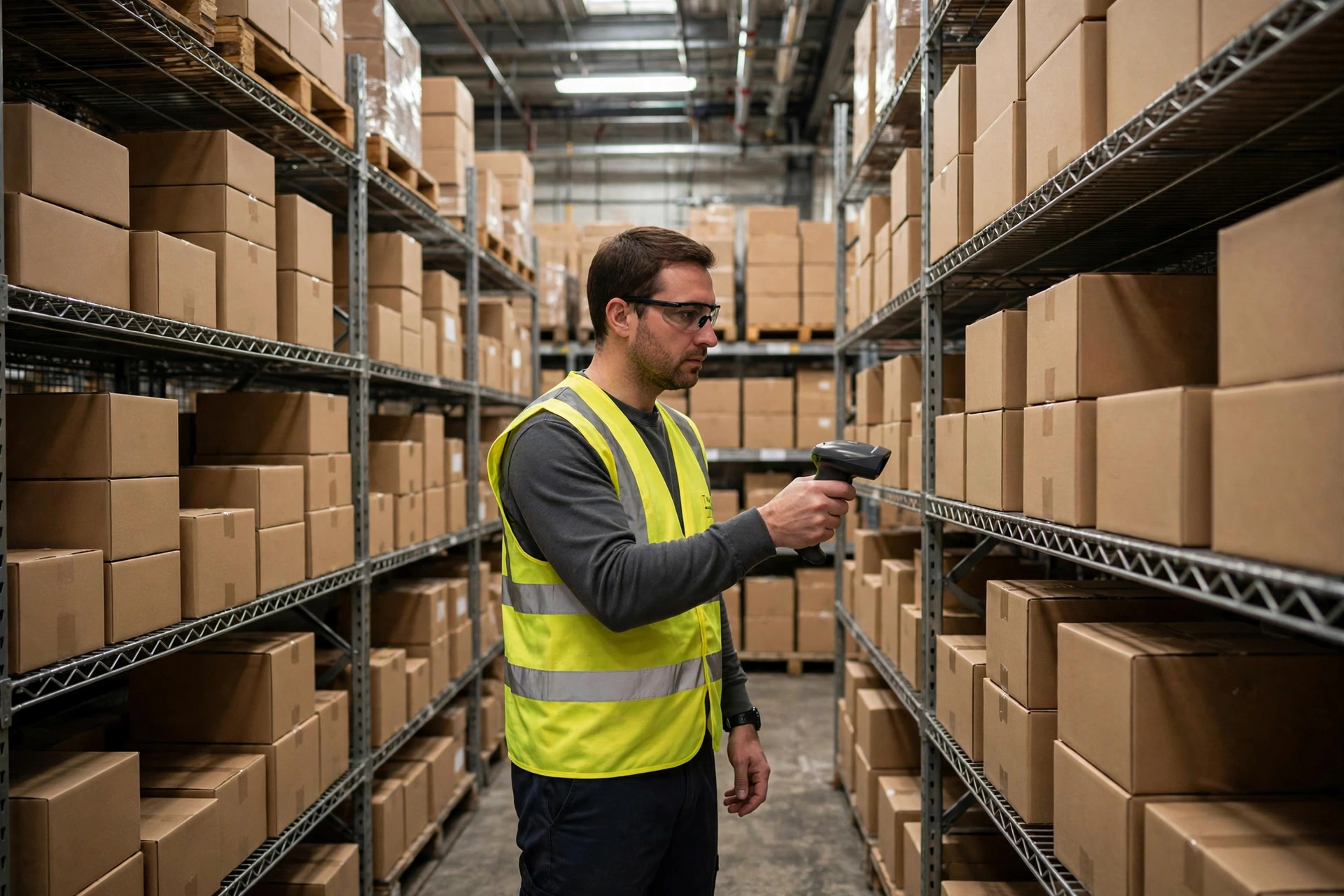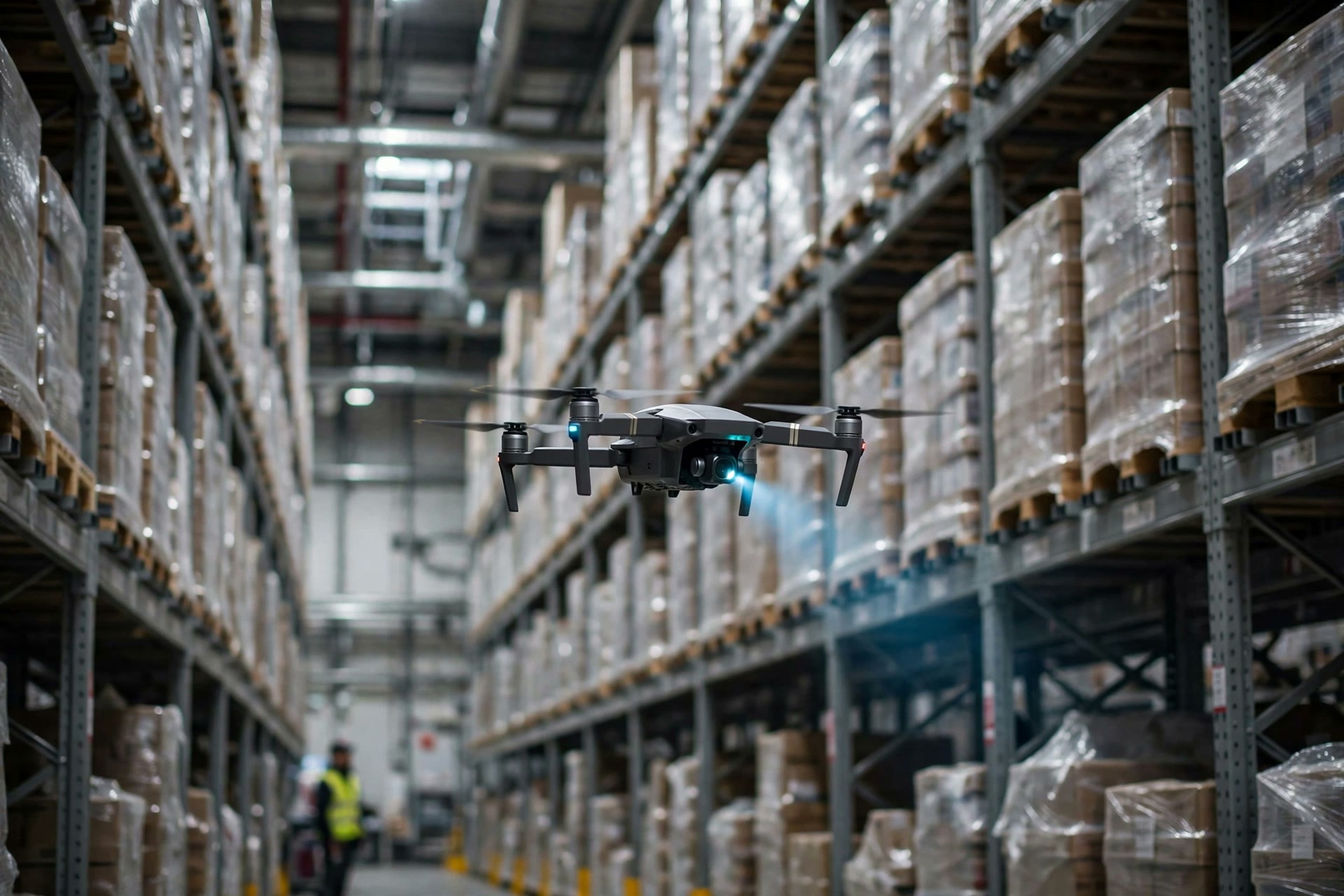
Cycle counting, one of the oldest crafts in warehousing, has started to fly. At recent industry expos, the drone-counting booths draw the biggest crowds; in logistics promotional films, the shot of a drone gliding past high-bay racking while reading location barcodes has become the standard visual shorthand for the "smart warehouse." But looking good in flight is not the same as counting well. How accurate is drone-based AI inventory counting, really — and can human verification actually be eliminated?
Let's start with what problem the drone is actually solving. Traditional high-bay counting is punishing work: counters ride lift equipment up level by level, or crane their necks aiming long-range scanners at labels ten meters overhead. It's slow, ergonomically brutal, and working at height carries genuine safety risk. The drone's pitch is straightforward — it does the climbing, flying pre-planned routes aisle by aisle, reading location barcodes with onboard cameras and feeding results back to the inventory system. On paper, the human seems ready to exit. In practice, the picture is considerably more complicated.
Two pilots, two endings
According to public reporting, a large European retailer's regional distribution center introduced counting drones for high-bay cycle counts about two years ago. The effect was visible: high-bay zones that once required scheduled shifts, lift equipment, and several days to cover are now flown on a routine plan in a fraction of the time. What deserves attention, though, is what the company did not do — it did not eliminate the human step. The drone's output is a "suspected variance list"; final confirmation and adjustment still belong to human counters. The machine scans, the human judges. The division of labor is explicit.
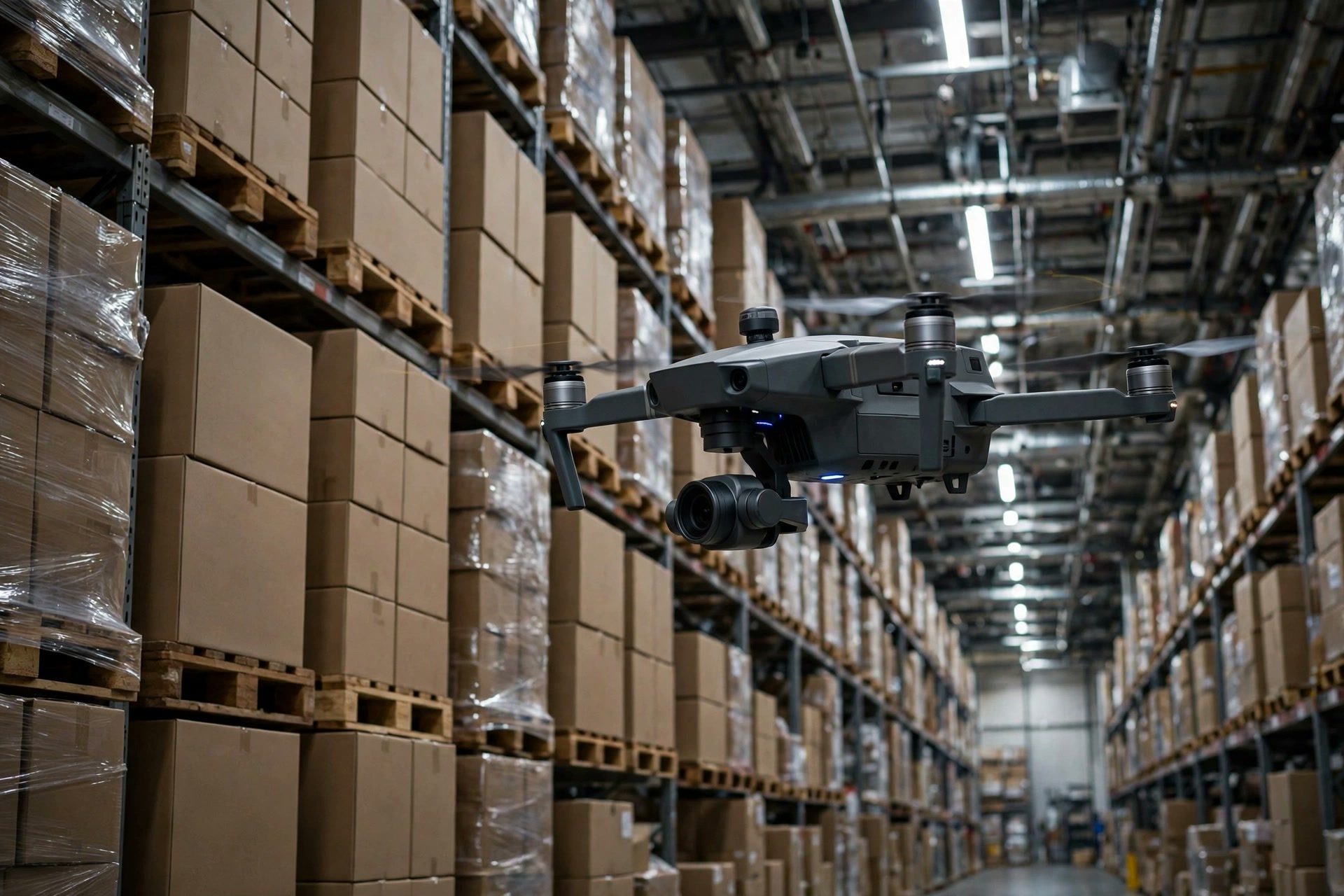
A second pilot, described in an industry exchange from a major Chinese e-commerce fulfillment center, ended differently. Three realities surfaced: GPS is unusable inside narrow aisles, so the drone relies on visual positioning — which drifts in environments where rack textures repeat endlessly; some products ship in reflective film packaging that onboard cameras cannot read at certain light angles; and during promotional seasons, slotting changes so frequently that the system's location map no longer matches the physical racks. The first round produced enough false positives that human re-verification workload actually rose. The project survived, but its scope shrank to zones with standardized barcodes and stable slotting.
Taken together, the two cases point to the same conclusion: whether drone counting succeeds rarely depends on the flying — it depends on whether the warehouse environment was prepared for it.
Three roots of the accuracy debate: misreading, mislocating, and the inability to act
Based on publicly available technical discussion and pilot feedback, disputes over drone counting accuracy trace to roughly three layers.
The first is misreading. Counting is, at bottom, recognition — identifying the location, reading the barcode, verifying the quantity. Onboard camera read rates depend on lighting, barcode reflectivity, damaged or wrinkled labels, and occlusion. A warehouse is not a photo studio; light conditions are messy, and barcodes are among the most fragile data carriers in the building — applied slightly crooked, wrinkled, or half-covered by stretch film, and recognition fails. A note on data discipline: vendors' publicly claimed read-rate figures vary widely in methodology, and there is a lack of independently verifiable third-party benchmark data, so this article cites no single accuracy number. Readers should treat such marketing claims with reserve.
The second is mislocating. With no GPS indoors, drones navigate by visual SLAM or pre-placed beacons, and positional drift is common in environments as repetitive as racking. Drift itself is manageable; what is dangerous is reading the right goods into the wrong location — logging A's quantity under B's address. That error is more insidious than a missed read, and far harder to untangle after the fact.
The third is the inability to act. A drone that finds a variance can only flag it. An extra carton, a missing carton, a mis-slotted pallet — the machine reports faithfully, but the physical work of investigating, correcting, and explaining still requires people. Counting was never just enumeration; its second half is reconciliation, and reconciliation remains a human task.
Running the numbers: three counting models compared
| Manual counting | Drone-only | Drone + human verification (hybrid) | |
|---|---|---|---|
| High-bay coverage | Low, needs lift equipment | High, automated routes | High |
| Labor per count | Heavy | Light, but needs pilot/maintenance | Moderate, focused on exceptions |
| Working-at-height risk | Present | Essentially eliminated | Essentially eliminated |
| Exception handling | Strong — found and fixed on the spot | Weak — flag only | Strong — humans clear flagged items |
| Result credibility | Depends on counter diligence | Depends on environment fit | Highest — dual validation |
| Fit | Any warehouse | Warehouses with standardized barcodes, stable slotting | Most high-bay warehouses |
The table hides a counterintuitive judgment: the most accurate and cost-effective model is not full automation but the hybrid — drone plus human verification. Many ROI calculations count only "headcount saved" and miss the rework that false positives create. The hybrid model frees people from climbing to count every location and concentrates them on the exceptions the machine flags — which is where human labor's unit output is actually highest.
A second counterintuitive point: what the drone saves is not "counting" money but "climbing" money. It never replaced the counter's judgment — it replaced lift equipment, height risk, and aisle downtime during counts. Once that is clear, the selection criterion changes: don't ask "can it fully replace people," ask "can it reliably bring back data from high locations."
There is also a frequently omitted hidden cost. A drone program's ongoing spend goes well beyond the airframe: battery rotation — high-frequency counting means multiple charge cycles daily, and batteries are consumables — software licensing, pilot and maintenance training, and in-warehouse flight safety management. Together, first-year total cost of ownership often runs well above the equipment quote. Any ROI model that compares only "device price" against "labor saved" will be systematically over-optimistic.
Where this is heading: human verification stays, but changes shape
Technologically, onboard recognition and indoor positioning keep improving — but the more interesting development is the combined architecture: drones for mobile scanning, fixed cameras for continuous monitoring of critical locations, AI aligning multi-source data. This "moving plus fixed" setup is becoming the mainstream choice for dense high-bay storage.
Yet however the technology evolves, one judgment seems robust: human verification is not going away. The reason is not that the technology is inadequate — it is that counting never ended at enumeration. Its endpoint was always the management act of "book matches physical." Tracing a variance's cause — a receiving mix-up, an over-pick, a system lag — takes human experience. Drones can make finding variances arbitrarily efficient; they cannot replace the responsibility of explaining them.
An open question to close on: when counting shifts from "a quarterly event" to "a background task running daily," should how we measure inventory management change too? Perhaps the future's core metric will no longer be the static snapshot of "count accuracy" but the response time from "variance created" to "variance resolved." Machines changed counting's frequency; frequency will eventually change management's definition — and that may matter more than the accuracy debate itself.
By Dr. Chen, Supply Chain Researcher