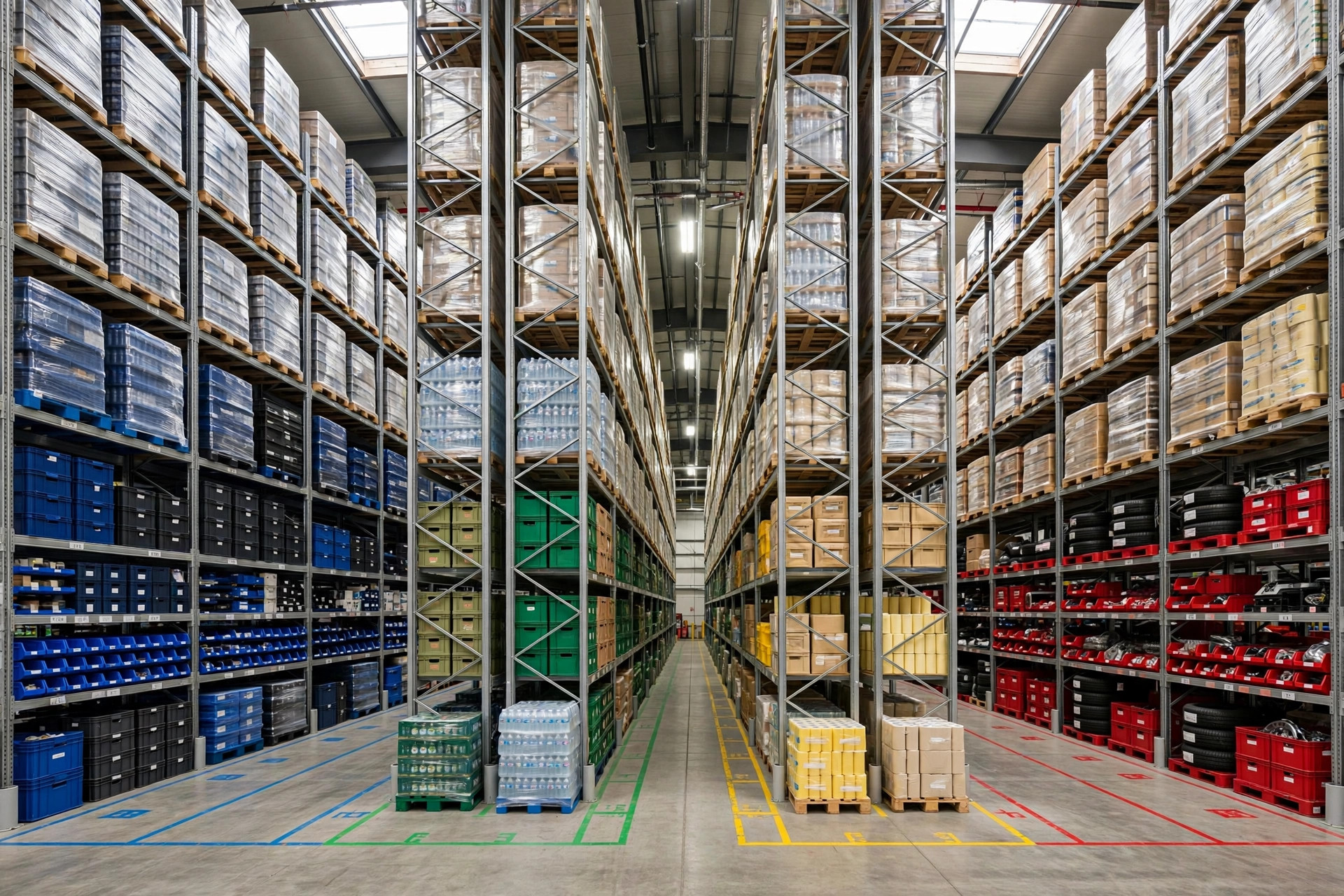
It was 3 a.m. on November 12 last year, and I was still on the floor. Peak season had just chewed us up. The A-zone aisle was jammed with returns nobody had time to put away, and the night crew's eyes were bloodshot. I stood there staring at the count sheet, and something felt off. One laundry detergent SKU: book said 1,240 cases, physical count said 1,193. Forty-seven cases, gone. Honestly, my first thought wasn't theft. It was that the books were a mess again. If you are looking up warehouse inventory shrinkage how to reduce, this is how our warehouse got it under control, the hard way.
First, Get the Term Right: Shrinkage Is Not Damage
A lot of folks hear "shrinkage" and picture crushed cartons or leaking bottles. That is damage, not shrinkage. Shrinkage is the gap between what your system says you have and what is actually on the shelf:
Shrinkage rate = (Book inventory - Physical inventory) ÷ Book inventory × 100%
Book higher than physical, shrinkage is positive. Book lower than physical, you get a negative number, an overage. The goods aren't lost; the books are short. You still have to investigate.
So what counts as normal? Here is the industry benchmark: according to the Warehousing Education and Research Council (WERC), the average warehouse shrinkage rate is about 0.2%, and anything over 0.46% should raise a flag. That is WERC's statistical benchmark, not a number some vendor made up. Hovering around 0.2% month after month, you are healthy. Creeping toward 0.46% for several months in a row, stop and investigate.
Where Shrinkage Comes From: Five Leaks
Shrinkage never appears out of thin air. After all these years on the floor, I have seen exactly five leaks:
One, receiving miscounts. A hundred cases arrive, somebody logs 110, and the books are 10 cases too high. Log too few, and the count comes up over. Night shifts in peak season are the worst for this: people are tired, trucks are waiting to leave, and the counting goes sideways.
Two, misplaced picks. The goods aren't lost. They are in the wrong slot. A picker stashes product in the empty bin next door to save a trip, and the system still thinks it is in the original location. You count the original location, you are short.
Three, system misses. Product ships, but the order never gets deducted. Returns, exchanges, and emergency transfers are the usual suspects. These exception orders get handled by hand, and when things get busy, somebody forgets.
Four, internal theft. Thieves rarely grab big items. They take small, high-value, easy-to-resell stuff, a few pieces at a time. Looking at a single month, you will never see it.
Five, damage never written off. A bottle leaks, a carton gets soaked, and somebody tosses it without filing a damage report. The physical goods are gone, the books still show them. Come count day, there is your gap.
The first three are management problems. The last two are process and people problems. They need different fixes.
Those 47 Cases: Three Days to Find a Misplaced Pallet
Back to those 47 cases of detergent. Not big enough to call the police, but big enough to drive you crazy. I put two senior guys on it full-time. On the third afternoon, they found all 47 cases in B-zone, slot B-07-3. Not one case missing.
Here is what happened. On peak day, A-zone was full. A picker, trying to save time, wheeled a whole pallet into an empty B-zone slot, thinking he would move it back later. Later never came, and the system still showed the stock in A-zone.
The lesson stuck with me: at least half of shrinkage is not lost product. It is product in the wrong place. Before you start suspecting people, find the goods first.
The 8 Earbuds: A Write-Off Process Failure
In March 2025, the high-value zone got us. Bluetooth earbuds, short three units in February, short five more in March. Small numbers, but the high-value zone runs on a zero-difference rule. One unit short means an investigation.
It turned out to be a write-off process failure, not theft. The QC inspector would open returned earbuds, find defects, and toss them in a pending bin, planning to file one big write-off at month-end. Then the cleaning crew hauled the pending bin out with the trash at the end of March. Eight units gone. The books still showed them.
After that, we made a rule: damage and defective open-box items get written off the same day they are found. No batching it to month-end.

Do the Math: What 0.2% and 0.46% Actually Cost
Don't shrug at a fraction of a percent. The numbers below are labeled example assumptions, just to give you a feel for the scale:
| Monthly throughput (example assumption) | At 0.2% shrinkage | At 0.46% shrinkage | At 1% shrinkage |
|---|---|---|---|
| 100,000 units | 200 units short | 460 units short | 1,000 units short |
| 500,000 units | 1,000 units short | 2,300 units short | 5,000 units short |
Now put money on it. Assume an average unit cost of $50 (example assumption) at a warehouse shipping 500,000 units a month: 0.2% costs $50,000 a month, $600,000 a year. At 0.46%, it is $115,000 a month, $1.38 million a year. At 1%, you are looking at $3 million a year. Folks, that is not pocket change. That is a small warehouse's entire annual profit.
So the 0.46% line is not there to scare you. It is a real money boundary. If you sit above it for months, some leak in your process is bleeding product nonstop.
The Counterintuitive Part: Zero Shrinkage Is Nothing to Celebrate
Let me be blunt. A lot of owners push shrinkage toward zero, and when it hits zero, they call a meeting to celebrate. I don't see it that way.
A warehouse that reports zero shrinkage month after month usually isn't well managed. The books are being smoothed. Counters hate taking the blame for a gap, so a few units get "adjusted" in the system. A receiving error gets wiped out with a month-end adjustment. The books look beautiful. The physical floor is still a mess. A warehouse reporting zero shrinkage is the one I trust least.
There is also a real trade-off: full physical inventory versus cycle counting. A wall-to-wall count is the most thorough, but it shuts the building down for a day. In peak season, one lost day costs more than the shrinkage itself. Cycle counting never stops the operation. Thorough versus timely. You can only pick one. We pick timely.
What We Do Now: Five Practices That Cut Warehouse Inventory Shrinkage
We tried plenty of things. Five stuck, and they are how we keep warehouse inventory shrinkage down. We still run them every day:
First, cycle counting, ABC-ranked. A-items, high value and high velocity, get counted weekly. B-items monthly. C-items quarterly. No more wall-to-wall shutdown counts.
Second, variance recheck by a second person. Never adjust the books on a first count. Over threshold, a different person recounts the location from scratch. If the two counts still disagree, a third person goes. The person who counted never adjusts their own numbers. Not in our building.
Third, two-person sign-off on receiving. One person counts, one person scans, both sign the same sheet. In peak-season night shifts, when everyone is exhausted, this rule never gets skipped.
Fourth, access control on the high-value zone. Earbuds, supplements, anything small and valuable sits in its own zone. Badge in, cameras on the slots, spot-counted monthly. It is not about distrusting the crew. It is about turning "we can't explain it" into "we can explain it."
Fifth, same-day damage write-offs. Damage found, photo taken, write-off filed, books cleared the same day. No batching to month-end.
We have run these five for over half a year. Our shrinkage rate dropped from around 0.5% to about 0.15%. No fancy technology. Just unglamorous work, done every day.
A Word to Fellow Managers
Folks, don't wait for the year-end physical to look at this number. Every month, when the count sheets come in, the first thing you calculate is shrinkage. Over 0.46%, investigate immediately. Find the leak and plug it. And when you investigate, find the goods before you suspect people.
One more thing. If your shrinkage hits zero, ask the counters first whether every variance got reported honestly. A real 0.15% beats a manufactured 0% a hundred times over.
By Chen Feng, Warehouse Operations Manager