When people ask me physical inventory vs cycle counting, which is better, I don't answer with philosophy. I answer with a bill.
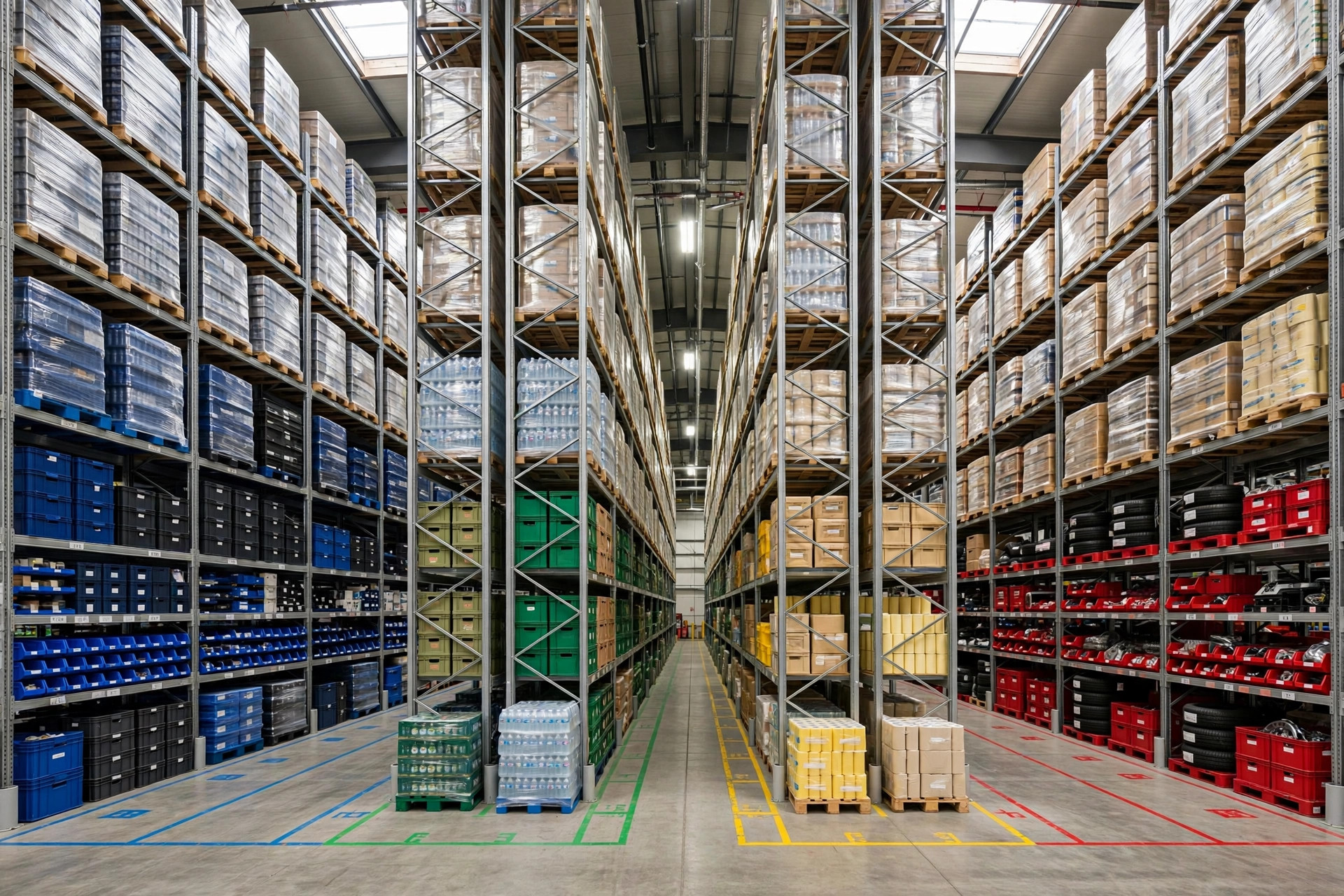
Last December, a 3PL warehouse in Southern California — 50,000 square feet, 8,000 SKUs, 2,500 outbound orders a day — shut down for two full days for its annual physical inventory. Forty people on the floor, plus an external audit firm. I ran the numbers for them: labor, 40 people × 16 hours × $22 an hour = $14,080. External auditors, flat fee: $8,000. The visible part of the bill: $22,080.
That's not the whole bill. The most expensive line item can't be rounded away: two days of zero outbound, 5,000 orders delayed. Multiply that by your own per-order margin — I can't do that math for you. But anyone who prices a full physical inventory on the first two rows only is fooling themselves.
The Real Cost of a Full Physical Inventory
Three line items: labor, auditors, shutdown. Here's the breakdown:
| Cost item | Math | Amount |
|---|---|---|
| Count labor | 40 people × 16 hrs × $22 | $14,080 |
| External audit | flat fee | $8,000 |
| Shutdown | 2 days × 2,500 orders/day — margin loss, fill in your own | ? |
| Visible total | $22,080 |
That question mark is the row most managers refuse to look at. During a shutdown, rent, insurance, and system subscriptions keep billing. Customers need explanations for delays. For 3PLs it's worse: contracts carry on-time-rate clauses, and I watched one 3PL lose a month of storage fees to each of two major clients after a three-day shutdown count. That penalty alone cost more than the count labor.
So the real problem with the annual count isn't that it's expensive. It's that the expense is opaque. What you can't see on the bill, you can't optimize.
What Cycle Counting Really Costs Per Year
Cycle counting never shuts you down, which sounds wonderful — until you run its numbers too. Same warehouse: 2 people, 2 hours a day, $22 an hour, 250 working days. That's 2 × 2 × 22 × 250 = $22,000 a year.
Notice something? A year of cycle counting labor costs about the same as the visible portion of one full physical inventory. The difference: there's no shutdown row, and inventory accuracy stays high all year instead of being accurate for one week and decaying for the other fifty-one.
In 2023 I followed an auto-parts warehouse through a full year on ABC cycle counting. Accuracy climbed from 92% to 98%, and the year-end auditor sample passed on the first try. Before that, they'd done the annual big count for years: accurate for a month, drifting back to 93% within a quarter. The difference is structural. A full count corrects; cycle counting prevents. Variances get caught daily and fixed daily, so the hole never gets big enough to matter.
One hard prerequisite, and I'll say it up front: you need a WMS. The system has to auto-assign counts by ABC class, lock locations, and close the loop on variances. Without a system, cycle counting is people wandering around scanning things off a spreadsheet — same money burned, accuracy flat. I've seen more than one small warehouse run cycle counts for six months with zero movement in accuracy. That's not a program, that's an expensive placebo.
The Decision Table: Match the Method to Your Size
The question of physical inventory vs cycle counting — which is better — comes down to three numbers: SKU count, daily order volume, WMS or no WMS. Plug them in:
| Your warehouse | Recommended | The money logic |
|---|---|---|
| < 2,000 SKUs, < 500 orders/day, no WMS | Weekend full count | 6 people, 2 days of overtime, ~$2,000; a year of cycle-count labor would cost you 4× that |
| 2,000–10,000 SKUs, 500–5,000 orders/day, WMS in place | ABC cycle counting + year-end sample | A items weekly, B monthly, C quarterly; sample at year end, never shut down |
| > 10,000 SKUs, or multi-client 3PL | Full cycle-count program | You can't afford a full shutdown; auditors and clients only trust continuous count records |
The middle tier is the most common and deserves the detail. A items — the 20% of SKUs driving 80% of picks — get counted weekly. B monthly. C quarterly. Over a year, every SKU gets touched at least 4 times; A items 50 times. How do you staff it? Two people, first half hour of the shift, working system-assigned tasks. That $22,000-a-year figure is exactly this.
One note for 3PLs: your clients read the audit report every year. Auditors trust continuous cycle-count records; a once-a-year big count makes clients nervous. That doesn't save money directly, but it keeps clients, and keeping clients is keeping revenue.
If you land in the weekend-count tier, do it properly: freeze receiving the Friday before, pre-print count sheets by zone, and run two independent counts on A items — the second count only where the first two disagree. A sloppy annual count is the worst of both worlds: you pay the shutdown and still can't trust the number.
The Counter-intuitive Part: Cycle Counting Can Cost a Small Warehouse More
This is the calculation most people get backwards. A small e-commerce warehouse — 8,000 square feet, 1,500 SKUs, 6 people, 300 orders a day. The owner went to an industry conference, came back, and announced cycle counting because "that's what the big companies do."
I ran his numbers: 1 person × 1.5 hours a day × 250 days × $20 an hour = $7,500 a year. Their old annual count: one weekend, 6 people, two days of overtime — a little over $2,000, and since they don't ship on weekends, shutdown cost was zero. $7,500 versus barely $2,000. Cycle counting cost nearly 4× more. And accuracy? No WMS, tasks assigned by spreadsheet, nobody following up on variances — six months in, the number hadn't moved.
That's the thing about cycle counting: small operations can't spread the labor. Pulling 2 people out of 40 is 5% of your workforce. Pulling 1 out of 6 is nearly 20%. Same method, different scale, completely different unit economics. Copying the big companies' playbook is how small warehouses set money on fire.
So, physical inventory vs cycle counting, which is better? One line:
If annual cycle-count labor > one full count's total cost × 1.2, don't bother with cycle counting.
Fill in your own three numbers: hourly wage, daily order volume, SKU count. Ratio above 1.2 — do the annual count and do it well. Below 0.8 — go cycle counting. In between — ABC cycle counting plus a year-end sample. There's no advanced or backward here. Only what pencils out and what doesn't. Run the numbers, and the answer runs itself.
By Lao Zhou, Logistics Cost Analyst