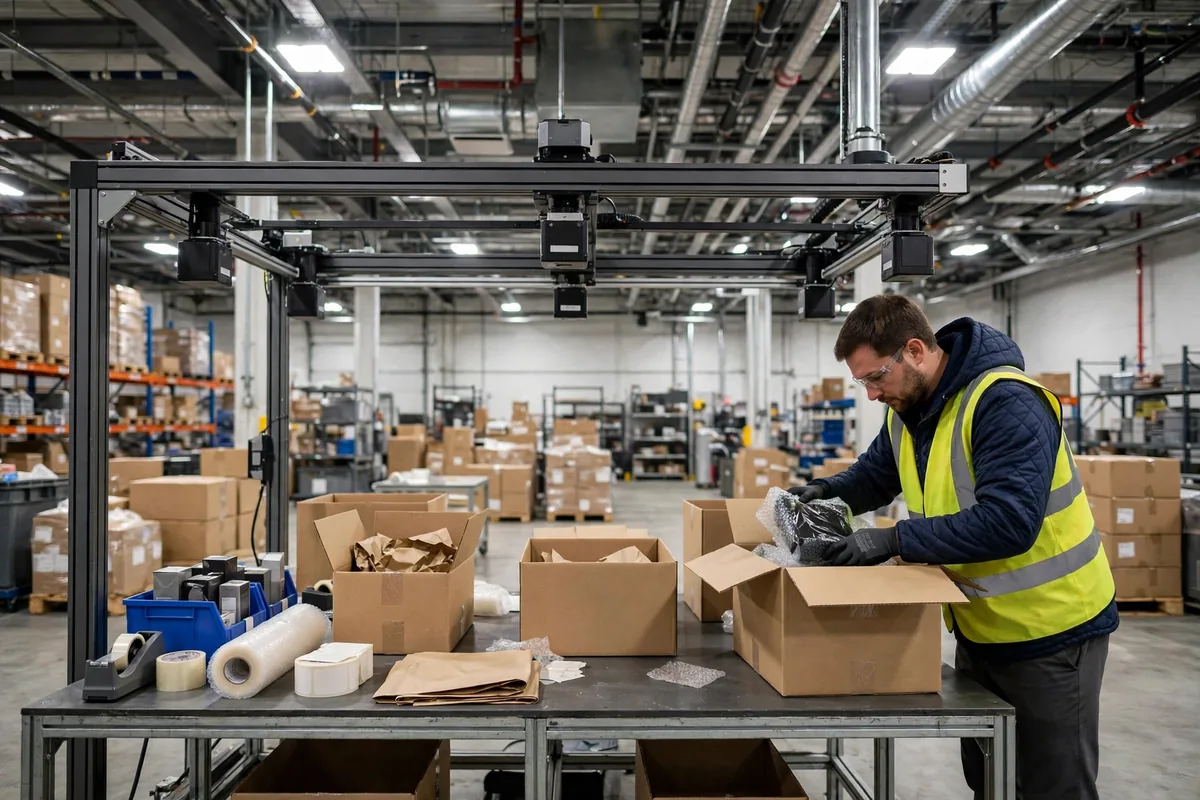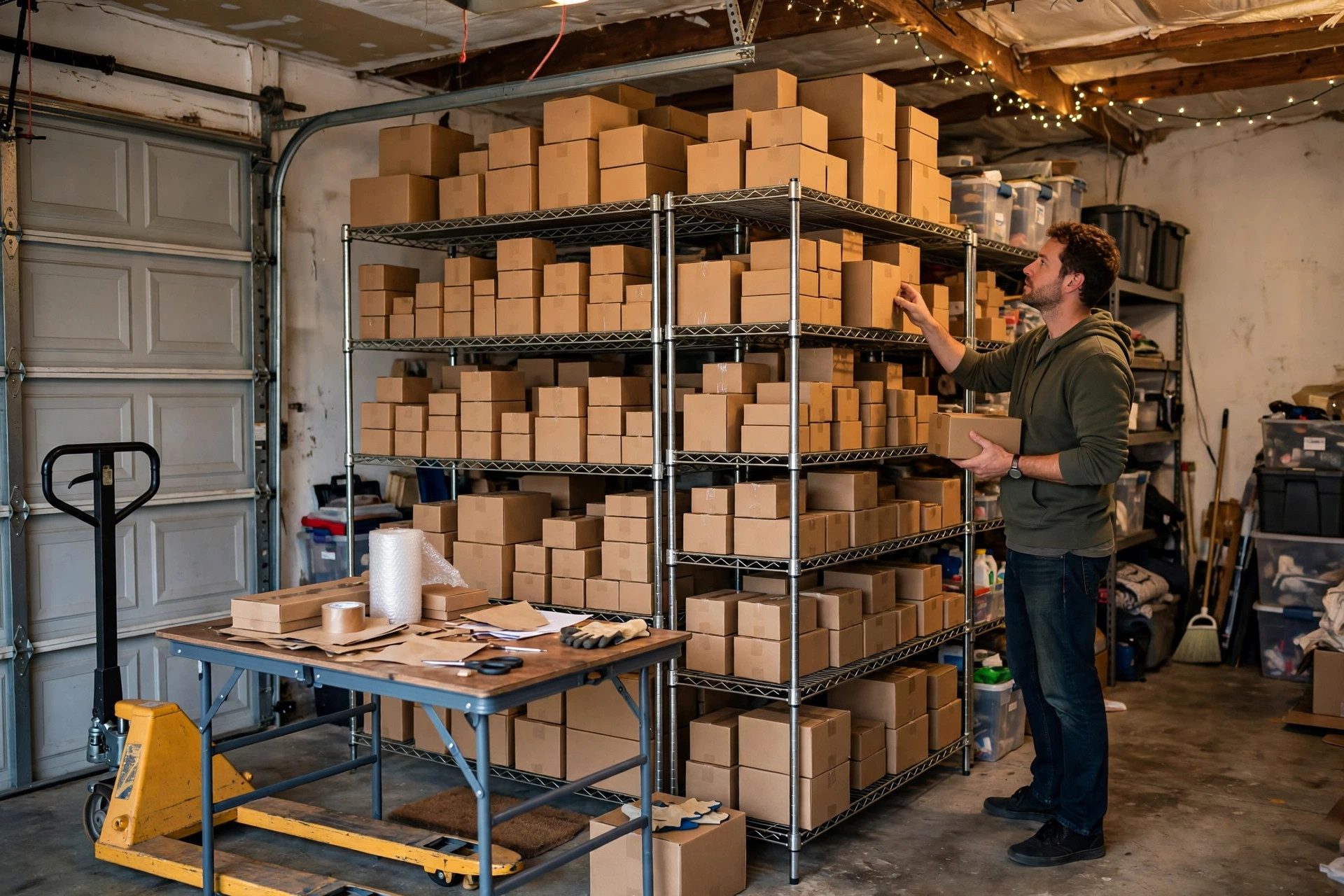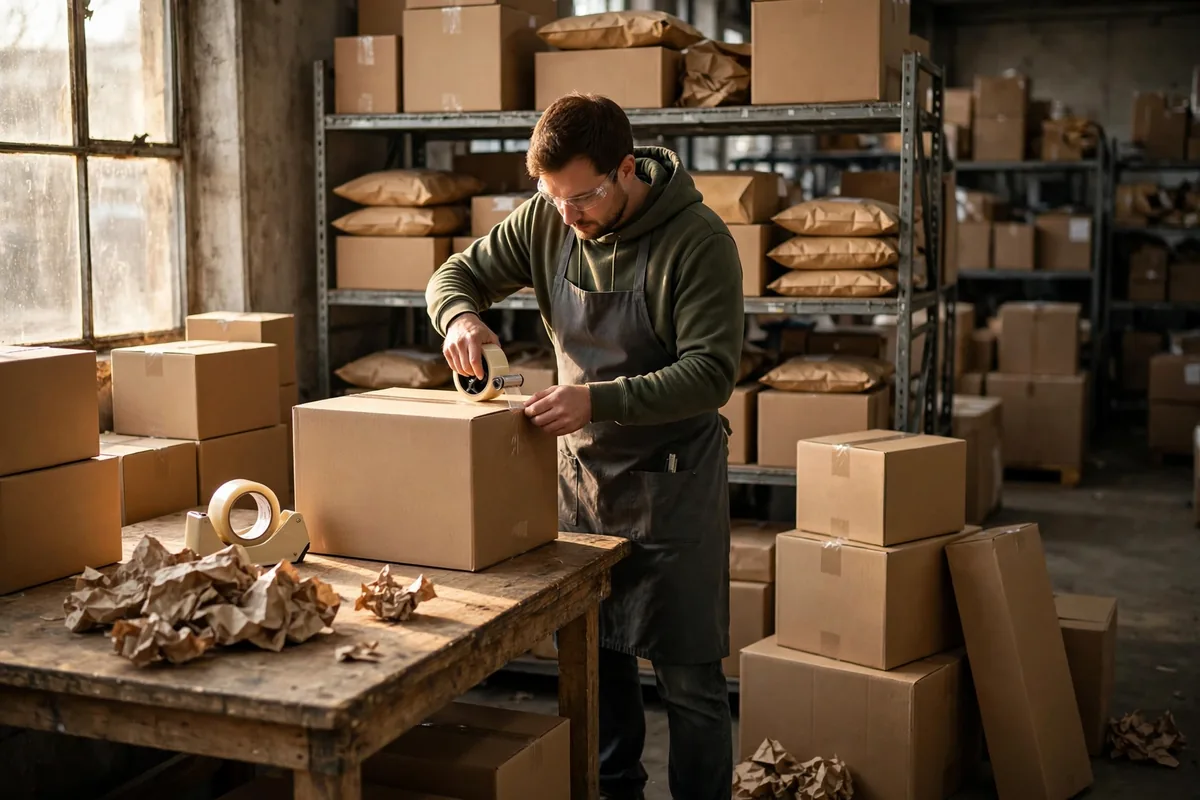
Let me tell you where our warehouse was bleeding money. Last fall I stood at the packing bench watching one of our guys pack a single insulated bottle — a bottle about the size of your hand — into a standard box big enough for two pairs of shoes. The empty space got stuffed with bubble wrap and crumpled paper until the box looked like it was wearing a winter coat. I picked it up and did the math in my head: about a third of that box was filler, but the freight bill was charged on the whole box's dimensional weight. We are a small warehouse. We cannot afford to burn money like that. A big 3PL can shrug off a dollar or two of filler and freight per order. We cannot — across a few thousand orders a month, that leakage adds up to a packer's wages.
So I did something deeply unglamorous: I laid our 20 best-selling SKUs out on the packing bench, measured each one, and pulled three months of outbound records. The result stung: six of those SKUs had been living, month after month, in boxes two sizes too big. Not because we were lazy. Standard boxes only come in a handful of sizes, and when your product falls between two sizes, you round up. Nobody ever sat down to do this math for us.
Where the Money Actually Leaks: Three Bills in One Box
Fair warning first: the numbers below are an illustrative example I built from my own warehouse's order volumes — a scenario to show the method, not industry pricing. Every warehouse has different volumes, products, and carrier discounts, so copying the numbers will get you burned; copying the method is what works. Dimensional-weight billing rules differ by carrier, so always check the latest policy on each carrier's official website rather than trusting any fixed formula in an article.
Say our warehouse ships 5,000 orders a month, and 2,000 of them are those six "wrong-box" SKUs. In a standard box, each order needs roughly an extra dollar's worth of filler — an illustrative figure, just to demonstrate the arithmetic. That is $2,000 a month, over $20,000 a year. And that is before freight: a box one size too big can push the dimensional weight up a bracket, adding a few dollars of freight per order. Two thousand orders times, say, three extra dollars of freight per order (again, an illustrative number), is another $6,000 a month.
| Cost per order | Standard box (illustrative example) | Custom-size box (illustrative example) | Difference |
|---|---|---|---|
| Dunnage | About $1.50 | About $0.30 | Saves about $1.20 |
| Extra freight from dimensional weight | About $3.00 extra | Baseline | Saves about $3.00 |
| Box unit price | About $1.80 | About $2.40 | Costs about $0.60 more |
| Damage and reshipment rate | About 1.5% | About 0.8% | Saves reships and complaints |
On those illustrative numbers, 2,000 orders a month saves several thousand dollars — tens of thousands over a year. The figures are made up; the direction is real. Custom boxes cost more as boxes and save money in three other places: dunnage, freight, and damage. Most people only compare the box price, decide custom is expensive, and keep paying the tuition in filler and freight forever. Here is the counterintuitive bit: the cheapest box does not mean the cheapest order. A cheap box is often subsidized by freight and filler.
The second story hurt more. Before last year's peak season, we had a client selling small home appliances — a long, skinny space heater. Standard boxes either could not fit it or left it rattling around inside. We shipped it for a month in oversized boxes stuffed with filler, and the damage rate climbed toward 3% (our own warehouse's rough experience at the time — your mileage will vary, measure your own). The client nearly walked. We finally gritted our teeth and ordered 500 custom boxes for that one SKU. Damage dropped fast, the client stayed, and then handed us two more product lines. Were those 500 boxes expensive? Yes. But losing a client costs far more. A small warehouse survives not by pinching every penny to the bone, but by knowing which pennies you must not pinch.
The Cheapskate's Test Drive: Three Moves Before You Commit to a Die
Forget the big-company playbook for custom size shipping boxes — full-range custom boxes with software that auto-matches every order to a box size. We cannot afford it and we do not need it. My dirt-cheap approach is three moves, and each one costs almost nothing.
First, measure. Do not guess. Lay out your top 20 SKUs by outbound volume, measure length, width, and height, write the numbers down, and compare them with the boxes they live in now. Only look at the top 20. If you try to customize the whole warehouse on day one, you will drown.
Second, try "semi-custom" first. Box suppliers usually stock dozens of existing cutting dies — a close size is far cheaper than a brand-new die. That is what we did: we switched two SKUs to a ready-made box one size smaller, ran it for two weeks, watched the filler use drop with our own eyes while damage stayed flat — and only then started talking about real custom sizes.
Third, negotiate like a small warehouse. Our order volumes are small and our bargaining power is weak, so I bundle two or three SKUs' custom boxes into one order, or split an order with the warehouse next door. The box factory wants volume; give them volume and they give you a price.
One more trap: do not overstock custom boxes. A custom size only fits your own products. The moment a client changes packaging, those boxes become expensive cardboard furniture. Our first custom batch, we got greedy and ordered 2,000 extra because the unit price looked good. The client changed packaging, and the leftovers sat in a corner for half a year. My rule now: the first batch covers about a month of volume. Reorder once it is running smoothly.
And do not forget to talk to the packers. A new box size means a new packing habit. Our crew kept stuffing filler out of habit for the first week — every dollar we saved went right back into the box. I stood at the bench for two days showing them: if the box fits snugly, fill less. Only then did filler use actually fall. Saving money is half the box and half the hands.
When Custom Boxes Pay Off — and When They Are a Waste
Here is a decision framework for other small warehouses. Four questions. If three answers are yes, go for it.
One: is this SKU's monthly volume stable? A few hundred orders a month, steady for three months running, is worth customizing. A one-off shipment is not. Two: is the current box obviously too big? If you can fit a fist in the gap between product and box, dimensional weight and filler are burning money. Three: is the damage rate on the high side? Fragile, long, or oddly shaped goods benefit from a snug box, because the fit itself is protection. Four: does your carrier mostly bill by dimensional weight? Dimensional-weight rules vary by carrier — check the latest policy on each carrier's official website. If your freight is billed on actual weight and dimensional weight never kicks in, custom boxes mostly save you filler, and the math has to be redone.
Do not customize when SKUs are scattered across sizes, volumes are unstable, dimensions change often, or packaging is about to change. Keep a few standard sizes on hand and switch to cheaper paper padding instead.
Here is the honest truth. Custom size shipping boxes are not high technology and they are not a big-company privilege. It is primary-school arithmetic: the box costs a little more, the filler, freight, and damage cost a lot less, and if the total works out, you do it — if not, you leave it alone. Plenty of small-warehouse owners are not bad at math. They just never sat down to do it. After we did, our filler purchases fell by nearly half on the illustrative-example basis I showed above, and the packing bench got cleaner.
Small warehouses have their own way of surviving: big companies compete on systems and scale; we compete on spending every cent where it counts. Measure first, test small, then talk custom. That one afternoon of arithmetic is worth your time.
By Xiao Ma, Small Warehouse Owner