Let me lead with the verdict, then the reasoning.
If you sort fewer than 30,000 orders a day, don't touch a crossbelt sorter. I've said this to at least ten warehouse owners. Nine disagreed on the spot. Eight came back within three years and told me I was right.
It's not that crossbelts are bad. They're excellent — the Ferrari of sortation. The problem is you don't buy a Ferrari for grocery runs. The gas, the maintenance, the insurance will eat you alive. That's exactly the mistake mid-size warehouses make: buying track-grade equipment for grocery-run volumes.
Here's the full math: where the two technologies actually differ, what volume justifies a crossbelt, what to buy instead, and the traps vendors won't tell you about.
The principle, one sentence each
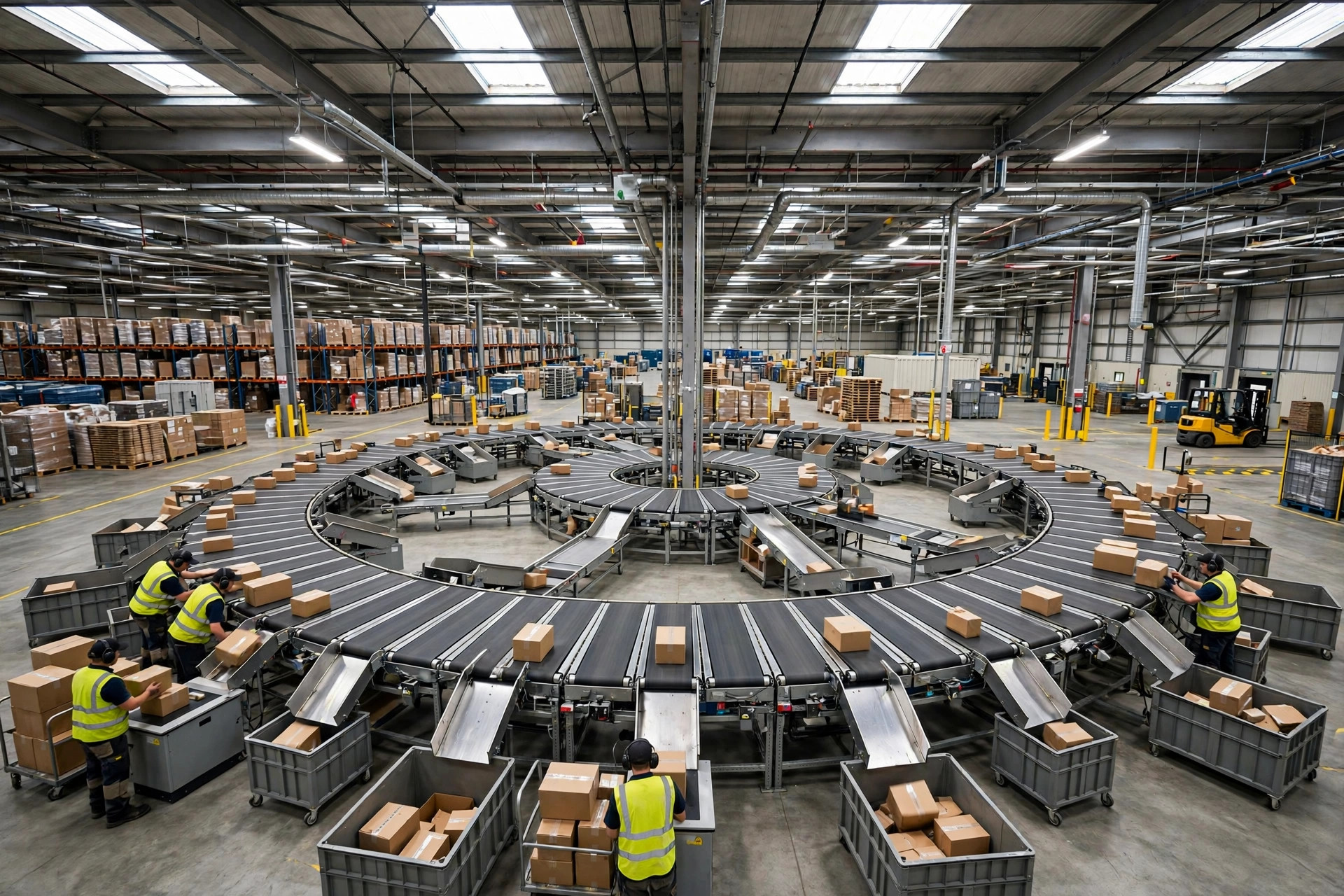
Crossbelt: a loop of small carriers, each with its own little belt. When a parcel reaches its chute, the belt fires and "spits" the item left or right. Bi-directional discharge, no turning around.
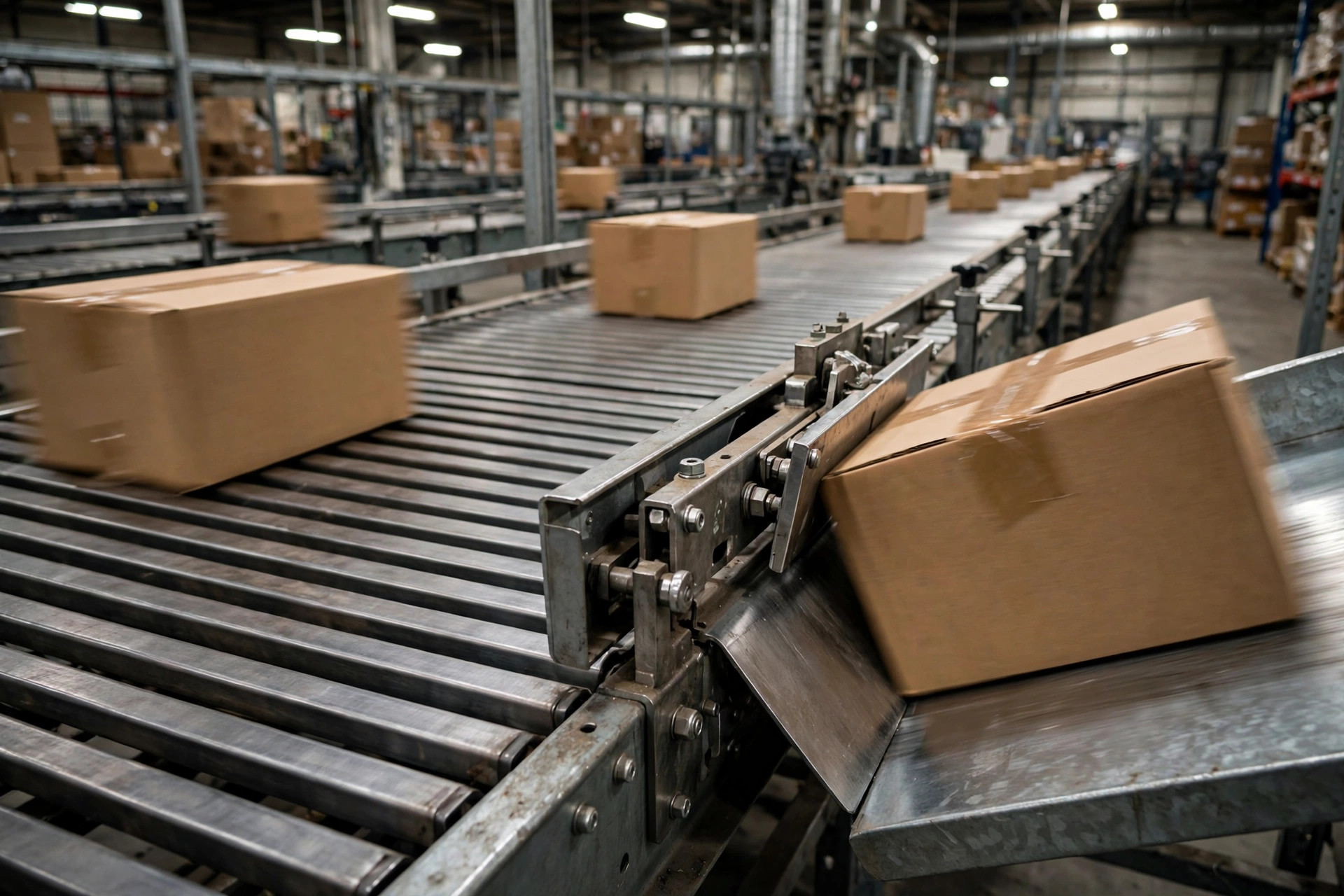
Sliding shoe: a slatted conveyor with a row of "shoes" riding on it. When a carton reaches its divert, several shoes slide sideways and push it into the spur. One-directional push.
One-line summary: the crossbelt unloads itself; the sliding shoe gets pushed off. Everything downstream follows from that difference.
Four dimensions, head to head
Throughput first. The industry's standard reference table puts crossbelts at 80–200+ cycles per minute and sliding shoes at 80–350, both running 200–600 feet per minute. On paper the shoe's ceiling looks higher — don't let the numbers fool you. A crossbelt's cycle means every carrier can discharge independently, handling smalls and irregulars alike. A shoe pushes, so shape, center of gravity, and friction all affect divert success. Dematic's white paper notes their latest sliding shoe sorter can hit 18,000 cartons per hour on a single machine — note the word "can." That's peak, not your Tuesday average.
Product mix is the real dividing line. Crossbelts handle everything from envelopes and books to four-foot boxes, and bi-directional discharge is kind to irregular shapes. Sliding shoes live in the world of standard cartons and totes — big, heavy, uniform is their comfort zone. Poly bags used to be their forbidden zone; vendors have engineered their way in over the last few years, but it remains their weak flank. Flip side: fragile items favor the shoe. A push is gentler than a toss, and you can slow the line down. A crossbelt at speed is a crossbelt at speed.
Noise. Traditional sliding shoe sorters are famously loud — at full speed the whole line roars, and some projects budget extra for sound dampening. Newer designs run slower with better drives and the noise comes down, but go listen on a live floor before you buy. The showroom lies. Crossbelts are relatively quieter, but "relatively" is doing heavy lifting — thousands of carrier motors spinning at once is nobody's library.
Maintenance. A crossbelt is a sea of carriers: hundreds of them, each with a motor, a belt, a control board. Deep spare-parts catalog; one dead carrier can stop the line. Sliding shoes are mechanically simpler, but shoes and slats are wear items — run fast long enough and replacement becomes a standing cost. Neither is install-and-forget. Both need dedicated techs, spares on the shelf, and preventive rounds. The difference: crossbelt maintenance is precision work; shoe maintenance is elbow grease.
The money math: how much, how many orders, what payback
Numbers. A mid-range crossbelt (5,000–12,000 parcels per hour) runs $1.8–2.4 million per market research; ultra-high-capacity (20,000+/hour) runs $3.5–5.2 million. Another industry report puts full parcel-sortation installations at up to $2–5 million. None of that includes building work, WMS changes, or the takeaway conveyors behind the chutes.
Now your volume. Thirty thousand orders a day sounds like a lot. Spread over an 8-hour shift, it's 3,750 an hour. A mid-range crossbelt does 5,000–12,000 an hour — your $2M+ machine finishes the day's work in three to four hours and idles in the sun the rest of the time. Depreciation doesn't pause because the line is off.
So what volume justifies it? My rule is crude but it works: a crossbelt needs 6–8 loaded hours a day. At 8,000 parcels an hour on a single shift, that's 50,000–60,000 orders a day minimum. Below that, utilization can't carry the depreciation. The math never closes.
Chute count matters too. A crossbelt is a loop; every chute eats loop length. More chutes, bigger loop, bigger footprint, bigger price. If you're sorting to twenty or thirty destinations, a crossbelt is an anti-aircraft gun aimed at a mosquito. A hundred-plus destinations with real volume — that's its home turf.
And the hidden cost: induction. A crossbelt needs manual or automated induction stations, and the faster it runs, the more demanding induction gets. A starved Ferrari still costs Ferrari money. Plenty of proposals simply omit the induction labor line. Don't let yours.
Can't afford the crossbelt? Look at these three
Sub-crossbelt volume doesn't mean manual sorting forever. Three lighter options that mid-size warehouses actually buy:
Manual sort with put-to-light (PTL). Every chute gets an LED tag; one operator in a put-wall setup sorts hundreds of orders an hour. Lowest capex of the three, flexible — new categories, new chutes, no surgery. The ceiling is human: past roughly 10,000 orders a day it starts to strain.
Wheel sorters. Rows of pivoting wheels along the belt; at the divert, wheels rotate and walk the carton off at an angle. Forty to seventy pieces a minute, quiet, simple to maintain, a fraction of crossbelt money. Sweet spot: standard cartons, under thirty diverts.
Pop-up wheel diverters. Sixty to eighty diverts a minute, even simpler, for smaller volumes and fewer destinations. The 24V DC versions are near-silent and sip power — in the sub-40-pieces-a-minute band, the value king.
Common thread: small money, fast payoff, no building surgery. When volume grows into crossbelt territory, replacing them won't hurt — because there wasn't much to write off.
Four things vendors won't tell you
Peak or average — a 2x cost difference. Vendors always size to your peak. Oversized equipment idles most days. But sizing to average means peak season buries you. My practice: size to 1.5x average, cover peaks with overtime and temp labor. Equipment is fixed cost; labor is variable. Do the math that way.
Chutes are never enough. Thirty destinations today, fifty next year as the business grows — and loop length is poured concrete. Adding chutes later means rebuilding. Size the loop for three years of destination growth. Better a slightly oversized loop now.
Hire maintenance before the equipment lands. Techs should be on-site three months early, installing and commissioning alongside the vendor's crew. Learning on a broken line during peak is how you lose customers. Stock critical wear spares on day one — don't count on 48-hour vendor delivery when the holiday rush is on.
Visit the reference customer, not the showroom. Showroom machines are polished. A live site is the truth: listen to the noise, watch the jam rate, and ask the maintenance tech "what do you hate fixing most." Three questions, and the machine's real character shows.
One last blunt word
The most common sortation mistake isn't picking the wrong model. It's picking the wrong league.
I've watched too many mid-size owners tour a big operator's facility and come home demanding a crossbelt. Daily volume: ten thousand-ish. Destinations: twenty-something. I ask one question: at your volume the crossbelt runs two hours a day — what are you paying for the other twenty-two? The look?
Equipment serves volume, not ego. Under 30,000 orders a day, put the money into people, put-to-light, and wheel sorters. Spend the rest on categories and customers — the returns are far better. The day your volume genuinely hits fifty, sixty thousand a day, the crossbelt sales rep will find you. Buy then, and the equipment waits on volume. Buy now, and volume waits on the equipment. That difference is the difference between making money and losing it.