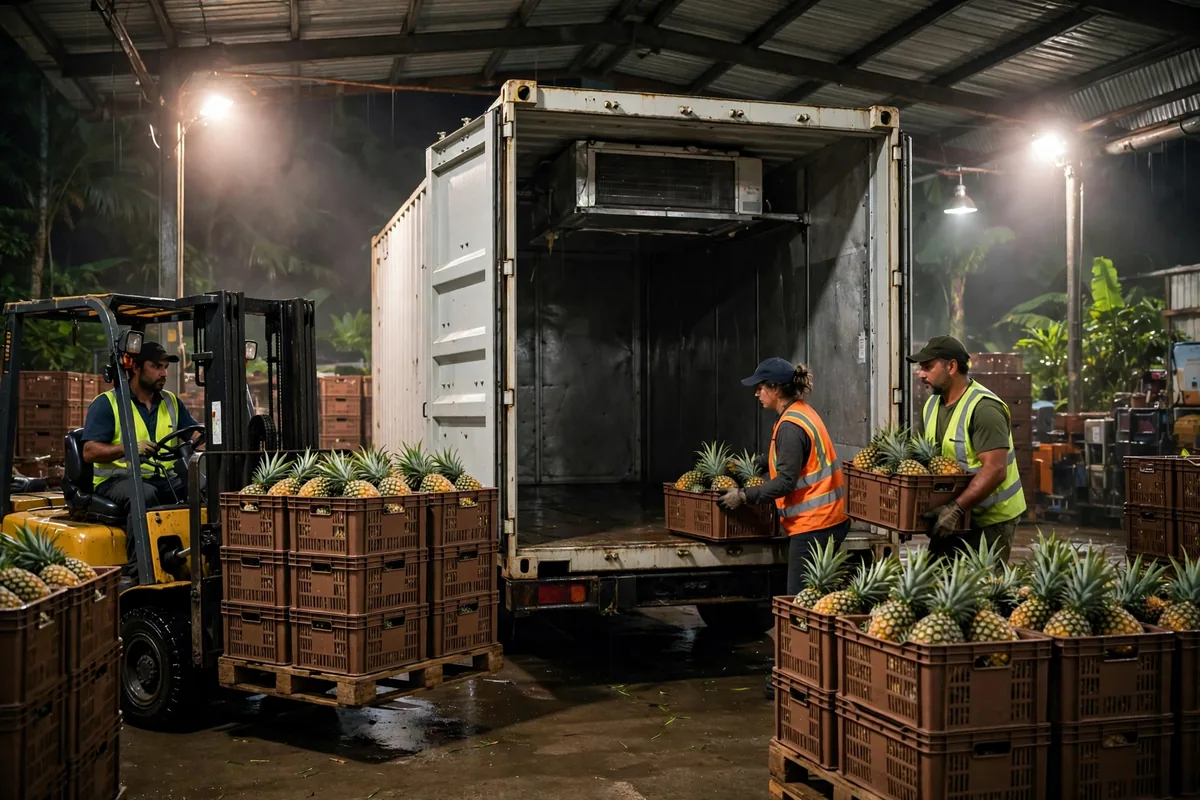
Let me tell you something about the Costa Rica pineapple export cold chain. In all my years on the road, the fussiest cargo I ever hauled was not precision instruments. It was pineapples. Instruments mind the bumps. Pineapples mind the temperature. Chill them too hard and the core turns brown. Let them run warm and they ripen before the ship docks, and the buyer sends the whole container back. Costa Rica moves about half the world's pineapple exports, and whether that cold chain holds or breaks is decided on the short road between the packhouse and the port.
Here is the lay of the land. Costa Rica is the world's largest pineapple exporter. In 2024 the trade was worth 1.14 billion euros, and in 2025 the country shipped 2.3 million tonnes. A little over half of it goes to North America and about 36 percent to the European Union, and 86 percent of all the pineapples the EU imports come from Costa Rica. The variety is almost all MD2, about 85 to 95 percent of commercial production. Harvest runs year-round, with April to July the peak, across roughly 40,000 hectares that directly employ about 30,000 people.
That night run: the Costa Rica pineapple export cold chain battle is half won before the box reaches the ship
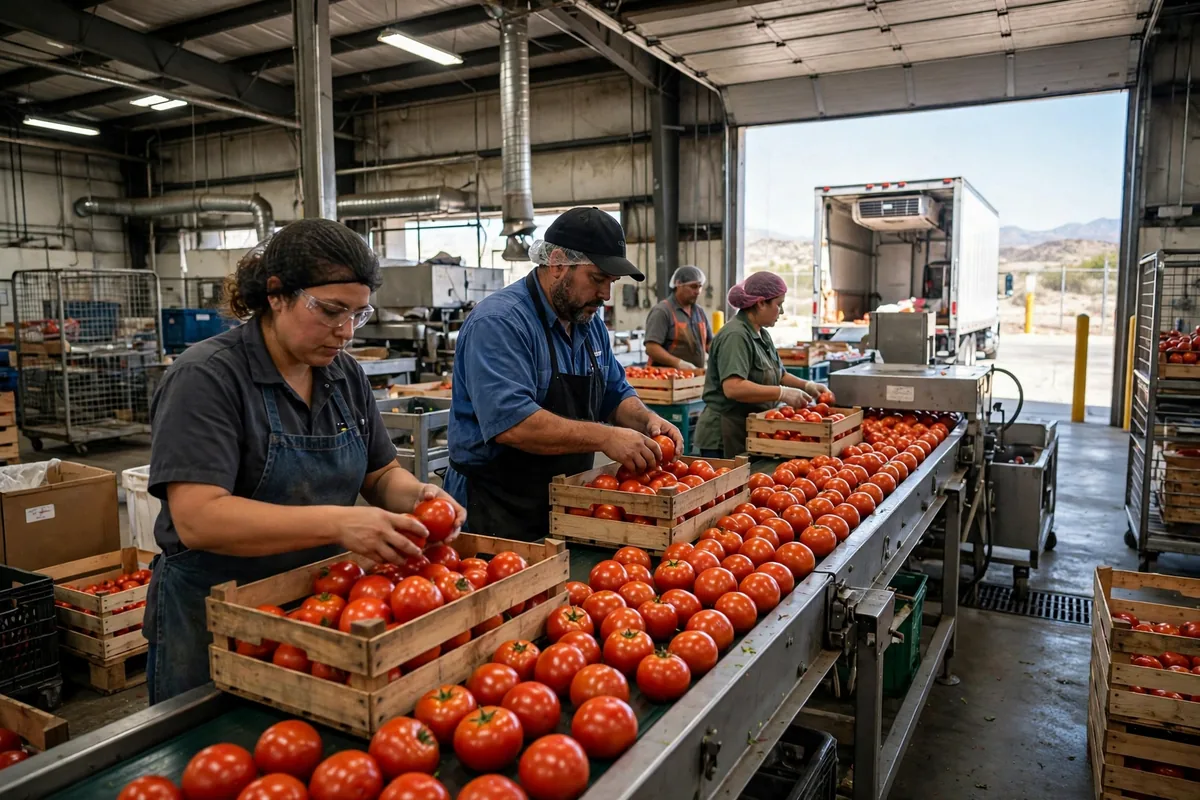
A couple of years back I was waiting at a packhouse gate outside Guapiles at two in the morning. The lights were on all night. Fresh-cut MD2 pineapples came off the grading line into 12 kg boxes, then into the pre-cooling room to pull the pulp temperature down to 7.2 to 9 degrees Celsius before a single box went into the container. An old hand there told me what I have told drivers ever since: a reefer is a thermos, not a refrigerator. Load warm fruit and the unit cannot pull the heat out. You are just cooking it slowly all the way to the port. The Costa Rica pineapple export warehouse cold chain wins its first battle in the packhouse, not at the terminal.
The Moin terminal at the port of Limon is not far from the growing areas, and most of the country's export pineapples leave through it. The sailings are kind: four days to Miami, about ten days to the northeastern United States, thirteen to fifteen days to the UK, Antwerp, and Rotterdam. That is not a long time at sea, but pineapples do not wait. Let the temperature gauge drift two degrees upward on the road and the whole container's shelf life has to be recalculated. Half the battle is the packhouse, the other half is the road. By the time the box reaches the port, it is the easy part.
While I waited at that gate, I picked up a habit I still keep: check the reefer's pre-cooling record and the data logger's battery before the first box goes in. Some units look fine from the outside, and then you pull the logger and the last trip's temperature curve is all saw teeth, which tells you the cooling unit is already unsteady. Loading pineapples into a box like that is sailing with a known leak. All a driver can do is report what he sees and let the shipper decide whether to swap the unit or take the chance. That is the part of the Costa Rica pineapple export warehouse cold chain nobody photographs, and it is where a lot of loads are quietly won or lost.
Costa Rica pineapple export cold chain: pineapples fear cold and heat both, and 7.2 degrees is the line
In driver talk, pineapples are afraid at both ends. The usual set point is 7.2 degrees Celsius, and anything up to 10 degrees is still safe ground. Drop below 7 degrees and you get pitting on the skin, internal browning, and the aroma goes with it. Go above 10 degrees and respiration speeds up, ethylene kicks in, and the fruit ripens faster than the ship sails. Humidity has to sit between 85 and 95 percent, and a 40-foot high-cube reefer takes about 22 to 24 tonnes. Those are the rules of the Costa Rica pineapple export warehouse cold chain. The numbers look simple on paper. Keeping them is anything but.
I know a fellow driver who shipped a container to Rotterdam a couple of years ago and thought colder meant safer, so he set the reefer to 5 degrees. The box opened at the port looking fine. The buyer cut one open and the core was ringed brown. Rejected on the spot. Chilling injury is not like a crash. A crash you can see right away. Chilling injury shows up two days after arrival, and by then there is nobody left to argue the claim with. He learned the hard way that colder is not safer, not with this fruit.
The unbroken-chain math, and who should be doing it
Here is the math on one container (illustrative example):
| Item | Value (illustrative example) |
|---|---|
| Container | 40 ft high-cube reefer |
| Load | About 22 tonnes, roughly 1,830 boxes of 12 kg |
| Loss scale | Every extra percentage point of loss is about 220 kg |
| What good practice saves | Cutting losses from 12 percent to 8 percent saves about 880 kg per container |
Research puts post-harvest losses for Costa Rican pineapples at an estimated 8 to 15 percent. That sounds small until you spread it over a container and it becomes a tonne or two. Here is the counterintuitive part: because pineapples are harvested all year, with no real off-season, the cold chain never gets a rest. There is no quiet month to shut the pre-cooling room down and fix things properly. The coolers, the reefers, the data loggers run all year, and the day one of them gets tired is the day the chain breaks.
So my advice to shippers is one sentence long. Do not start by asking about the freight rate. Ask three things first: what temperature did the packhouse pre-cool to, was the container pre-cooled before stuffing, and does the temperature logger travel with the box? Get straight answers to those three and the math on an unbroken chain finally adds up. Fifteen years on the road taught me one rule I still trust: in the cold chain, whatever you save up front, you pay for at the back end.
By Shifu Zhao, Trucking Veteran (15 yrs)