In September 2024, a 3PL warehouse in Ontario, California running a parcel outbound line got a call from the city: neighbors were complaining about nighttime noise. An inspector showed up with a meter. At the property line, one meter out: 78 dB(A). The local nighttime limit was 55 — check your local ordinance, limits vary by jurisdiction. Twenty-three decibels over.
Twenty-three decibels sounds abstract until you translate it. Decibels are logarithmic: +10 dB feels roughly twice as loud to a human ear. Twenty-three dB over the limit means the neighbors perceived it as nearly five times louder than allowed. Picture someone running a power drill outside your bedroom window — except a conveyor doesn't take breaks. It runs all night.
The owner's first instinct was to buy acoustic enclosures and wrap the whole line. I talked him out of it. Before you spend a dollar on containment, find out where the sound is coming from. Otherwise you're buying an expensive guess.
Noise Has Five Fathers. Identify Yours First.
Conveyor noise comes from five sources, and the physics is no more complicated than an old bicycle: dry bearings squeal (idler bearings), a loose chain clunks (chain and sprocket wear), a cracked frame shudders at speed (structural resonance), a brake pad rubbing the rim hisses nonstop (belt grinding the side skirt), and the motor hums (motor and gearbox). Think of it that way and diagnostics get simple.
One number to memorize: +3 dB means the sound power doubled. So don't set a goal like "cut 20 dB" — that's fantasy. A 6 dB reduction is a genuine, dramatic improvement.
Measure correctly. Use A-weighting — dB(A). Meter at the property line, one meter out, 1.2 meters off the ground, 10-minute equivalent level. And the step everyone skips: measure the background with the line stopped. I've watched people chase a 70 dB reading for weeks before discovering the background alone was 65 — courtesy of the freeway next door. Their conveyor contributed 5 dB. You cannot fix your way out of that.
The Triage Table: Locate Before You Spend
| Source | What it sounds like | Quick localization | Fix cost |
|---|---|---|---|
| Worn idler bearings | High-pitched squeal that changes pitch with speed | Mechanic's stethoscope (or a long screwdriver pressed to the frame), section by section; the bad one runs hot | Low: replace individual idlers |
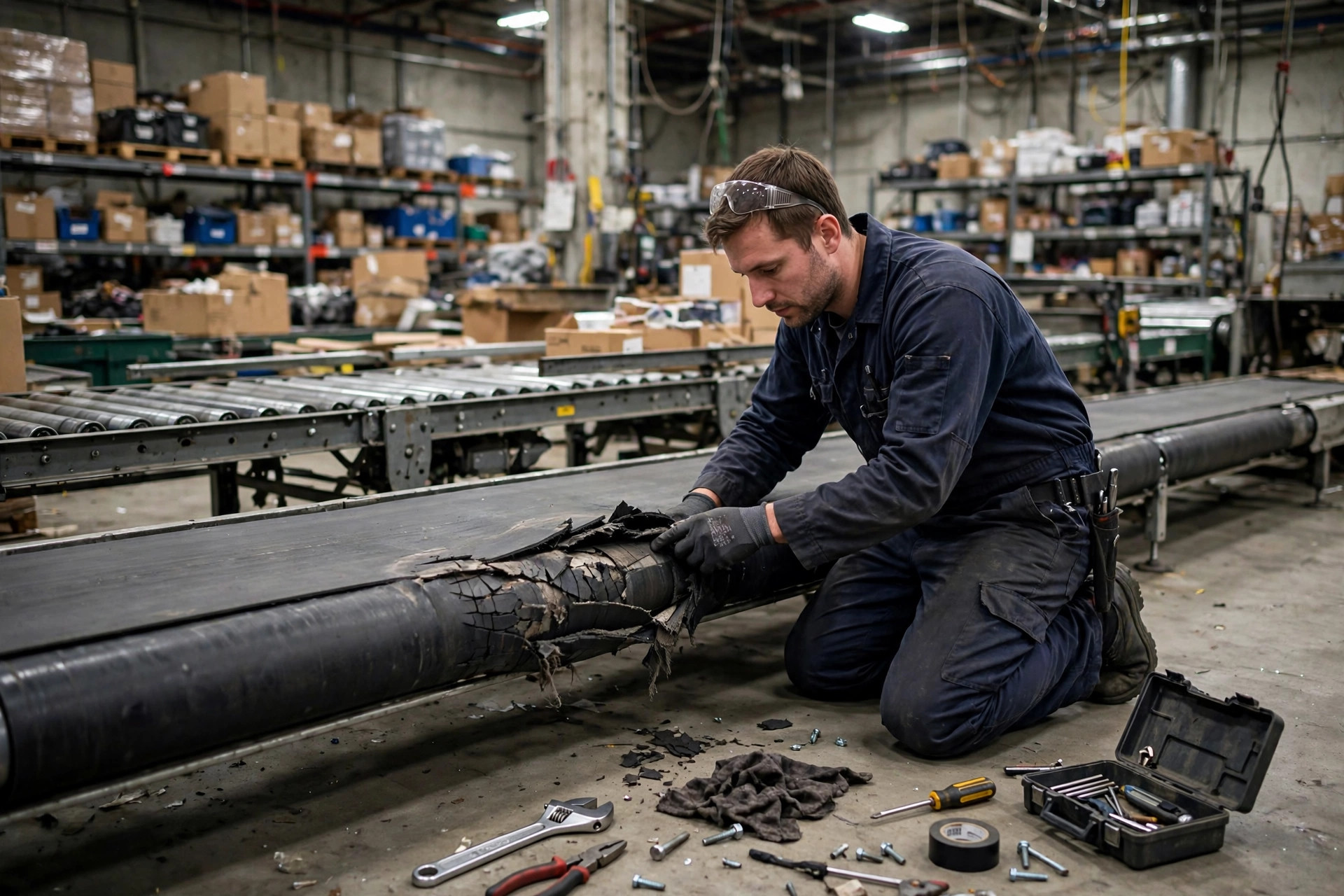
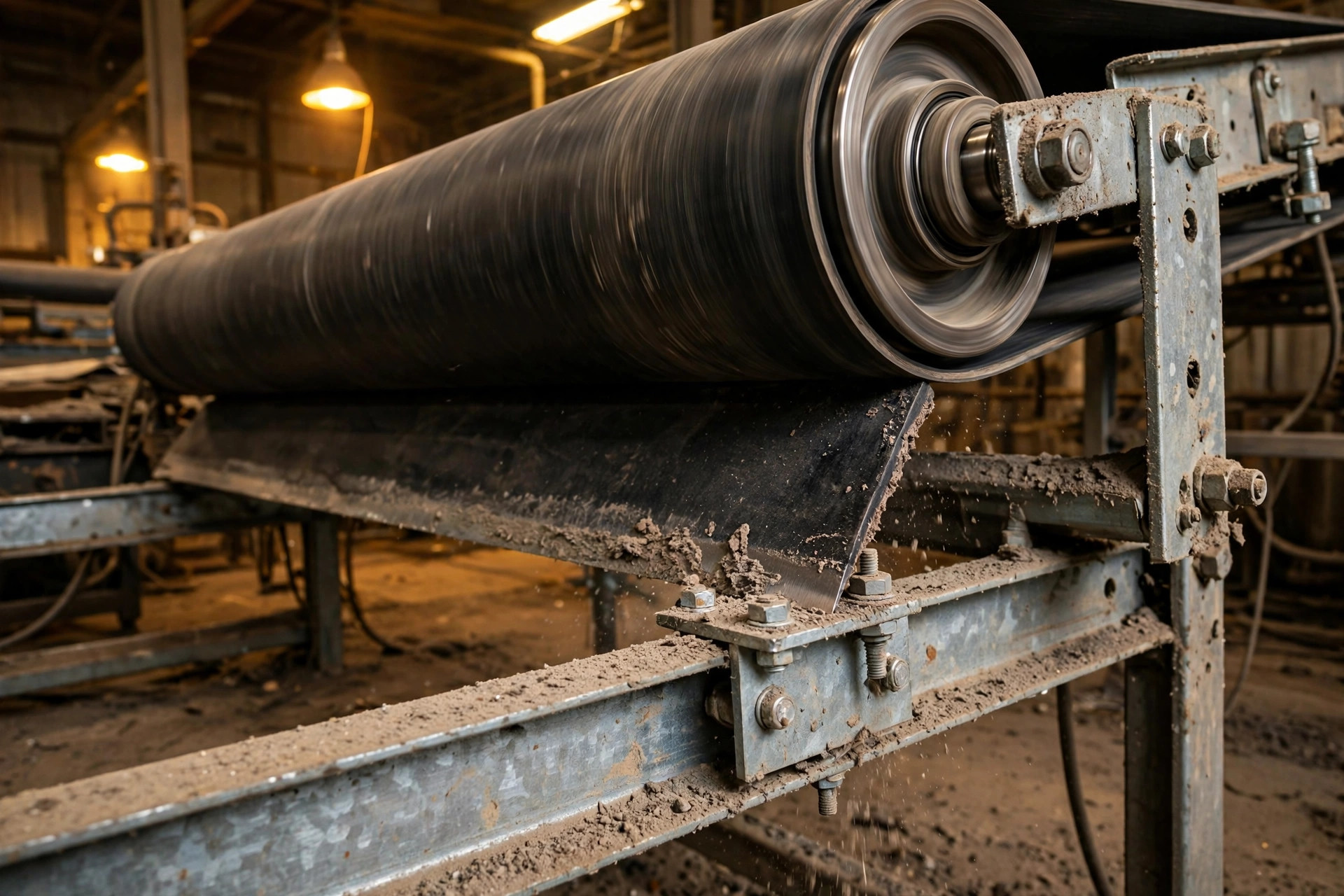
| Belt rubbing side skirts | Constant friction hiss, black dust caked on the skirt | Check belt edges for fraying, skirt interiors for dust buildup | Low: realign belt, add auto-tracking units |
| Chain / sprocket wear | Rhythmic clicking | Measure 10 links; past roughly 3% elongation it's scrap | Medium: replace chain and sprockets as a set |
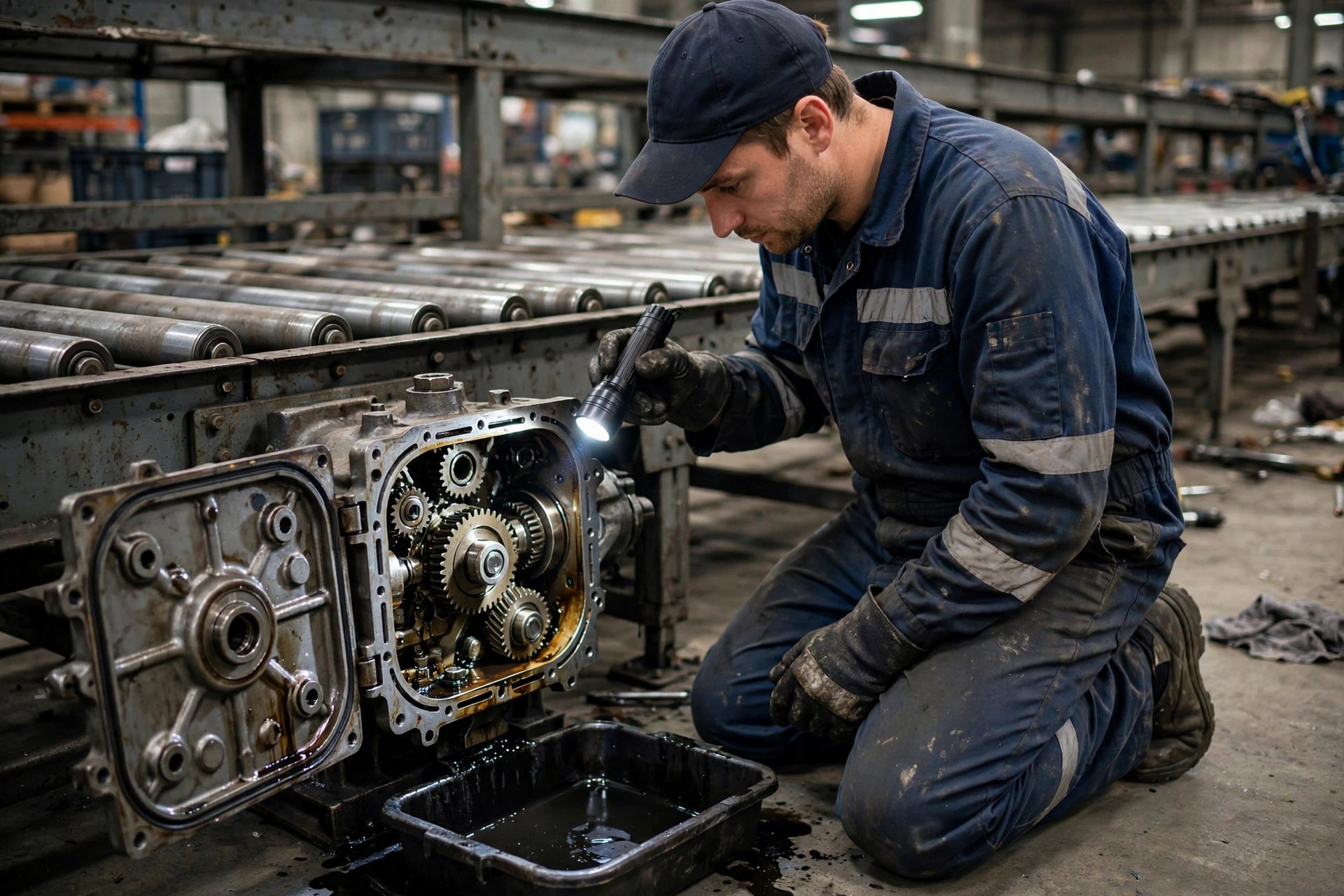
| Motor / gearbox | Low-frequency rumble you feel through walls | Decouple the load and run it empty — noise gone means the load side, noise stays means the motor | Medium: replace bearings or the unit |
| Structural resonance | Suddenly loud at one specific speed, comes and goes | Ramp the VFD slowly through the speed range and find the peak | Low: add diagonal bracing, isolation pads |
The order matters. Decouple the motor first, then walk the idlers, then sweep for resonance. Do it backwards and you'll condemn a motor for what was actually a resonance — an expensive misdiagnosis.
Two True Stories
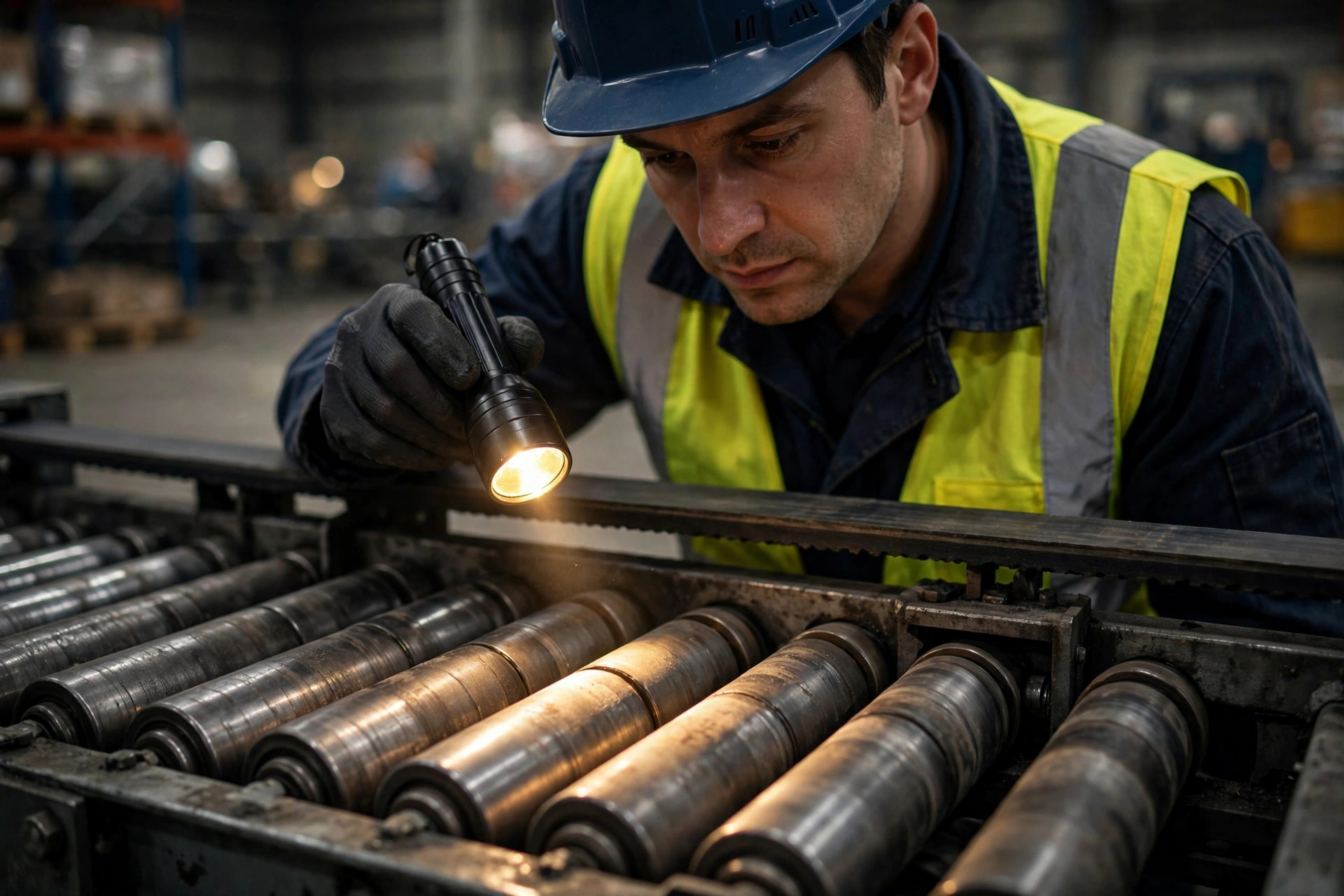
Back to Ontario. Meter in hand, we walked the line section by section and found two culprits. First: 40-plus idlers in the middle section with rusted bearings — that stretch sat near the dock doors, rain splashed in, and the grease had turned to grinding paste. Second: the belt was tracking 3 cm off-center, grinding the side skirt around the clock. The fix was two things: quiet-rated idlers (manufacturer lab data claimed −6 dB; we measured −5 dB at the property line — close enough to believe) and two auto-tracking units to pull the belt back. Re-test: 58 dB(A). Still 3 dB over. But the complaints stopped. Why? The remaining 3 dB was low-frequency background that dissolved into the ambient before reaching the houses. That's the thing about decibels: the difference between −5 and −8 dB sounds almost identical to a human ear, but costs twice as much to achieve.
The second story is more infuriating. In 2023, an e-commerce fulfillment center in Texas had a sortation line that made the whole building hum — the offices upstairs couldn't hold meetings. They replaced the motor. Then the gearbox. Close to a hundred grand, zero change. I took one look: one leg of a mid-span support was floating off the floor, and the whole steel section was vibrating like a guitar string — the motor speed happened to match its natural frequency. The fix? Two diagonal braces welded on. Half a day's work. Resonance is like pushing a swing: get the rhythm right and a gentle push sends it sky-high. The motor is the hand pushing; the steel frame is the swing. Swap the person pushing all you want — if you don't touch the swing, nothing changes.
The Playbook After a Complaint Lands
Don't panic when the complaint comes in. Don't get defensive either. Work the sequence:
- Log it the same day. Time, complainant location, which line was running, operating conditions. No log, no defense later.
- Self-measure within 24 hours. Use the method above. Keep the data. It won't hold up officially, but it tells you how big the problem is.
- Hire a certified third party. Get a formal report. Don't cheap out here — the report is the only yardstick that matters before and after, and it's what you show the regulator and the neighbors.
- Fix the source before considering enclosures. Idlers, tracking, chain, resonance — spend from the bottom of the table upward. Enclosures are the last resort: once the covers go on, routine inspection dies. An idler fails inside and you can't see it. You're trading tomorrow's maintenance for today's quiet.
- Re-test and follow up. Third-party re-test after the fix, then proactively call the complainants with the numbers in hand. People are reasonable when you show up with data.
The Maintenance Trap: The Most Expensive Savings Is "If It Still Turns, Don't Touch It"
The biggest trap in conveyor maintenance is one sentence: "if it still turns, don't touch it." One seized idler grinding under a belt — how much does a belt cost versus 40 idlers? A child could do that math, but nobody on the floor does it. Then there's grease: too much of it flings everywhere, collects dust, and turns into lapping compound that kills bearings faster. Grease little and often.
The real killer is the maintenance window. The line runs all day; the only window is 11 PM to 4 AM, and nobody wants to walk idlers at midnight. So small problems grow into big ones, and big ones grow into complaints. My advice: treat idlers as consumables. Swap them on running hours, on a schedule — don't wait for them to get loud. By the time a bearing is audible, you're already late.
One Counterintuitive Call
Human ears are most sensitive to high frequencies, so everyone on the floor swears "the squealing section is the loudest." But the complaints almost always come from low-frequency rumble — low frequencies travel through walls and across hundreds of meters. Regulations measure total level, not "the part that sounds worst." So don't remediate by ear. Remediate by meter. The meter says which section is over; you fix that section.
And I have a shot to fire at a sacred cow: buying enclosures first is panic-buying 90% of the time. A cover buys you maybe 10 dB, and it blocks cooling and inspection access. Fix the source; if you're still over after that, then consider the cover. Get the order wrong and the money is gone.
Whether the money was worth it comes down to one number: nighttime A-weighted equivalent level at the property line, one meter out — compliant, and complaint count at zero. The meter number is for the regulator. The complaint count is for you. Get both right, and the money was well spent.
By Da Liu, Automation Engineer