We run a small warehouse, and we can't afford to burn money on the fancy stuff — that's the first thing that pops into my head every time I think about buying equipment. But the conveyor emergency stop is different. You don't save money on an e-stop, because every dollar you save there can come back as a medical bill and a shutdown.
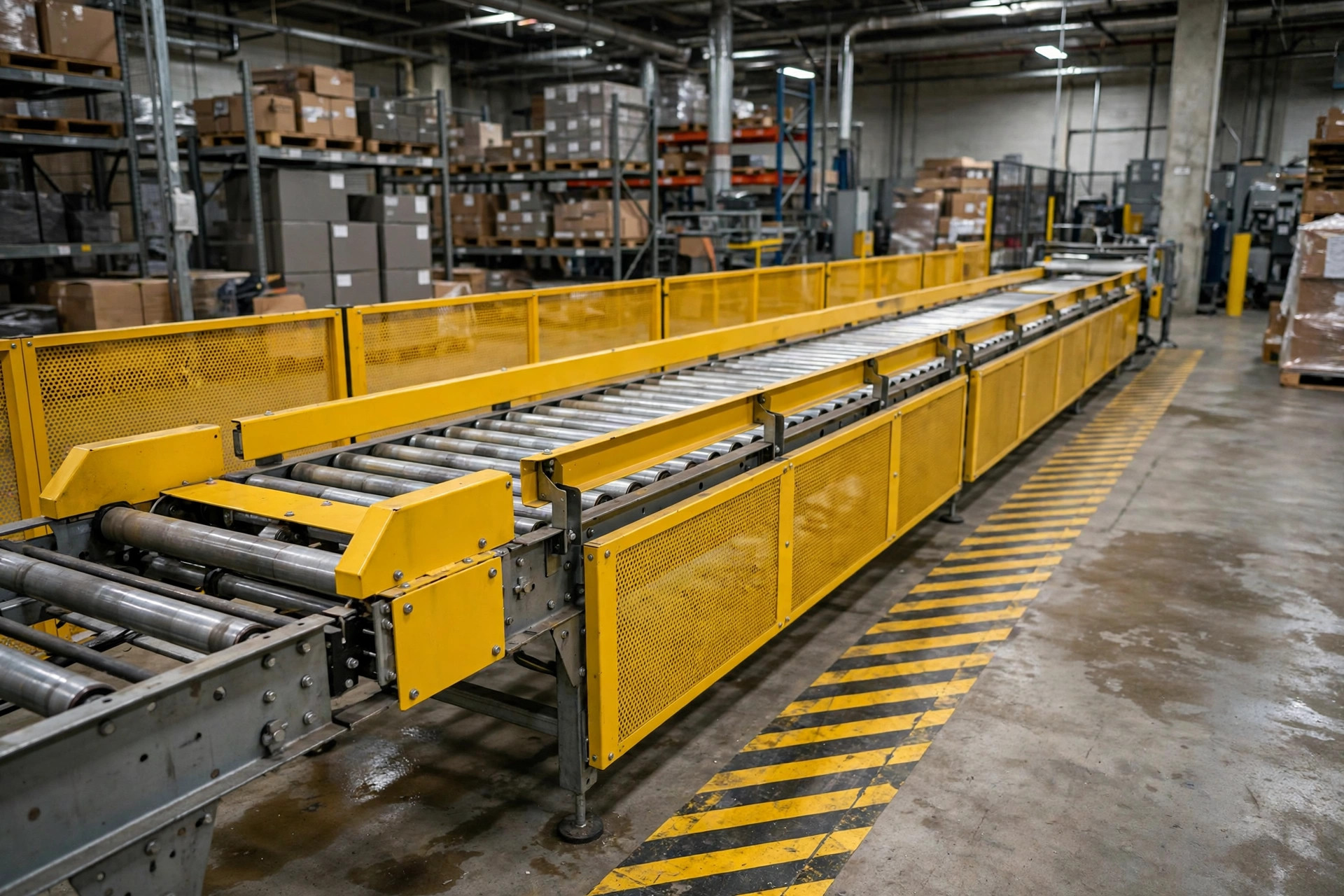
Let me tell you what actually happened in our warehouse. Last summer, a roller conveyor line we'd installed two weeks earlier was running when a packer's sleeve got caught between a roller and a carton. The coworker next to her slapped the red mushroom button without thinking. The line stopped, she was fine, her sleeve was torn. Afterward I watched the camera footage: less than three seconds passed between the sleeve catching and the button being hit. If that button had been two meters farther away, or blocked by a stack of cartons someone had parked in front of it, I don't want to think about what would have happened. That day I learned something: an emergency stop button is worth exactly as much as whether someone can reach it in those three seconds.
After the Conveyor Emergency Stop: How the Line Actually Stops
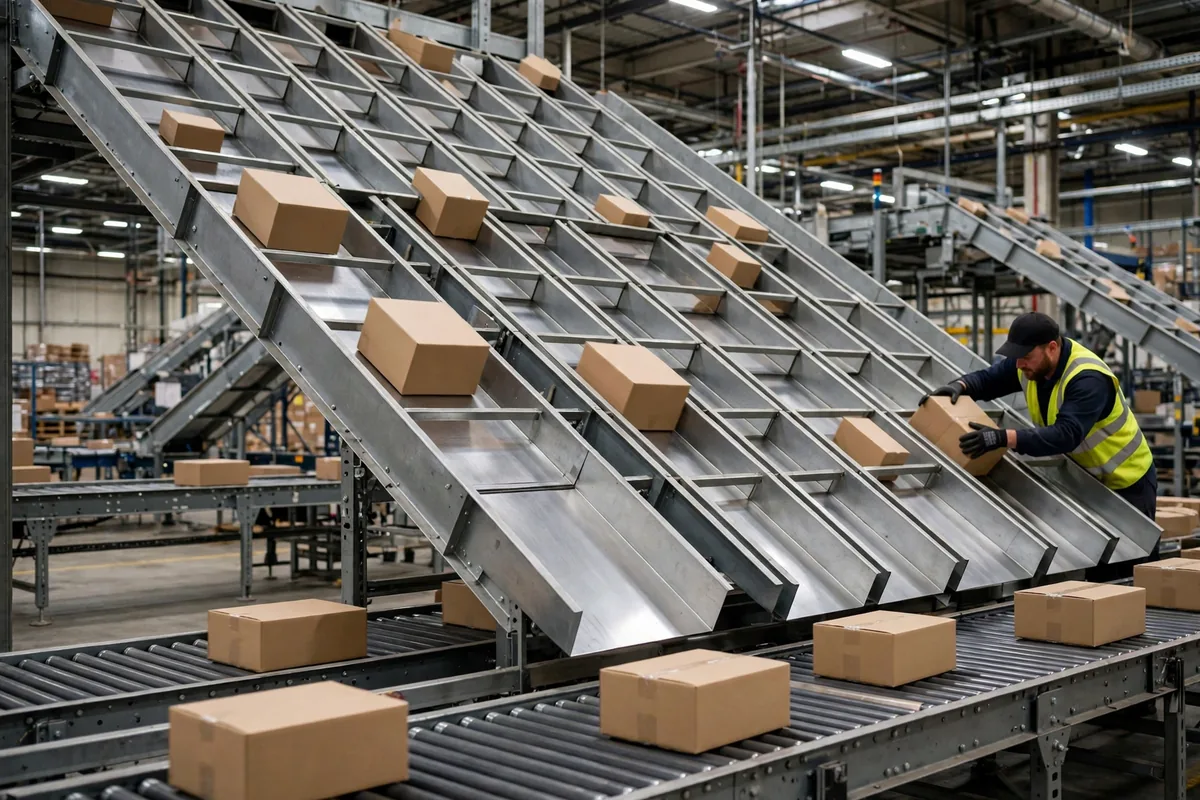
Most people think an e-stop just cuts the power and the whole line goes dark. It's not that simple. There are two ways a line can stop. One cuts power immediately and lets the rollers coast to a halt. The other is a controlled stop: slow down first, wait for the goods to settle, then cut power. Which one is right depends on what your line carries. Light cartons? An immediate stop is fine. Heavy goods, or goods running on an incline? A hard stop sends cartons sliding forward or dropping, and that can hurt someone by itself.
Our line carries light parcels, so we use the immediate stop. But I only learned later that the stop method isn't something you guess — it comes out of a risk assessment: how heavy the goods are, how fast the line runs, how long it is, whether there's a slope. When the integrator installed our line, they asked me all of this, and at the time I thought they were being fussy. Now I think asking those questions in detail is what being responsible looks like.
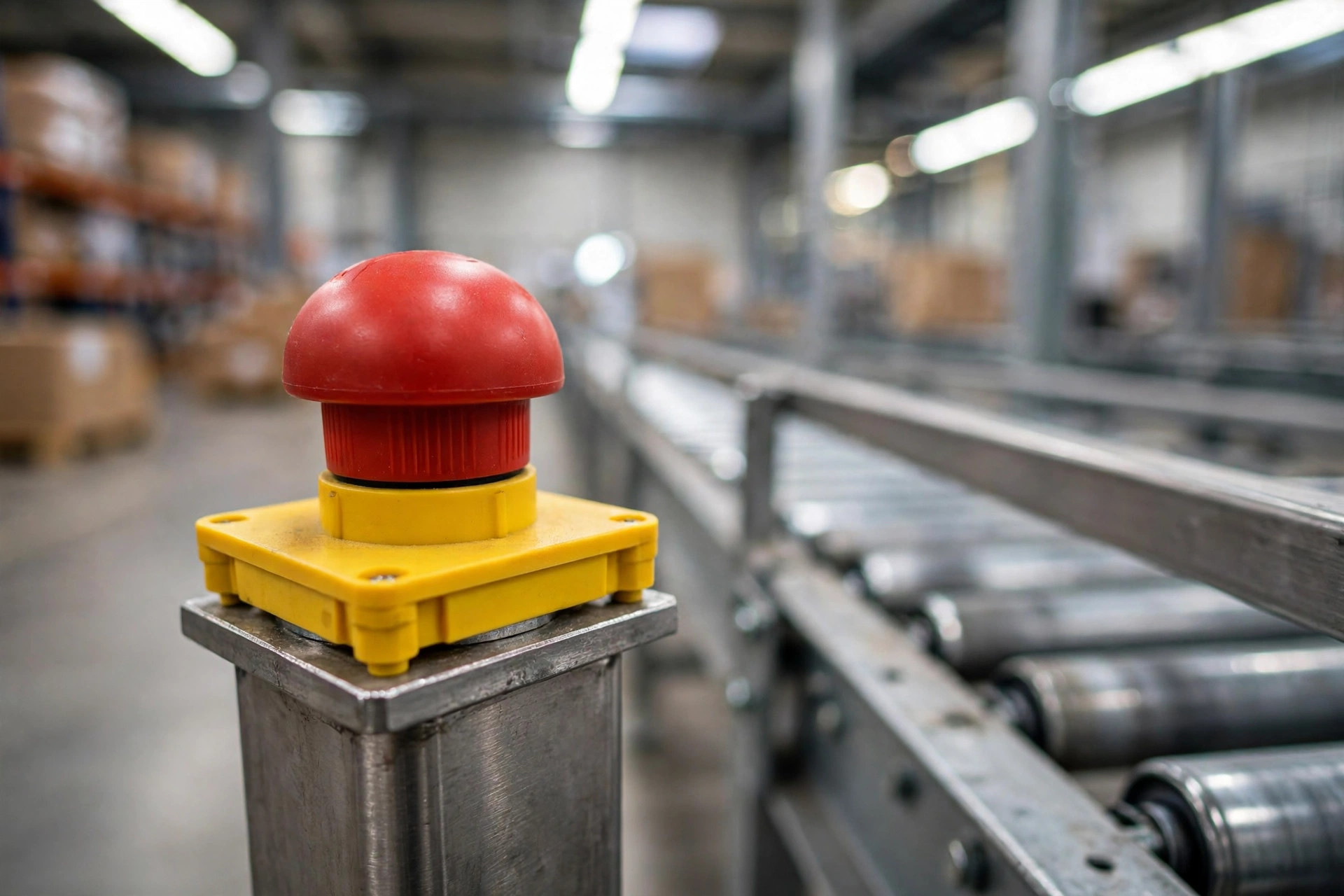
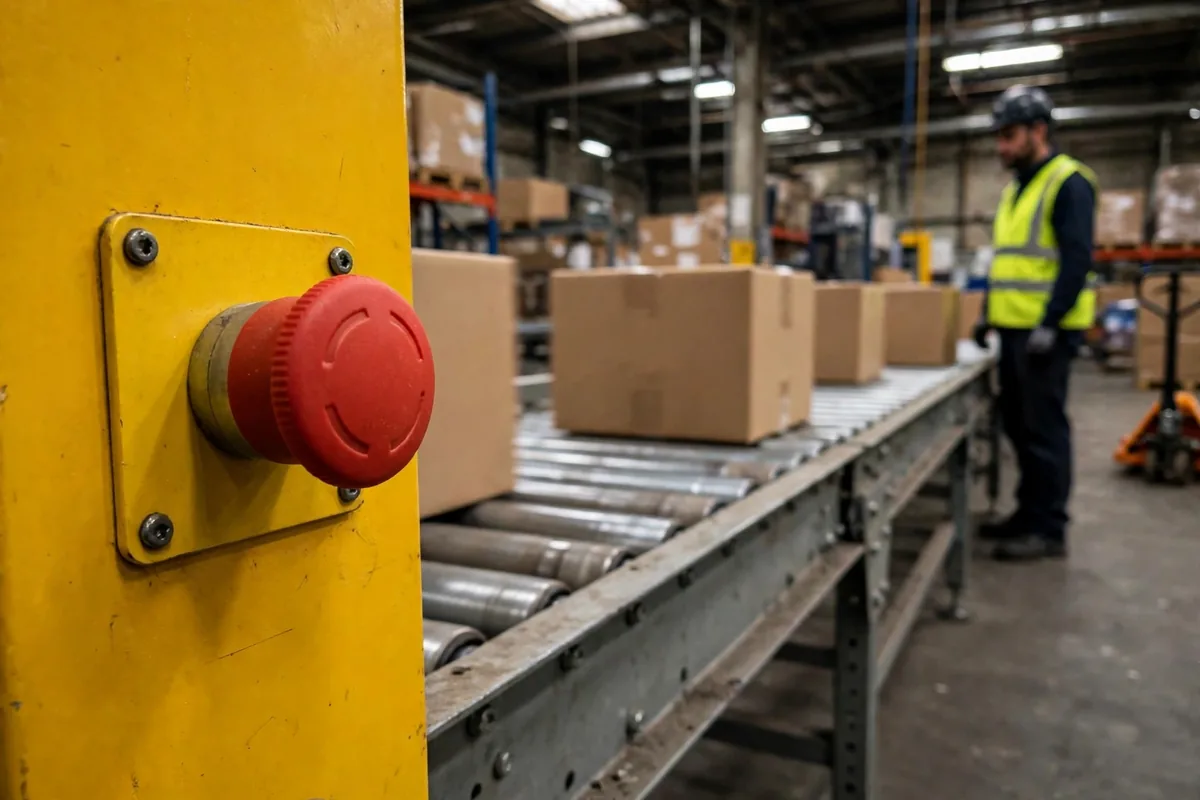
The button itself has rules too. By standard, the actuator is a red mushroom head on a yellow background. That color scheme isn't decoration — it's so a panicking person can spot it at a glance. When you press it, it has to latch: it stays down when you let go. A button that pops back up on its own has no business being called an emergency stop. And here's something a lot of people don't know: e-stop devices have to be within reach everywhere people work — at operator stations, at loading points, at both ends of the line. Our line is a little over twenty meters long, and at first it only had two buttons, one at each end, with a long blank stretch in the middle. We added a pull-cord switch later, so now anyone along the whole line can grab the cord and stop it. That cord cost almost nothing, but it closed the biggest hole in the entire line.
On the standard numbers, I checked before writing: the design principles for the emergency stop function are ISO 13850:2015, adopted in Europe as EN ISO 13850. The device itself falls under IEC 60947-5-5, and the wiring and control side under IEC 60204-1. I'm not listing those to show off. The point is practical: when you buy a button, don't just look at the price. Ask whether it meets those standards. A cheap button with no standard behind it is decoration, not safety.
The Conveyor Emergency Stop Reset Step Is Where Things Go Wrong
Pressing the button is only step one. Step two is worse: who resets it, when, and what happens before the reset.
Here's the counterintuitive part: releasing the e-stop does not mean the machine can start again. The standard is explicit — disengaging the device shall only permit restarting, not restart the machine by itself. A second deliberate action, like pressing a separate start button, is required. If your line starts moving the moment someone twists the button back out, that line is faulty. Fix it.
In our warehouse we have a hard rule: whoever hit the e-stop is responsible for the reset, or the shift lead does it. Nobody else touches it. Before the reset, we look around: is everyone clear of the line, is whatever got caught removed, is there a jammed carton on the rollers, is anyone still bent over picking up goods? Then someone calls out that the line is about to start, waits to make sure nobody objects, and only then presses start. Written out it sounds fussy. In practice it takes about a minute. But that one minute guards against the worst kind of accident: one person still inside the line fixing something while another person outside presses start.
There's also the question of who holds the reset authority. We're a small warehouse and we keep things loose, but even loose needs a rule: only the shift lead and the person responsible for the equipment can reset. New hires and temp workers don't touch the reset. I've seen warehouses where anyone could reset, so one person hit the stop and someone else casually reset it while the first person was still working on the line. Just picturing it is frightening enough.
Restart Interlocks: Cheap Fixes and the Line You Don't Cross
Big companies talk about safety interlocks with words that sound expensive — dual channels, monitored circuits, all of it. We can't afford that setup, but the baseline doesn't change. My cheap version is three things. They don't cost much, and they work.
First, pull-cord plus buttons as a double guarantee: a long line must have a cord, and a short line needs a button at every workstation, reachable from anywhere. Second, lockout and tagging: before anyone works on the line, cut the power, hang a "maintenance in progress, do not switch on" tag on the switch, and keep the key in the pocket of the person doing the repair. The tag costs a few dollars, the key is already there, and this homegrown method blocks the most common accident of all — an accidental restart. Third, test every e-stop once a month: press each button in turn and check whether the line stops, whether it stops cleanly, whether the latch holds, and whether the reset works smoothly. Write the results down. The test takes less than half an hour, and it catches a dead button before you need it — because a button nobody touches for months can fail silently, and discovering that in an emergency is too late.
Let me do the math, with illustrative scenario figures: our line runs 8 hours a day, and one hour of downtime costs us a few hundred dollars in labor and delayed orders. But a single crush injury — medical bills, a shutdown for inspection, higher insurance — easily runs into five figures, and that's before counting what the injured person goes through. What we spend in a year on testing and maintaining the e-stop system is about the cost of one dinner out. You don't need a cost analyst to see which side of that equation wins.
Small warehouses have their own way of surviving, but safety doesn't come in a small-warehouse version and a big-company version. Can you install fewer buttons? Sure — a short line with few workstations doesn't need five. But latching, reset discipline, and restart prevention are three things you can't skip. Skip them, and you're gambling with people.
One last self-check for you: walk into your warehouse right now, point at any conveyor line, and ask the operator three questions. When was the last time someone hit the e-stop? Who did the reset? Is there any spot along the line where you can't reach a button? If those questions don't have answers, your e-stop system is still at the "we installed a button" stage — and that's a long way from "it can actually save someone."
By Xiao Ma, Small Warehouse Owner