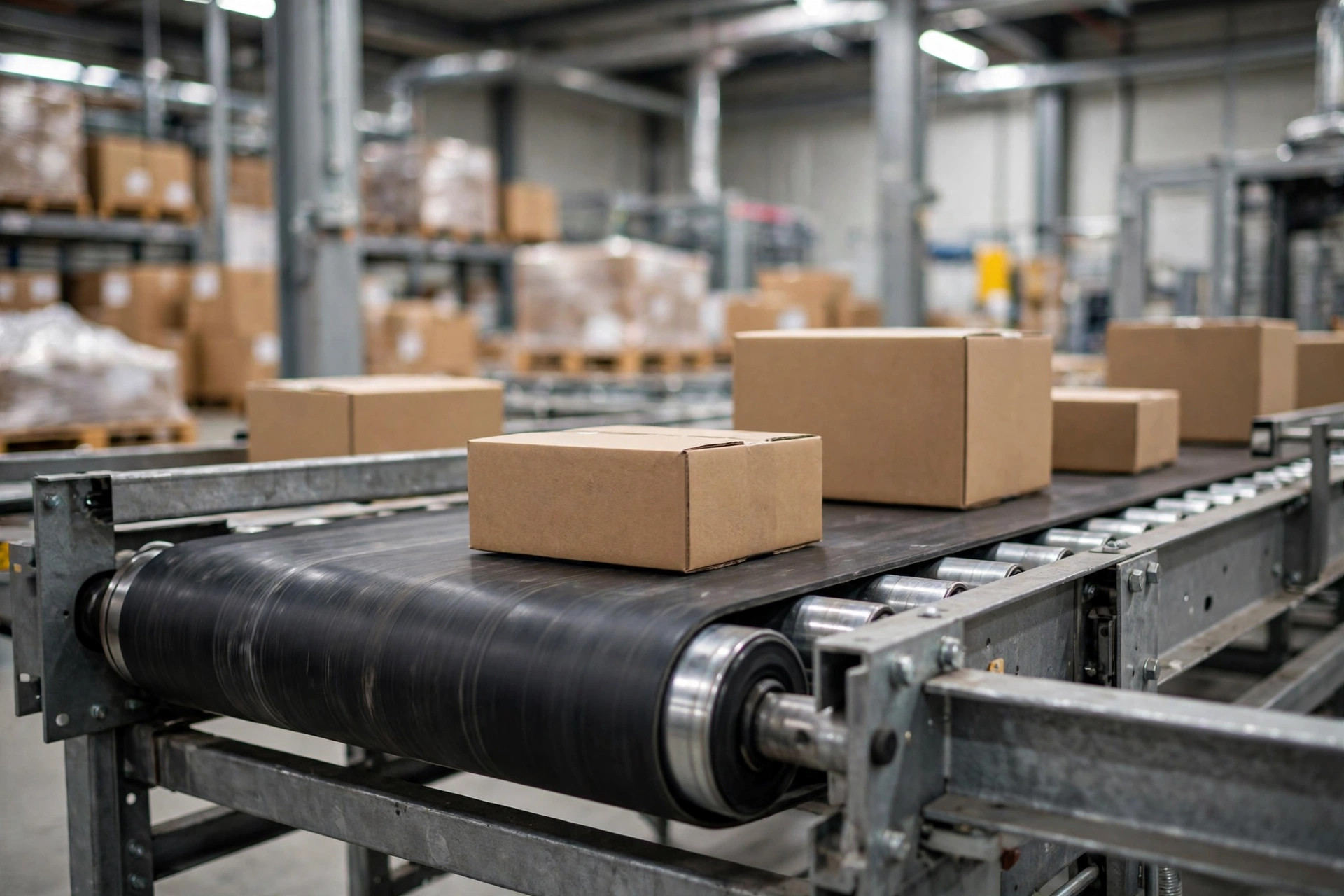
Last fall, conveyor belt misalignment nearly stopped an apparel e-commerce warehouse in eastern China right before peak season — a brand-new belt on a sortation line drifting right, grinding against the skirt boards, shedding rubber dust across the floor. The shift lead and two techs spent three days adjusting idlers, then added two sets of training idlers for good measure. Next morning: still drifting.
I took one look and had them jog the splice to an accessible spot. Tape measure out: the splice was cut nearly a centimeter out of square. The belt was a parallelogram. No amount of idler adjustment was ever going to fix that.
Here's my verdict up front: conveyor belt misalignment is rarely the belt's fault. There are three culprits. Check them in order and you're done by lunch; get the order backwards and you'll burn a month on idlers for nothing.
Why Conveyor Belt Misalignment Happens: Get the Physics First
Old-timers in this trade have a saying with three parts: a belt runs toward the tight side, toward the high side, and toward the tail of the pulley rotation. In plain English — the belt drifts toward whichever side has more tension, whichever side sits higher, and away from the direction the pulley is turning.
Think of it like two people carrying a shoulder pole: whichever side pulls harder, the pole swings that way. A belt is stubborn in exactly this way — it only cares whether tension is balanced side to side. It does not care how many times you've adjusted the idlers.
There's also a clever bit of design worth knowing: many pulleys are crowned, slightly fatter in the middle than at the ends. You can think of the pulley as coaxing the belt toward center — a belt naturally climbs toward the largest diameter. That's self-tracking, not magic. But its correcting force is limited. Get the tension imbalance big enough and no amount of coaxing holds.
So the whole phenomenon reduces to one sentence: either side-to-side tension is unbalanced, or something keeps pushing the belt sideways. Follow that logic and the troubleshooting order writes itself.
Culprit #1: Pulleys and Idlers Not Square to the Frame (Check This First)
The number-one culprit, and the one most often wrongly acquitted: pulley and idler axes not perpendicular to the conveyor centerline.
Here's the counter-intuitive call: if a brand-new line mistracks on day one, the problem was almost certainly born on installation day — not a defective belt. I've seen too many projects where the install crew eyeballed it with a spirit level, called it "flat," and never shot it with a laser.
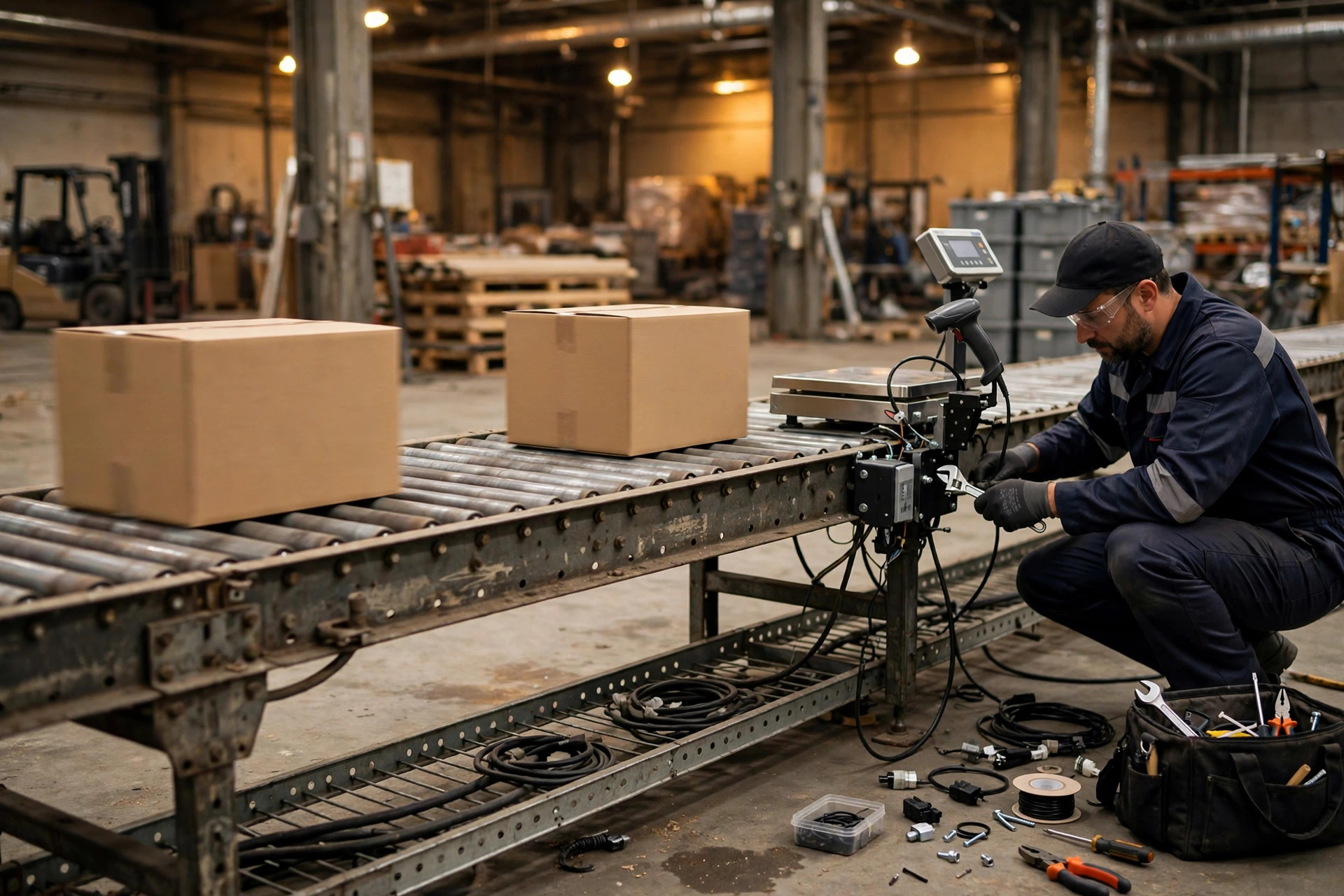
Two years ago, a 3PL warehouse in eastern China commissioned a new incline conveyor. Day one, the belt walked left. The installers swore the frame was level. I put a laser level on it: the tail pulley axis was 4 millimeters out of square. Re-squared it — twenty minutes — and the belt ran true. Four millimeters, invisible to the naked eye. The belt, however, sees everything.
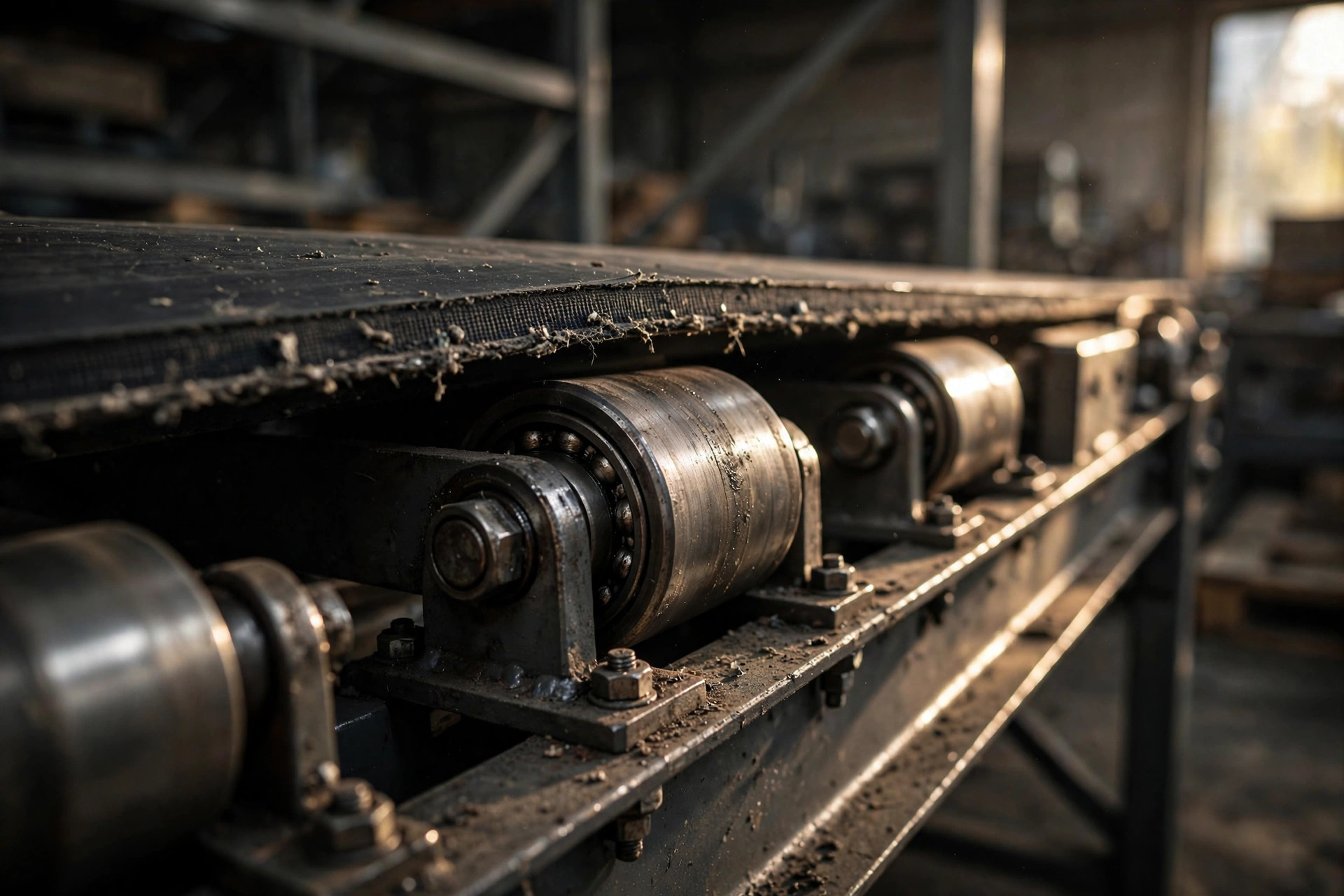
How to check: shut it down, pull two diagonal tape measurements across the frame — a few millimeters of difference is all it takes — then put a square on each pulley and check the axis against the centerline. Frame and pulleys first, belt second. That ordering is the whole game.
Culprit #2: A Crooked Splice or a Badly Cut Belt (Check This Second)
Frame square, pulleys true, still drifting? Now look at the belt itself: a splice cut out of square, or a belt that left the factory as a parallelogram.
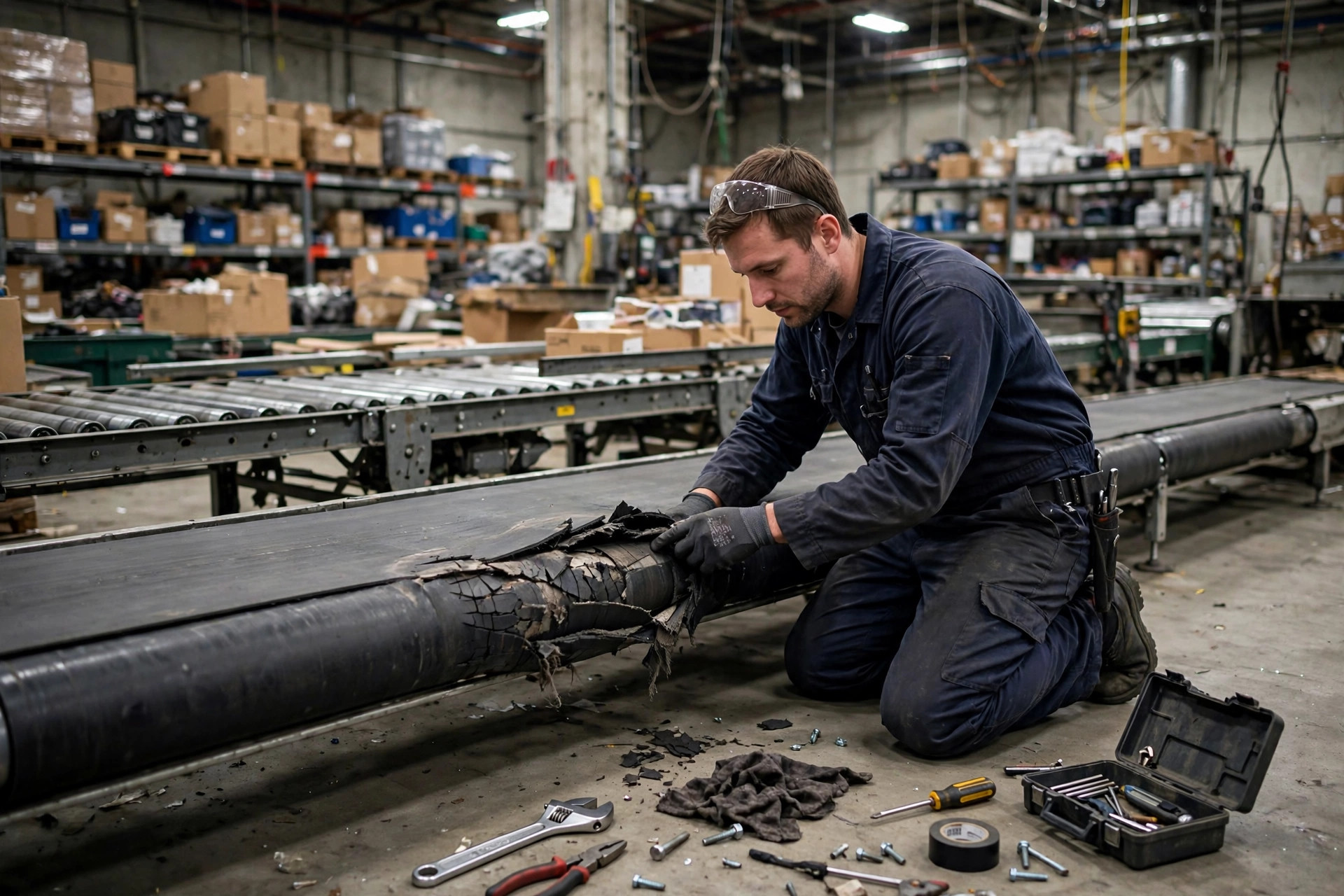
The apparel warehouse from the opening was the textbook case. The splice was nearly a centimeter off, so every revolution the splice hit the pulley with a little sideways shove, walking the belt further each pass. Adjusting idlers against that is arm-wrestling the belt's geometry. You will lose.
How to check: jog the splice to where you can work on it and measure from each edge of the splice to the belt edge — a big difference between the two sides is your smoking gun. The field-expedient version: run the belt empty and watch whether the drift pulses in sync with the splice going around. If it does, you've found it.
Now the trade-off nobody wants to hear: a vulcanized splice is nearly as strong as the belt itself and runs smooth, but it costs you half a shift of downtime. A mechanical fastener (belt lacing) takes thirty minutes — but the joint ends up thicker on one side, and can become a brand-new source of mistracking. Some plants skip vulcanizing to save half a shift, lace it, and end up with mistracking plus spillage for the next three months. Save half a day, pay for a quarter. That math never works.
Culprit #3: Off-Center Loading and Material Buildup (Check This Last)
First two clear, still drifting? Now look at operations: the feed landing off-center, or material caked onto pulleys and return idlers.
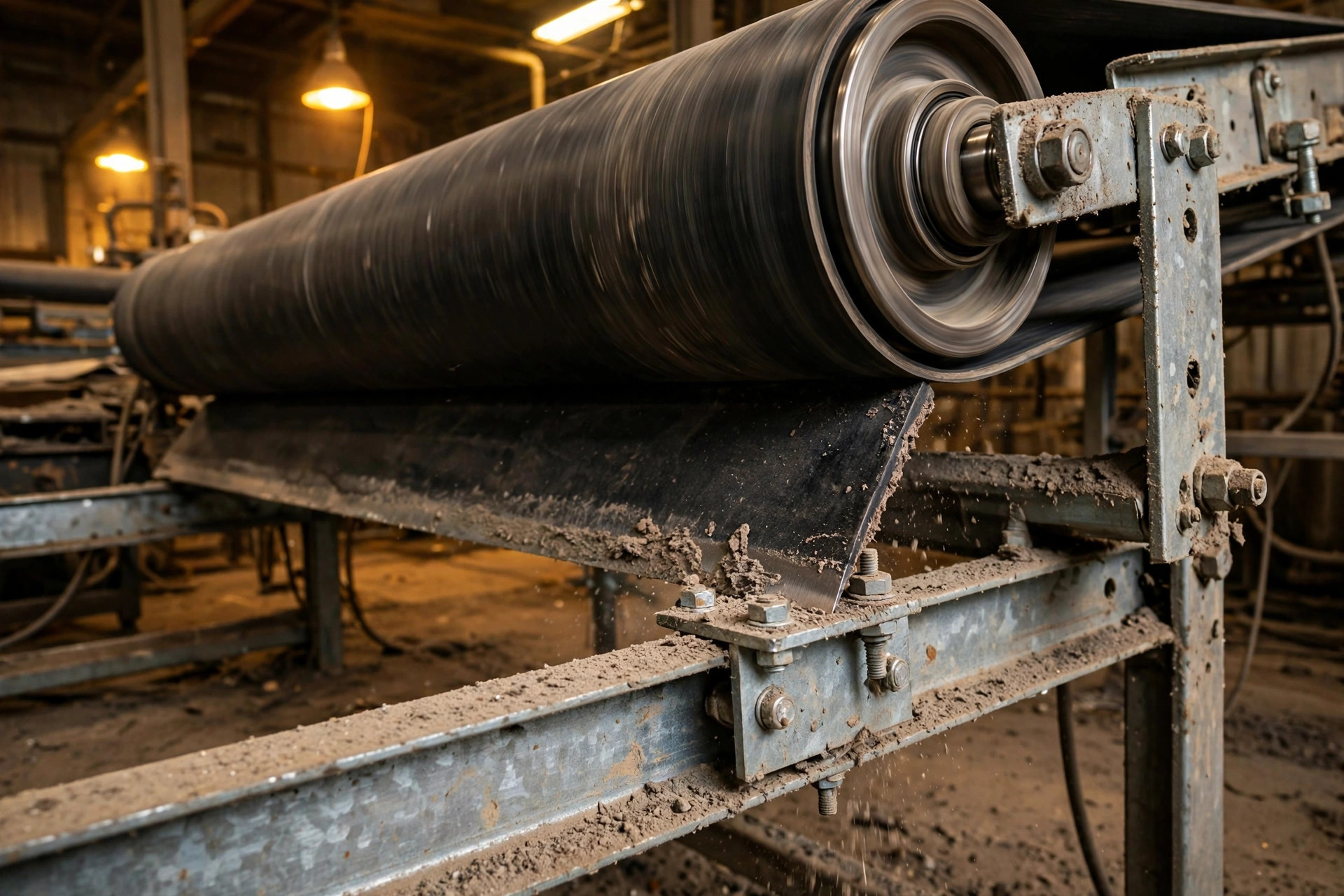
An off-center material stream is a constant sideways push. And a return pulley with a layer of caked dust becomes a cone — larger diameter on one side — so of course the belt walks toward the smaller side. Buildup is the sneaky one: more drift means more spillage, spillage becomes new buildup. A feedback loop.
A parcel hub's incline belt drove everyone crazy with intermittent drift: heavy flow, it walked; light flow, it behaved. The crew nearly replaced every idler on the line. I had them look at the loading chute first — it had shifted, dropping the stream nearly 10 centimeters off-center onto one side of the belt, and the return pulley was wearing a coat of dust. Straightened the chute, scraped the pulley. Problem gone, not a single part replaced.
Note the pattern, because it saves you half a day: intermittent drift points away from installation. Installation problems drift every day, consistently. Intermittent? Go look at the load and the buildup first.
The Maintenance Trap: Training Idlers Are Band-Aids, Not Medicine
Which brings me to a pseudo-need I have zero patience for: "buy an automatic belt tracker and forget about it."
Training idlers and self-aligning frames only correct mild, occasional drift. They're band-aids. With a crooked splice or an unsquare pulley, you could bolt on ten trackers and the belt would still chew its edge. Putting a band-aid on a fracture — expensive and useless. Fix the root cause first, then decide whether you even need the band-aid. Order matters.
Two more classic traps: adjusting only the take-up screws without squaring anything. Take-up sets tension, not direction — a loose belt slips, but tightening one never cured drift. And the other: adjusting without locking. Two days of vibration backs the screws off, the drift returns, and you waste another round chasing what looks like a new problem.
The Cost of Conveyor Belt Misalignment: Running the Numbers on All Three Culprits
| Culprit | Time to diagnose | Fix cost | Recurrence after proper fix |
|---|---|---|---|
| Pulleys/idlers out of square | 1–2 hours incl. shutdown measurement | Low, mostly labor | Very low once squared |
| Crooked splice | Half a shift incl. re-splice downtime | Medium, vulcanizing cost | Near zero |
| Off-center loading / buildup | Under an hour | Low | Returns if you skip cleaning and chute alignment |
(Magnitudes only — calibrate against local labor and parts pricing.)
The point of the table: done in order, even the most expensive fix is half a shift plus one vulcanized splice. Done backwards — adjust idlers, add trackers, replace idlers, repeat — you burn multiples of that in labor and downtime.
Whether the money is worth it comes down to one number: a belt that dies early from edge wear costs you a new belt, a vulcanized splice, and half a shift of a stopped sortation line — do that math yourself. Two techs for half a day to re-square the pulleys and redo the splice costs a fraction of that. Troubleshooting order is money order.
By Da Liu, Automation Engineer