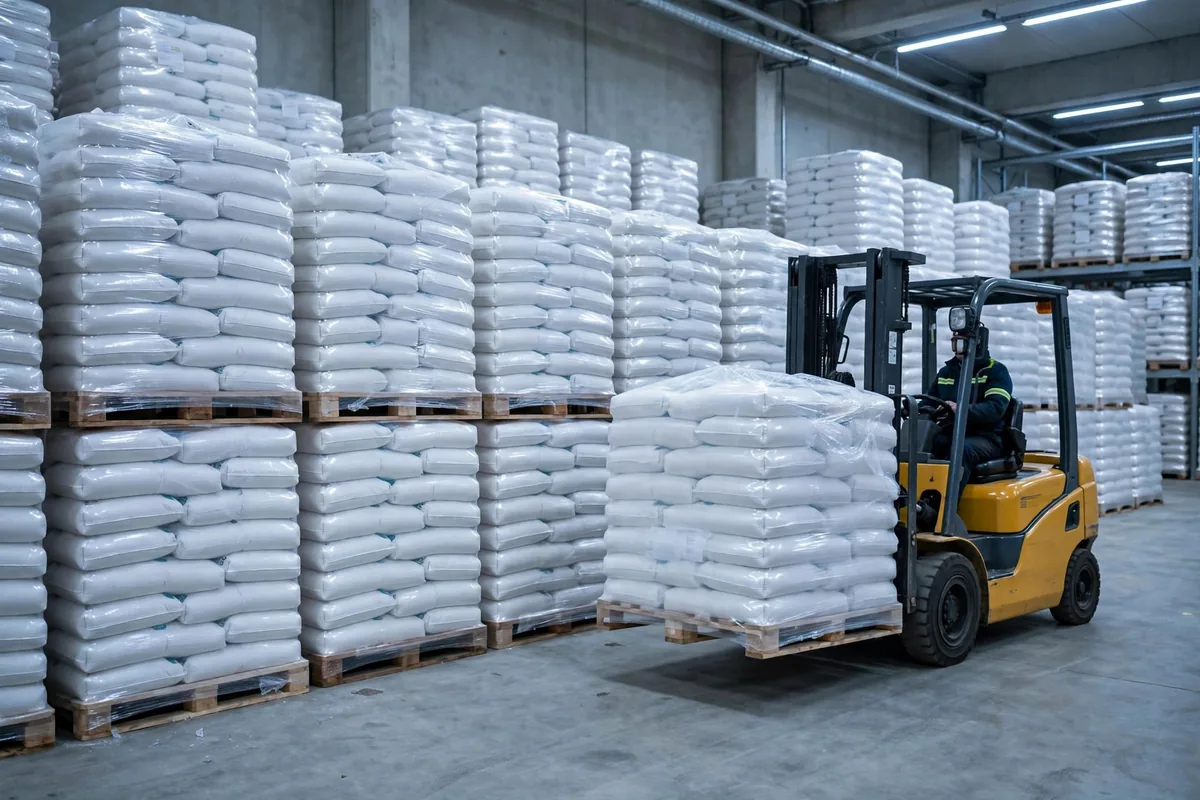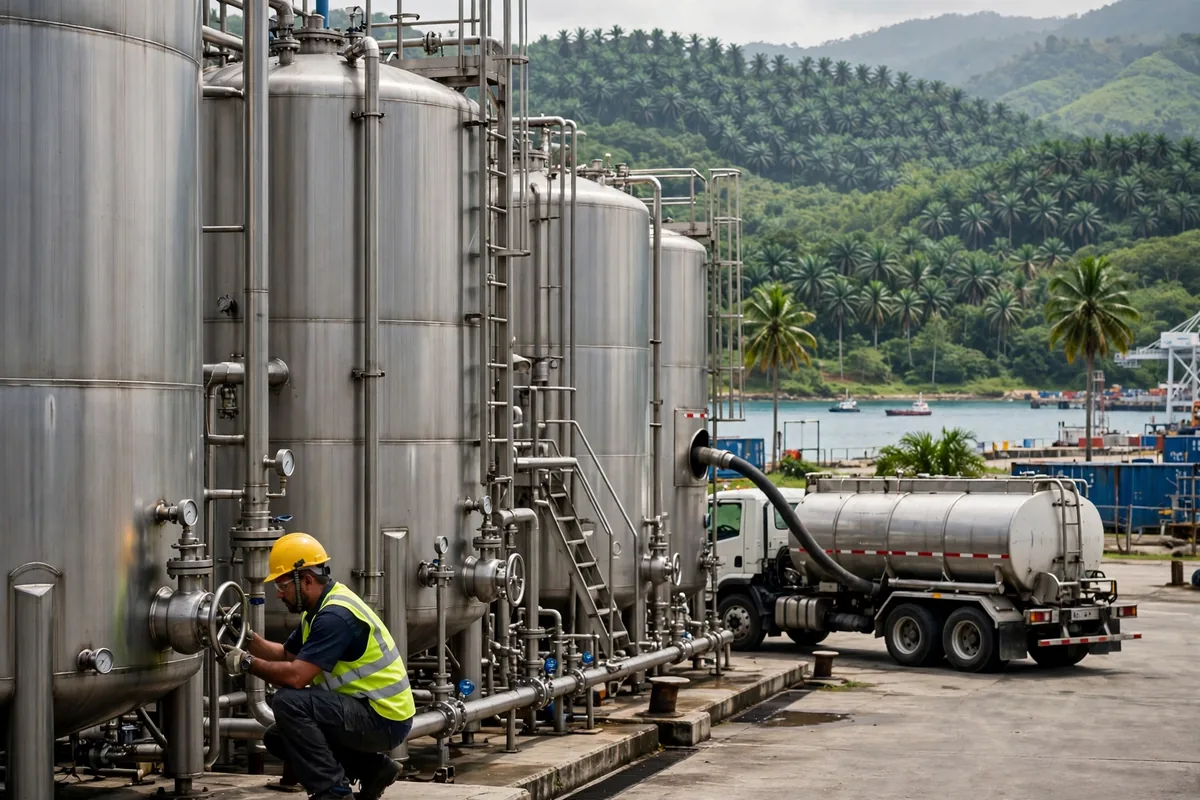
Let me open with a number, because that is where every honest conversation about Colombia palm oil export warehouse storage starts. According to the U.S. Department of Agriculture, Colombia produced 1.9 million tonnes of palm oil in 2024/25, but exports were expected to come in at only around 420,000 tonnes. Less than a quarter of what the country grows ever leaves it. Domestic demand, led by biodiesel, eats the rest. And when export volumes are that thin, storage stops being a rounding error. Pick the wrong form — bulk tank or drums — and one shipment's margin is gone before the vessel sails.
Colombia Palm Oil Export Warehouse Storage: Bulk Tank or Drums
Early in 2025, I helped a friend who trades South American farm products price out a shipment of crude palm oil: from an inland mill in Colombia to a port warehouse on the Caribbean coast, waiting on a vessel. He had two options, and their cost structures had almost nothing in common. The table below is an illustrative scenario, with figures estimated from quotes at the time — not market rates, and not a price list:
| Cost item | Bulk tank | Drummed in containers |
|---|---|---|
| Storage form | Port tank farm, charged per tonne per day | Drummed, then held in a general warehouse or yard |
| Packaging cost | Close to zero | Drums plus filling labour — the biggest line |
| Handling steps | Pumped through a pipeline, done in one move | Fill, seal, stack, load — four pairs of hands |
| Loss risk | Cross-contamination and residue; tank cleaning billed separately | Leaking and rusted drums; budget for a breakage rate |
| Right batch size | Only pays off above a few hundred tonnes per lot | Better for small lots and several buyers |
The line most people skip is tank cleaning. A bulk tank is not a water jar. Whatever the previous cargo was, the tank has to be washed and inspected before your palm oil goes in, and the cleaning fee is charged per tank, not per tonne. My friend's first lot was barely over 200 tonnes. Once cleaning and the minimum rental period were added in, bulk storage cost him nearly ten percent more per tonne than drums. The lesson was plain: bulk saves on packaging and loses on the fixed costs of a small lot.
Drums are not a free pass either. The trap sits at the port. Around Cartagena, liquid bulk lives in separate facilities along the Mamonal industrial strip, while containers move through different terminals. Drummed oil goes through the container terminal, where sailings are frequent and the process is familiar. Bulk oil goes through the liquid terminal, where sailings are fewer and waiting is longer. Three extra days waiting for a vessel means three extra days of tank rent. If you price storage and vessel schedules on separate sheets, you will price them wrong.
What Colombia Palm Oil Storage Actually Fears: Oxidation, Heat, and Water
Palm oil is a liquid cargo, and it fears different things than dry goods do. Crude palm oil fears oxidation, heat, and water. Oil leaves the mill hot, and it has to cool before it goes into a tank. On Colombia's Caribbean coast, heat and humidity are a year-round fact, and a tank baking in the sun warms the oil inside it. Oxidation has no alarm bell. By the time a buyer rejects the lot on acidity, the damage is done.
The worst case I saw was an exporter who stored oil in an old tank at the mill itself and waited two weeks for a vessel. Rainy season arrived, the tank roof seal had aged, and water seeped in and sat on the oil surface. The buyer's sample came back over the moisture limit, and the whole lot was sold at a discount. The money he lost would have paid for three months in a proper port tank. His problem was not bad luck. It was treating storage as "put it there and forget it." Liquid storage is never that. It is daily temperature checks, regular sampling, and roof seal inspections. Skip one, and you keep the risk that goes with it.
Drums move the moisture battle onto the drum itself. Steel drums fear rust; plastic drums fear sun. Salt air on the Caribbean coast is unkind to steel, and rust works from the outside in — a drum can look fine on the surface while the bottom is already thinning. My rule costs nothing: raise drums off the floor on pallets or dunnage. Warehouse floors sweat in that climate, and a drum sitting directly on concrete rusts from the bottom up twice as fast. It is a habit, not a purchase.
Consolidation and the Port: Don't Let the Oil Wait for the Ship
Colombia's palm oil exports carry one structural feature that shapes storage: the export share is shrinking. A USDA report from March 2025 noted that exports fell from over 40 percent of production in 2018/19 to just over 20 percent in 2023/24, while the mandatory biodiesel blend — 10 percent — absorbs a growing share of crude oil at home. Fewer export lots means it is harder to fill a whole vessel, so consolidation is now routine.
Consolidation creates two storage problems. The first is mixed lots: oil from different mills and different batches goes into one tank, and the buyer grades the whole tank on its weakest batch. One bad lot drags the entire tank down. The second is timing mismatch: the first oil in pays rent while it waits for the last oil to arrive. My rule is to price the waiting before agreeing to consolidate. If the wait runs past three days, the freight saved usually does not cover the extra tank rent.
One more practical point on the port itself: Cartagena is not a single terminal. It is a port zone spread around Cartagena Bay and the Mamonal strip, with containers, liquid bulk, and dry bulk handled at different facilities. Before booking, confirm which terminal your cargo enters and which tank farm it sits in, and make sure the trucking company knows. My friend's tanker once drove to the container terminal gate before discovering it could not enter. A full day burned on a U-turn. With liquid cargo, one wrong gate costs one day.
So the ledger for Colombia palm oil export warehouse storage comes down to three lines. Batch size decides the form, and the form decides the cost structure. In liquid storage, quality risk costs more than rent. And vessel schedules and tank rent belong on the same sheet — priced apart, they will be priced wrong. Above 500 tonnes per lot with a firm sailing date, bulk tanks win. Small lots, several buyers, uncertain sailings — drums in containers are the safer call. Get that dividing line right, and everything else follows.
One number worth writing in the margin of that ledger: industry figures from Fedepalma show Colombian palm oil exports reached 560,000 tonnes in January to September 2026, up 22 percent year on year — a record for the period. When exports climb, port tank capacity and vessel space are the first things to tighten. Lock storage contracts early instead of hunting for a tank after the vessel is booked. As volumes rise, consolidation windows shorten and the batch threshold for bulk falls. That is exactly when the bulk-versus-drum line deserves to be recalculated.
By Lao Zhou, Logistics Cost Analyst