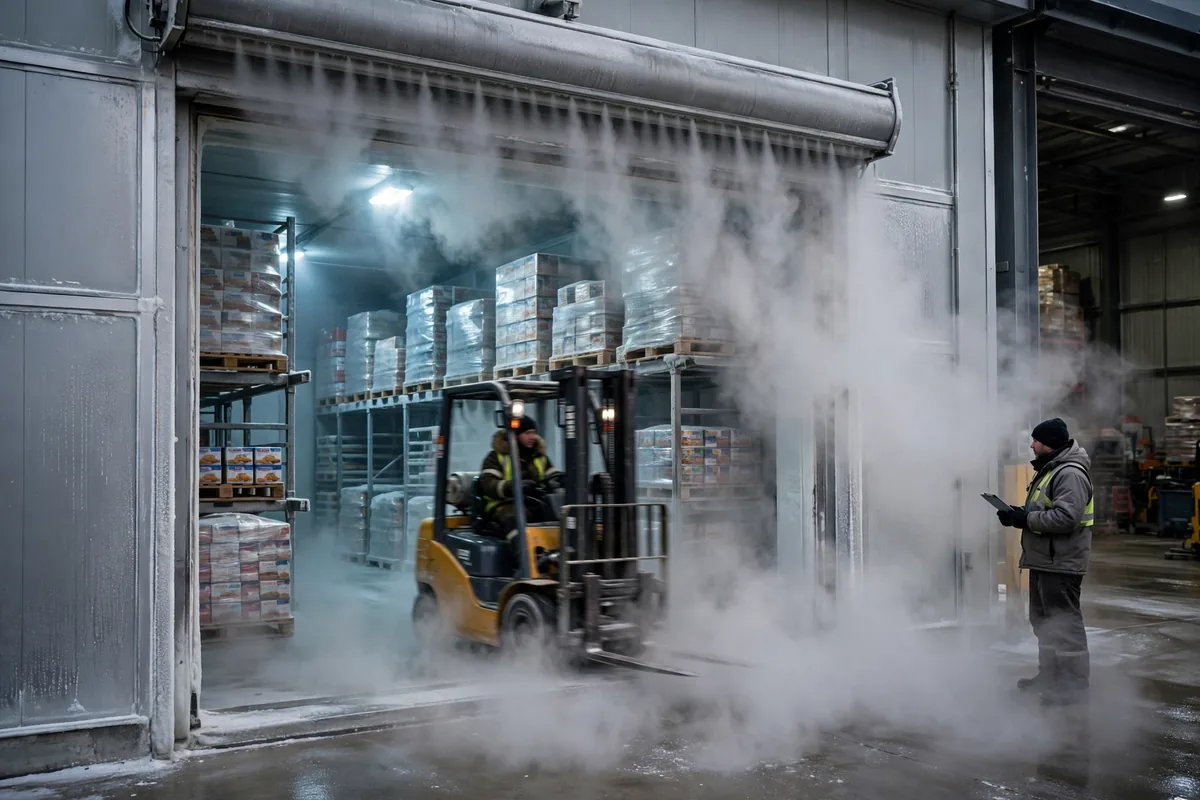
Our first cold storage inventory counting low temperature job happened on a January night, and it went badly enough that I still tell the story at industry dinners. I took four people into a freezer running around minus twenty, with a plan to finish one zone in two hours. Half an hour in, two handheld terminals had shut themselves down from the cold, one person's pen would not write, and another could barely grip the scanner through thick gloves. An hour later we walked out with half a zone counted and numbers that did not reconcile, and we had to redo the whole thing the next day. That night taught me the lesson this whole article is about: in a freezer, you are not planning around the stock. You are planning around the fact that human beings cannot stay in there. Our little warehouse cannot afford to burn money the way big operations do, so the big-company playbook of sending everyone in for a continuous shift was never going to work for us.
The First Problem in Cold Storage Inventory Counting Is Not Frost, It Is People Running Out of Time
In sub-zero air, a person's useful working time is measured in minutes. Fingers stiffen, glasses fog, and thinking slows down. Counting while shivering does not produce careful work, it produces confident-looking errors. So we made a rule that sounds lazy and works brilliantly: nobody stays inside for more than twenty minutes at a stretch, then comes out for ten minutes to warm up before going back in. A rotation sheet hangs on the freezer door with entry and exit times, and the shift lead enforces one thing only, which is that the clock is not negotiable. It looks slower on paper. In practice it is faster, because rework drops off a cliff.
Equipment needs the same low-temperature thinking. Handheld terminals should sit in the cold anteroom for a while before going in, instead of traveling straight from a warm office, because that temperature swing fogs the screen first and kills the device second. Spare batteries ride in an inside pocket, kept warm by body heat, and get swapped during each rotation. Frosted labels are a constant headache, and our fix is almost embarrassingly simple: the day before a count, one person goes in with a single job, wiping frost off the labels on the racks we plan to count, and photographing them for reference. The next day, scan success jumps. It sounds like nothing. It saves more time than any gadget we have bought.
Our Three Tricks for Cold Storage Counting: Small Zones, Rotation, and Counting Twice
Our current routine has three parts, and none of them cost anything. First, split the freezer into small zones, where one zone equals one shift's work. Count a zone, seal it, hand the numbers over on the spot, never save everything for one big reconciliation at the end. Second, rotate people on the twenty-minute rule, and make the person coming out read their numbers aloud to the person going in, so the two of them check each other immediately while any doubt can still be resolved inside. Third, count everything twice, but with split duties: the first pass counts quantities only, the second pass checks product names and batch numbers only. Two people covering the same zone with different jobs catch mistakes that one careful person misses.
That second pass saved us once, and I will never drop it. One winter we took in a batch of frozen goods and, trying to save time at receiving, mixed two neighboring batches onto the same pallet zone. The first count came back with the total exactly right, but the batches swapped. If we had accepted the total, the wrong batch would have shipped to a customer sooner or later. The person doing the batch check caught it, we split the batches overnight, and we told the customer what had happened before they found out themselves. That is when I made it a rule: a freezer count is not finished when the totals match. If the batches do not match, you have not finished counting. A total that looks right while the batches are wrong is more dangerous than an obvious shortage, because nobody goes looking for it.
Another lesson came from a customer audit. A restaurant-chain client sent someone to spot-check three rack rows of frozen goods we stored for them one March, and one row came up short by a dozen units against the books. Because we had kept the zone sheets, the rotation log, and the second-pass sign-offs, we could trace it the same day: a rush shipment the previous month had been picked at night, and the picker had recorded two pallets in each other's positions. The books were right, the goods were in the wrong row. Clean records turned an awkward moment into a trust-building one, and that client later moved another product line to us. Records feel like paperwork until the day they act as a small warehouse's proof of credibility.
Closing up after a count deserves the same care. Frozen goods pulled out for verification start thawing fast, so our rule is to do verification at the cold-room door with a small refrigerated cart, then get everything straight back inside. Goods that thaw and refreeze are a quality problem and an accounting problem at once, and we learned that one the expensive way, exactly once. Keep the tool list short, too: one reliable scanner and two body-warmed spare batteries beat a shelf of fancy gear. Every extra device is another thing that can freeze.
The Math: Counting Slowly Is the Cheap Option
People ask whether splitting zones, rotating staff, and counting twice pushes labor costs up for cold storage inventory counting. We did the math for our warehouse, and the answer is that it does not, once you count the real costs. An extra half-day of labor for a count costs a few people's half-day wages. One batch shipped to the wrong customer costs return freight, reshipping, a compensation claim, and a damaged relationship, easily several counts' worth of money. Add the quality loss from temperature swings every time the freezer door cycles, which never shows up as a line item but always shows up in customer complaints, and the slow method wins on every line.
| Approach | Apparent cost | Real cost |
|---|---|---|
| One continuous count | Saves half a day of labor | Errors, rework, wrong-batch shipments |
| Zones, rotation, double count | Extra half day of labor | Trustworthy data, no angry customers |
There is a hidden bill as well. Every time the freezer door opens and closes during a count, the temperature swings and the refrigeration units work harder, which shows up on the monthly power bill. Counting one zone at a time has a side benefit: only one zone's door cycles at once, temperatures stay steadier, and power and spoilage both drift downward.
Here is the counterintuitive part, and it is the heart of the whole method: the most accurate freezer count does not come from assigning your most careful employee. It comes from designing a process where nobody has to push through misery. A shivering person cannot be careful, no matter how diligent they are. Get the rotation right, split the work small enough, and ordinary staff produce reliable numbers. Big warehouses buy accuracy with systems and equipment. We do not have that budget, so we buy it with process design, and process design mostly means admitting early that people cannot stay in a freezer for long.
If you run a small cold operation like ours, here is my honest advice. Wipe the labels the day before and do not feel embarrassed about it. Keep batteries in a warm pocket and do not trust the low-temperature rating on the box, because at minus twenty everything gets derated. Post the rotation sheet on the door and let the shift lead enforce it without exceptions. Never accept matching totals as a finished count until the batches have been checked separately. Small warehouses have their own way of surviving: we cannot outspend the big players on equipment, so we outthink them on process, and that starts with respecting the simple fact that nobody does good counting while freezing.
By Xiao Ma, Small Warehouse Owner