Here's a counterintuitive take to start: the most expensive part of running a cold storage warehouse isn't refrigeration. It's the door.
The compressor runs all year, but the electric meter really starts spinning during those hours when forklifts shuttle in and out and the dock door cycles open and closed. Every opening lets in a slug of heat that takes the compressor tens of minutes to pump back out. It's like bailing water out of a boat while someone pours it back in with a hose — you'll never bail fast enough.
What Actually Happens When the Door Opens
First, the physics. The moment the door opens, an air exchange begins: warm outside air is less dense, so it rises and flows in over the top of the doorway; cold inside air is denser, so it spills out along the floor. Think of the cold room as bleeding — cold air hemorrhages out through the lower half while hot air pours in through the upper half. The bigger the opening and the larger the indoor-outdoor temperature gap, the more violent the exchange.
On a summer day the dock sits in the mid-30s Celsius while the freezer holds at minus 18 — a 50-degree spread. Leave the door open for a minute and the air within several meters of the doorway has essentially been replaced. The temperature probe, usually mounted mid-room, might only show a 1–2 degree blip, and you think "that's fine." But the product on the racks nearest the door can climb several degrees at the surface — the probe is too far away to see the disaster zone. It reports an average, not the front line. That's why many cold stores have temperature logs that "look compliant" while product near the door keeps getting freeze-thaw complaints.
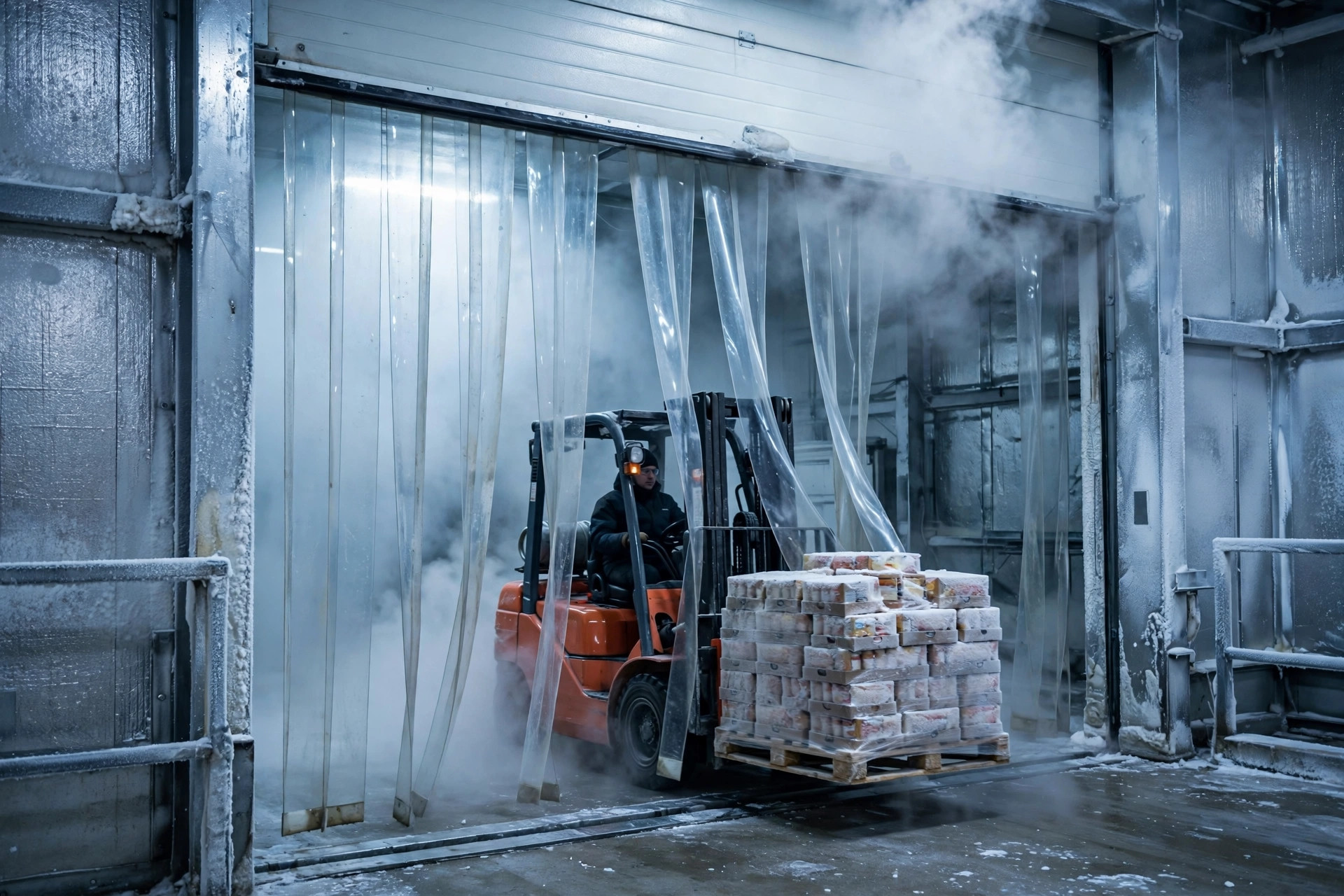
In 2023 I walked a grocery distribution cold-chain site in southern China — a minus-18 freezer cycling its door 200-plus times a day. Their power bill showed refrigeration alone eating over seventy percent of the site's electricity — even the owner felt something was off. We swept the doorway with an infrared gun: every opening sent surface temperatures on the racks within three meters climbing within minutes. We ran the numbers — one high-speed roll-up door, each opening cut from over a minute to a dozen seconds, and the heat flooding the doorway drops by more than half. The retrofit cost tens of thousands of yuan; at their electricity rate it paid for itself in under a year.
Air Curtains, High-Speed Doors, Buffer Vestibules: Where's the Dividing Line?
There are exactly three industry answers to door-opening heat gain: air curtains, high-speed roll-up doors, and buffer vestibules (anterooms). The dividing line between them isn't price — it's opening size times opening frequency.
| Option | Upfront cost | Fits which openings | Fits which frequency | Heat blocking | Fatal weakness |
|---|---|---|---|---|---|
| Air curtain | Low (thousands) | Personnel doors, receiving windows | Frequent foot traffic | Moderate | Useless on large dock doors |
| High-speed roll-up door | Mid (tens of thousands) | Forklift dock doors | Dozens to hundreds of cycles/day | Good | Curtain tears on impact, stiffens in deep freeze |
| Buffer vestibule | High (hundreds of thousands) | Large doors | Ultra-high frequency, high-value goods | Best | Expensive, eats floor space, forces a layout redesign |
The rule is simple: if the opening is wider than about three meters, or forklifts drive through it, put in a high-speed door and stop thinking about air curtains.
And on air curtains, let me say something that'll annoy a few people: installing an air curtain on a forklift dock door is basically a pseudo-solution. An air curtain's airspeed and coverage width are limited — on a four-to-five-meter-wide opening, the turbulence kicked up by a passing forklift rips the curtain apart and hot air floods in anyway. It's holding up an electric fan to block an open garage door — psychological comfort, not actual effect. Air curtains are built for small personnel openings and receiving windows. Put one in the wrong place and those few thousand go down the drain. I've seen warehouses with an air curtain roaring over the big door, the owner convinced the problem was handled — while the power bill told a different story.
The high-speed door is the standard answer for forklift doors, but here's the detail that matters: opening speed has to match your operating tempo. A fast door with forklifts queuing at the threshold is speed wasted; a slow one gets rammed by an impatient driver, and the curtain is scrap within months. Pull your peak-hour counts, size the door's cycle rate with headroom. One more thing — standard curtain fabric goes stiff and brittle around minus 15. Freezer duty demands low-temperature fabric. Don't cheap out on that.
The vestibule is the ultimate answer — an entry hall for the cold room where the two doors never open together. But it's the priciest, eats dock space, and forces a flow redesign. Only worth it when you have all three: an extreme temperature spread, brutal frequency, and high-value product. For a plain 0–4°C chiller, a vestibule is usually overkill.
Beyond hardware, half the battle is operations — and it costs nothing. First, don't let forklifts queue at the doorway: three trucks idling at the opening means the door stays open the whole time, which is just paying refrigeration money for a traffic jam. Dispatch in waves so there's never more than one truck at the door. Second, if a run can carry two pallets, don't make it carry one — halve your door cycles. Third, close the door behind you. Sounds like a platitude, but I've measured it with an IR gun: the same door closed promptly versus left to time out, and the temperature rebound on the doorway racks differs by roughly a factor of two. These moves cost zero and punch well above their weight.

The Three Maintenance Pitfalls That Burn the Most Money
Getting the selection right is only the first half. The second half is all maintenance. When door temperature control fails, eight times out of ten it's not a selection error — it's neglected upkeep.
Pitfall one: aging door seals. This is the highest-ROI repair in the building, and the easiest to ignore. Frost building up thicker and thicker around the door frame is your alarm bell — the rule is simple: if this month's frost is thicker than last month's, replace the seal, no debate. A few hundred in seals can block multiples of that in heat load. I've seen sites topping up refrigerant year after year when the real disease was air leaking through the door gap.
Pitfall two: a misaligned air curtain. Tilt the discharge angle by ten degrees and the curtain misses the floor of the opening entirely — the unit might as well be off. Worse, forklifts knock them crooked all the time and nobody notices — the air just blasts the door frame. The acceptance test is crude but effective: wave a tissue across the doorway and you'll see instantly whether the curtain is intact. This belongs on the monthly inspection sheet; in reality, most sites never look at the unit again after installation day.
Pitfall three: running a damaged roll-up door. A failed limit switch that leaves the door an inch short of closed, a curtain torn by a forklift and left flapping — a high-speed door with a gap insulates about as well as no door at all. Same for fabric that goes rigid in winter and won't roll up — freezer duty needs low-temp fabric; standard fabric won't survive one winter.
Early in 2024, a seafood cold store on China's east coast called us: their evaporators frosted absurdly fast, defrosting four or five times a day, the compressor running nearly nonstop. They suspected the refrigeration plant. On site, the story was different: the dock door seals had aged and cracked, gaps wide as a finger; the air curtain above the door had been knocked sideways by a forklift, blowing all its air at the door frame. Warm humid air marched straight in, froze onto the evaporator coils, and the thicker the frost, the harder the compressor worked — a vicious circle. New seals, curtain realigned — two weeks later, defrost cycles were down to one or two a day. Nothing wrong with the plant. Everything wrong with the door.
So is the money worth it? Look at this one number: retrofit cost ÷ monthly electricity saved = payback in months. Door-related fixes — high-speed doors, seal replacements, curtain realignment — usually pay back in months. A vestibule pays back in years. Any door project with a payback beyond two years? Don't sign yet — go check your seals and door discipline first; ten to one, that's where the problem lives. If you can't manage the door, every conversation about refrigeration optimization is just talk.
By Da Liu, Automation Engineer