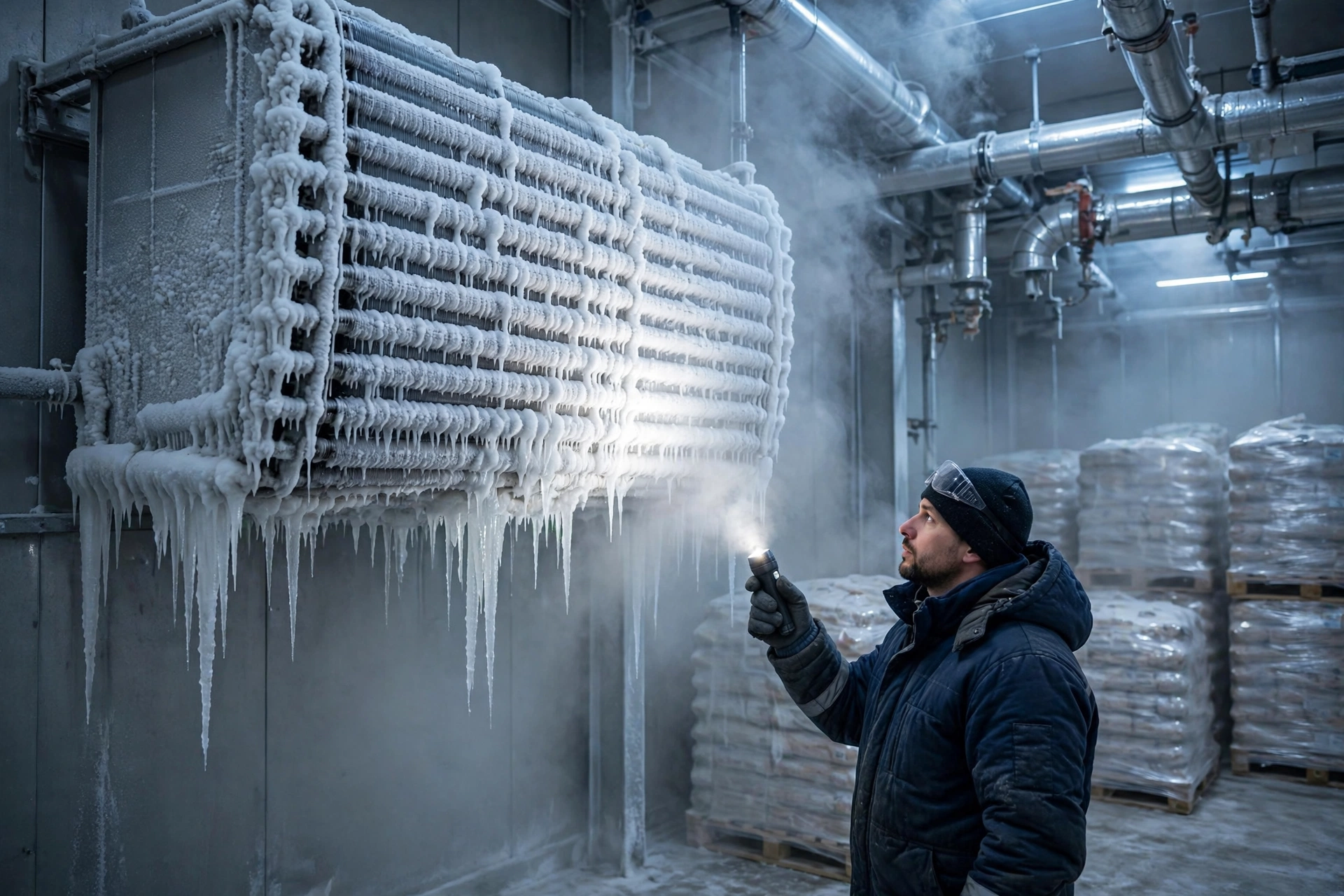
Last December, a cold storage defrosting failure at a frozen dumpling warehouse in northern China let the temperature drift. Their room had slipped from minus twenty-five degrees Celsius to minus eighteen, and a batch of dumplings came back from the customer with frost on the surface. On site, half the evaporator fins were choked with ice. One electric heating element had burned out, the defrost cycle had run its full course, and the frost was still there. The defrost schedule was not the problem. The choice made years earlier, when the room was built, was the problem: nobody had done the math on whether that room should have used electric heat or hot gas in the first place.
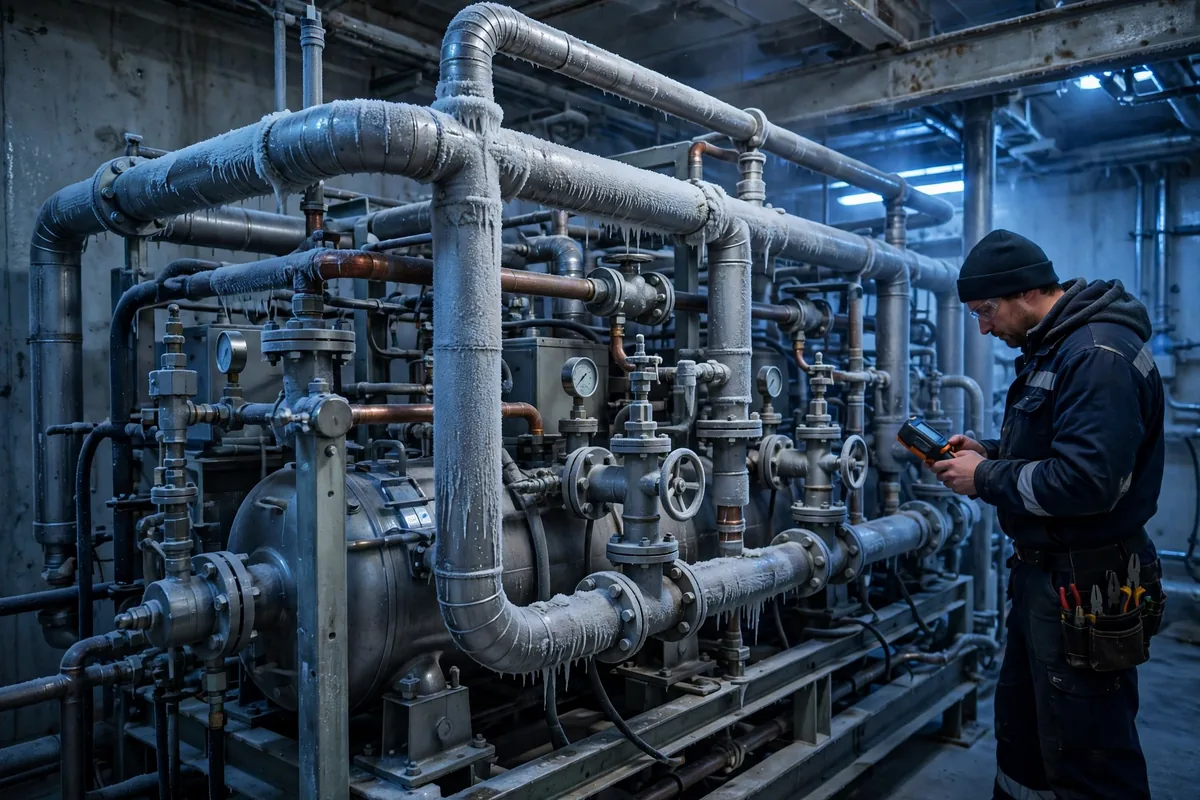
Cold storage defrosting has exactly two roads, and they start from different places. Electric defrost buries resistance heating elements inside the evaporator fins and melts frost with current. Think of it as fitting the evaporator with an oversized electric blanket. Hot gas defrost takes the hot, high-pressure gas coming off the compressor discharge and routes it back into the evaporator, melting frost with heat the system already produced. Think of it as clearing a car windshield with waste heat from the engine: the heat is not newly made, it is borrowed. Where the heat comes from decides how every number after it works out.
Where the Heat Comes From: Two Roads for Cold Storage Defrosting
Electric first. Its virtue is simplicity: a set of elements, a contactor, a thermostat, and any electrician can fix it. A single fin heating element typically runs between two and a half and three and a half kilowatts, a figure printed plainly on the selection sheet, so the electricity bill holds no surprises. Its flaw is equally plain: the heat is newly created, the meter spins in real time, and where an element does not sit tight against the frost, heat warms the air before it warms the ice. Industry references commonly put hot gas defrost at around ten minutes per cycle and electric defrost at twenty to forty-five minutes, and every extra minute of defrost is time the room spends drifting upward while the product pays for it.
Hot gas second. Its heat comes from compressor discharge, a by-product of running the system anyway, so the direct electricity cost of a defrost cycle is low; the valves and controls draw little next to a heater bank. One refrigeration equipment maker's literature claims roughly seventy percent of the hot gas heat sticks to the ice and only about thirty percent spills into the room as extra load. Treat that split as a vendor's figure, not a standard, but the direction is right: hot gas melts frost fast and the room spends less time disturbed. The price sits on the other side of the ledger: a four-way valve or hot gas bypass valve group, reworked piping, and control logic. The system gets a full step more complex, and a single leaking weld can waste a whole defrost cycle.
Cold Storage Defrosting Head to Head: Five Hard Comparisons
| Factor | Hot gas defrost | Electric defrost |
|---|---|---|
| Heat source | Compressor discharge waste heat, low direct electricity use | Resistance elements, the meter spins for real |
| Defrost speed | Fast, around ten minutes per cycle | Slow, twenty to forty-five minutes per cycle |
| Room temperature swing | Fast melt, but heat enters the room; the swing depends on control quality | Heat applied only to the coil, swing comparatively contained |
| Upfront and retrofit cost | Valve group plus piping, expensive retrofit, shutdown needed | Elements plus a contactor, cheap retrofit, swappable in a day |
| Maintenance weak point | Valves, welds, control logic | Burned-out elements, aging wiring |
The energy row is the one most often misread. Some vendor literature insists electric beats hot gas on power, while the refrigeration engineering consensus runs the other way: hot gas reuses waste heat, electric creates heat from scratch. Both sides are arguing about different bills. Count only the minutes the defrost runs and electric looks clean. Count the compressor working conditions, the energy spent pulling the room back down after each defrost, and the efficiency lost when a half-melted coil keeps icing up, and hot gas usually comes out ahead. Run your own room's operating data instead of trusting either side's brochure.
The Dividing Line: Which Rooms Take Hot Gas, Which Take Electric
First, low-temperature frozen rooms, minus twenty-five degrees and below, where frost builds fast and defrost runs often, four cycles a day is normal: take hot gas. With electric heat at half an hour per cycle, defrost alone eats two hours of cooling time a day, and the compressor sprints to catch the temperature back up. A fresh-food distribution center in southern China converted a minus eighteen degree frozen room to hot gas in the summer of 2025. The retrofit shut the room for two days and one weld leaked and had to be redone, but defrost time fell from about half an hour per cycle to roughly ten minutes, and the temperature swing narrowed visibly.
Second, small chilled rooms, zero to four degrees, one or two evaporators: take electric. Frost builds slowly here and one defrost a day is often more than enough, so the money a hot gas valve group and piping would cost buys several years of extra electricity for the heaters. Maintenance matters even more: a small room usually has no dedicated refrigeration technician, a burned element swaps out in half an hour, while a hot gas valve fault waits for the manufacturer's engineer and the product cannot wait.
Third, mid-size rooms around minus eighteen degrees with about four evaporators: let the retrofit budget decide. One more case deserves its own mention: an old room already due for refurbishment. If the piping is being reworked and the insulation replaced anyway, the marginal cost of adding a hot gas valve group is far lower, and the job gets done in passing. If the piping was just renewed, tearing it open for defrost alone piles construction cost and shutdown losses onto the bill. Selection is never only about equipment data; it is about whether the room's construction window allows the disruption.
Here is a worked example, clearly labeled as a hypothetical: four evaporators, each heating element rated at three kilowatts, four defrost cycles a day, half an hour each. Daily defrost electricity comes to three times four times zero point five times four, which is twenty-four kilowatt-hours a day, or seven hundred and twenty a month. How much hot gas would save depends on your local electricity price and compressor conditions; another site's saving percentage cannot be copied onto your room. There is only one formula that matters: the extra money the retrofit costs, divided by the money saved on electricity each month, equals the payback in months. Past thirty-six months, do not bother.
The Maintenance Traps: Each Method Has Its Own Way to Die
Electric dies bluntly: an element burns out. The dumpling warehouse is the example. One dead element, one evaporator half-defrosted, frost building cycle after cycle, fan airflow dropping, room temperature drifting.
Hot gas dies more gracefully, and is harder to catch: a valve leaking internally. A hot gas valve that does not seat properly lets hot gas sneak into the evaporator during cooling, the room never quite reaches temperature, the electricity bill creeps up, and nothing looks wrong from the outside because the valve body appears fine. The other common failure is control logic: the temperature probe that ends the defrost is mounted in the wrong spot, the cycle cuts back to cooling before the frost has melted, and the whole round was wasted. For the first month after a hot gas system goes live, record the room temperature curve around every defrost weekly. If the curve looks wrong, check the probe position first, then the valve.
Here is the counterintuitive part: when defrost is chosen badly, the loss is not on the electricity bill, it is on the product. One incomplete defrost, fins half-blocked with ice, heat exchange efficiency down, the compressor running at high load for hours, room temperature drifting two or three degrees, frozen goods frosting over, chilled goods losing shelf life. None of that shows on the meter; all of it shows up in customer complaints. Electricity is the visible bill. Product loss is the invisible one, and it is usually bigger.
Whether the money is worth it comes down to one number: the extra cost of the retrofit divided by the electricity saved each month. A payback inside thirty-six months means hot gas is worth doing. Past that, leave the electric system alone, spend the money on probes and wiring terminals instead, and put the maintenance where it actually pays.
By Da Liu, Automation Engineer