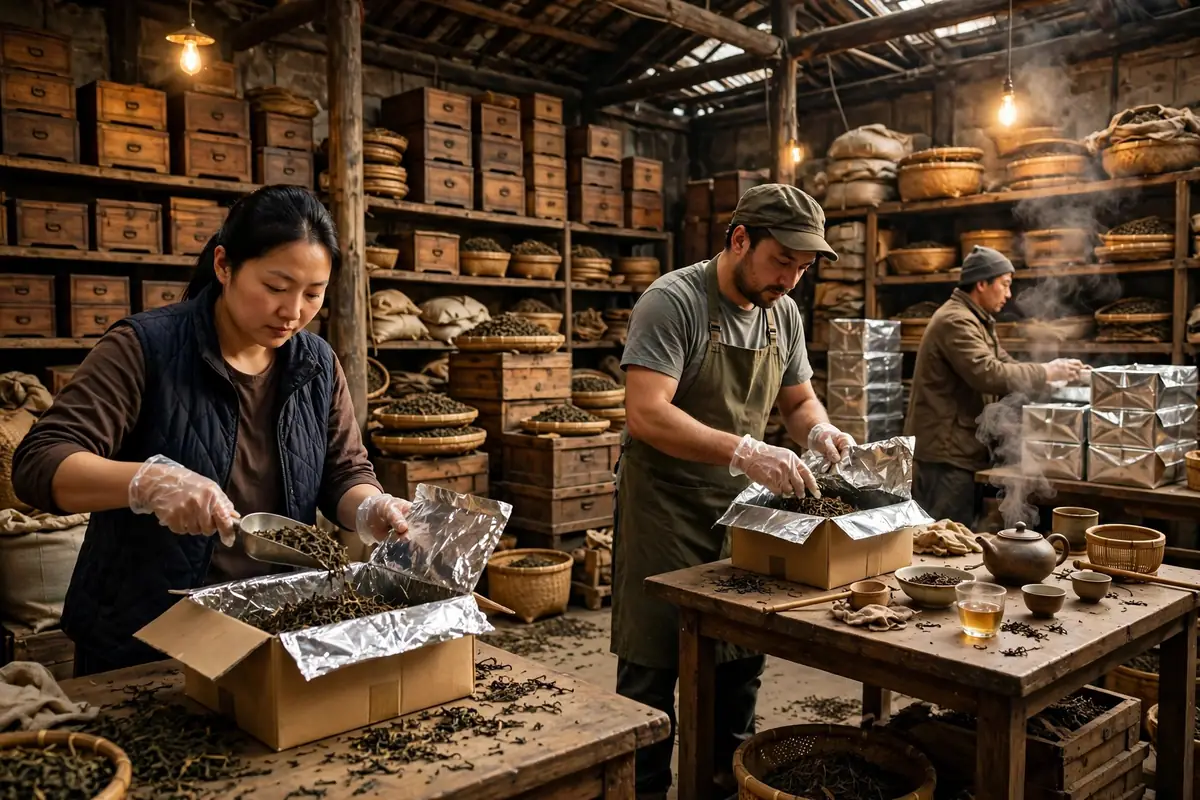
We run a small warehouse, and we cannot afford to burn money like the big players — I'll put that up front, because this is a story about how a small warehouse takes on tea export jobs without bankrupting itself.
Here's what happened. Last spring tea season, a friend who exports tea came to me with a batch of green tea bound for Morocco. Could my little warehouse hold it for two weeks until the container was ready? The picture in my head was immediate: a 3,000-square-metre warehouse, dozens of tonnes of green tea, and right next to it the spice samples and detergent left over from last month's client. Anyone in this trade knows tea absorbs smells like a sponge. If I'd said yes without thinking, that tea would have arrived in Morocco tasting like a spice market.
China tea export warehouse storage sounds, when the big companies describe it, like climate-controlled halls and automated racking. Very impressive. But look at the real numbers: China exported about 374,100 tonnes of tea in 2024, worth about 1.42 billion US dollars, and green tea made up about 81.4 percent of it. The biggest buyer, Morocco, took about 81,000 tonnes in a single year, with Ghana second at about 39,000 tonnes. This bulk green tea doesn't travel in fancy little tins. It travels in multi-tonne packs, and what wins is warehouse basics, not expensive equipment. A small warehouse can't compete on automation. It can compete on basics.
In China Tea Export Warehouse Storage, Green Tea and Pu-erh Are Opposites
The easiest way to wreck a tea shipment is to store every tea the same way.
Green tea and pu-erh need opposite treatment. Green tea wants to be sealed, dark, and cool — ideally below 15 degrees Celsius — and its best drinking window is six to twelve months. Leave it too long and the aroma simply fades away. Pu-erh is the reverse: it's alive, ageing slowly on purpose. Warehouses in Yunnan keep it at roughly 60 to 68 percent relative humidity and 20 to 25 degrees, with gentle airflow. Vacuum-seal pu-erh the way you'd seal green tea and the ageing stops. Leave green tea open the way you'd leave pu-erh and it picks up odours and goes stale within weeks.
Last April, a tea factory warehouse in Zhejiang learned this the expensive way. Illustrative scenario: a new warehouse keeper, trying to save effort, stored a fresh batch of Longjing green tea in the same zone as some aged pu-erh, separated by a single row of racking. Two weeks later the buyer opened the boxes and the Longjing carried a stale, aged note. The customer docked the payment. Nothing was wrong with the tea itself — the storage had confused two teas with opposite needs.
My cheap fix is embarrassingly simple: green tea gets its own zone with a green label on the door; pu-erh gets its own zone with a yellow label. The two zones don't share a fan and they don't share pallets. Zoning costs no money. It costs attention.
Odour Control: Where a Small Warehouse Outworks a Big One
Tea absorbs surrounding smells faster than most people believe. Put green tea next to spices, coffee, or cleaning products and it picks up the smell within hours. That's not folklore, it's physics — dry leaves act like a sponge for whatever is in the air. Jasmine tea is scented using exactly this principle, with leaves resting beside fresh blossoms. The same talent, pointed in the wrong direction, is a disaster.
One number to remember: once the air around dry tea passes about 60 percent humidity, the leaves start reabsorbing water, and water brings mould and stale flavour. Mouldy tea isn't a downgrade problem — it's a write-off. So moisture control and odour control are the same job. How clean your warehouse is, and what the air smells like, decides whether your tea arrives at port as the same tea that left the factory.
During the spring season of 2025, we took in a batch of green tea heading for North Africa. Illustrative scenario: the shipper wanted to save money and asked us to stack it against the back wall, no separate zone needed. I walked over and looked. The base of the wall was damp, and in the corner sat a box of mothballs left by a previous client. I turned down those terms. I'd rather lose one order than let my warehouse become the scene of an accident. The tea went into a dry zone of its own, and it passed inspection at the destination on the first try. That shipper became a repeat customer. The order I gave up bought me a long-term client.
Our three cheap tools for odour control: a hygrometer hung in the middle of the zone, read twice a day; racking kept a hand's width from the wall, so damp creeping up the wall hits air before it hits your tea; and a sniff test before unloading — if the zone smells wrong, find the source before a single box goes in, not after.
Sharing a Container: The Cheapest Trick in China Tea Export Warehouse Storage
Get consolidation right and you save real money. Get it wrong and the claims eat every cent you saved on freight.
A standard 40-foot container holds about 67.7 cubic metres and carries about 27 tonnes. Tea is bulky, light cargo, so work out before loading whether you'll run out of space or weight first. For bulk green tea heading to Morocco, the rule is one container, one tea, one packing style. Don't mix green tea with black tea, or loose leaf with gift boxes, in the same box. Mixing saves one freight bill, and then the destination inspection finds cross-contamination and the claim costs more than the freight ever did.
Here's how the three consolidation options stack up, from a small warehouse's experience. The table is a hypothetical worked example to show the structure:
| Option | What you do | Where you save | Where it goes wrong |
|---|---|---|---|
| Full container, direct | One shipper fills the box | No waiting, stable schedule | Half-empty box burns freight money |
| Same-tea sharing | Two shippers share one box of the same green tea | Shared freight, flexible sailing | One leaky pack lets moisture into both lots |
| Mixed-tea sharing | Green, black, and oolong in one box | Highest box utilisation | Worst odour risk, claims nobody can untangle |
Here's my counterintuitive judgement: a small warehouse shouldn't chase the big client's full-container order. It should chase same-tea shared loads. Big clients have their own climate-controlled halls and fixed sailing schedules — a small warehouse will never out-equip them. But it can out-care them. Same tea, same destination port, same packing, two shippers in one box, and the small warehouse does zoning, moisture control, and loading carefully. That's a job the shipper trusts you with.
And one honest word: in tea export, don't chase speed, chase stability. Green tea fears heat, moisture, light, and strong smells. Miss any one of those four and that's where the money leaks out. A small warehouse doesn't have a big company's budget, but it has one thing the big companies don't: the owner walks the floor every day, and one sniff tells him whether the zone smells right. You can buy equipment. You can't buy a nose.
In the end, the maths of China tea export warehouse storage is simple enough for a small warehouse: store each tea in its own zone, keep moisture below the mould line, keep strange smells away, and share containers only with the right partner. Small money, well spent, works because someone looks twice, writes down one more number, and takes one more sniff of the air. A small warehouse has its own way of surviving.
By Xiao Ma, Small Warehouse Owner