Here's the verdict up front: forklift CE certification export requirements are simpler than most exporters think — and more dangerous than most think.
Simpler, because ordinary electric and diesel counterbalance forklifts don't need a Notified Body at all. The manufacturer can walk the self-declaration path and legally affix the CE mark. More dangerous, because "self-declaration" means exactly what it says: the moment you sign, all the liability is yours.
I've seen manufacturers get this wrong in both directions. One camp treats CE as a certificate you buy — shopping around for a Notified Body to issue a "CE certificate" while nobody builds a real technical file. The other camp signs a declaration off a template and ships. Both end badly. Two sides to this story, so let's take them apart.
The trap I watched happen: 40 trucks stuck in Hamburg for two months over a manual
Early 2024. A forklift maker in Zhejiang shipped 40 electric counterbalance trucks to a dealer in Hamburg, Germany. The trucks themselves were fine — test reports in hand, EU Declaration of Conformity signed. Then the dealer found the problem: the operation and maintenance manual came in English only. No German version.
In Germany, that's not a "we'll fix it next time" detail. The Machinery Directive requires instructions in the official language of the country where the machine is used — an English manual doesn't cut it in Germany. The dealer wouldn't sell them; if market surveillance pulled one, the liability would land on him. The 40 trucks sat in the dealer's warehouse for nearly two months while the German manual was rewritten, typeset, printed, and flown over. Storage fees, rush printing, a missed selling season — tens of thousands of euros burned.
The trucks were compliant. The paperwork wasn't. In my experience, that's how CE projects usually fail: rarely the machine, usually the paper.
Two paths to forklift CE certification: self-declaration or a Notified Body?
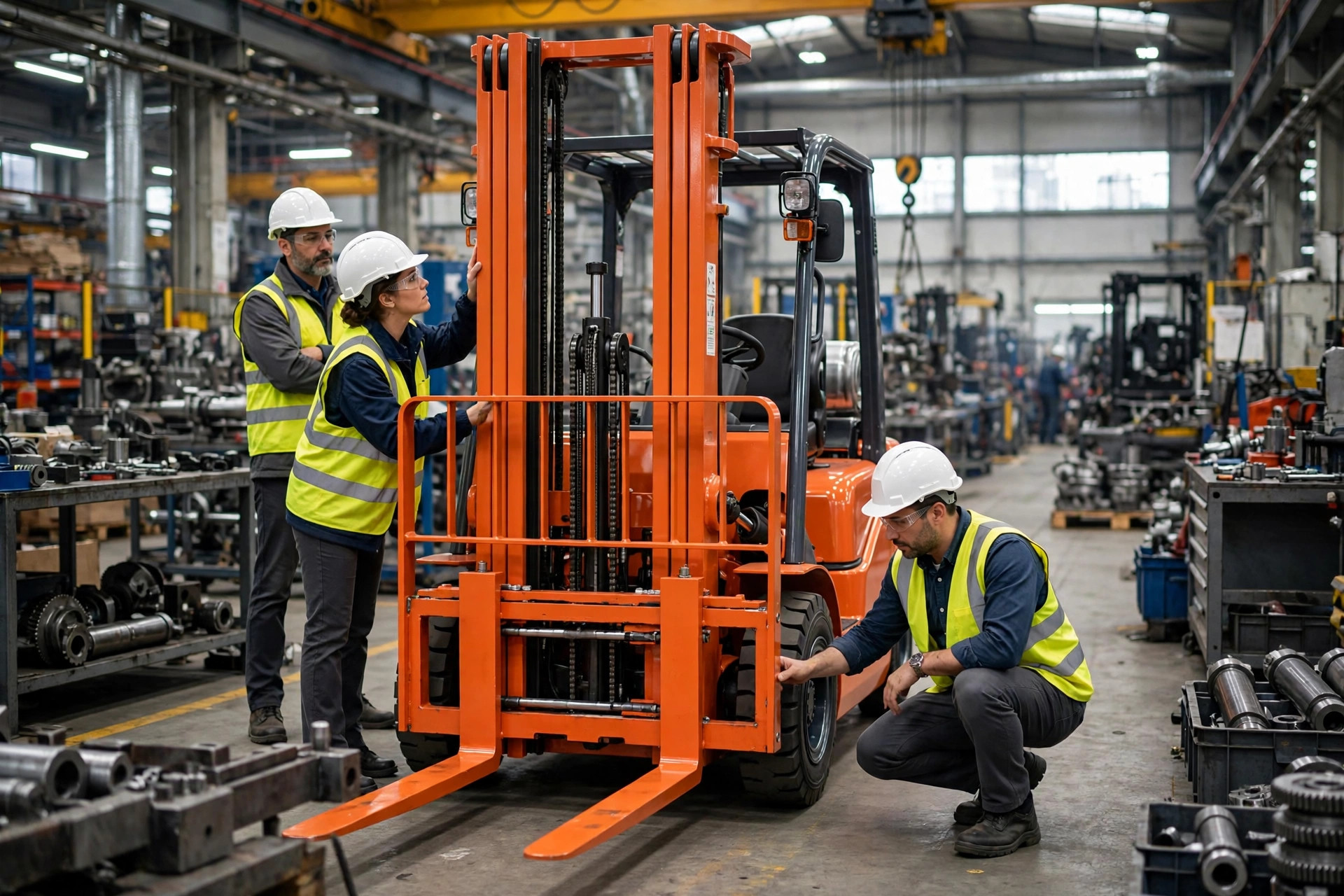
This is the first thing to get straight. The current Machinery Directive 2006/42/EC splits machinery in two: Annex IV lists high-risk equipment — circular saws, vehicle servicing lifts, that sort of thing — which must go through a Notified Body's type examination. Everything else: the manufacturer builds the technical file, signs the DoC, affixes the CE mark. That's legally sufficient.
Forklift trucks are not on Annex IV. So the standard path for forklift CE certification is self-declaration.
| Self-declaration | Notified Body involvement | |
|---|---|---|
| Applies to | Non-Annex IV equipment — forklifts fall here | Annex IV high-risk machinery; or voluntary NB reports as extra backing |
| Legal basis | Machinery Directive Article 12, Annex VII technical file + Annex VIII internal production control | Annex IX type examination / Annex X full quality assurance |
| Deliverable | Manufacturer signs the EU Declaration of Conformity, affixes CE | NB issues a type-examination certificate; the NB's number follows the CE mark |
| Timeline | Depends on how solid your technical file is | Sample submission plus scheduling — usually longer |
| Two sides | Cheaper and faster, but 100% of the liability sits with you | Costlier and slower, but third-party backing helps with big dealers |
I've watched too many manufacturers pay a Notified Body for a "CE certificate" they didn't legally need, treating it as a get-out-of-jail card. Two sides to it: for forklifts, that piece of paper isn't mandatory — but if you're selling into major German or French dealer networks, their purchasing departments do sleep better seeing an NB report. Spend the money if it helps the deal, just don't confuse it with immunity. When something goes wrong, the first person they come for is whoever signed the DoC.
One timing variable to watch: from 20 January 2027, Regulation (EU) 2023/1230 replaces Directive 2006/42/EC, with no transition period. If you're starting a CE project in the second half of 2026, build the technical file to the new regulation's expectations now — otherwise you'll be redoing it the moment 2027 arrives.
The Stage V emissions gate for diesel and LPG forklifts
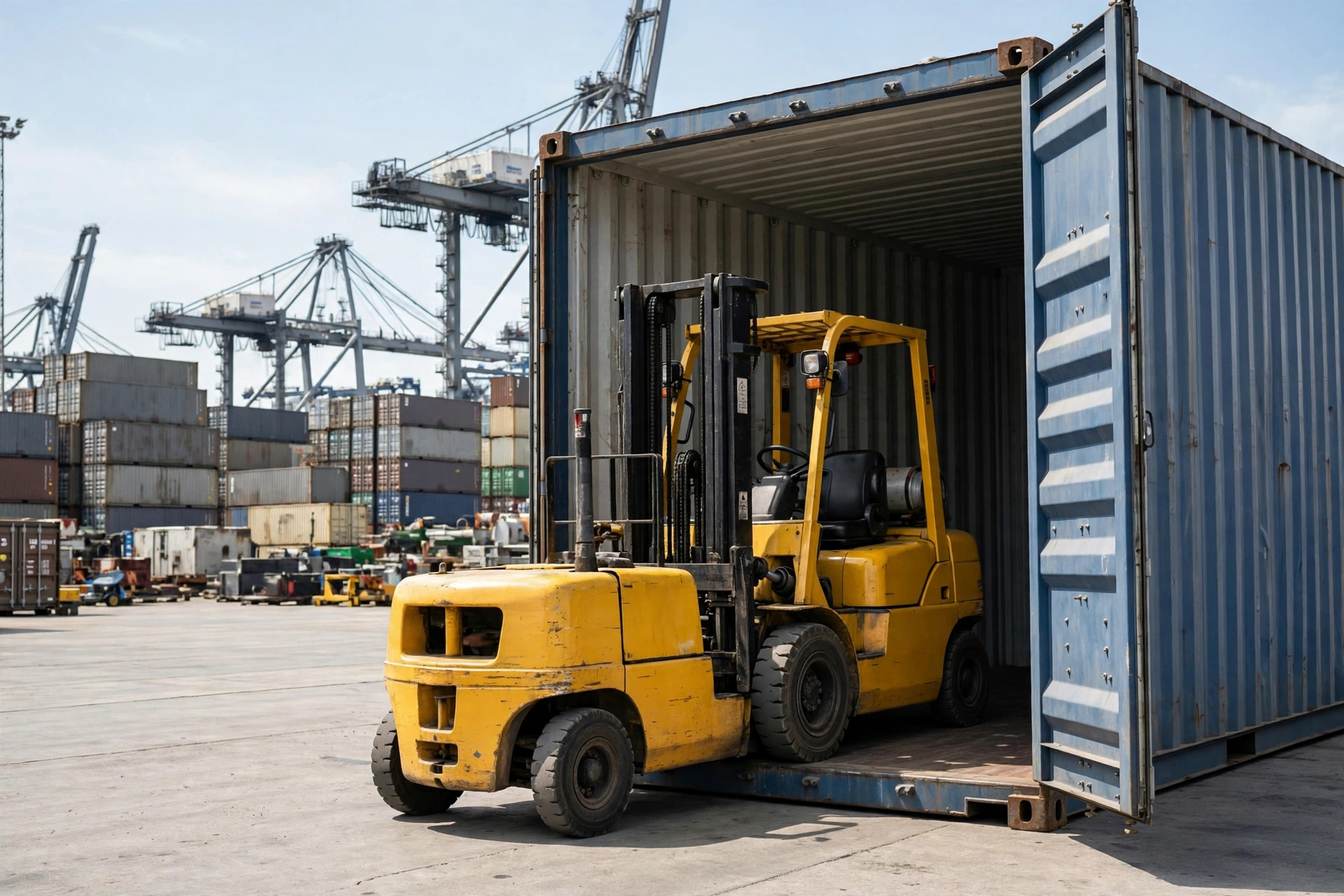
Here's the second red line people miss. Since 1 January 2019, new diesel and LPG forklifts sold in the EU must meet Stage V emission standards under the non-road mobile machinery regulation (EU) 2016/1628 — regardless of engine size. Small diesel engines get no pass.
I know of a case where a manufacturer shipped a batch of small diesel forklifts to Poland, assuming "small machines, nobody checks." At the port, customs asked for the engine type-approval documents. They couldn't produce them. The whole container was detained. The fix was re-export — freight and port charges down the drain.
Two sides to this one, too: diesel forklifts are already losing ground in Europe, where indoor warehouses have gone almost entirely electric. Retrofitting a diesel model for Stage V (particulate filters and the rest) isn't cheap — that money might be better spent pushing your electric line instead. Do the math on which truck actually earns you the margin.
Three compliance traps in forklift CE export
Trap one: an incomplete technical file. Risk assessment, design drawings, test reports, the list of harmonised standards applied (the EN ISO 3691 series is the core safety standard for industrial trucks) — all of it. Market surveillance can ask for the file, and the declaration of conformity must be kept for at least 10 years. Plenty of manufacturers build a technical file "for the certificate," with test data that doesn't match the trucks actually shipping. That's a time bomb.
Trap two: manual language. As the Hamburg story shows, instructions must be in the destination country's official language — German for Germany, French for France, Polish for Poland. One English manual for all of Europe doesn't work. And get the translation done by someone who knows machinery terminology; a machine-translated manual tells the dealer everything about how seriously you take this.
Trap three: nameplate and DoC details. The CE mark goes next to the manufacturer's name, at least 5 mm tall, proportions respected. The nameplate needs the manufacturer's name and address, model, serial number, and year of manufacture. The DoC must list every applicable directive and regulation. One more thing: a Chinese manufacturer with no EU entity needs to designate an EU Authorised Representative — and note that a distributor is not automatically your authorised representative. Get the roles in writing.
The counterintuitive part: a CE mark is not a hall pass
Plenty of people assume that once the CE mark is on, Europe is wide open. Bluntly put, CE is a sworn statement by the manufacturer: "this machine complies with EU law, and I'm responsible if it doesn't." Customs and market surveillance authorities keep their right to inspect, detain, recall, and fine.
The real trade-off is this: the true cost of CE certification was never the piece of paper. It's the fundamentals — a real technical-file system, testing capability, multilingual documentation, emissions compliance. If a factory can't build a technical file, its CE project is a house on sand: compliant on paper, one real inspection away from collapse.
Before you stick that mark on, ask yourself one question: if German market surveillance asked for your technical file tomorrow, could you hand it over? If not, that CE mark is a ticking time bomb.
By Lao Mi, Supply Chain Veteran (20 yrs)