If I had a dollar for every "this case erector is garbage" complaint I have heard on a plant floor, I could retire early. Eight times out of ten, the machine is fine — the tuning is not. Think of a case erector as a pair of mechanical hands: the suction cups are the fingers, the folding arms are the wrists, and vacuum pressure is the grip strength. Weak fingers or a crooked wrist, and of course the box slips. Before you curse the equipment, run the fingers-wrists-grip checklist. Most jams get located within half an hour.
Start with how the thing actually works, because tuning without understanding the mechanism is just guessing. An automatic case erector does three things: vacuum cups pull a flat blank from the magazine, folding arms fold the four bottom flaps in a strict sequence, and the taper seals the bottom with tape. Step two — bottom folding — is where nearly all jams happen. The flaps fold in a fixed order, coordinated by mechanical stops and cylinder timing. Miss the timing by a fraction of a second and the flaps collide, wedging the half-formed case in the forming chamber. It is like closing a cabinet with four doors: there is an order, and forcing it out of order jams everything. That is why jams look random but never are — it is always timing and force.
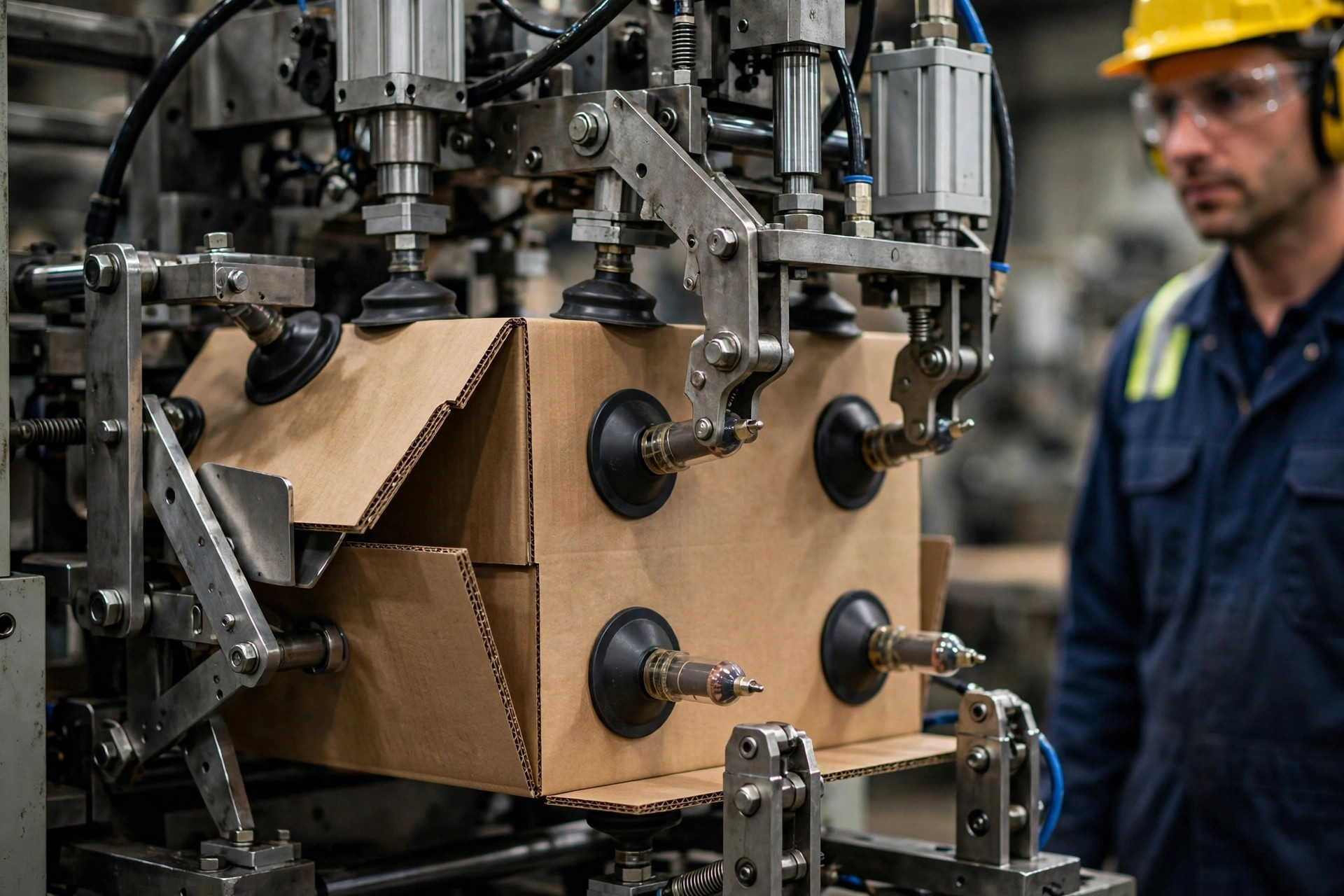
Fall 2024, a third-party logistics warehouse outside Suzhou. Their erector was rated at a dozen cases a minute but jammed roughly every half hour, with an operator stationed beside it whose full-time job was poking boxes loose. I pulled the run data: uptime at 91%, mean time between failures under 40 minutes. The root cause was embarrassingly mundane — plant air pressure had sagged, the cups could not hold full vacuum, blanks came up crooked, one flap never seated, and the tape went on sideways. The fix was equally mundane: a dedicated regulated air line for the erector and a fresh set of cups, the old ones gone hard with age. Jams dropped from a dozen a day to about one. Uptime back above 98%. Same machine, no new money — just tuning.
Early 2025, an e-commerce fulfillment warehouse in Dongguan watched its erect success rate slide from 98.5% to 94% over two months, and nobody could find why. The machine parameters were identical to the year before. What had changed was the corrugated supplier — a cheaper vendor, lighter board, shallower score lines, and blanks that had picked up moisture. Case erectors have opinions about their cardboard: score lines too shallow and the bottom never folds crisp; moisture too high and the flaps go limp; blanks out of square and they wedge in the chamber. We added an incoming inspection for the blanks — score depth, squareness, moisture content — and rejected anything out of spec. The success rate recovered within a week. Lesson: changing your box supplier means re-tuning the machine. No shortcuts.
Here is the core of the checklist — a jam troubleshooting table. Symptom, most likely cause, fix. Tape it to the side of the machine:
| Symptom | Most likely cause | Fix |
|---|---|---|
| Jams concentrated at the folding stage | Weak vacuum or worn cups | Check air pressure and vacuum gauge; replace hardened cups |
| Formed case lopsided, one side high | Moisture-damaged blanks or shallow scores | Switch to a dry batch; check score depth |
| Bottom tape crooked or lifting | Blank out of square, incomplete forming | Adjust folding guide clearance; check blank squareness |
| Random jams with no pattern | Cycle rate too high for the mechanism | Drop speed ≈10% and watch uptime |
| Jam spike after a blank batch change | Blank spec drift | Re-tune against the new blanks; lock parameters |
One more thing people always skip: how the blanks are loaded into the magazine. Warped blanks that were stored flat under weight, blanks loaded with the score lines facing the wrong way, a magazine stuffed so tight the cups double-feed — all of these masquerade as machine problems. A five-minute check of the magazine — fan the stack, confirm orientation, leave breathing room — eliminates a surprising share of "mystery" jams before you touch a single parameter.
Fixing jams is only half the job — the other half is drawing the selection line correctly at purchase. Erectors come in two schools: vacuum-cup and mechanical-grip. Vacuum is fast and simple but picky about the blank surface — coated board or rough recycled surfaces leak vacuum. Mechanical grippers physically clamp the blank, tolerate worse cardboard, but run slower and have more moving parts. Think of it as a suction-cup hook versus a clamp: the hook needs a smooth wall, the clamp works on anything. If your box supply is stable and high quality, vacuum is fine. If you switch suppliers often and quality swings, buy the gripper type and stop paying for two extra cases a minute you cannot actually use.
Now the money math: where is the break-even between a case erector and manual forming? A practiced worker forms roughly 1,500 to 2,000 cases a day, fatigue included, which puts manual cost at a few dimes per case. One erector does a dozen-plus cases a minute, and one operator can mind two machines. Rough rule: if daily volume is consistently above 3,000 cases, a machine pays for itself in one to two years. Below 1,500 a day, keep forming by hand — the machine will just gather dust. I draw this line hard: no volume, no automation. Money spent does not come back.
Here is the counterintuitive one: faster is not better. I have watched plant after plant crank the cycle rate up — 15 cases a minute at 97% success — when backing off to 12 gets you 99.5%. Do the math: one jam costs at least five minutes of stopped line plus re-feeding, which wipes out the speed gain and then some. Lifting uptime from 93% to 99% is the equivalent of getting half a machine for free. The first rule of tuning is always success rate first, speed second. And one more thing people miss: match the erector's rate to the downstream process. If manual packing follows, cases pile up on the conveyor no matter how fast you erect them. The line runs at the speed of its slowest station — an erector outrunning downstream is just waste.
Three maintenance traps I have personally stepped in. First, suction cups are consumables, not heirlooms. Silicone cups harden with age and lose a third of their grip long before your eyes notice; by the time they start dropping blanks, jams are everywhere. Replace them quarterly, and clean the vacuum filter while you are at it — a clogged filter performs exactly like a leaking cup. Second, the vacuum generator is an air hog. The moment plant air fluctuates, the erector is the first casualty. A dedicated regulated line is non-negotiable. Third, do not stage your blanks at the dock door. One rainstorm pushes moisture content past the limit, the flaps go soft, and no amount of tuning will save you. Keep blank storage dry, especially in the rainy season.
One more shot, at a pet peeve: vendors pushing six-figure "AI vision inspection for erect quality." My take is blunt — a well-tuned erector runs above 99.5%. Spending six figures to inspect the remaining half percent, when fresh cups and incoming blank inspection get you there for pocket change? Classic pseudo-need. Spend where it counts.
So: is the money worth it? It comes down to one number — the erector's uptime. 99% is passing, 99.5% is excellent. If you are not there, do not talk about new machines or vision systems. Run the checklist above three times. Most problems show themselves by the second pass.
By Da Liu, Automation Engineer