When someone asks me to help choose a print and apply labeling system warehouse teams will run every day, the first question is almost always price. My first question back is different: of your bad labels, how many are crooked, how many are missing, and how many simply will not scan? Those three failures look identical from the shipping dock. They come from completely different places.
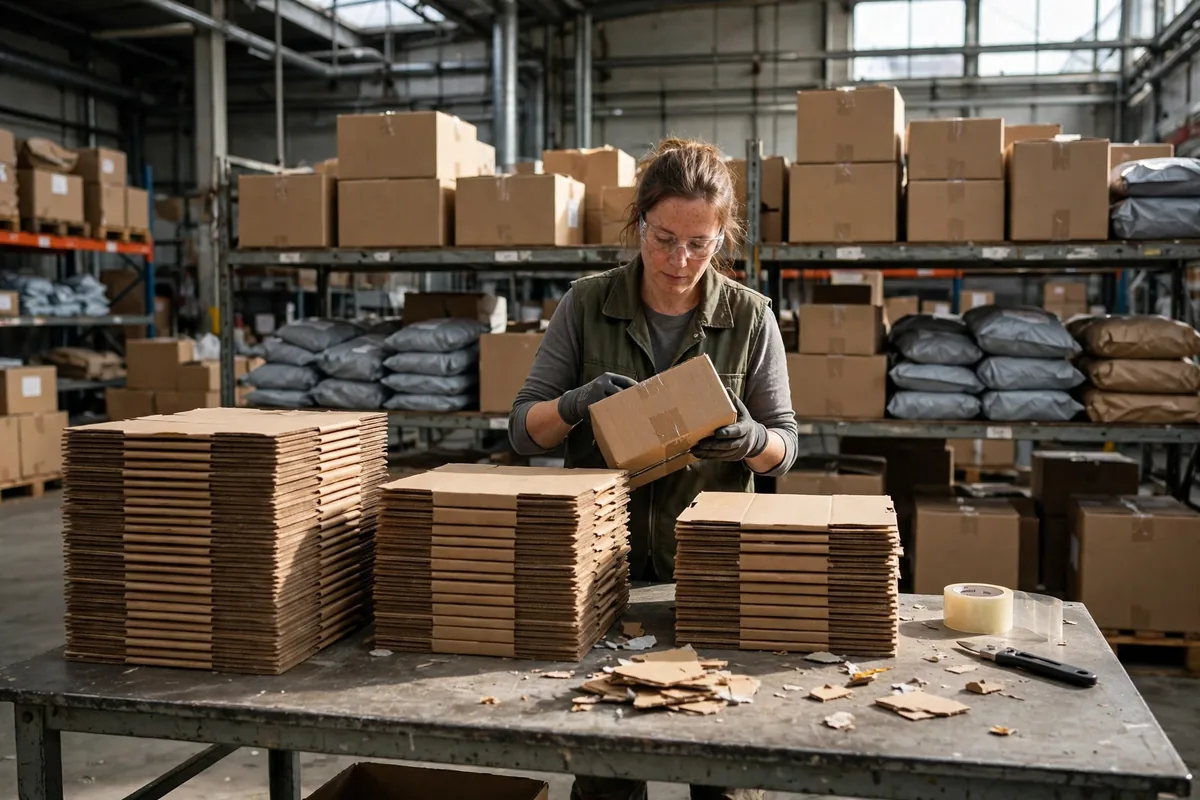
Last year I spent half a day on an outbound line at an e-commerce warehouse shipping several thousand orders a day in peak season. The carrier kept rejecting parcels because the shipping labels would not scan, and the warehouse manager was ready to replace the applicator with a more expensive imported unit. I flipped through the rejected cartons one by one. The labels were fine. The cartons were not: after taping, the top panel bulged slightly, so the label bridged across the hump, wrinkled, and distorted the barcode. No scanner reads a barcode printed on a wrinkle. Replacing the machine would have changed nothing. That is like fitting a new engine because a tire is flat.
How a print and apply labeling machine actually works
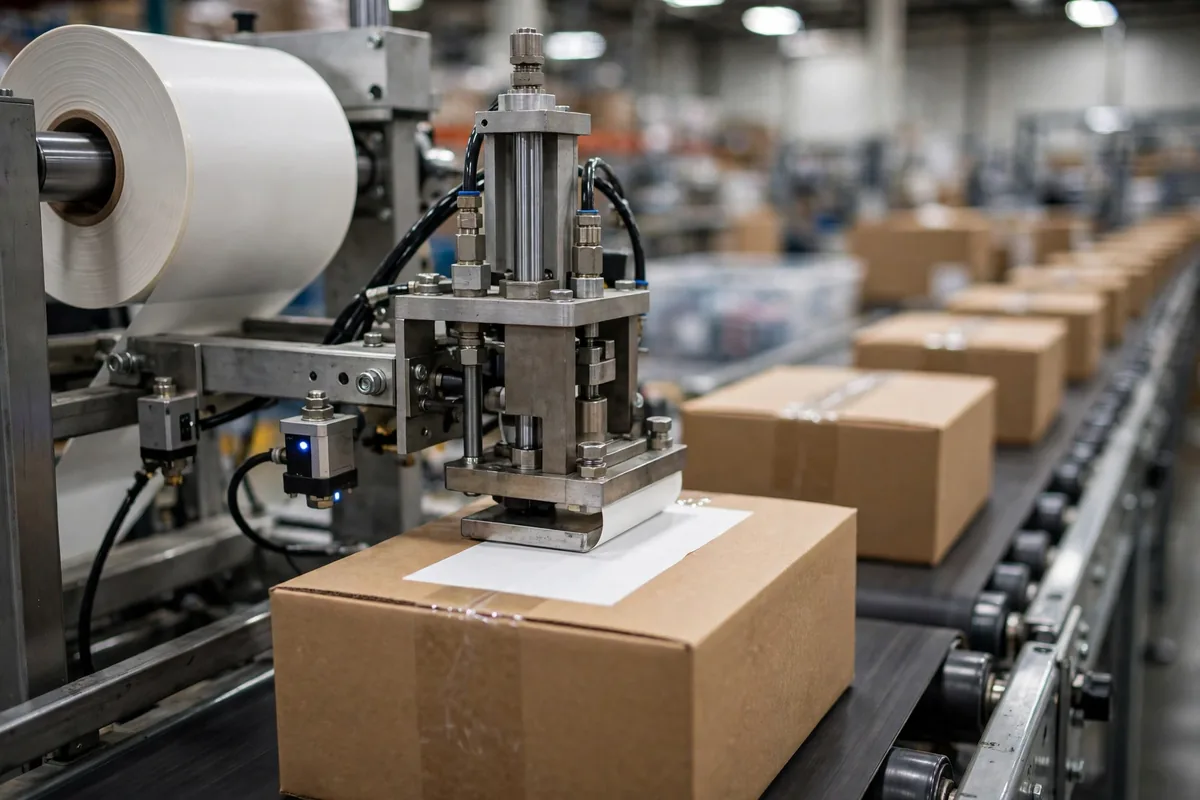
You can think of the machine as three small workstations bolted onto one frame. The print engine produces the label. The peel mechanism separates the label from its liner. The applicator carries the label to the carton surface. A failure in any one of the three shows up as the same crooked, missing, or unreadable label, which is why troubleshooting by symptom alone wastes so much money.
The applicator is the fussiest of the three. It quietly assumes your cartons arrive flat-topped, at a consistent height, at an even pace. Real warehouses deliver none of those reliably. So the first rule of selection is this: test the machine with your worst cartons, not your best. Every applicator looks brilliant on a perfect box.
Print and apply labeling system warehouse selection: blow-on, tamp-on, or swing arm
There are three mainstream application methods, and the dividing lines are clearer than most sales decks admit:
| Method | How it works | Best fit | Trade-off |
|---|---|---|---|
| Blow-on | A puff of air blows the label onto the carton, no contact | Fragile surfaces, large height variation | Fast, but the least precise; sensitive to air pressure and drafts |
| Tamp-on | A pad presses the label onto the surface | Uniform cartons, consistent height | Best placement accuracy, but unforgiving when carton height wanders |
| Swing arm | A mechanical arm swings the label onto the top or side | Side application, mixed carton sizes | Most flexible, most moving parts to maintain |
Brochures quote throughput figures generously; in practice these systems run in the range of a few dozen cartons per minute depending on label size and carton spacing, and you should always size against the manufacturer's specification sheet and your own peak-hour volume, never against the headline maximum.
Two dividing lines matter most. The first is height variation. If tall and short cartons run mixed on the same line, a rigid tamp pad will either miss the short boxes or crash into the tall ones. Either fix the variation upstream with a leveling or height-control section, or choose blow-on or a floating tamp design. The second line is label position. Top-only application is easy for all three. Side application that must keep up with a moving carton is swing-arm territory; do not let anyone sell you a top applicator on a modified bracket as an equivalent.
A distributor of household goods I worked with had exactly the height problem: mixed small and large cartons, and roughly two in ten labels landing half on the carton edge. They kept the applicator. They added a short top-press roller section ahead of it and swapped in a tamp pad with stroke compensation. The defect rate fell immediately. Money spent matching the line beat money spent on a pricier machine.
The uncomfortable part: most bad labels are not the machine's fault
After enough years around these lines, my working estimate is that around seven in ten labeling defects come from carton condition and label stock, and fewer than three in ten from the machine itself. A damp, soft carton, lifting tape, or a bulged top panel guarantees a crooked label. Label stock with a slippery face or aggressive adhesive causes feed and peel problems. Low print contrast or a barcode placed too close to the label edge guarantees scan failures downstream. None of that is cured by a more expensive applicator.
So I have a deliberately crude acceptance test. Bring three things to any machine trial: your worst carton, your current roll of labels, and your real peak volume numbers. Results produced with perfect cartons and premium labels are a performance for the buyer. Results produced with your worst carton are what you will live with in peak season. A vendor who welcomes that test usually has a machine worth buying.
Maintenance traps: the printhead and the roller nobody mentions
Two maintenance items decide whether a print and apply labeling system warehouse operation stays boring or becomes a nightly incident. The first is the printhead. It is a consumable. As elements wear out, the barcode gains a thin white line, scans start failing, and the machine says nothing — it happily applies defective labels until the carrier sends the parcels back. Your routine must include scanning finished, applied labels every shift, not just checking that labels come out.
The second is contact hardware: tamp pads and rollers pick up adhesive, harden with age, and start applying uneven pressure, so one edge of the label is firm and the other lifts. Blow-on systems have the equivalent trap in the air supply — unstable pressure means unstable label flight. None of these parts is expensive, but brochures rarely state replacement intervals. Ask before signing: full consumables list, unit prices, recommended replacement cycles, in writing, as a contract annex. And have your own operator change the label roll and ribbon during the trial. If a roll change takes more than a few minutes, peak season will teach you what that costs.
In the end, a print and apply labeling installation is only the last link in a chain that starts with carton quality, label stock, and line pacing. Whether the money is well spent comes down to one number: first-pass read rate — the share of applied labels a scanner reads correctly the first time. If that number is low, audit your cartons and labels before you audit the machine. If it stays high, the supposedly mid-range machine you already own probably does not need replacing at all.
By Da Liu, Automation Engineer