The Verdict First: Do Not Just Chase the Few Kilometers Next to the Port
To put it bluntly, when people talk about warehouse locations in Cartagena, their first instinct is almost always the same: the closer to the port, the better. I have seen too many people think that way, and I have seen too many of them regret it. Here is my verdict up front. A port-side warehouse suits fast-turning goods that move in and out frequently. A suburban warehouse suits operations that need space and long-term stock cover. An inland distribution point suits players whose national distribution is already proven and who need to squeeze line-haul cost. None of the three is superior in itself. The choice is a trade-off, and the wrong location will quietly turn any freight saving into rent, tied-up stock, and endless coordination.
This issue has two sides. One side is distance on the map: half an hour's drive from port to warehouse looks beautiful. The other side is operational friction that no map shows: traffic around the port, queuing for pickups, tight warehouse supply, and the way the rainy season disrupts inbound and outbound rhythm. Choosing a warehouse is not choosing a straight-line distance. It is choosing whether the whole chain runs smoothly.
A Pit I Watched Firsthand: The Port Warehouse That Was Close but Not Cheap
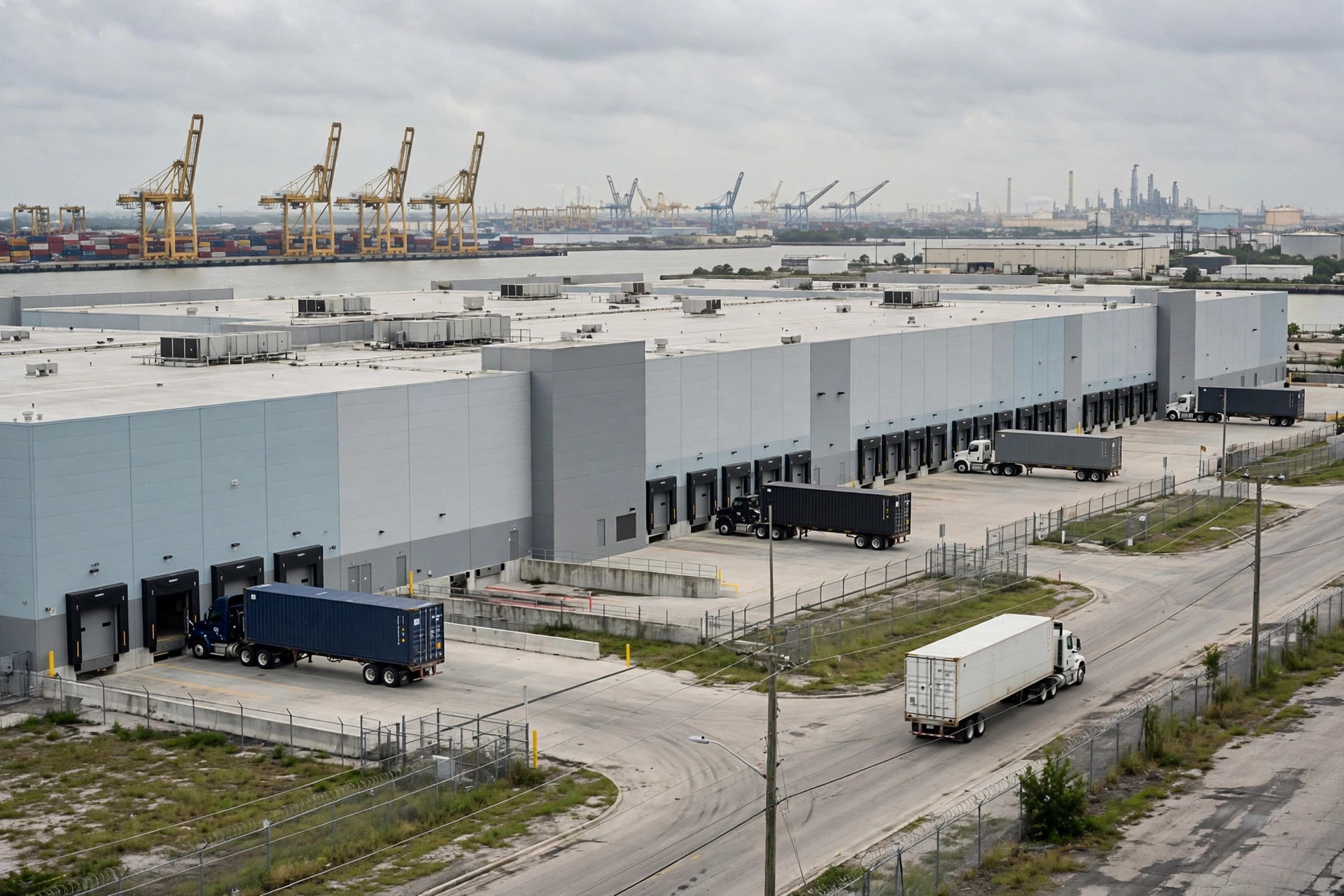
A few years ago, a client distributing imported goods into North America asked me about a Cartagena layout. He rented a well-located small warehouse near the port, reasoning that cargo could be picked up and split as soon as a vessel berthed. For the first three months it worked beautifully. By the fourth month, every problem arrived at once. In peak season, traffic around the port grew heavy and pickup queues lengthened. The warehouse was small, so overflow had to be rented elsewhere at short notice, and suddenly management was split across two sites. Worse, when a customer demanded an urgent split shipment, the warehouse simply could not marshal enough people and vehicles in time. On paper, short-haul savings looked good. In reality, temporary storage and coordination costs ate them entirely.
The lesson was direct: a port warehouse earns its keep on turnover speed, not on storage. The moment it is used as a long-term stockroom, its floor area, clear height, and dock doors become bottlenecks. The longer goods sit in a port warehouse, the faster its advantage evaporates. Here is the counterintuitive judgment: being close to the port can be the start of high cost, because you pay a premium for proximity without actually capturing speed.
A Second Case: The Suburban Warehouse That Saved a Shaky Operation
Another case ran in the opposite direction. A team distributing daily consumer goods also wanted the port at first, but the budget would not stretch, so they settled for a much larger warehouse on the outskirts. At first they doubted themselves, worried that distance from the port would cause missed deadlines. After two quarters, the numbers told a different story. With ample space, promotional stock and returns both had room. With more dock doors, large and small vehicles stopped competing for access. In the slow season, part of the space could even be flexed to other uses.
The key change was rhythm. Instead of chasing every vessel arrival, they fixed two pickup days per week and built a repeating schedule: port pickup, suburban inbound, national dispatch. Fewer trips, larger batches, and the effect of port queuing was spread thin. This case proves something newcomers often miss: a suburban warehouse loses on distance but wins on space and composure, and distance can be offset by fixed schedules and batch operations. Counting only distance and ignoring rhythm is the second classic trap in site selection.
The Three-Way Trade-Off, in One Table
| Location | Best for | Biggest advantage | Biggest cost |
|---|---|---|---|
| Near-port warehouse | Fast-turning, frequently moved, schedule-sensitive goods | Fast pickup, fast response | Tight space, little price flexibility, volatile in peak-season congestion |
| Suburban warehouse | Operations needing space, long stock cover, returns and promotion buffers | Ample space, calm scheduling, flexible use | An extra short-haul leg, rhythm must be managed with fixed schedules |
| Inland distribution point | Players with proven national distribution and stable line-haul volume | Closer to end markets, better line-haul cost structure | Heavy upfront commitment, needs real national order density |
On pricing, I will state one principle and give no specific figures: rents and labor levels differ substantially across the three options and swing with season and warehouse availability, so any specific rate someone quotes you should be checked against the latest local quotations before signing. In broad terms, port warehouses usually sit in the most expensive band, suburban space is noticeably gentler, and an inland point shifts the cost burden away from rent toward upfront investment and line-haul organization.
A Decision Framework: Answer Three Questions Before You Sign
My decision framework for clients has only three questions, and answering them honestly prevents most big mistakes. Question one: how many days does your stock sit in the warehouse on average? If the answer is a few days to two weeks, a port warehouse deserves serious discussion. If it is a month or more, a suburban warehouse is probably the better deal. Question two: are your orders mostly sudden or mostly planned? Sudden orders and rush additions make a port warehouse's response speed valuable. Planned orders that can be scheduled make a suburban warehouse's composure more valuable. Question three: is your national distribution proven? If your main markets already span several cities, an inland point belongs on the agenda. If you are still testing a single market, do not rush to build inland.
One more warning: contract terms bury more traps than location itself. Lease flexibility, expansion priority, a clause for temporary peak-season overflow, and exit conditions: if those four are not negotiated, even the best location becomes a cage. This matters most for port warehouses, where a flexible contract in a tight peak season is worth more than a modest rent discount. I have seen too many people shrug at signing time and regret it at peak.
One Sentence to Close
Cartagena is not a market with a single right answer. Port, suburban, and inland locations each have their own way of working. Do not ask which is best. Ask how long your goods stay, how urgent your orders are, and how far your distribution reaches. Once those answers are clear, the warehouse location reveals itself. You are not choosing a point on a map. You are choosing the rhythm of your business for the next year, and when the rhythm is right, the warehouse is right.
By Lao Mi, Supply Chain Veteran (20 yrs)