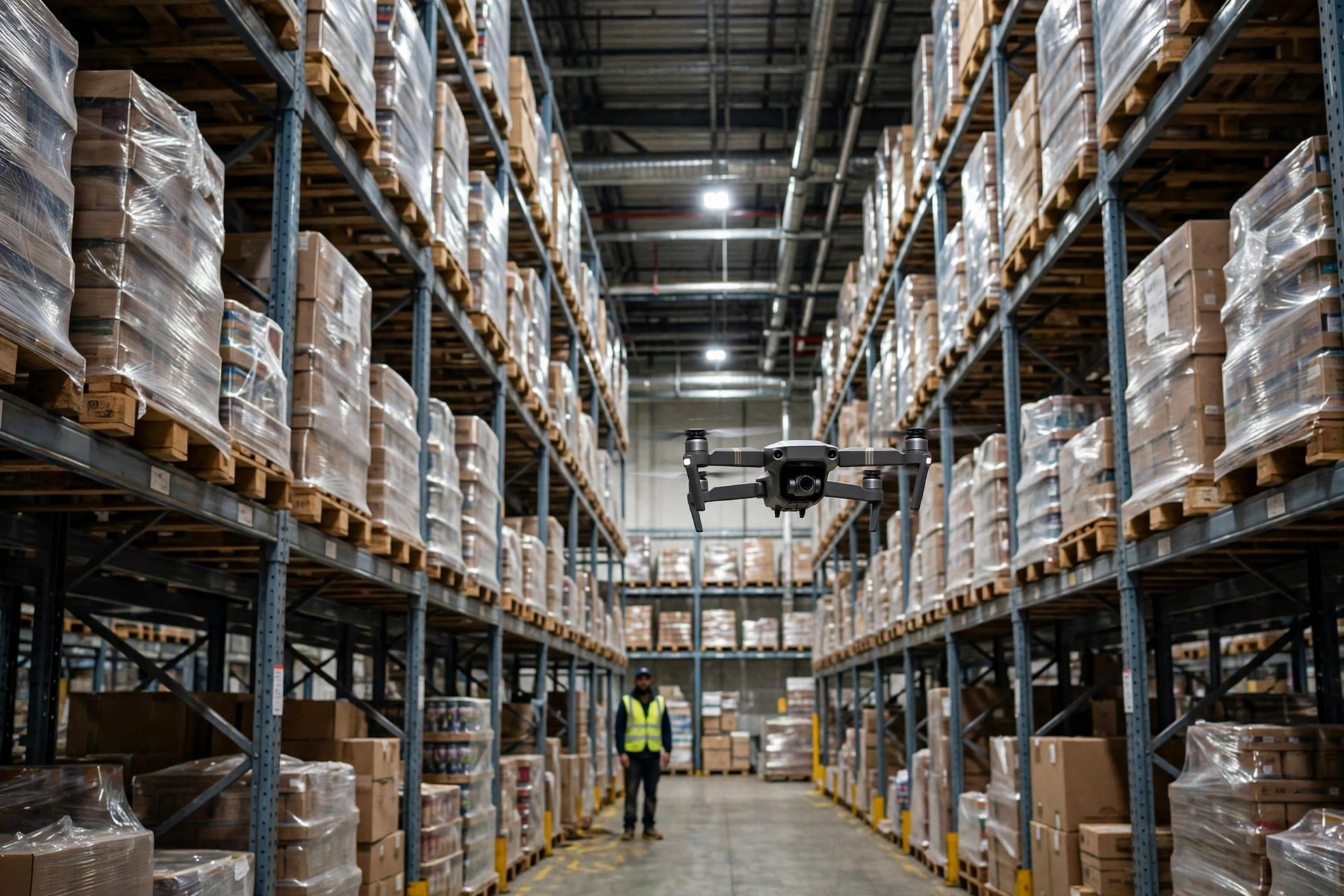
Camera pallet counting has attracted growing attention in warehouses over the past two years, and the reason is easy to understand: stock counting is repetitive, time-consuming, and often postponed during peak periods, while a camera system appears to offer a way to count without stopping work or scanning each pallet one by one. The discussion changes, however, once the question shifts from whether a system can count to the more demanding set of questions that actually matter for adoption: under which conditions does it count accurately, how is that accuracy measured, and how accurate must it be before it is worth using?
The phenomenon is best understood through field conditions rather than demonstrations. In the second half of 2024, I observed a pilot system in a third-party warehouse in East China, where overhead cameras faced a finished-goods staging area and the software reported the number of layers and total pallets, while staff checked the output on a screen. On clear mornings, neatly stacked pallets required almost no intervention; in the late afternoon, as light entered through side windows at a lower angle, shadows stretched the edges of some pallets, and the system occasionally read a shadow as an additional layer. A second case, in an e-commerce warehouse in North China in early 2025, showed a different failure mode: during a promotion period, pallets were temporarily staged along both sides of an aisle, front pallets blocked the view of those behind them, and the system could only infer the rear count from past stacking patterns, an inference that broke down precisely when promotional stacking density changed. Neither case proves that a particular algorithm is weak. Together, they suggest that the accuracy of camera pallet counting is not a fixed property of the technology, but an outcome produced jointly by the scene, the lighting, the stacking condition, and the measurement protocol.
Camera Pallet Counting Accuracy Needs a Better Denominator
A single headline accuracy figure, reported without its denominator, carries very little information. The more useful questions are what the sample included, where the errors clustered, and whether those errors were concentrated in a particular type of pallet. A reusable acceptance framework should therefore split the sample along at least four dimensions: pallet type and stacking method, time of day and lighting condition, degree of occlusion, and packaging material. Each category needs a manually verified reference count; without that reference, the term accuracy has no anchor.
The comparison with manual counting also needs care, because manual counting should not be treated as a flawless baseline. Manual counts are usually stable in routine, neatly stacked, low-volume areas, but the probability of missed counts, double counts, and handover errors rises at height, at night, during peak periods, and when several people divide a count. A fairer comparison is not vision versus people in the abstract, but the error structures of the two methods on the same sample under the same acceptance rules. Vision errors tend to concentrate at boundary conditions such as occlusion and reflection, while manual errors tend to concentrate in fatigue and handover. Because the distributions differ, the remedies differ as well: the former calls for scene redesign and broader sample coverage, while the latter calls for process controls and verification steps.
| Dimension | Typical vision counting error source | Typical manual counting error source |
|---|---|---|
| Lighting | Backlight, side light, and shadows that stretch edges | Restricted sight lines at height and at night |
| Occlusion | Front pallets hide rear pallets, forcing inference | Handover points where counts are missed or duplicated |
| Stacking | Uneven layers, tilted pallets, and damaged edges | Layer counts estimated by eye, drifting with fatigue |
| Packaging | Reflective film, transparent wrap, and dark cartons | Sealed cartons that cannot be verified without labels |
Lighting, Occlusion, Uneven Stacking, and Reflective Film Each Fail Differently
Lighting failure is usually not a problem of insufficient brightness, but of uneven brightness distribution. The same area can present a completely different shadow structure in the morning and in the late afternoon, and if the training data covered only one lighting distribution, the system can develop a systematic bias when the time of day changes. The remedy is not simply to add more light, but to ensure that samples cover the full daily lighting range, or to use supplementary lighting to narrow the scene into a more stable distribution.
Occlusion is closer to a missing-information problem than to a recognition problem. When a rear pallet is fully hidden behind a front pallet, the camera has not received enough information, and any output must be an inference based on historical stacking patterns. That inference may perform well in areas where stacking is stable, but during promotions, returns surges, or temporary staging, the pattern itself changes, and inference error grows accordingly. In heavily occluded areas, therefore, the first question should not be whether the algorithm is accurate, but whether the layout leaves enough observable space for vision to work at all.
Uneven stacking and reflective film belong to another category. Uneven layers make the very definition of a layer ambiguous, since tilted, sagging, or ragged pallets cannot be divided by a single uniform rule, while reflective film creates bright patches that erase edge information in the image. Both cases point to the same conclusion: the boundary of vision counting often lies not inside the algorithm, but in the physical state of the goods and packaging. If stacking standards have not converged, a vision system is effectively absorbing the error produced by an unstable site condition.
Acceptance Metrics Should Come Before Scale-Up
A cautious deployment path begins with acceptance metrics on a small scope, and only then considers expansion. At minimum, three measures are needed: accuracy by scenario, rather than a single overall figure; the distribution of errors, especially whether the system systematically overcounts or undercounts, since overcounting and undercounting have asymmetric effects on inventory decisions; and the cost of human review for uncertain samples, because if the uncertain fraction still requires substantial manual work to close, an improvement in recognition accuracy does not automatically translate into a counting efficiency gain.
Here the counterintuitive point deserves attention. The pilot area with the highest measured accuracy is often not the most valuable area to scale. The neatest, best-lit, least occluded area will naturally show the best vision performance, but it is also the area where manual counting is least error-prone, so the replacement value is limited. The areas where manual counting is most costly and error-prone, such as high racks, night shifts, or large temporary staging zones, are often the same areas where vision is most likely to fail. That trade-off means the value of camera pallet counting cannot be judged from technical metrics alone; it depends on which cost, in which area, is actually being replaced.
Where Visual Counting Is Likely to Go Next
Judging from the current direction of development, visual counting is more likely to become an assisted verification tool before it becomes a full replacement. In areas with standardized stacking and controllable lighting, it can support frequent spot checks and exception alerts; in areas with heavy occlusion and unstable stacking, it is better suited to producing a list of pallets that require human review than to publishing an inventory number directly. As camera placement, supplementary lighting, and stacking standards improve, the observable area will expand, but physical constraints such as occlusion and reflection will not disappear simply because algorithms improve.
That leaves an open question worth tracking. If warehouses in the future redesign stacking, lighting, and aisle layouts in order to accommodate vision counting, then what exactly are we measuring when accuracy improves: progress in the vision technology itself, or progress in site standardization? The two look similar in a report, but they imply different investment decisions. The first suggests a more general technology; the second suggests that only warehouses willing to remodel their sites will obtain the same benefit. Until that distinction is clearer, the most useful stance may be to treat camera pallet counting as a measurement system whose value depends on the scene it observes, rather than as a counting method that can be judged in isolation.
By Dr. Chen, Supply Chain Researcher