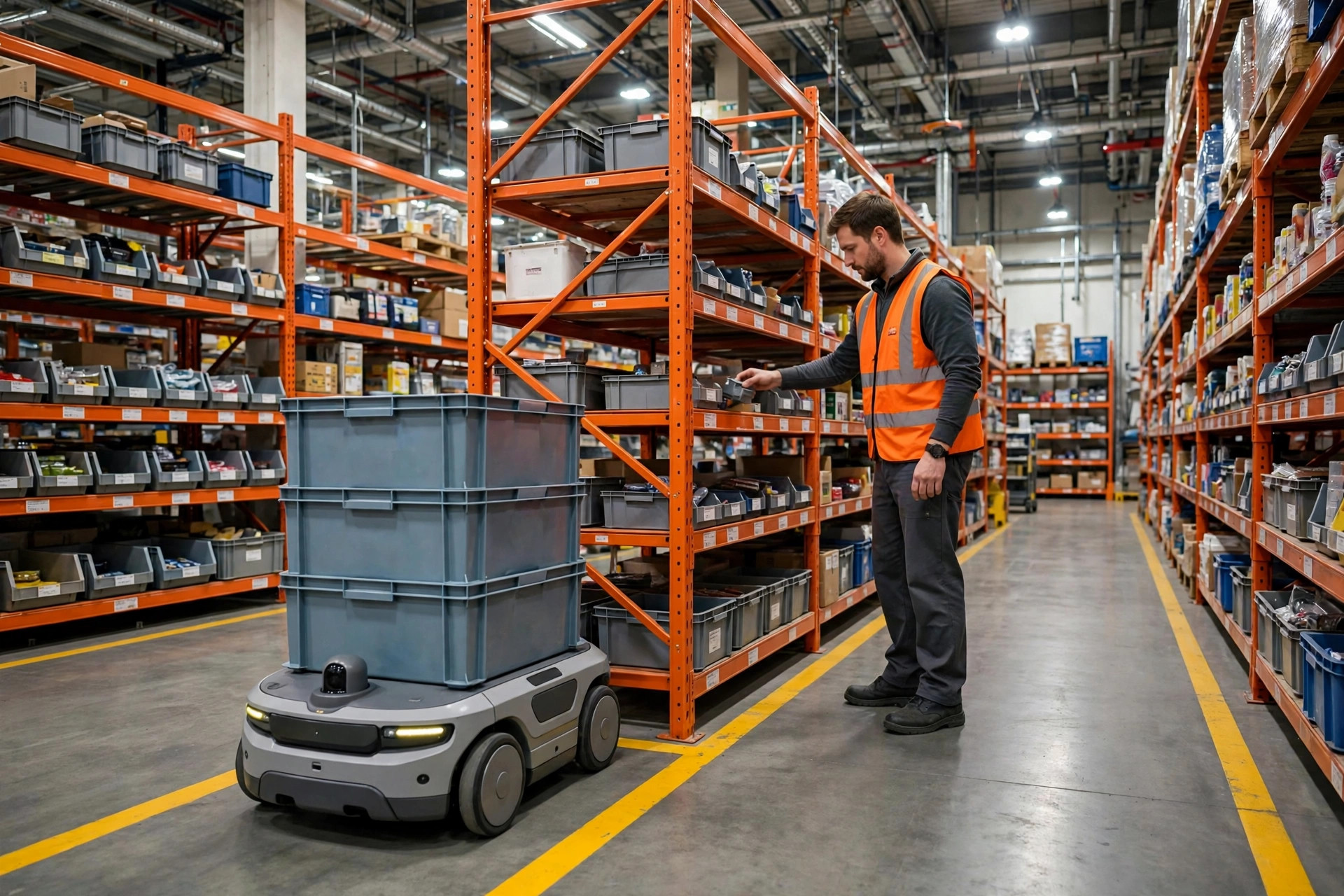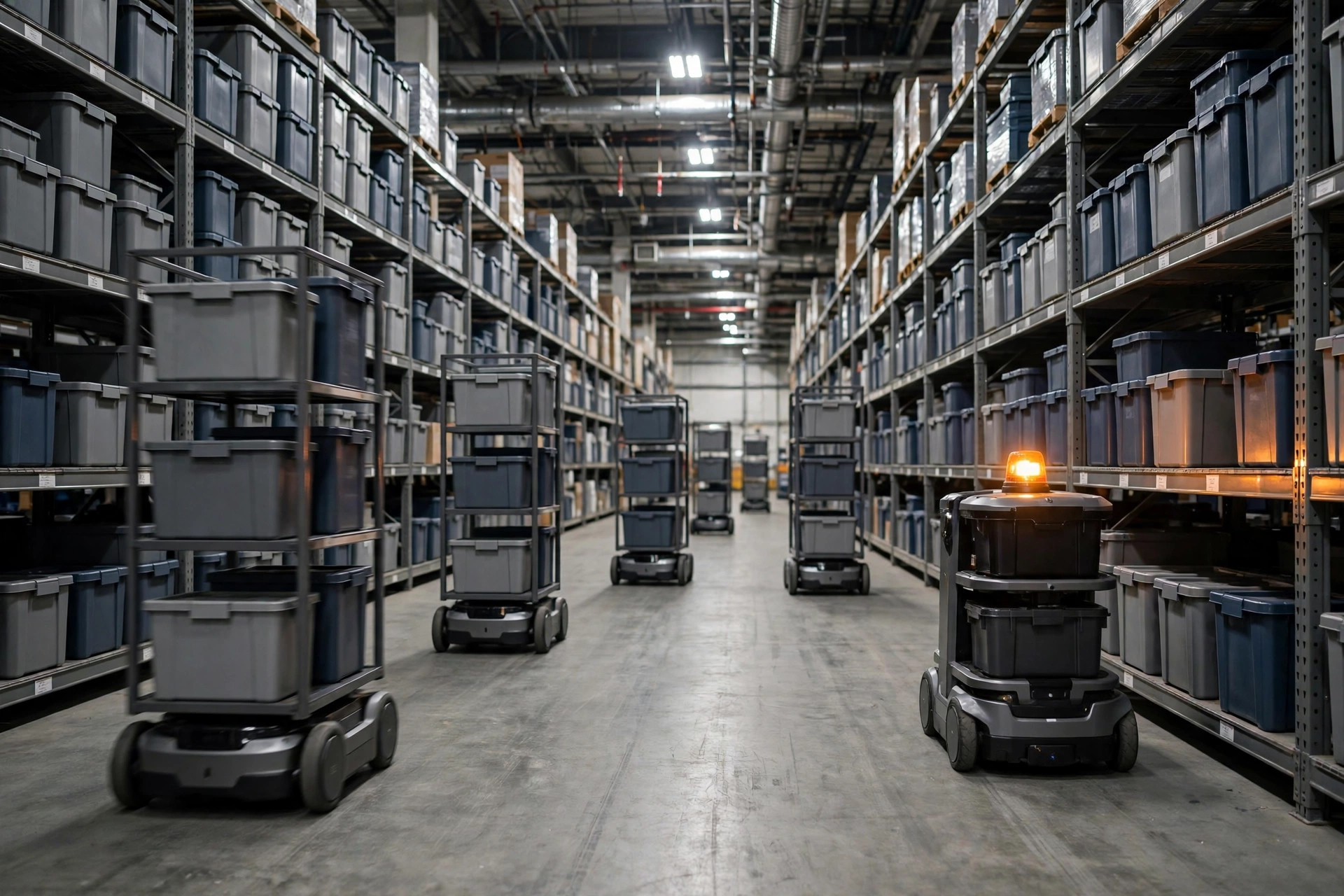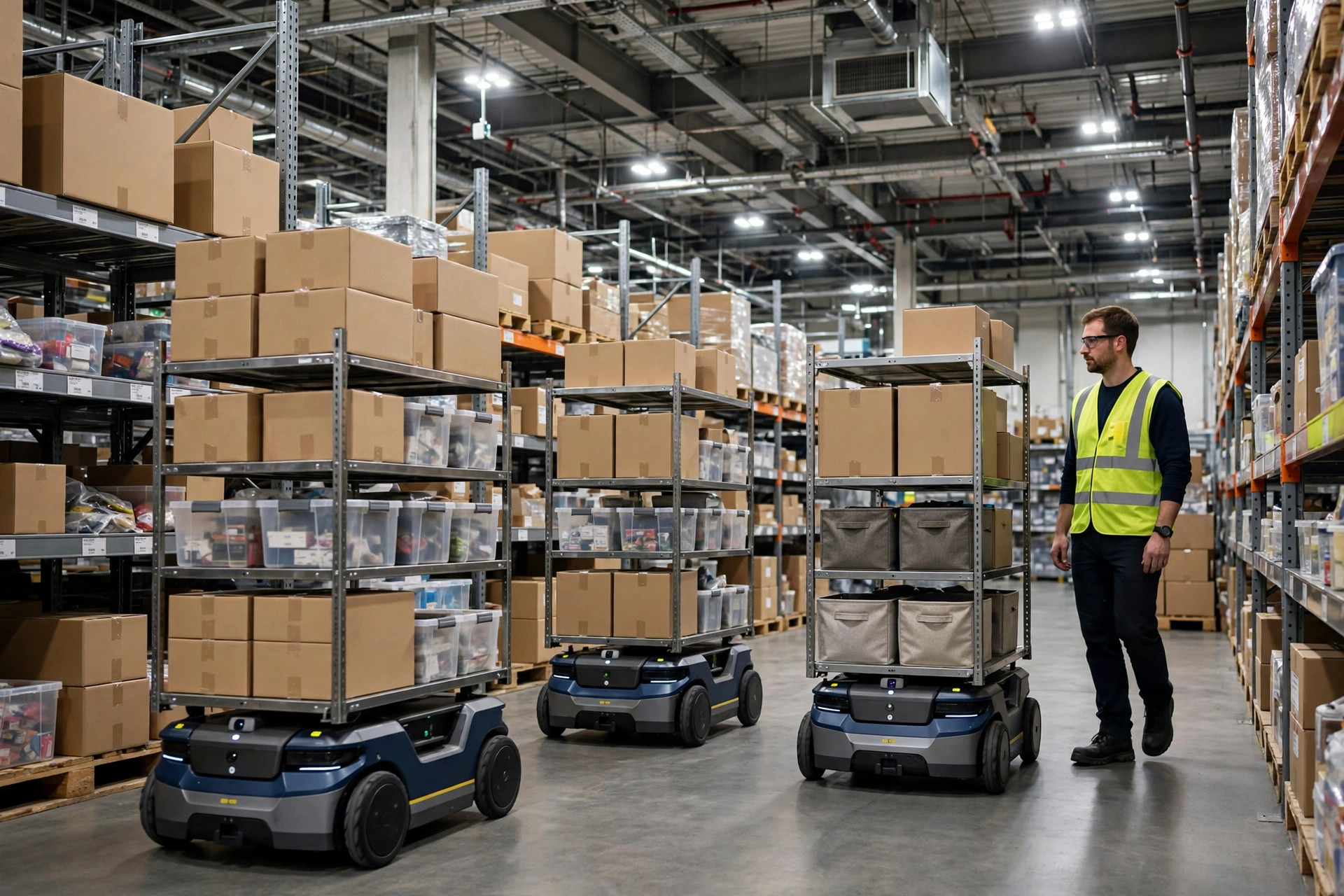
Conclusion up front: bin tote robot warehouse picking fits warehouses with many order lines, small items, and thousands of SKUs — and it is a poor fit for warehouses shipping big, heavy goods in a handful of lines. Get that call wrong and every later decision, from layout to ROI math, goes wrong with it. I have watched two warehouses walk in opposite directions on this question: one cut its picking labor roughly in half, the other shut its robots down after three months and went back to manual picking. The equipment was not the difference. The order profile was.
Why bin tote robot picking saves walking, not picking
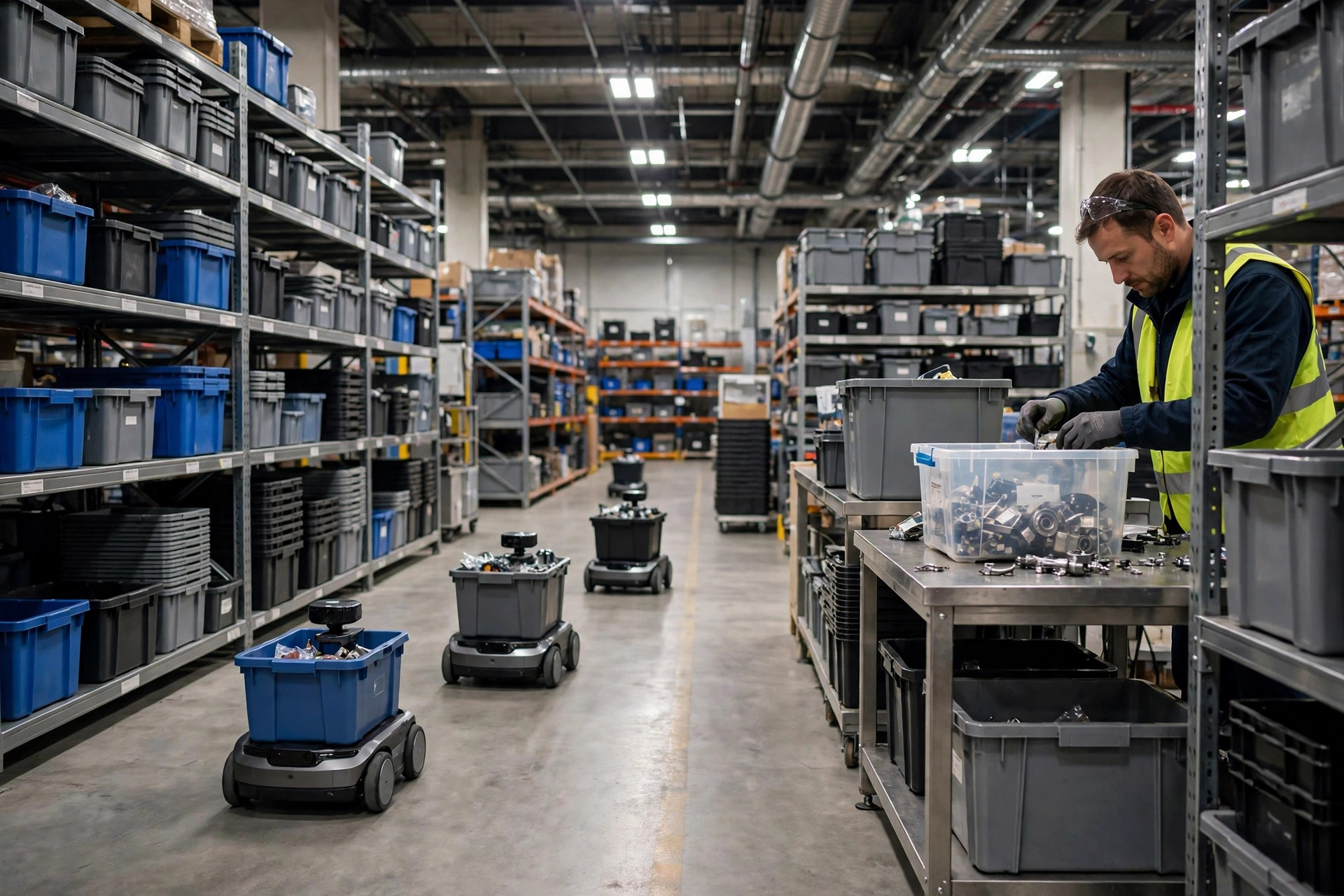
In manual picking, walking is the tax. Shelf-moving robots carry a whole rack to the picker; a bin system carries one tote. Watch a demo video and both look elegant. Put them against a real order profile and the difference shows up fast.
In the fall of 2023, a consumer-electronics accessories warehouse in Ningbo asked me to evaluate its options. It carried well over ten thousand SKUs, and a typical order ran three to five lines at one or two units per line. Pickers were covering distances in the ten-kilometer range per day, based on system traces. A shelf-moving design had a concrete flaw: the five lines on one order might sit on three different racks, so moving whole racks meant hauling a large amount of unrelated product for every order. A bin system moved only the tote holding the item actually ordered, so the work scaled with order lines rather than with rack contents, and an error stayed inside one tote instead of spreading across a rack.
A small-appliance parts warehouse in Dongguan was the mirror image. Few lines per order, large quantities per line — often dozens of the same item on one order. Sending totes back and forth saved nothing, because the picker still waited for tote after tote to arrive, and utilization never got where the business case assumed. I told them not to buy a bin system and to spend the money on put walls and verification instead. They disagreed at first, ran a two-week trial, and killed the proposal themselves. I have seen that exact mistake three times now, and every time the cause was the same: the decision was made from a demo, not from the order-line distribution.
The screening method is simple and needs no simulation software. Pull one month of orders and bucket them by lines per order: single-line, two to five, five to ten, ten-plus. Then look at average units per line. The higher the share of two-to-ten-line orders with low units per line, the stronger the case. The higher the share of single-line bulk orders, the weaker it gets. That bucket table is the first exhibit in the business case. Without it, do not talk about vendors.
| Option | Best order profile | What moves | Typical weakness |
|---|---|---|---|
| Bin and tote robots | Many lines, small items, many SKUs | One tote | Poor for large items and full-case shipping |
| Shelf-moving AMRs | Medium lines, items clustered per rack | A whole rack | Unrelated items get hauled too |
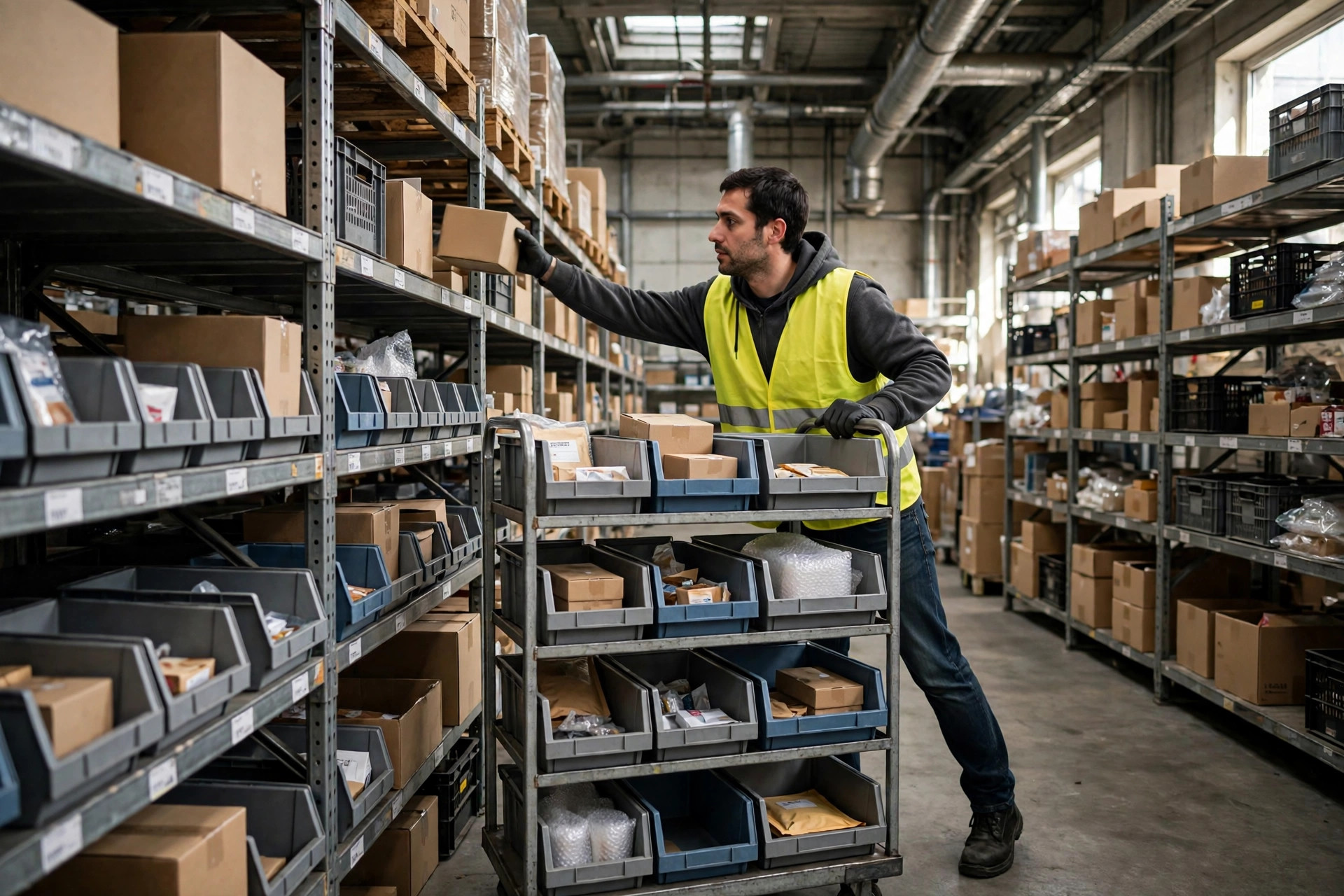
| Manual picking | Unstable order mix, low volume | The picker walks | Walking time, dependence on experienced staff |
Here is the counter-intuitive part: the system does not make the picking motion faster. The picker standing at the station moves at the same speed. Throughput rises because waiting, walking, and hunting for the right bin disappear into machine time. Flip that around, and you get the trap: if the real bottleneck is downstream — verification, packing, labeling — a faster pick face changes nothing about total outbound volume. Measure the bottleneck first, then decide where the money goes. That order is non-negotiable.
The go-live checklist: twelve items before you switch on
Teams evaluating bin tote robot warehouse picking usually ask about speed first; the failures below are about exceptions, not speed. Bin projects rarely fail on the robots. They fail on WMS integration, tote management, and floor layout. This is the list I walk through the night before every go-live, and I do not switch on with an unchecked item.
Totes and hardware: first, tote size must be set by the largest item plus its dunnage, with room left for a label and a clean scan angle. Second, the empty-tote return route must be drawn on the floor plan — empties piling up beside the pick station is the most common floor failure I see. Third, every tote ID must map one-to-one to a container record in the WMS, so a scan lands directly on that tote's item detail.
Systems and data: fourth, once the WMS releases a wave, robot tasks must follow wave priority, not nearest-tote convenience. Fifth, out-of-stock, cycle-count-locked, and damaged totes each need a hold state, and held tasks must not block the queue behind them. Sixth, after a network drop and reconnect, task status must resume automatically rather than requiring someone to confirm tasks one by one. Seventh, the pick-confirmation message back to the ERP must carry quantity, lot, and serial fields with nothing missing.
People and floor: eighth, station height, lighting, and scan angle must be tested with real staff at real heights — comfortable in a demo is not the same as comfortable for eight hours. Ninth, charging and maintenance zones must be marked off-limits so a charging queue never blocks the main aisle. Tenth, new hires must run a full shift of real orders in training, not just watch a video. Eleventh, the exception owner must be named per shift, with a phone number on the wall, including nights. Twelfth, power loss, network loss, and system upgrade must each have been rehearsed once. A plan that has never been rehearsed is not a plan.
In the spring of 2024, a household-goods warehouse in Suzhou hit item six on go-live eve. In the disconnect-reconnect test, a dozen already-fetched tote tasks lost their status: robots sat still while the WMS showed the tasks complete. The vendor took two days on site to fix the state machine. Had we switched on that night, the morning shift would have faced totes arriving for orders the system believed were already picked. That is what a checklist is for — moving go-live day's chaos into the night before, while there is still time to fix it.
Where bin tote robot picking goes wrong
The first failure is mixed-up totes. When totes for several orders alternate at one station, pickers work from memory and mis-picks climb. The fix is deliberately boring: one pending tote at the station at a time, only that tote's order lines on screen, and a scan verification after the pick rather than before it. Do not trust memory. Give the person one job at a time and they will not get it wrong.
The second failure is waves cut too large. People assume bigger waves keep robots busier, but a bigger wave means one stuck tote holds up the whole wave's confirmation, and packing waits for the full wave before it can start. My rule is to cut waves small, sized to the number of stations, and to park exception totes outside the main queue so one tote cannot stall everything behind it.
The third failure is budgeting for equipment and forgetting the retrofit. Floor leveling, rack spacing, charger capacity, WMS interface work, staff training — together these routinely add a large chunk on top of the equipment quote. A business case that shows only an equipment price and an ideal throughput number has a fictional ROI. List every retrofit line, discount throughput to the trial's measured figure, and the number you take to management will survive contact with reality.
One last honest note: bin tote robot warehouse picking is not the default answer to warehouse modernization. It is the specific answer to a specific order profile. Many lines, small items, many SKUs — worth a serious evaluation. Few lines, big items, a profile that changes daily — fix the manual process and the wave management first, and revisit equipment later. Get that judgment right and the project is halfway done.
By Lin Xiao, WMS Implementation Consultant